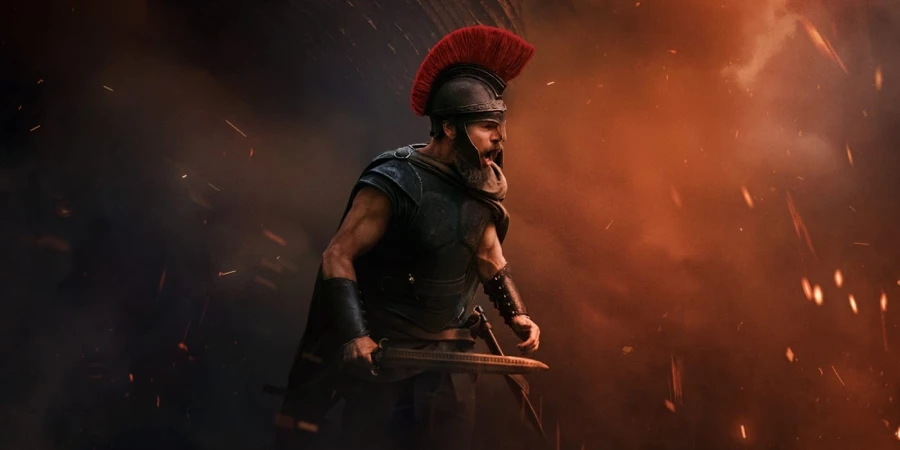

Christopher Nolan finally shot an entire movie on IMAX film, and he picked a nearly three-thousand-year-old poem to do it. The Odyssey turns Homer’s cleverest hero into a haunted man who considers his greatest trick a crime against heaven. Matt Damon’s Odysseus does not defy the gods; he spends a decade begging for their forgiveness. Consider this your only warning, because we are spoiling everything below.
Detailed Summary
A Bard, a Horse, and an Interrupted Song
Travis Scott’s nameless Bard opens the film, singing of an age that seemed magical. His song carries us to the beaches of Troy, where riders approach a towering wooden horse left behind by the departed Greeks.
Sinon (Elliot Page), the lone Greek who stayed behind to sell the lie, dies in a hail of arrows. As the Trojans drag their strange prize toward the city, the song cuts off mid-verse. Nolan will make us wait for the rest.
Ithaca Under Siege
Eight years after the war, most Greeks believe Odysseus is dead. Suitors have flooded his palace on Ithaca, circling Penelope (Anne Hathaway) and draining the kingdom dry.
Telemachus (Tom Holland) never met his father, yet he refuses to accept the loss. Meanwhile, the smooth and ruthless Antinous (Robert Pattinson) proposes marriage to Penelope, plotting to cut her son out of the royal line entirely.
Trapped on Ogygia
Far away, Odysseus lives as the pampered prisoner of the nymph Calypso (Charlize Theron). Visions of Athena (Zendaya) keep urging him to leave, though the goddess never physically intervenes.
Calypso pushes him to reflect on his long road home. That reflection becomes the film’s spine, unfolding through nested flashbacks.
Blinding the Cyclops
After leaving Troy, Odysseus and his crew follow a stray sheep into a cave and meet Polyphemus (Bill Irwin), a mountain of a Cyclops. Trapped inside, the men blind the creature and slip out at dawn hidden beneath its flock.
Victory curdles fast, though. Their blinded captor prays to Poseidon for vengeance, and Odysseus makes things worse by firing a taunting arrow back into the cave. Several crewmen wonder aloud whether their king just cursed the entire voyage.
Giants on the Shore
On the Laestrygonian coast, the crew finds a lone child in the forest. Its piercing scream summons colossal giants, who destroy one of the ships and slaughter dozens of men.
Odysseus barely reaches the shoreline alive. As a result, supplies run low and morale collapses, with the survivors questioning every choice their leader makes.
Circe and the Pig Problem
On Aeaea, the witch Circe (Samantha Morton) lures the hungry crew to a feast laced with drugs. One by one, the men transform into pigs, helpless under her magic.
Odysseus, hunting elsewhere after a near mutiny, discovers the horror when a wounded animal turns back into a screaming man. Rather than fight her, he talks Circe down, and she offers a path home: sail north into the twilight and consult the dead.
A Detour Through the Underworld
Where fire meets ice, the crew sacrifices sheep to summon the departed. Agamemnon (Benny Safdie) appears and recounts his murder at the hands of his own wife, Clytemnestra (Lupita Nyong’o), a chilling preview of a homecoming gone wrong.
Sinon appears too, and Odysseus honors the fallen man’s sacrifice. Finally, the blind prophet Tiresias delivers his warning: Poseidon’s rage will follow them, and they must never harm the sun god’s sacred cattle on Thrinacia.
Sirens, a Sea Monster, and Forbidden Cattle
Wax in their ears carries the men safely past the Sirens. Nonetheless, a monstrous sea creature snatches several sailors from the deck moments later, and Eurylochus (Himesh Patel) rages at Odysseus for gambling with their lives.
Dead winds strand the starving crew on Thrinacia, where they break their vow and slaughter the sacred cattle. Only Odysseus abstains. When they finally set sail, a cataclysmic storm shatters the ship and drowns every last crewman.
Seven Lost Years
Odysseus washes ashore on Ogygia, where the lotus flower blurs his sense of time. Years vanish while Calypso keeps him close, though his memories of Penelope and Telemachus never fade.
Eventually, she relents and names the price of leaving: he must surrender himself to Poseidon and let the sea decide his fate. He accepts, and the ocean carries him home to Ithaca at last.
Menelaus and a Scarred Helen
Meanwhile, in the present, Telemachus visits Menelaus (Jon Bernthal) in Sparta. Through flashback, we endure the sweltering hours inside the Trojan Horse alongside the hidden Greeks.
Nolan lands a sly twist here: Helen of Troy (Lupita Nyong’o) bears a prominent facial scar, and Menelaus laughs at the legends about her beauty launching a thousand ships. Stories, the film keeps reminding us, warp with every retelling.
Antinous Springs His Trap
Back on Ithaca, Antinous learns where Telemachus went and dispatches bandits to Pylos with grisly instructions. They must kill the prince and return with his ears and nose as proof.
Disguised as pilgrims, the killers butcher Telemachus’s companions at a temple. However, a weathered stranger intervenes at the last second and saves the prince’s life. Odysseus has come home.
The Beggar in the Palace
Father and son orchestrate a plan. Telemachus returns to the palace, announces that Odysseus is near, and orders a banquet for every suitor.
That night, the disguised king comforts Argos, the dying family dog, and that tenderness gives him away to his son. Telemachus greets him with three quiet words: “Welcome home, stranger.”
At the feast, the beggar introduces himself as Sinon and needles Antinous into throwing a bowl at his head. A guest has now been struck under the host’s roof; Zeus’s law of hospitality lies broken, and the trap is set.
Movie Ending
Penelope announces one final contest: string Odysseus’s great bow and fire an arrow through twelve axe heads. Suitor after suitor fails, and Antinous refuses to even try. Then the beggar steps forward, strings the bow with ease, and threads the impossible shot.
Recognition lands like a thunderclap. With the doors sealed, Odysseus turns the bow on the suitors and cuts them down as they scramble for weapons. Telemachus joins the fight when his father becomes surrounded, and together they finish the slaughter.
Antinous receives a deliberately slow death. Odysseus gives him a message for the fallen waiting in Hades: their king will honor them by sailing west, into the unknown.
Before the bloodshed, though, the film hides its true climax in a quiet scene. Speaking through a door to a Penelope who still thinks him a beggar, Odysseus confesses what really happened at Troy. Nolan replays the sack of the city, and this time it plays as a massacre of innocents rather than a triumph.
One image cuts deepest. Odysseus’s men behead a kneeling priestess of Athena beside her goddess’s desecrated statue, and the priestess wears Zendaya’s face. Every vision of Athena we have watched may have been guilt itself, haunting a man who broke Zeus’s law with the Trojan Horse long before he ever blinded a Cyclops.
Victory costs Odysseus everything. Arrows protrude from his back after the battle, and instead of reclaiming his throne, he hands it to Telemachus. He announces a final voyage west with Penelope at his side, a self-imposed exile to honor his dead crew.
Nolan then blurs the frame. We watch the couple sail toward the horizon, yet we also see Odysseus bleeding out in the throne room while Penelope cradles him. Much like Gladiator, the film strongly implies the voyage plays out inside a dying man’s mind, a mercy granted by the woman who loves him.
Ultimately, the closing moments return to burning Troy and the destruction of the wooden horse. Stories survive only through song, the film argues, and the Bard’s interrupted verse completes itself at last.
Are There Post-Credits Scenes?
No. Nolan has never attached a post-credits scene to any of his films, and The Odyssey keeps that streak intact.
Stay seated anyway. The credits play the original song “When I’m Home” by James Blake, Travis Scott, and Ludwig Göransson, with lyrics co-written by Nolan himself, a first in his career. A closing card dedicates the film to David Keighley, the late IMAX executive whose name graces the production’s new camera.
Type of Movie
The Odyssey is an epic fantasy action film with the soul of an antiwar drama. Monsters, storms, and possible gods share the screen with survivor’s guilt and a civilization fraying at the edges.
Tonally, it sits closer to Dunkirk and Oppenheimer than to a breezy swords-and-sandals romp. Expect an R rating, a runtime of nearly three hours, and an ambiguity about the divine that lingers long after the credits.
Cast
Nolan assembled one of the starriest ensembles of his career. Here are the key players:
- Matt Damon – Odysseus
- Anne Hathaway – Penelope
- Tom Holland – Telemachus
- Robert Pattinson – Antinous
- Zendaya – Athena
- Lupita Nyong’o – Helen of Troy / Clytemnestra
- Charlize Theron – Calypso
- Samantha Morton – Circe
- Jon Bernthal – Menelaus
- Benny Safdie – Agamemnon
- John Leguizamo – Eumaeus
- Himesh Patel – Eurylochus
- Elliot Page – Sinon
- Bill Irwin – Polyphemus, the Cyclops
- Mia Goth – Melantho
- Travis Scott – The Bard
Film Music and Composer
Ludwig Göransson scored The Odyssey, his third collaboration with Nolan after Tenet and Oppenheimer. Owner of Oscars for Black Panther and Oppenheimer, the Swedish composer chased a sound that felt timeless rather than conventionally historical.
To get there, he built the score around ancient Greek instruments: the double-piped aulos, the lyre, and roughly three dozen gongs. In addition, human voices weave through the music, with James Blake’s singing shaping its emotional pacing.
Spanning 23 tracks and nearly two hours, the album rewards a full listen. Standouts include the ominous “Zeus’s Law,” the ten-minute descent of “Hades,” “Circe” featuring Samantha Morton, and the ferocious “The Trial of the Bow / Vengeance.” Closing song “When I’m Home” doubles as an early awards-season contender.
Filming Locations
Nolan shot the film in 91 days across six countries: Morocco, Greece, Italy, Iceland, Scotland, and the United States. His rule stayed simple throughout: real places over green screens, wherever humanly possible.
Morocco supplied the ancient world’s grandest backdrops. For instance, crews built Troy around Aït Benhaddou, the UNESCO-listed fortress village near the Atlas Mountains, while the beaches of Essaouira hosted the Trojan Horse’s discovery and Odysseus’s departure by sea.
Greece grounded the myth in its homeland. Production filmed across the Peloponnese, notably at Voidokilia Beach and Nestor’s Cave, which reportedly became the lair of Polyphemus.
Sicily’s island of Favignana played Ithaca, a lovely bit of casting since scholars link the real island to Odysseus’s landfall in Homer. Cast and crew climbed 900 feet each morning to the Castello di Santa Caterina, which served as the palace exterior.
Elsewhere, Scotland’s Culbin Forest staged the Laestrygonian ambush, Iceland’s glaciers and volcanic coasts evoked the road to the Underworld, and Universal’s Falls Lake in Los Angeles handled controlled water work. Crews shot the rough open-sea sequences for real off the Scottish coast aboard a full-size wooden ship.
Awards and Nominations
Fresh off its July 17, 2026 release, the film has not yet competed in any awards season. Critics already frame it as a major Oscar contender, so expect this section to look very different by next spring.
Behind the Scenes Insights
- The Odyssey is the first feature shot entirely with IMAX film cameras, a milestone Nolan had chased since The Dark Knight in 2008.
- IMAX engineered a new, quieter camera nicknamed the Keighley for the production, letting Nolan record whispered dialogue inches from an actor’s face.
- Cinematographer Hoyte van Hoytema convinced Nolan the format could handle intimacy by filming a child reciting David Bowie lyrics in extreme close-up.
- Crews built the Trojan Horse practically, roughly 35 feet tall, and Nolan insisted on no wheels so the Trojans would have to drag it.
- John Leguizamo arrived on set to meet Nolan and found the director crammed inside the horse with about 20 actors and the camera team.
- Jon Bernthal shot the horse-landing sequence in freezing water and refused Nolan’s offer of a break, shouting that the director would not break him.
- According to Matt Damon, the production built a Cyclops model roughly 18 meters tall inside a real cave.
- More than 2 million feet of IMAX film and around 5,000 costumes went into the shoot.
- At a reported $250 million, this stands as the most expensive film of Nolan’s career.
Inspirations and References
Homer’s epic poem, composed nearly three thousand years ago, provides the foundation. Nolan also folds in events from The Iliad, especially the horse and the fall of Troy, which the Odyssey itself only references.
Casting Travis Scott as the Bard nods deliberately to oral tradition. Nolan has explained that rap strikes him as the modern descendant of the poem’s original handed-down performance.
Critics read the film as the closing chapter of an informal war trilogy alongside Dunkirk and Oppenheimer. All three wrestle with the machinery of war and the guilt of the men who operate it.
Alternate Endings and Deleted Scenes
No alternate endings or deleted scenes have surfaced, and history suggests none ever will. Nolan famously avoids shooting excess material and never releases director’s cuts; his theatrical version stands as definitive.
Consequently, the ambiguity of the finale is the point, not a compromise. Do not hold out for an extended edition that settles whether Odysseus survives.
Book Adaptations and Differences
Yes, the film adapts Homer’s Odyssey, one of the oldest surviving works of Western literature. Nolan wrote the screenplay himself, and he makes several bold departures.
Biggest change first: the gods never physically appear. Homer’s Athena constantly intervenes and even brokers the poem’s final peace, whereas Nolan renders her as a vision that may be pure guilt. Similarly, Hermes, who frees Odysseus from Calypso on the page, never shows up at all.
Nolan reframes the Trojan Horse as Odysseus’s original sin, a violation of sacred hospitality. Homer treats it as the hero’s crowning cleverness. That single shift converts a homecoming adventure into a redemption story.
Other changes sting in smaller ways. Helen bears a scar instead of legendary beauty, Antinous actively orchestrates an assassination plot, and Odysseus finishes the story gravely wounded. Homer, in contrast, lets his hero live on, with Tiresias prophesying a gentle death in peaceful old age.
Memorable Scenes and Quotes
Key Scenes in The Odyssey
- Sweating out the hours inside the Trojan Horse during the claustrophobic prologue
- Blinding Polyphemus and escaping the cave beneath his sheep
- Giants erupting from the forest after a single child’s scream
- Circe’s banquet dissolving into a nightmare of squealing pigs
- Agamemnon’s ghost describing his own murder in the Underworld
- A divine storm annihilating the last ship and its crew
- Odysseus comforting the dying dog Argos outside the palace
- The trial of the bow exploding into a locked-room massacre
- Penelope cradling a dying Odysseus as a ship sails west
Iconic Quotes
- “Welcome home, stranger.” Telemachus greets the father he finally recognizes.
- “I am nobody.” Odysseus’s alias, echoing the poem’s most famous trick.
- Circe’s directions to the Underworld, “where the river of fire meets the river of ice.”
- Calypso’s parting demand that Odysseus give himself up to Poseidon.
Easter Eggs and Hidden Details
- Odysseus introduces himself to the suitors as “Sinon,” honoring the bravest man he ever knew.
- His “Nobody” alias preserves Homer’s legendary pun on Odysseus’s false name.
- Jon Bernthal slips a version of his trademark “let me tell you something” line into Menelaus’s dialogue.
- Opening narration describes an age that only “seemed” magical, quietly seeding the film’s doubt about the gods.
- Favignana, the real island standing in for Ithaca, is the same “goat island” where scholars believe Homer’s hero landed.
- Zendaya’s face on the executed priestess reframes every earlier Athena vision on a second viewing.
- A credits card dedicates the film to David Keighley, whose name the new IMAX camera carries.
Trivia
- IMAX 70mm tickets went on sale a full year before release, an unprecedented move, and premium showings sold out almost instantly.
- This marks Nolan’s thirteenth feature film and his second consecutive release with Universal Pictures.
- Matt Damon previously appeared in Interstellar and Oppenheimer, but this is his first lead role for Nolan.
- Tom Holland, Zendaya, and Jon Bernthal also share the Spider-Man franchise, where Bernthal plays the Punisher.
- A six-minute prologue screened months early in front of IMAX 70mm showings of Sinners and One Battle After Another.
- Reviews landed in the mid-90s on Rotten Tomatoes during opening week.
- Even Fortnite joined the launch, adding Odysseus and Agamemnon skins to the game.
- Jennifer Lame, Nolan’s editor on Tenet and Oppenheimer, cut the film.
Why Watch?
Watch it because nobody else makes movies at this scale anymore. Nolan delivers real ships, real storms, and a genuinely surprising reinvention of a story you thought you knew. Moreover, the emotional payoff between Damon, Hathaway, and Holland earns every minute of the nearly three-hour runtime.
Christopher Nolan’s Other Movies
- Following (1998)
- Memento (2000)
- Insomnia (2002)
- Batman Begins (2005)
- The Prestige (2006)
- The Dark Knight (2008)
- Inception (2010)
- The Dark Knight Rises (2012)
- Interstellar (2014)
- Dunkirk (2017)
- Tenet (2020)
- Oppenheimer (2023)
Recommended Films for Fans
- Troy (2004)
- Gladiator (2000)
- The Return (2024)
- Jason and the Argonauts (1963)
- Clash of the Titans (1981)
- The Northman (2022)
- Ben-Hur (1959)
- 300 (2006)
- Ulysses (1954)