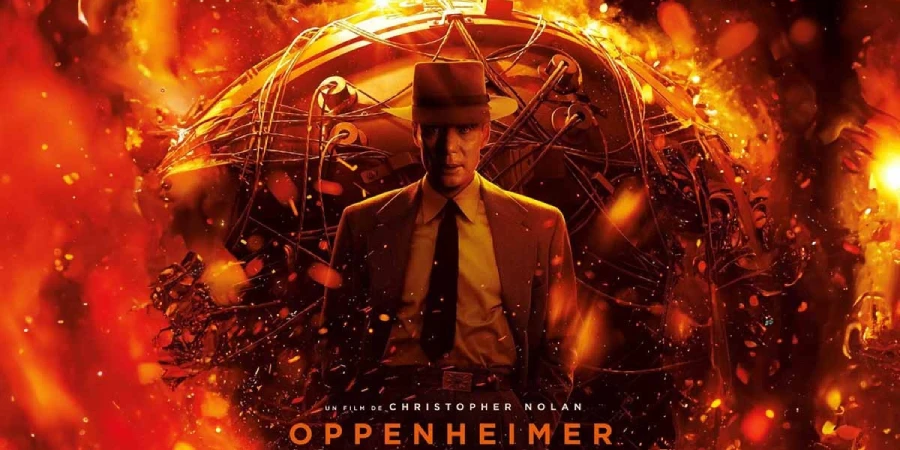
A man builds the most destructive object in human history, then spends the rest of his life on trial for having second thoughts. Christopher Nolan turns that contradiction into a three-hour thriller where the deadliest weapon is a closed-door hearing. Every spoiler sits below, including the pond conversation that lands like a gut punch. Consider yourself warned.
Detailed Summary
A Poisoned Apple at Cambridge
Young J. Robert Oppenheimer arrives at Cambridge as a gifted but deeply miserable graduate student. Lab work defeats him, and his tutor Patrick Blackett treats him with open contempt.
One night he injects an apple with cyanide and leaves it on Blackett’s desk. Panic arrives by morning.
He lunges across the room and knocks the fruit out of Niels Bohr‘s hand, seconds before the visiting Dane takes a bite. Admittedly, the source biography treats that story as disputed. Nolan treats it as character.
Gottingen, Berkeley, and a New American Physics
Bohr points him toward Gottingen, where Max Born supervises his doctorate and quantum theory finally clicks. Stars collapse and light fractures behind his eyes throughout the film. Nolan uses those flashes as a window into a mind that thinks in pictures.
Back in the United States, he teaches at Berkeley and Caltech at the same time. Within a few years he builds the first great American school of theoretical physics.
Jean Tatlock, Kitty, and the Party Question
Berkeley also brings Jean Tatlock into his life. She is a psychiatrist, a Communist Party member, and the great destructive love of his biography.
She hands him the Bhagavad Gita in bed and asks him to read aloud. That is where the film plants its most famous line, long before any bomb exists.
Meanwhile he meets Kitty Puening, a biologist with a radical past and an inconvenient husband. She gets pregnant, divorces, and marries him inside a year.
His own politics stay left of center rather than formally red. He funds Spanish Civil War relief through party channels, backs a campus union, and watches his brother Frank sign a party card. Consequently the government opens a file that will hang him two decades on.
Groves Comes Calling
In 1942, Lieutenant General Leslie Groves arrives with a job nobody sane would want. He needs a director for a bomb laboratory. Unsurprisingly, he picks the theorist with the messy security file, because that man is ambitious enough to say yes.
Oppenheimer sells him on one idea: build a secret town where the scientists can actually talk to each other. He names the spot himself. Los Alamos exists because a sickly teenager once fell in love with a New Mexico mesa.
Building the Secret City
Recruitment becomes seduction. He pitches Isidor Rabi, Edward Teller, Hans Bethe and a cocky young Richard Feynman on the biggest physics problem ever posed.
A town rises fast on the mesa: houses, a school, a bar, barbed wire everywhere. Kitty drinks her way through the isolation. Her husband, in contrast, blossoms into a general in a cardigan and a porkpie hat.
Bohr’s Warning and Teller’s Nightmare Math
Bohr escapes occupied Denmark and reaches Los Alamos carrying a warning rather than a formula. Winning the race is not the real problem, he argues; the world that comes after it is.
Teller soon produces a calculation suggesting the detonation might ignite the atmosphere. Oppenheimer drives to Princeton and puts the numbers in front of Albert Einstein. Bethe eventually reworks them down to near zero.
Near zero is not the same phrase as zero. Everyone in that room understands the difference. However, everyone proceeds regardless.
Jean’s Death and a Marriage Under Strain
Oppenheimer breaks security protocol to visit Jean in San Francisco, and army counterintelligence photographs every minute of it. A few weeks afterward she dies in her bathtub, ruled a suicide.
Nolan shoots that death with a gloved hand pushing her head under the water, leaving the question deliberately open. Kitty, on the other hand, refuses to let her husband grieve out loud. Grief has become a security risk.
Germany Surrenders, the Work Continues
Victory in Europe removes the project’s stated reason for existing. Leo Szilard circulates a petition, and several scientists ask why a weapon built against Hitler should now fall on Japan.
Oppenheimer hears them out, yet he argues for finishing anyway. He tells himself the world will never fear this thing until it sees what the thing does. Ultimately that rationalization becomes the tragedy in miniature.
The Trinity Test
July 16, 1945 nearly collapses under a thunderstorm. Groves leans on the meteorologist, the sky clears, and the countdown starts.
Of course, Fermi takes bets on atmospheric ignition, which absolutely nobody finds funny. Men smear on sunscreen, lie face down in the dirt, and wait behind welding glass.
Light arrives first, enormous and completely silent. Nolan holds that silence far past comfort before the shockwave lands and the roar catches up. Physics dictates the edit here; as a result, the sequence plays as horror rather than spectacle.
Hiroshima, Nagasaki, and the Gymnasium
Target selection happens in a Washington conference room. Secretary Henry Stimson strikes Kyoto off the list, partly because he honeymooned there.
Oppenheimer learns about Hiroshima the way everyone else does, from a radio announcement. Next comes a victory speech in a Los Alamos gym, delivered to a stomping, cheering crowd.
Feet pound the bleachers until the rhythm becomes a heartbeat, the room whites out, and a young woman’s face peels away in front of him. Notably, the film never shows Hiroshima or Nagasaki.
Nolan welds the camera to Oppenheimer’s limited perspective. In turn the horror feels evasive and complicit at once.
Blood on His Hands
Oppenheimer visits the Oval Office and tells Harry Truman he feels he has blood on his hands. Truman offers a handkerchief and a lecture: nobody in Hiroshima cares who built the bomb, only who dropped it.
As the physicist shuffles out, Truman instructs an aide never to let that crybaby back in the room. Two minutes of screen time reframe everything that follows.
Strauss, Isotopes, and a Very Long Grudge
Lewis Strauss hires him to run the Institute for Advanced Study in Princeton. Soon after, he watches Oppenheimer say something to Einstein beside a pond.
Einstein walks straight past Strauss without a word. Naturally, Strauss decides he has been insulted for life.
Worse follows at a 1949 congressional hearing. Oppenheimer publicly mocks Strauss’s position on isotope exports, and the room laughs at him.
Humiliation delivered by a celebrity scientist is not something Strauss intends to forgive. Moreover, Oppenheimer opposes the hydrogen bomb from his chair on the Atomic Energy Commission’s advisory committee.
Teller wants that weapon badly, and so does the Air Force. Strauss thus acquires powerful allies and a personal motive at the same moment.
The 1954 Security Hearing
William Borden subsequently sends a letter accusing Oppenheimer of serving as a Soviet agent, and the commission suspends his clearance. Strauss arranges a private hearing rather than a trial.
No rules of evidence apply in that room. Prosecutor Roger Robb gets the wiretap transcripts; the defense gets almost nothing.
Robb walks him through the Chevalier affair and the ridiculous cover story he invented for security officers in 1943. He drags him through Jean Tatlock’s hotel room too, with Kitty sitting a few feet behind him.
Kitty takes the stand and dismantles Robb in return. Indeed, those fifteen minutes justify Emily Blunt’s entire casting.
Teller testifies that he would feel safer with the nation’s security in other hands. Afterward he extends a handshake, a gesture the film pays off much later.

Movie Ending
Two of the three board members vote to strip the clearance, and the third dissents in writing. Oppenheimer keeps his life, his fame and his lectures. However, he loses the access that made him useful to power.
Nolan stages the verdict as ritual humiliation rather than legal reasoning. Robb never proves espionage, because proving espionage was never the point. Moreover, the board never needed proof to do the job Strauss wanted done.
Black-and-white footage takes over from that verdict onward. In 1959, the Senate weighs Strauss’s nomination for Secretary of Commerce.
Physicist David Hill testifies that Strauss engineered the destruction of Oppenheimer out of wounded vanity. Senators reject the nomination, and an aide notes that a young senator named John F. Kennedy helped sink him.
Strauss rages about scientists closing ranks. Even so, he remains convinced that he is the wronged man in this story.
A flash-forward shows Lyndon Johnson presenting Oppenheimer with the Enrico Fermi Award in 1963, an institutional apology that restores nothing. Teller waits in the receiving line. Kitty looks him dead in the eye and refuses his hand.
Nolan closes by returning to the pond, where the conversation Strauss misread for three hours plays out in full. In fact it had nothing whatsoever to do with Strauss.
Oppenheimer had told Einstein that those old calculations about a chain reaction were never really about the atmosphere. Asked what he means, he says he believes they started one anyway.
Missiles climb out of silos, the sky catches fire, and the planet burns behind his closing eyes. That image snaps the opening epigraph into focus: Prometheus hands humanity fire and hangs on a rock forever.
His punishment is not the hearing at all. Specifically, it is knowing exactly where the fire goes next.
Audiences usually ask how much of this actually happened, and the answer is most of it. The 1954 revocation happened, Strauss really did lose his confirmation, and in December 2022 the Department of Energy formally vacated the decision against Oppenheimer.
Nolan ends on a face rather than an explosion. That choice is the entire argument of the film.
Are There Post-Credits Scenes?
No, there are none. Nolan has never tacked a scene onto the end of his credits, and he did not break the habit here. Therefore the credits roll clean, from the first name to the last.
Once the screen cuts to black, the story is complete. Nonetheless, plenty of viewers sit through the credits anyway, mostly because the music and the silence that follows feel like part of the experience.
Type of Movie
On paper this is a biographical drama. In practice Nolan built a legal thriller with a horror film hiding inside it.
Two hearings supply the structure while the bomb supplies the dread. In addition, the paperwork frightens you more than the explosion does. Tone travels from academic wonder to procedural paranoia to something very close to grief.
Its R rating comes from nudity, language and adult subject matter rather than violence. Granted, the hallucination sequences disturb far more than anything graphic does. Running time hits 180 minutes, and the pacing rarely lets anyone relax.
Cast
- Cillian Murphy – J. Robert Oppenheimer
- Emily Blunt – Katherine “Kitty” Oppenheimer
- Matt Damon – Leslie Groves
- Robert Downey Jr. – Lewis Strauss
- Florence Pugh – Jean Tatlock
- Josh Hartnett – Ernest Lawrence
- Kenneth Branagh – Niels Bohr
- Benny Safdie – Edward Teller
- Jason Clarke – Roger Robb
- Casey Affleck – Boris Pash
- Rami Malek – David Hill
- Tom Conti – Albert Einstein
- Gary Oldman – Harry S. Truman
- Matthew Modine – Vannevar Bush
- David Krumholtz – Isidor Rabi
- Dane DeHaan – Kenneth Nichols
- Alden Ehrenreich – Senate Aide
- Jack Quaid – Richard Feynman
- Dylan Arnold – Frank Oppenheimer
- Tony Goldwyn – Gordon Gray
- David Dastmalchian – William Borden
- Macon Blair – Lloyd Garrison
- Alex Wolff – Luis Alvarez
- Josh Peck – Kenneth Bainbridge
- Olivia Thirlby – Lilli Hornig
- Michael Angarano – Robert Serber
- Danny Deferrari – Enrico Fermi
- Christopher Denham – Klaus Fuchs
- Jefferson Hall – Haakon Chevalier
- James Remar – Henry Stimson
- Matthias Schweighofer – Werner Heisenberg
- Gustaf Skarsgard – Hans Bethe
- Devon Bostick – Seth Neddermeyer
Film Music and Composer
Ludwig Goransson wrote the score, and Nolan asked him for violin before a finished script even existed. Violins carry almost all of the anxiety here. Specifically, they race, stutter and refuse to resolve for three hours.
“Can You Hear the Music” turns quantum wonder into an accelerating panic attack. “Destroyer of Worlds” drives the countdown, while “American Prometheus” closes the film on something closer to mourning than triumph.
Silence does as much work as sound. Crucially, Goransson pulls the music out entirely at Trinity, which is exactly why that sequence flattens audiences.
Goransson is Swedish, trained at Berklee, and best known as Ryan Coogler’s collaborator on Creed and Black Panther. Furthermore, he had already scored Tenet for Nolan before this reunion.
His Oppenheimer work took both the Academy Award and the Golden Globe. Above all, the score gave the film a nervous system.
Oppenheimer Filming Locations
New Mexico does most of the heavy lifting. Production built a full Los Alamos town near Ghost Ranch, in the high desert country around Abiquiu where Georgia O’Keeffe painted for decades.
That choice matters more than it looks. Oppenheimer picked the mesa because he loved the landscape as a young man. Filming there, therefore, puts his private romanticism on screen beside the guard towers.
California covers the university years, with the Berkeley campus standing in for its own history. Eventually the story moves east to Princeton, New Jersey, home of the Institute for Advanced Study, the pond, and Strauss’s territory.
Los Angeles handled interiors, including the cramped hearing room where the third act lives. For the Trinity sequence, the crew staged practical explosions in the New Mexico desert instead of handing the job to a computer.
Awards and Nominations
Oppenheimer dominated the 96th Academy Awards, converting thirteen nominations into seven wins. Its haul included Best Picture, Best Director, Best Actor for Cillian Murphy and Best Supporting Actor for Robert Downey Jr.
Ludwig Goransson won Best Original Score, Hoyte van Hoytema won Best Cinematography, and Jennifer Lame won Best Film Editing. Notably, Nolan had never won an Oscar before that night.
Indeed, Murphy and Downey collected their first as well. Elsewhere the film won five Golden Globes, including Best Motion Picture Drama, plus seven BAFTAs.
Screen Actors Guild voters gave it Outstanding Cast alongside individual trophies for Murphy and Downey. Emily Blunt, by comparison, earned Supporting Actress nominations across the major ceremonies without a win.
In addition, the Academy recognized the film for adapted screenplay, sound, production design, costume design and makeup.
Behind the Scenes Insights
- Nolan wrote Oppenheimer’s sections of the screenplay in the first person, an unusual choice designed to trap the reader inside one man’s head.
- Color footage represents Oppenheimer’s subjective experience, whereas black-and-white footage represents Strauss’s supposedly objective view. Nolan labeled the two strands “Fission” and “Fusion.”
- Kodak manufactured black-and-white IMAX film stock for this production alone, since none had ever existed.
- No computer-generated imagery created the Trinity blast. Instead the effects team combined practical explosions, forced perspective and macro photography.
- Principal photography ran roughly 57 days, remarkably brisk for a film of this scale.
- Cillian Murphy had appeared in five earlier Nolan films before he landed a lead role in one.
- Murphy dropped considerable weight for the part and has described living an almost monastic existence during the shoot.
- Downey shaved his head and stripped out his usual verbal flourishes; as a result, the performance barely registers as him.
- Universal Pictures released the film, marking Nolan’s first departure from Warner Bros. in about two decades.
- Gary Oldman shot the entire Truman confrontation in roughly a single day of work.
- Interestingly, Nolan handed the role of Edward Teller to fellow filmmaker Benny Safdie.
Inspirations and References
Nolan adapted American Prometheus: The Triumph and Tragedy of J. Robert Oppenheimer, the Pulitzer Prize-winning biography by Kai Bird and Martin J. Sherwin. Their research stretched across roughly twenty-five years.
His interest sharpened during Tenet, whose dialogue already name-checks Oppenheimer and the atmospheric ignition scare. Robert Pattinson handed him a collection of Oppenheimer’s speeches as a wrap gift, and the idea took hold from there.
Declassified transcripts of the 1954 hearing supply much of the courtroom dialogue. Greek myth supplies the frame; that opening card about Prometheus quietly announces the ending before the story begins.
Alternate Endings and Deleted Scenes
Nolan works from tight scripts and shoots very little he does not plan to use. For instance, no significant deleted scenes have surfaced from this production at all.
Home releases offered making-of documentaries rather than cut footage. No alternate ending exists either, and every version on earth finishes at the pond.
One market did receive an altered cut. India’s censors digitally added a black dress to Florence Pugh during the Bhagavad Gita scene after public complaints.
Everywhere else the 180-minute theatrical version stayed untouched. Beyond that, the only real variation is presentation, since the film returned to IMAX 70mm repeatedly during awards season.
Book Adaptation and Differences
Yes, this is a book adaptation, and a faithful one in outline. Bird and Sherwin trace the same arc: prodigy, director, martyr.
Nolan’s largest invention is structural. For instance, he promotes Strauss to co-lead and splits the film into two competing viewpoints, a device the biography never uses.
The pond conversation with Einstein is dramatized rather than transcribed, since nobody knows what those two men said. Similarly, Nolan compresses years of committee politics into single scenes and folds minor figures into composites.
Some episodes appear in the book as contested reports rather than settled fact, the poisoned apple among them. The film presents them as lived experience, because it follows memory rather than footnotes.
Finally, the biography carries on to Oppenheimer’s death in 1967 and its long aftermath. Nolan stops earlier, at the Fermi Award and the water.
Memorable Scenes and Quotes
Key Scenes
- The poisoned apple at Cambridge, which establishes his self-destructive streak in under three minutes.
- Jean handing him the Bhagavad Gita and demanding that he read the line aloud.
- The drive to Princeton to ask Einstein whether a bomb might set the sky on fire.
- The Trinity countdown, especially that long stretch of silence between light and sound.
- The gymnasium victory speech, where cheering curdles into a hallucination of burned faces.
- The Oval Office visit that ends with Truman calling him a crybaby.
- Kitty’s cross-examination, delivered with pure controlled fury.
- Teller’s offered handshake after his testimony, refused years down the line by Kitty.
- Above all, the final pond reveal, played twice and understood only on the second pass.
Iconic Quotes
- “Now I am become Death, the destroyer of worlds.” (Oppenheimer, quoting the Bhagavad Gita)
- “They won’t fear it until they understand it.” (Oppenheimer, arguing to finish the bomb)
- “Genius is no guarantee of wisdom.” (Bohr, delivering the film’s thesis early)
- “Now we’re all sons of bitches.” (Bainbridge, immediately after Trinity)
- “Amateurs seek the sun, get eaten.” (Strauss, explaining how power actually works)
- “Don’t let that crybaby back in here.” (Truman, after the handkerchief)
- “I believe we did.” (Oppenheimer to Einstein, the last line that matters)
Easter Eggs and Hidden Details
- The Prometheus epigraph works as a spoiler in plain sight: a man hands over fire and suffers for eternity.
- Elsewhere, raindrops hitting the pond in the opening moments rhyme visually with the chain reaction imagery that closes the film.
- Stomping feet in the gymnasium serve as sound design for a detonation the movie deliberately refuses to show.
- The apple carries double duty, invoking both Eden and Newton on a Cambridge campus.
- Color and monochrome function as a hidden point-of-view key; most viewers only decode the system in hindsight.
- Likewise, the script’s chapter titles, “Fission” and “Fusion,” describe two men’s psychologies as much as two reactions.
- Alden Ehrenreich’s aide never receives a name, which quietly marks him as a composite rather than a historical figure.
- Klaus Fuchs sits quietly in meetings for much of the running time before the script reveals his espionage.
- Kitty’s refusal to shake Teller’s hand pays off a gesture planted an hour earlier in the hearing room.
Trivia
- Worldwide grosses topped $975 million, which makes this the highest-grossing biographical film ever released.
- It opened the same day as Barbie, and the “Barbenheimer” double feature became a genuine cultural event in July 2023.
- Unsurprisingly, at release it ranked among the highest-grossing R-rated films in history.
- Of course, it was also Nolan’s first R-rated feature since Insomnia back in 2002.
- At 180 minutes, it remains the longest film he has directed.
- A single IMAX 70mm print runs about eleven miles long and weighs several hundred pounds.
- Very few theaters worldwide can project IMAX 70mm, so fans crossed state lines and national borders to find one.
- Murphy became the first Irish-born winner of the Best Actor Oscar.
- The Department of Energy vacated the 1954 clearance decision in December 2022, months before the film reached cinemas.
- Emma Thomas, Nolan’s wife and longtime producing partner, accepted the Best Picture Oscar as a producer.
Why Watch?
Few blockbusters trust an audience this much. Nolan turns equations, committee meetings and a rigged hearing into unbearable suspense, then detonates it all using sound alone. Murphy’s hollowed-out performance follows you home. Watch it loud, and watch it big.
Christopher Nolan’s Other Movies
- Following (1998)
- Memento (2000)
- Insomnia (2002)
- Batman Begins (2005)
- The Prestige (2006)
- The Dark Knight (2008)
- Inception (2010)
- The Dark Knight Rises (2012)
- Interstellar (2014)
- Dunkirk (2017)
- Tenet (2020)
- The Odyssey (2026)