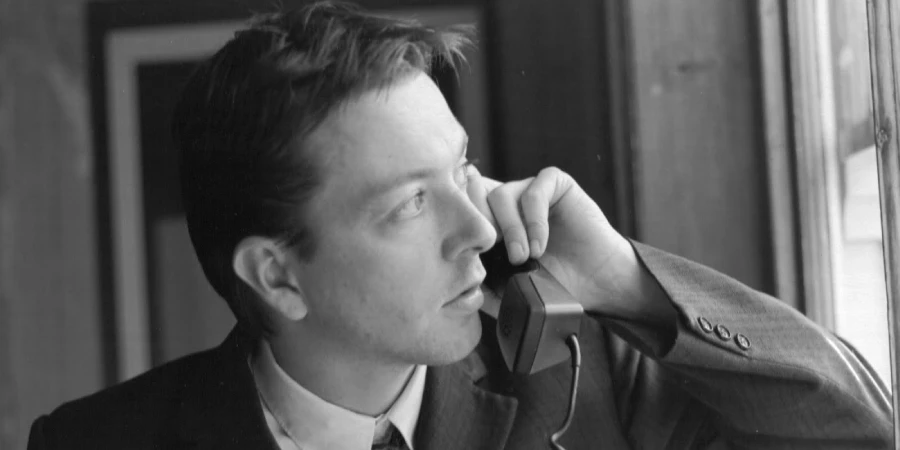

Christopher Nolan shot Following on weekends, with a budget reportedly under $6,000, and somehow built a noir thriller tight enough to make your palms sweat. This is the film that announced a filmmaker with a pathological need to scramble time. Bill, a broke London writer who follows strangers for creative inspiration, stumbles into a con man named Cobb, and the whole thing collapses into a trap so elegant it still stings on a second watch.
Detailed Summary
Bill Starts Following Strangers
Bill is unemployed, directionless, and has developed a habit of tailing random people through London. He tells himself it is research, material for writing. It is also clearly a symptom of profound loneliness.
He sets rules for himself: never follow the same person twice, never follow women alone, never let it get personal. He breaks every single one of these rules, almost immediately.
The Encounter with Cobb
Cobb spots Bill following him and confronts him directly. Rather than walking away, Cobb pulls Bill into his world with the casual confidence of a man who has done this before. He is a burglar, and he wants a partner.
What makes this scene so sharp is how Cobb flips the power dynamic instantly. Bill came to observe; Cobb decides to be observed on his own terms. Jeremy Theobald’s Bill looks genuinely startled throughout, which is exactly right.
The Burglaries Begin
Cobb takes Bill on break-ins around London. They do not steal for money, at least not primarily. Cobb is obsessed with what objects say about the people who own them, touching things, rearranging items, leaving small traces of intrusion.
This is the best stretch of the film. Nolan directs these sequences with a quiet menace, keeping the camera close and the spaces narrow. You feel the wrongness of being in someone else’s home without their knowledge.
The Blonde Woman
During one break-in, they enter the flat of a young woman later referred to in the film simply as the Blonde. Bill grows obsessed with her. He goes back to the bar where she works and introduces himself, starting a relationship built entirely on a lie.
She tells him she has a problem: a gangster named The Bald Man is blackmailing her with photographs. Bill, hungry to impress her, agrees to help. This is exactly where he starts walking into the trap, though the film withholds that truth for a while longer.
Cobb’s True Game
Bill slowly adopts Cobb’s style: he cuts his hair, buys a suit, starts carrying himself differently. He has effectively become a new person, which suits Cobb’s plan perfectly.
Cobb has been running a long con from the beginning. He picked Bill deliberately, shaped him, and steered him toward the Blonde because she is Cobb’s accomplice, not his victim. Every moment of apparent friendship was a setup.
The Murder
Bill goes to The Bald Man’s flat to retrieve the photographs, following the Blonde’s instructions. He finds The Bald Man dead, beaten with a claw hammer. Bill’s fingerprints are now on the weapon.
He panics and flees. The film here delivers its coldest moment: Bill realizing that every action he has taken, every choice he thought was his own, was choreographed by someone else. Theobald sells this with a stillness that is more unsettling than any outburst would have been.
Movie Ending
Bill goes to the police and confesses everything. He genuinely believes he is turning himself in as a witness, a man who was manipulated. His confession is detailed, and he names Cobb.
The detective sits across from him and lets him finish. Then he shows Bill a photograph. It is Cobb, yes, but Cobb in disguise: in the sequences Bill experienced, Cobb was wearing a costume, a bald cap, altering his appearance for each job. The real Cobb is The Bald Man that Bill found dead in the flat.
Bill did not just stumble into a trap. He narrated his own destruction to a police officer. Cobb and the Blonde engineered everything so that Bill would be holding the murder weapon, would have a documented history of break-ins, and would confess it all in sequence without realizing what he was confessing to.
The Blonde, meanwhile, is last seen leaving London with a man who appears to be a senior criminal, implying she gets away clean. Cobb is already dead before Bill even understands his own role. Bill is arrested, alone, for a murder he did not commit, by telling the truth.
That final irony is the film’s sharpest edge. Nolan is interested in how a person can be rewritten by someone else’s design without ever suspecting it. Bill’s tragedy is not stupidity; it is that he was specifically chosen because his hunger for meaning made him malleable.
Are There Post-Credits Scenes?
Following has no post-credits scene. Once the film ends, it is over. No stingers, no additional footage.
Type of Movie
Following is a neo-noir thriller with strong elements of psychological crime drama. Its tone is cold, clinical, and relentlessly bleak, with occasional dry wit buried under the surface tension.
Nolan shoots it in black-and-white, which is not an aesthetic flourish for its own sake. It strips the film of warmth deliberately, matching the moral landscape of every character on screen.
Cast
- Jeremy Theobald – Bill (The Young Man)
- Alex Haw – Cobb
- Lucy Russell – The Blonde
- John Nolan – The Policeman
- Dick Bradsell – The Bald Man
Film Music and Composer
David Julyan composed the score for Following. He would go on to collaborate with Nolan again on Memento and The Descent. His work here is spare and unobtrusive, which suits the film’s low-budget texture perfectly.
There are no grand musical statements. The score works like an undertow: you feel it pulling at the edges of scenes without it ever announcing itself. For a first feature made under severe financial constraints, that restraint is genuinely impressive.


Filming Locations
Following was shot almost entirely on location in London. Nolan and his small crew worked without permits in many cases, shooting guerrilla-style on weekends when his collaborators were available.
The city feels lived-in and slightly hostile. Narrow streets, cramped flats, and dim bars reinforce the claustrophobia of Bill’s world. London here is not a postcard; it is a grey maze that swallows people.
The choice to shoot on location rather than in controlled studio spaces gives the film a documentary grain. These look like real places where real, slightly desperate people actually live.
Awards and Nominations
Following screened at several international film festivals following its debut, including the San Francisco International Film Festival, where it gained early attention. It did not accumulate major competitive awards but served as the calling card that helped Nolan secure financing for Memento.
Behind the Scenes Insights
- Nolan shot the film over roughly a year, working only on weekends because the cast and crew held day jobs during the week.
- The entire production budget was under $6,000, funded by Nolan himself.
- Because they shot without permits, the crew had to work quickly and quietly in public spaces to avoid being stopped.
- The non-linear structure was built into the script from the beginning, not imposed in the editing room.
- Nolan acted as his own cinematographer, keeping the crew as small as physically possible.
- Jeremy Theobald, who plays Bill, was a friend of Nolan’s and not a professional actor at the time.
- The film was shot on 16mm black-and-white reversal film stock.
Inspirations and References
Nolan has cited classic American noir fiction and film as reference points, though he has not publicly named specific titles as direct inspirations for Following. The DNA of writers like Cornell Woolrich and Jim Thompson runs through the film’s sense of fate closing in on ordinary men.
Patricia Highsmith’s work, particularly her interest in identity theft and the way one person can colonize another’s life, feels thematically close to what Nolan is doing with Bill and Cobb. There is no confirmed direct literary source, but the influence of that tradition is hard to miss.
Alternate Endings and Deleted Scenes
No officially documented alternate endings or deleted scenes for Following have been released publicly. Given the film’s extremely limited budget and tight shooting schedule, significant unused footage seems unlikely.
What exists is what Nolan intended. This was a film made with such precision of resources that there was little room for expensive experimentation with alternate cuts.
Book Adaptations and Differences
Following is an original screenplay written by Christopher Nolan. It is not based on any book, short story, or pre-existing source material. Any thematic parallels to existing fiction are matters of influence, not adaptation.



Memorable Scenes and Quotes
Key Scenes
- Cobb catching Bill in the act of following him and immediately taking control of the conversation, reframing himself as the subject rather than the mark.
- The first break-in, where Cobb handles a stranger’s belongings with an intimacy that reads as more violating than theft.
- Bill finding The Bald Man’s body and standing frozen in the flat, the claw hammer already in his hand.
- Bill’s police confession playing out in full while the audience slowly realizes the confession is a map of his own guilt.
- The final revelation that Cobb wore a bald cap throughout, and that the man Bill thought was a separate antagonist was Cobb himself.
Iconic Quotes
- “You take it away, show them what they had.” (Cobb, on why he leaves traces during break-ins)
- “I started to follow people… I’m a writer.” (Bill, justifying his obsession to Cobb)
Easter Eggs and Hidden Details
- The non-linear structure front-loads images of Bill looking disheveled and beaten, which retroactively recontextualize every scene once you understand the full timeline.
- Cobb’s name resurfaces in Nolan’s later work: Leonardo DiCaprio’s character in Inception shares the same name, a detail that has fueled significant fan discussion about recurring themes of manipulation and constructed realities.
- Bill’s gradual wardrobe change, from rumpled casualness to a neat suit, mirrors Cobb’s own appearance, visually signaling the identity transfer before the script confirms it.
- The Blonde’s flat contains several objects that appear in subsequent break-in scenes, suggesting Cobb and she have been coordinating their targets longer than Bill knows.
Trivia
- Nolan was 27 years old when he made Following.
- The film runs approximately 69 minutes, making it one of the shortest films in Nolan’s filmography.
- Its non-linear narrative structure directly prefigures the approach Nolan would use far more ambitiously in Memento two years later.
- Nolan reportedly developed and processed the film stock himself to save money.
- The film was not widely distributed on its initial release but gained a much larger audience after Memento made Nolan’s name known internationally.
- John Nolan, who plays the detective, is Christopher Nolan’s uncle.
- The shoot stretched across roughly twelve months because of the weekend-only production schedule.
Why Watch?
Alex Haw’s performance as Cobb is the most underrated element of early Nolan: the man moves through every scene like he already knows the last page of the script, and watching him operate on Bill is more instructive about manipulation than most psychology textbooks. For a film that costs nothing and runs barely over an hour, it constructs a trap precise enough to fool you even when you know one is coming.
Director’s Other Movies
- Memento (2000)
- Insomnia (2002)
- Batman Begins (2005)
- The Prestige (2006)
- The Dark Knight (2008)
- Inception (2010)
- The Dark Knight Rises (2012)
- Interstellar (2014)
- Dunkirk (2017)
- Tenet (2020)
- Oppenheimer (2023)
Recommended Films for Fans
- Memento (2000)
- The Usual Suspects (1995)
- Shallow Grave (1994)
- Blood Simple (1984)
- Brick (2005)
- Pi (1998)
- The Machinist (2004)
- Primer (2004)
- The Talented Mr. Ripley (1999)