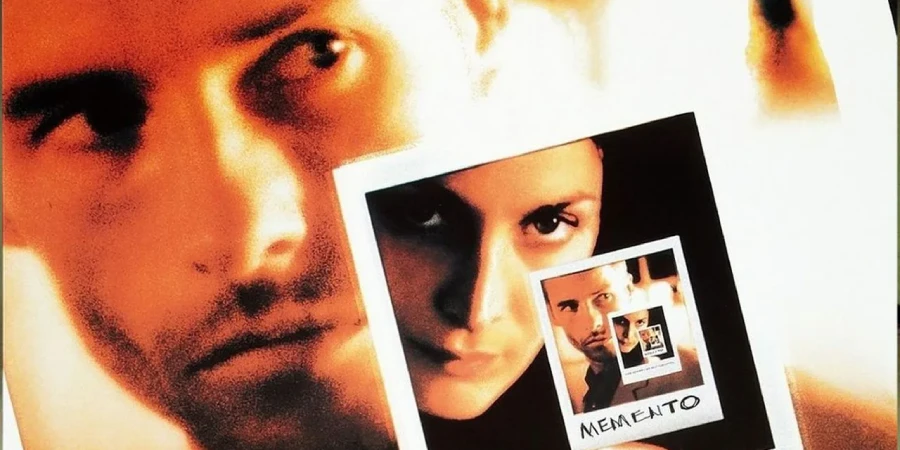

Guy Pearce tattoos notes onto his own skin because he cannot make new memories, and that single visual fact tells you everything about what Memento is willing to do to its audience. Christopher Nolan shoots the film in two interleaved timelines: one running backward in color, one running forward in black-and-white. By the time those two threads collide, you realize you have been complicit in your own deception.
Nolan made this film for roughly four million dollars, and it rewired expectations for what a thriller could demand from a viewer.
Detailed Summary
The Opening Polaroid
Nolan opens the film in reverse. A Polaroid photograph of a dead man slowly loses its image, the bullet retreats into the gun, and Leonard Shelby (Guy Pearce) un-shoots Teddy (Joe Pantoliano). It is one of the most audacious opening shots in modern American cinema, and it does something clever: it hands you the ending before you know what anything means.
Leonard’s Condition
Leonard suffers from anterograde amnesia, a condition that prevents him from forming new memories after a traumatic event. He woke from the attack that killed his wife unable to retain anything new beyond a few minutes. His last solid memory is of two men breaking into his home, assaulting his wife, and leaving him with a head injury.
He manages his daily life through a brutal system of Polaroid photographs, written notes, and tattoos burned permanently into his skin. His chest reads: “John G. raped and murdered my wife.” His hands, arms, and torso carry a map of clues toward the man he believes killed her.
Natalie and the Letter
In the color timeline, Leonard stays at a motel and encounters Natalie (Carrie-Anne Moss), a bartender with her own agenda. She uses Leonard’s condition against him without mercy. She insults and provokes him until he hits her, then leaves the house, waits for the memory to fade, and returns with a bruised face to claim an unknown man attacked her.
Leonard, who has no memory of striking her, writes a note warning himself not to trust Natalie. Then she manipulates him into discarding the note. She needs Leonard to deliver a license plate check on a man named Dodd, someone she owes money to. Leonard does it, never knowing she played him.
Teddy’s Role
Teddy, whose real name is revealed as John Edward Gammell, presents himself as a friendly cop helping Leonard. He guides Leonard toward targets, feeds him information, and maintains a cheerful, conspiratorial energy that feels almost parental. Guy Pantoliano plays the role with a grin that never quite settles into trustworthy.
Teddy is also the man Leonard photographs at the start of the film and labels: “Don’t believe his lies.” Leonard wrote that warning himself, at some earlier point, for reasons that only become clear at the end.
Sammy Jankis
Throughout the film, Leonard tells the story of Sammy Jankis, a man with the same condition who Leonard investigated as an insurance adjuster before his own injury. Sammy’s wife, convinced he was faking, tested him by asking him to administer repeated insulin injections. Sammy injected her into a diabetic coma, and she died. Leonard uses Sammy’s story as proof that his condition is real and that he is different from Sammy because he has purpose.
Late in the film, a flash of imagery shows a woman sitting in a chair in the same pose as Sammy’s wife. That detail quietly suggests the story is not entirely about someone else.
The Black-and-White Thread
Running alongside the color segments, a black-and-white thread shows Leonard in his motel room, speaking on the phone with an unknown caller. He talks through his philosophy of memory, facts versus conditioning, and the mechanics of purpose. These scenes provide texture and backstory, but they also plant seeds about who Leonard really is before the amnesia fully set in.
Movie Ending
Teddy pulls Leonard aside and delivers the film’s gut-punch. He tells Leonard that he already found John G., the real attacker, about a year earlier. Teddy claims he helped Leonard track down and kill the actual killer. Leonard has no memory of it. His quest is already over, and has been for a long time.
Teddy goes further. He suggests that Leonard’s wife actually survived the attack, that she lived with his amnesia for a period afterward, and that it was Leonard himself who accidentally killed her with repeated insulin injections, just as Sammy Jankis supposedly killed his own wife. Sammy Jankis, Teddy implies, never really existed the way Leonard tells it. Leonard displaced his own guilt onto an invented patient.
Leonard rejects all of it. He chooses not to believe Teddy, and in a voiceover, he explains his reasoning with chilling clarity: he needs a reason to live, a mission, a purpose. If the truth kills the mission, he will manufacture a new lie. He writes Teddy’s license plate number on a note, adds it to his records, and sets the kill in motion. He knows, in this moment of clarity, exactly what he is doing.
Cut to the opening shot. Leonard kills Teddy. A new false memory begins to form. Nolan holds on Leonard’s face as he drifts back into the fog, peaceful, purposeful, and wrong about everything.
What makes this ending so corrosive is its refusal to provide relief. Leonard is not a victim of his condition so much as its architect. He curates his own reality, discards evidence that contradicts his narrative, and executes innocent people while telling himself he has no choice. Nolan never softens that.
Are There Post-Credits Scenes?
Memento contains no post-credits scene. Nolan ends the film cold, with no additional footage after the credits begin. Given the film’s structure, any post-credits tag would undermine the point entirely.
Type of Movie
Memento is a neo-noir psychological thriller. Its tone is cold, paranoid, and darkly ironic. It draws from classic noir in its use of an unreliable protagonist, a femme fatale figure, and a murdered woman as the engine of plot, but it subverts the form by making the detective the most dangerous and deluded person in the story.
There is also a philosophical dimension that sits alongside the thriller mechanics. Nolan genuinely interrogates what memory does for human identity, what we owe to truth, and whether purpose built on lies is preferable to purposeless reality.
Cast
- Guy Pearce – Leonard Shelby
- Carrie-Anne Moss – Natalie
- Joe Pantoliano – Teddy (John Gammell)
- Mark Boone Junior – Burt (motel clerk)
- Jorja Fox – Leonard’s Wife
- Stephen Tobolowsky – Sammy Jankis
- Harriet Sansom Harris – Mrs. Jankis
- Callum Keith Rennie – Dodd
Film Music and Composer
David Julyan composed the score for Memento. Julyan worked with Nolan on several early projects, and his approach here leans heavily into texture rather than melody. Sustained drones, low strings, and ambient tones replace conventional thriller scoring.
That choice pays off. A traditional orchestral score would tell the audience how to feel. Julyan’s music refuses to do that; it simply hums with unease and lets the structure disorient you on its own terms. The most underrated element of the film might be precisely this restraint in the sound design.
Filming Locations
Memento was shot almost entirely in and around Los Angeles, California. Nolan and his team used real motels, diners, and urban locations rather than constructed sets. That decision matters enormously: the generic, interchangeable quality of American roadside architecture reinforces Leonard’s disorientation.
Every location looks like it could be any other location. A motel room is a motel room. A parking lot is a parking lot. Leonard cannot rely on environmental cues to orient himself, and neither can the audience. Place becomes as unstable as memory.
Awards and Nominations
Memento earned Academy Award nominations for Best Original Screenplay (Christopher Nolan) and Best Film Editing. It won Independent Spirit Awards including Best Director and Best Feature. The screenplay nomination was widely seen as overdue recognition for a studio-bypassing film that had spread mostly through word of mouth.
Behind the Scenes Insights
- Christopher Nolan adapted the screenplay from a short story by his brother, Jonathan Nolan, called Memento Mori, which Jonathan wrote while Christopher was developing the concept.
- Guy Pearce prepared for the role by studying the actual neuroscience of anterograde amnesia and consulted with specialists to keep Leonard’s behavior credible.
- Nolan shot the color sequences in reverse order on set, so the crew was also experiencing the story non-chronologically during production.
- The film was initially picked up by Newmarket Films after larger studios passed on it, unsure how to market a film that ran backward.
- Nolan reportedly structured the screenplay in a way that made it nearly impossible to read linearly, ensuring readers experienced the disorientation intended for audiences.
- Carrie-Anne Moss came off the massive success of The Matrix (1999) and took the role of Natalie specifically because it required something colder and more morally compromised than Trinity.
Inspirations and References
Jonathan Nolan’s short story Memento Mori is the direct source material. Jonathan wrote the story partly while sitting in a car on a long road trip, and it told the same basic story in prose form, with a key difference: the written version unfolds in second person, addressing the amnesiac directly.
Nolan also drew on the real neurological case of H.M. (Henry Molaison), a patient who lost the ability to form new long-term memories after a surgical procedure and became one of the most studied individuals in the history of neuroscience. Sammy Jankis’s portrayal in the film reflects genuine details from such cases.
Classic noir films, particularly those featuring investigators who are more compromised than the criminals they chase, clearly shaped the moral framework. Films like Chinatown (1974) live in the film’s DNA.
Alternate Endings and Deleted Scenes
No significantly alternate ending has been publicly released. Nolan has been consistent about his intentions for the film’s conclusion, and no version of the film exists in which Leonard learns the truth and acts on it differently.
A special DVD edition released the film with the option to watch the color sequences in chronological order. Nolan included that option not as a definitive version but as a way to prove that watching it chronologically is actually less interesting and less true to the story’s meaning.
Book Adaptations and Differences
Memento is not based on a novel. It is adapted from Jonathan Nolan’s short story Memento Mori. The story uses second-person narration, which puts the reader directly inside the protagonist’s perspective in a way that is impossible to replicate on screen.
Christopher Nolan’s solution was structural: he replaced second-person narration with reverse chronology, making the audience’s confusion functional rather than illustrative. It is a genuinely elegant translation of the source material’s intent into cinematic terms.

Memorable Scenes and Quotes
Key Scenes
- The reverse opening: A Polaroid photograph de-develops in Leonard’s hand. Blood retreats from a wall. A body rises from the floor. Before a single line of dialogue, Nolan establishes the rules.
- Natalie’s manipulation: She baits Leonard into hitting her, steps outside to let the memory dissolve, returns with a bruised face, and watches him apologize for something he no longer knows he did. Carrie-Anne Moss plays the scene without blinking.
- Leonard burns Teddy’s photo: Standing in a field, Leonard holds a lighter to Teddy’s Polaroid after completing the kill. His face shows something close to peace. Nolan cuts away before the grief of the scene can settle.
- The insulin injection flash: A single cutaway shows a woman in a chair in a familiar pose. It lasts less than two seconds. Most first-time viewers miss it entirely, and on a rewatch it recontextualizes every scene before it.
- Leonard’s voiceover on purpose: Lying in bed, Leonard explains that he has to believe his actions matter, even knowing what he knows. Guy Pearce delivers the line without self-pity, which makes it far more disturbing than a tearful reading would.
Iconic Quotes
- “Memory can change the shape of a room; it can change the color of a car. And memories can be distorted. They’re just an interpretation, they’re not a record.”
- “I have to believe in a world outside my own mind. I have to believe that my actions still have meaning, even if I can’t remember them.”
- “We all need mirrors to remind ourselves who we are.”
- “Now, where was I?”
Easter Eggs and Hidden Details
- The black-and-white sequences, when assembled chronologically, reveal that Leonard’s phone calls in the motel are with Teddy himself, casting every piece of advice Teddy gives in a sinister new light.
- Leonard’s tattoo placement is deliberate: information he trusts most lives closest to his heart, while less trusted notes are on his extremities.
- Burt the motel clerk is renting Leonard two rooms simultaneously and pocketing the difference. Leonard never notices because he forgets he already checked in.
- The photograph of Natalie has no caption written on it at several points in the film, which means Leonard has no written warning about her when he needs one most.
- The film’s color palette in the color sequences is deliberately washed out and flat, matching the quality of a Polaroid photograph rather than naturalistic cinematography.
- Teddy’s number plate, which Leonard uses to mark him for death, has the letters and numbers visible in earlier scenes if you pause and look, long before Leonard writes them on the photo.
Trivia
- Christopher Nolan shot the film in approximately 25 days on a small budget.
- Guy Pearce was cast partly because Nolan wanted an actor whose face audiences did not automatically associate with a franchise or prior heroic role.
- Jonathan Nolan’s short story Memento Mori was published in Esquire magazine after the film came out, not before it was released.
- The film was screened at the Venice Film Festival and the Toronto International Film Festival in 2000 before its wider theatrical release in 2001.
- Nolan has said that the film is, in part, about his own experience of losing track of the story while writing it and having to reconstruct it through notes.
- Stephen Tobolowsky, who plays Sammy Jankis, based his physical performance of the condition on documented clinical behaviors rather than theatrical exaggeration.
Why Watch?
Guy Pearce plays Leonard not as a tragic figure seeking sympathy but as a man who has quietly chosen comfortable delusion over painful truth, and watching that choice unfold in reverse puts the audience in the uncomfortable position of rooting for a killer. No other film of its era asks you to feel that specific kind of complicity. Nolan builds his entire structure around making that discomfort inescapable rather than optional.
Director’s Other Movies
- Following (1998)
- Insomnia (2002)
- Batman Begins (2005)
- The Prestige (2006)
- The Dark Knight (2008)
- Inception (2010)
- The Dark Knight Rises (2012)
- Interstellar (2014)
- Dunkirk (2017)
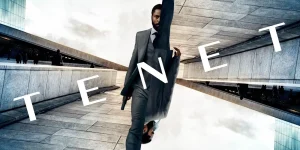
- Tenet (2020)
- Oppenheimer (2023)