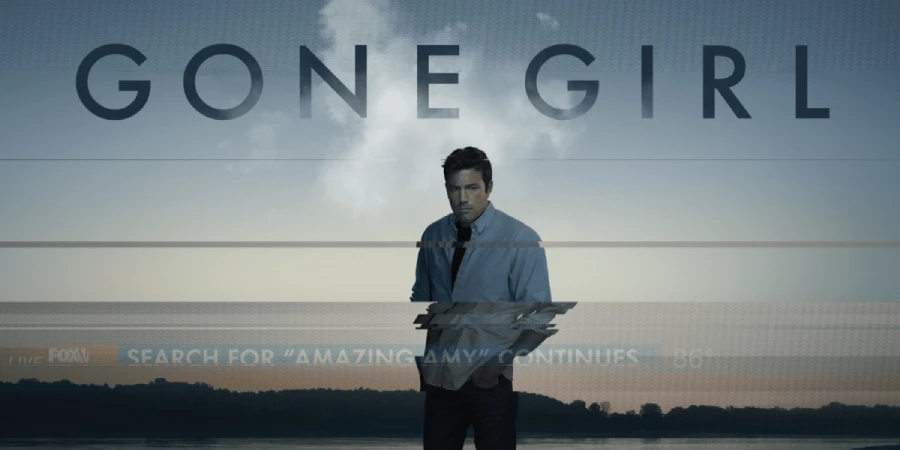

Rosamund Pike sits across from a detective, smiling just slightly too much, and you realize you have been completely fooled for the past hour. David Fincher’s Gone Girl is a film about marriage as a performance, and it pulls off the trick by making you perform right alongside its characters. Nick Dunne spends the first half looking guilty of murder. His wife Amy spent that same time framing him for it.
Detailed Summary
Nick and Amy on the Morning of Their Anniversary
Nick Dunne, played by Ben Affleck, wakes up on the morning of his fifth wedding anniversary feeling restless and disconnected. He heads to a bar he co-owns with his twin sister Margo, drinks bourbon before noon, and gets a call that his house has been broken into. He returns to find the front door open, a glass coffee table shattered, and his wife Amy completely gone.
Detective Rhonda Boney arrives and immediately picks up on something off about Nick. His affect is flat. He poses for a photo with a volunteer searcher, grinning. Every behavioral choice he makes in public looks wrong on camera, and Fincher shoots him from slightly unflattering angles throughout these early scenes to keep the audience suspicious.
Amy’s Diary and the Story It Tells
We cut between the present investigation and Amy’s diary entries, read in voiceover. These entries paint Nick as a controlling, increasingly frightening husband. Amy describes falling for him in New York, their sweet courtship, and a slow descent into resentment after they relocate to Missouri for his mother’s illness. She writes about being afraid of him. She writes that she thinks he might hurt her.
Fincher presents these flashbacks in warm, golden cinematography, a deliberate contrast to the cold blue-grey of the present-day investigation. It is a visual trick that tells you something is wrong before the screenplay confirms it. Warm light equals false memory.
The Investigation Closes In on Nick
Police discover that Nick has been having an affair with a young student named Andie. They find a credit card Amy supposedly never used, maxed out on purchases Nick made. A woodshed on his property turns out to be full of expensive gifts, hidden. Every clue points directly at Nick, arranged with almost surgical precision.
Nick’s lawyer Tanner Bolt, played with tremendous relish by Tyler Perry, enters the picture. Perry is genuinely one of the most underrated elements of this film. His Tanner is sharp, funny, and refreshingly competent in a film full of people failing at basic human tasks.
The Twist: Amy Is Alive
Halfway through the film, Amy’s narration drops its pretense. She reveals, directly to camera in voiceover, that she staged the entire disappearance. She planted the diary. She planted the clues. She faked her own blood. She has been living in a motel under a false name, watching Nick’s media coverage with clinical satisfaction, and adjusting her plan as he responds to it.
This is the film’s great gear-shift. Rosamund Pike’s performance up to this point already felt slightly too controlled, too self-aware. In retrospect, every diary voiceover was a performance within a performance. Pike narrating the fake diary with just a trace of irony in her voice is the best piece of audio acting in the entire film.
Amy’s Plan Starts to Unravel
Amy’s cash gets stolen at the motel by a pair of petty thieves who figure out she has money. Broke and exposed, she runs to her ex-boyfriend Desi Collings, played by Neil Patrick Harris with an unsettling, obsessive calm. Desi installs her in his lakeside mansion but quickly reveals his controlling nature. He monitors her, restricts her movements, and makes it clear she is not leaving.
Amy recalibrates, as she always does. She decides Desi is her next plot device. She seduces him, then cuts his throat during sex, staging it as a violent rape escape. She drives back to St. Louis, soaked in his blood, and walks through the front door to a crowd of reporters and a stunned Nick.
Nick Knows Exactly What She Did
Nick is not relieved. He is horrified. He understands immediately that Amy killed Desi and manufactured another alibi. He tells Tanner. He tells Detective Boney. Nobody can prove it, because Amy planned everything too well. The physical evidence supports her story of rape and captivity.
Nick goes on television and delivers a perfectly calibrated public message to Amy, speaking in their private language, telling her he understands her, that she is amazing. He is trying to lure her into a false sense of security long enough to expose her. Amy, watching from a hotel room, smiles slowly. She is not fooled, but she is charmed.



Movie Ending
Amy announces she is pregnant with Nick’s child, conceived using a sperm sample she secretly had stored. Nick cannot leave her now without abandoning his child to a woman he knows is a killer. Detective Boney investigates Desi’s death and clearly suspects Amy, but the forensic case against her is too weak. Amy walks free.
Nick sits down to write a book exposing everything. Amy finds it and reads it with a strange pride. She tells Nick that she knows he wrote it, that she finds it brilliant, and that she is going to have it destroyed. She holds all the cards: the pregnancy, the public sympathy, the physical evidence pointing toward her victimhood.
In the film’s final minutes, Nick lies in bed next to Amy and turns to look at her. She turns to look at him. Her smile is thin and deliberate. His expression is the face of a man who has just understood that the cage he is in was custom-built. The camera holds on them together, this perfect American couple, and the last image is Nick pressing his face into Amy’s hair, an act that looks like tenderness and reads as surrender.
What Fincher refuses to do here is offer any catharsis. Nick does not escape. Amy is not punished. Their marriage simply continues, now stripped of every pretense, two people who understand each other completely and are trapped by that understanding. It is a bleak argument that some relationships survive not on love but on mutual knowledge of what the other is capable of.
Are There Post-Credits Scenes?
Gone Girl has no post-credits scene. Once those final frames of Nick and Amy fade, the film is done. Fincher is not in the business of softening endings with bonus content.
Type of Movie
Gone Girl is a psychological thriller with strong noir DNA. It borrows the missing-woman structure of crime procedural television and then systematically dismantles every expectation that structure creates. Tonally, it sits in a strange, uncomfortable space between dark satire and genuine menace.
Fincher keeps the film from tipping into camp by shooting everything with deadpan precision. Even the more outrageous plot turns, and there are several, play completely straight. That tonal discipline is what separates the film from a pulpy guilty pleasure.
Cast
- Ben Affleck – Nick Dunne
- Rosamund Pike – Amy Dunne
- Neil Patrick Harris – Desi Collings
- Tyler Perry – Tanner Bolt
- Carrie Coon – Margo “Go” Dunne
- Kim Dickens – Detective Rhonda Boney
- Patrick Fugit – Officer Jim Gilpin
- David Clennon – Rand Elliott
- Lisa Banes – Marybeth Elliott
- Missi Pyle – Ellen Abbott
- Emily Ratajkowski – Andie Fitzgerald
- Sela Ward – Sharon Schieber
Film Music and Composer
Trent Reznor and Atticus Ross composed the score. This was their third collaboration with Fincher, following The Social Network and The Girl with the Dragon Tattoo. Their approach here leans into dread rather than melody, creating music that feels like surveillance: cold, patient, mechanically precise.
Tracks like What Have We Done to Each Other open and close the film, looping back on themselves the way the plot does. Reznor and Ross build textures out of synthesizers and processed sound rather than traditional orchestration. Nothing in the score feels comforting, which is exactly right.



Filming Locations
Principal photography took place in and around Cape Girardeau, Missouri, which doubled as the fictional North Carthage. Fincher wanted real Midwestern geography: strip malls, flat streets, houses that look like they contain quiet desperation. Cape Girardeau delivered all of that.
Some scenes were also shot in Los Angeles for interiors and certain production logistics. Desi’s lakeside house was shot to feel isolated and pristine, an architectural prison dressed up as a reward.
The choice to shoot on real Midwestern locations rather than dress up a backlot matters enormously to the film’s credibility. Amy’s obsessive resentment of her new environment makes sense the moment you see the location. She is a Manhattan creature dropped into a place that has no use for her particular kind of performance.
Awards and Nominations
Rosamund Pike received an Academy Award nomination for Best Actress, which she deserved completely. She did not win, losing to Julianne Moore for Still Alice. Pike also received Golden Globe and BAFTA nominations for the same performance.
Gone Girl received a Golden Globe nomination for Best Motion Picture (Drama). Trent Reznor and Atticus Ross received nominations for their score from various critics groups. Fincher himself received a Directors Guild of America nomination.
Behind the Scenes Insights
- Gillian Flynn, who wrote the source novel, also wrote the screenplay herself, which is unusually rare for big-studio adaptations of bestselling thrillers.
- Fincher reportedly shot many takes of each scene, sometimes in the dozens, pushing actors toward a worn-down, slightly numb quality rather than heightened performance.
- Ben Affleck was cast partly because his natural tendency toward a guarded, slightly smug affect fit Nick Dunne perfectly without requiring him to push into caricature.
- Rosamund Pike gained and lost weight deliberately across the production timeline to reflect Amy’s physical journey through the different phases of the story.
- Tyler Perry had reportedly never been directed by a filmmaker of Fincher’s style before and has spoken about how different the experience felt from his own productions.
- Fincher used digital cameras throughout, which gave him the cold, flat, slightly overlit look he wanted for the present-day investigation scenes.
- Neil Patrick Harris wore prosthetics to simulate blood loss during the throat-cutting scene, with practical effects used to keep the crew’s performance reactions genuine.
Inspirations and References
Gillian Flynn’s 2012 novel of the same name is the direct source. Flynn has spoken about drawing on real missing-person media cases and the way television coverage shapes public perception of guilt and innocence before any evidence is presented.
The Scott Peterson case is a widely cited real-world parallel, involving a husband convicted of murdering his pregnant wife and the media circus that surrounded it. Flynn took that media dynamic and complicated it by making the wife the architect of the situation rather than the victim.
Patricia Highsmith’s work, particularly her Tom Ripley novels, seems relevant to Amy’s character construction. Amy shares Ripley’s sociopathic adaptability and his/her pleasure in the performance of normalcy.
Alternate Endings and Deleted Scenes
Flynn has discussed that the novel and screenplay both went through significant structural development before landing on the ending that exists in the film. Early versions apparently involved different resolutions to the Nick-Amy standoff.
Fincher has not released any significant deleted scenes publicly, and there is no widely available alternate ending cut. Given Fincher’s control over his finished product, it is unlikely a substantially different cut exists outside of whatever remains in the studio vault.
Book Adaptations and Differences
Gone Girl is based directly on Gillian Flynn’s 2012 novel of the same name. Flynn wrote both the book and the screenplay, which kept the adaptation unusually faithful in structure and voice.
One notable difference is the ending. In Flynn’s novel, the final emotional dynamic between Nick and Amy carries slightly different weight, with Nick’s internal monologue making his trapped resignation more explicit on the page. Fincher translates that interiority into pure visual language, relying on Affleck’s face in that final shot rather than narration.
Amy’s “Cool Girl” monologue appears in both novel and film, though the film version is slightly condensed. It remains one of the most quoted passages in either form, and Flynn’s screenplay preserves its best lines intact.



Memorable Scenes and Quotes
Key Scenes
- Amy’s “Cool Girl” monologue, delivered in voiceover while she drives, listing every performance women put on to be acceptable to men, is the film’s thesis statement delivered at motorway speed.
- Nick posing for a smiling photograph with a volunteer at the search center, while Detective Boney watches from across the room, captures the film’s entire argument about optics versus reality in one frame.
- Amy slitting Desi’s throat during sex, blood spraying across white sheets, is shot with a cold, almost architectural calm that makes it more disturbing than any horror film staging would have been.
- Nick’s television interview with Sharon Schieber, where he performs contrition and understanding while speaking coded messages to Amy, is a masterclass in two actors playing people playing roles.
- Amy walking through her front door covered in Desi’s blood, the press cameras clicking, her face a mask of shock and relief she built from scratch the night before.
- The final scene, both of them in bed, Nick pressing his face into Amy’s hair while she stares forward with that small, satisfied smile.
Iconic Quotes
- “What are you thinking? How are you feeling? What have we done to each other? What will we do?” (Nick, opening voiceover)
- “Nick Dunne took my pride and my dignity and my hope and my money. He took and took from me until I no longer existed.” (Amy, diary)
- “I’m so much happier now that I’m dead.” (Amy, after the twist reveal)
- “Men always say that as the defining compliment, don’t they? She’s a cool girl. Being the Cool Girl means I am a hot, brilliant, funny woman.” (Amy, the Cool Girl monologue)
- “You two are the most fucked up people I have ever met and I specialize in fucked up people.” (Tanner Bolt)
Easter Eggs and Hidden Details
- Amy’s treasure hunt clues for Nick on their anniversary are laced with genuine clues about their marriage’s decay if you listen closely to the wording. She is taunting him even in the misdirection.
- Fincher plants Nick’s bar, named “The Bar,” as a deliberate joke about Nick’s lack of imagination and ambition, qualities Amy catalogues with contempt.
- Amy’s motel television is always tuned to coverage of her own disappearance, a quiet image of a woman watching her own fiction air in real time.
- The color palette of Amy’s diary flashbacks, warm amber and soft focus, visually echoes romantic comedy cinematography, a genre the film is actively deconstructing.
- Fincher frames Nick through doorways and windows frequently in the early scenes, a visual motif suggesting he is under observation long before he realizes he is.
- Amy’s book character, Amazing Amy, always outdoes her real-life counterpart in the children’s books her parents wrote. This detail quietly explains decades of Amy’s psychology without spelling it out.
Trivia
- Reese Witherspoon was initially attached to the project as a producer and as a potential lead before Rosamund Pike was cast.
- Gillian Flynn wrote the screenplay herself and has stated she deliberately changed some plot elements from her own novel, viewing the film as a separate creative object.
- Ben Affleck’s natural public persona at the time, frequently criticized and second-guessed by entertainment media, added a meta-layer to his casting as a man who cannot control his own public image.
- Fincher has said he was drawn to the project partly because of its critique of cable news media and the way guilt is manufactured and consumed as entertainment.
- Carrie Coon, who plays Margo, was relatively unknown to film audiences at the time despite significant stage work. Gone Girl was a major introduction for her to mainstream audiences.
- Rosamund Pike has stated that playing Amy required her to suppress her instinct to make the character sympathetic, a discipline that took deliberate, consistent effort across the entire shoot.
- Tyler Perry was cast against type, and Fincher has noted that casting a star associated with broad comedy in a role requiring crisp, intelligent authority was a calculated decision.
Why Watch?
Watch this film because Rosamund Pike constructs a character who is simultaneously the villain, the smartest person in every room, and a pointed argument about what society asks women to perform. Her face in the final shot, that small, closed smile while Nick presses his face into her hair, communicates something a page of dialogue could not. Affleck matches her beat for beat, which nobody expected.
Director’s Other Movies
- Alien 3 (1992)
- Se7en (1995)
- The Game (1997)
- Fight Club (1999)
- Panic Room (2002)
- Zodiac (2007)
- The Curious Case of Benjamin Button (2008)
- The Social Network (2010)
- The Girl with the Dragon Tattoo (2011)
- Mank (2020)
- The Killer (2023)