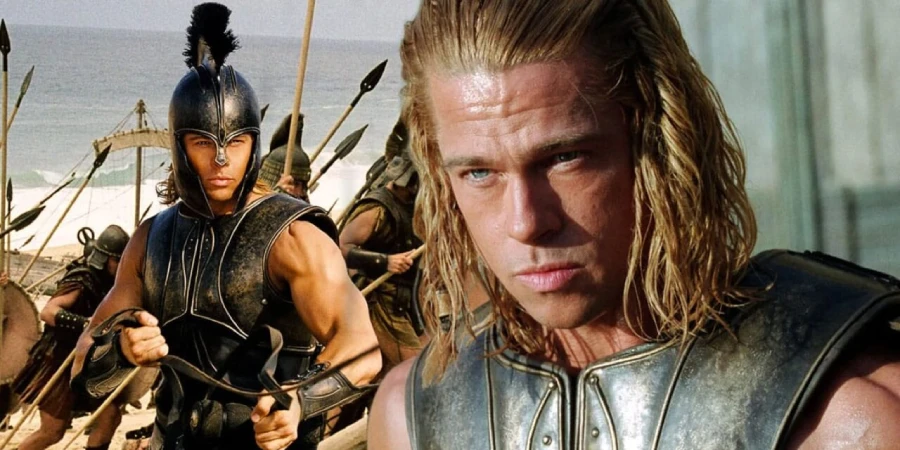

Wolfgang Petersen spent around $175 million to build ancient Troy on a Malta backlot, and then he blew it up. That choice tells you everything about what this film is: a spectacle that commits fully to its own destruction. Brad Pitt plays Achilles as a man who wants to be remembered forever and spends two hours proving he deserves it, right up until a poisoned arrow ends the argument.
Forget the gods, forget Homer’s divine machinery; Petersen strips the myth down to flesh and pride, and the result is messier and more interesting than its reputation suggests.
Detailed Summary
Two Kingdoms, One Stolen Queen
Paris, prince of Troy, falls for Helen, queen of Sparta, during a diplomatic visit. He smuggles her back to Troy aboard a Trojan ship, directly betraying King Menelaus of Sparta, his host.
Menelaus is furious. He calls on his brother Agamemnon, king of Mycenae, who sees the situation less as a romantic crisis and more as a golden excuse to conquer Troy, a city that has blocked Greek expansion for decades.
Achilles Joins the War He Does Not Believe In
Achilles has no interest in Agamemnon’s political ambitions. His mother Thetis tells him plainly: sail to Troy and win eternal glory, but never come home. Stay, and live a long quiet life that nobody remembers.
He chooses Troy. Not for Agamemnon, not for Menelaus, not for Helen. He goes purely for the legend, and Petersen frames this decision as almost clinical, a man choosing a product over a life.
The Greek Fleet Arrives
A thousand ships descend on the Trojan coast. Achilles and his Myrmidons sprint off their boats first, charging the beach before anyone else has landed. Achilles personally kills the priest guarding Apollo’s temple on that beach, an act of impiety that will echo later.
Ajax fights alongside the Greeks. Odysseus (Sean Bean, reliable and sharp) provides the political intelligence that Achilles refuses to supply. From the start, the Greek camp operates as two factions: Agamemnon’s empire-building machine and Achilles’ personal glory project.
Hector Versus the Greek Champions
Hector, Troy’s greatest warrior and Paris’s older brother, carries the film’s moral weight from his very first scene. Eric Bana plays him with a quiet gravity that makes every other character look slightly selfish by comparison. Hector loves his wife Andromache, his infant son, and his city; he fights because he must, not because he craves renown.
Hector kills Menelaus during a duel that Paris interrupts, which breaks the rules of single combat and drags everyone back into full war. Agamemnon is pleased. The chaos suits him.
Briseis and Achilles
Greek soldiers raid Apollo’s temple and take a young priestess named Briseis captive. Achilles takes her under his personal protection after stopping his own men from assaulting her. What begins as a pragmatic claim of ownership shifts into genuine feeling over a series of tent conversations.
Agamemnon, jealous of Achilles’ fame and tired of his insubordination, takes Briseis away to assert authority. Achilles refuses to fight any further. His withdrawal from battle is not a sulk; it is a calculated withdrawal of the one resource Agamemnon actually needs.
Patroclus Takes the Armor
With Achilles sidelined, the Greeks start losing badly. Patroclus, Achilles’ young cousin, watches the carnage and cannot stay still. He borrows Achilles’ armor and leads the Myrmidons into battle, letting the Trojans believe Achilles has returned.
Hector sees through it eventually and kills Patroclus in single combat. When he pulls off the helmet and realizes he has killed a boy, not Achilles, Bana plays the moment with a look of sick understanding. He knows what he has just triggered.
Achilles Returns for Revenge
News of Patroclus’ death breaks Achilles completely. Brad Pitt does his best work here: a sustained, wordless grief that turns the character from a cool professional into something animal. He screams, he weeps, and then he goes very quiet. That quiet is the most frightening part.
He rides to the walls of Troy and calls Hector out. The duel is extended, brutal, and genuinely hard to watch because the audience has been set up to respect both men. Achilles kills Hector and then, in a rage that crosses every line, ties Hector’s body to his chariot and drags it around the city walls.
Priam Walks Into the Enemy Camp
King Priam of Troy walks alone into the Greek camp at night to retrieve his son’s body. Peter O’Toole plays this scene with a dignity that hushes the entire film around him. He kneels before Achilles, kisses the hands that killed his son, and asks for Hector back.
Achilles agrees. The two men sit together, eat, and share a silence that says more than any speech could. It is the film’s best scene, and it works because Petersen finally gets out of the way and lets two actors inhabit the quiet.
The Trojan Horse
Odysseus conceives the wooden horse. The Greeks appear to sail away, leaving the horse on the beach as a supposed offering to the gods. The Trojans drag it inside their walls despite the warnings of Cassandra.
That night, Greek soldiers hidden inside pour out and open the city gates. Agamemnon’s full army floods in. Troy burns.
Movie Ending
Troy falls fast and savagely. Agamemnon’s men tear through the city, slaughtering soldiers and civilians without distinction. Priam refuses to flee and faces Agamemnon directly, who kills the old king on the steps of Apollo’s altar, committing the same sacrilege he had criticized Achilles for earlier in the film.
Paris, who started the whole war, finally does something useful: he gets Andromache, Briseis, and a group of survivors out through a secret passage beneath the city. He also finds a bow. He is not a great warrior, but he can shoot.
Achilles goes into the burning city to find Briseis, not to fight, not to loot. He finds her. Then Paris appears on a high step and shoots him. Multiple arrows hit Achilles, the last one in the heel. Achilles pulls each arrow out with a terrible deliberateness, holds Briseis, and dies on his feet before sinking to the ground. Brad Pitt plays those final moments with a physical stillness that makes the death feel earned rather than staged.
Briseis kills Agamemnon with a knife, which the film frames as a moment of agency for a character who has been passed between powerful men all movie. Paris leads the survivors out. Odysseus finds Achilles’ body and lights it on a funeral pyre, paying a last respect that Agamemnon never would have granted.
What the ending argues, bluntly, is that glory and empire both burn. Achilles got his legend. Agamemnon got a knife. Troy got ash. Nobody won cleanly, and Odysseus, the smartest man in the room, walks away from ruins he helped create.
Are There Post-Credits Scenes?
No. Troy has no post-credits scene of any kind. Once the credits roll, they roll alone. You can leave the theater.
Type of Movie
Troy is an epic historical action drama. It runs long, it costs a fortune in extras and armor, and it takes the ancient world seriously as a setting even while updating its emotional register for a modern audience.
Tonally, the film sits in an interesting space. It is not campy like Clash of the Titans, not grim like a war documentary, and not reverent like a Sunday-school Bible epic. It plays as a prestige blockbuster with genuine dramatic ambitions that it almost, not quite fully, lives up to.
Cast
- Brad Pitt – Achilles
- Eric Bana – Hector
- Orlando Bloom – Paris
- Diane Kruger – Helen
- Brian Cox – Agamemnon
- Sean Bean – Odysseus
- Peter O’Toole – King Priam
- Rose Byrne – Briseis
- Brendan Gleeson – Menelaus
- Garrett Hedlund – Patroclus
- Saffron Burrows – Andromache
- Julie Christie – Thetis
Film Music and Composer
James Horner composed the score for Troy. Horner was one of Hollywood’s most experienced composers for large-scale epics, having previously scored Titanic and Braveheart. His work here is orchestrally lush, leaning on brass and percussion to drive the battle sequences.
The score also incorporates a prominent female vocal element, a Horner signature at this point in his career. Some critics found it overfamiliar for that reason. Personally, the main theme works best during the Priam and Achilles tent scene, where Horner strips the arrangement back and lets strings do quiet work instead of heroic declaration.
Josh Groban performed the end-credits song “Remember,” written for the film. It is unabashedly emotional and fits the film’s preference for feeling over restraint.
Filming Locations
Principal photography took place in Malta, where the production built the city of Troy on a large exterior set. Malta’s limestone landscape and warm Mediterranean light give the coastal sequences a convincing ancient-world texture.
Additional shooting took place in Mexico, specifically in the Cabo San Lucas area, for the beach assault sequences. The wide, hot shoreline reads as the Aegean coast convincingly enough.
Morocco provided some of the desert and landscape shots. Shooting across three countries gave the film a genuine geographic scale that a single backlot could not have produced.
Awards and Nominations
Troy received an Academy Award nomination for Best Costume Design, which is honestly the right category for a film where half the budget appears to be bronze armor and flowing robes. It did not win.
The film picked up nominations at the MTV Movie Awards and other popular-vote ceremonies, but it was not a major awards-season player. Critics were divided and Oscar voters were cooler still.
Behind the Scenes Insights
- Brad Pitt injured his Achilles tendon during production, which required a production pause. The injury affecting that specific tendon on that specific actor for that specific film is the kind of coincidence that writes itself.
- Director Wolfgang Petersen had originally planned to include the gods as active characters, in line with Homer’s text. That idea was dropped in favor of a secular, human-driven story. The decision significantly changes the film’s thematic focus.
- Eric Bana trained extensively in sword combat for the role of Hector and performed most of his own fight choreography.
- Orlando Bloom had already filmed The Lord of the Rings trilogy as an archer; the bow felt natural, which is good, because Paris is mostly defined by one famous arrow shot.
- Peter O’Toole, already in his seventies during filming, reportedly brought extensive research into the psychology of grief to the Priam role, drawing on theatrical experience with Sophocles and Euripides.
- The production built over 100 ships for the Greek fleet sequences, some practical and some extended with digital effects.
- Brian Cox played Agamemnon with an explicit decision to make him charming as well as villainous, arguing that purely monstrous rulers do not hold power for long. That choice pays off; Cox is the most watchable presence in the Greek camp scenes.
Inspirations and References
The film draws primarily from Homer’s Iliad, the ancient Greek epic poem that covers a portion of the Trojan War, specifically the events surrounding Achilles’ rage and its consequences. Homer wrote it, scholars date it to roughly the 8th century BC, and it remains the primary source text for every Troy adaptation.
Petersen and screenwriter David Benioff also drew on other ancient sources to fill in events Homer’s poem skips, including the fall of Troy itself, which the Iliad does not actually depict. The wooden horse comes from later texts and from Virgil’s Aeneid.
The film consciously removes the gods as active participants. In Homer, Athena, Apollo, Ares, and others intervene physically in battle. Petersen’s version re-frames divine intervention as superstition and human psychology. This is a significant interpretive choice, not a mistake.
Alternate Endings and Deleted Scenes
A Director’s Cut was released on home video, running approximately 196 minutes compared to the theatrical cut’s 163 minutes. The extended version restores several scenes that deepen character relationships, particularly the bond between Achilles and Briseis and Hector’s family life in Troy.
Many critics and fans consider the Director’s Cut a meaningfully better film. The added Hector and Andromache material makes his death hit harder. If you have only seen the theatrical version, the extended cut is worth tracking down.
No significantly different ending was reported for any version; both cuts conclude with the fall of Troy and the same character fates.
Book Adaptations and Differences
Troy is loosely adapted from Homer’s Iliad, but “loosely” is doing serious work in that sentence. The film compresses events that span years in myth into what feels like a few weeks. Several major characters who survive in Homer die in the film, and vice versa.
In the Iliad, Menelaus survives the war. In the film, Hector kills him mid-film. Ajax is a major figure in the poem; the film gives him limited screen time. Briseis is a background figure in Homer; Benioff’s script makes her a central character and gives her the knife that kills Agamemnon.
Agamemnon, in myth, returns home and is murdered by his wife Clytemnestra; the film reassigns his death to Briseis inside burning Troy. Patroclus is Achilles’ closest companion in Homer, with a relationship scholars have long debated; the film recasts him as a younger cousin, softening the dynamic.
The gods, present throughout Homer as active combatants and manipulators, are entirely absent from the film as physical beings. Characters pray to them and reference them, but no divine hand ever directly intervenes. That is the single biggest structural departure from the source.
Memorable Scenes and Quotes
Key Scenes
- The beach assault: Achilles leaps from his boat and sprints across the sand alone before his army has even landed. The camera tracks him at ground level, sand kicking up around his feet, as he covers the beach at a pace that makes him look genuinely superhuman.
- Achilles and Priam in the tent: O’Toole kneels, takes Pitt’s hands in both of his, and speaks quietly about being a father. Pitt’s face goes through about six different emotions in eight seconds without a word spoken. The scene works because both actors go still.
- Hector vs. Achilles: The duel outside the city walls, with Trojans watching from the ramparts and knowing they are about to lose their champion. Bana and Pitt choreograph it as two professionals killing each other rather than two heroes competing for glory.
- Patroclus’s death: Hector removes the helmet and sees a boy’s face. He stands over the body without celebrating. Troy’s walls are visible behind him and they look less safe than they did an hour ago.
- Achilles dragging Hector: The camera pulls back to a wide shot as the chariot circles the walls. No music for a long moment. The Trojans on the walls cannot look away and neither can the audience.
- Priam recovering Hector’s body: The old king walks out of the dark into the firelight of the Greek camp carrying gold. No army, no escort, nothing but a father who wants his son back.
Iconic Quotes
- “I’ll tell you a secret. Something they don’t teach you in your temple. The gods envy us. They envy us because we’re mortal, because any moment might be our last.” (Achilles to Briseis)
- “I’ve fought many times, and I’ve never seen men fight with such discipline. These Myrmidons… they’re something else.” (Hector)
- “There are no pacts between lions and men.” (Achilles)
- “I’ve known many men who thought they were gods. They’re dead. You’re still alive.” (Priam to Achilles)
- “All my life I’ve lived by a code, and the code is simple: honor the gods, love your woman, and defend your country.” (Hector)
Easter Eggs and Hidden Details
- Achilles kills the guardian of Apollo’s temple in the opening beach sequence. Apollo’s arrow, in mythological tradition, guides Paris’s fatal shot at the end. The film keeps the divine cause-and-effect even without showing the gods directly.
- Odysseus watches most of the film’s major disasters from a slight remove, as if already calculating how the story will be told later. Sean Bean plays this with small eye movements and a habit of standing just outside the main group. It is a subtle, smart performance choice.
- Hector’s son appears very briefly in an early domestic scene. That child, in mythological tradition, is Astyanax, whom the Greeks kill after Troy falls. The film does not show this, but Andromache’s urgency to flee the city reads differently if you know the myth.
- The wooden horse’s scale relative to the city gates is slightly implausible even within the film’s logic. Several Trojan soldiers glance up at it with expressions that suggest they know this is a terrible idea. Cassandra screams it directly. Nobody listens.
- Agamemnon’s death inside Troy mirrors his mythological fate: killed indoors, by someone he considered beneath him. The film changes who holds the knife, but the shape of the humiliation stays intact.
Trivia
- Brad Pitt trained for months to build Achilles’ physique, working with a personal trainer and adopting a specific diet protocol for the role.
- Sean Bean, who plays Odysseus, is one of cinema’s most famous screen deaths. He survives Troy. This is remarked upon every time the film comes up in conversation online.
- David Benioff, who wrote the screenplay, would later go on to co-create the Game of Thrones television series with D.B. Weiss.
- Eric Bana has noted in interviews that Hector was one of his personally favorite roles, citing the character’s internal conflict between duty and survival instinct.
- The film removes Achilles’ divine invulnerability as a literal fact, treating the heel weakness as metaphor and myth rather than physical reality. His heel is still where the fatal arrow lands.
- Peter O’Toole was in his early seventies during filming and physically walked long distances across the Malta set in full costume to prepare for the night scenes as Priam.
- Garrett Hedlund, who played Patroclus, was making one of his earliest major film appearances. His relatively unknown face helped sell Patroclus as someone younger and less seasoned than the legends around him.
- Wolfgang Petersen shot much of the beach assault sequence in sequence, meaning the actors ran the actual beach multiple times across multiple shooting days for continuity.
Why Watch?
Watch it for Eric Bana, who builds the most complete human being in the entire cast from a character the script treats as the moral center and then kills without flinching. His Hector fights a war he knows is wrong to protect a city he knows will fall, and Bana makes that quiet certainty visible in every scene without once tipping into self-pity. The Priam tent scene alone is worth the full runtime. Bring patience for the slower middle act; the payoff is real.
Director’s Other Movies
- Das Boot (1981)
- The NeverEnding Story (1984)
- Enemy Mine (1985)
- In the Line of Fire (1993)
- Outbreak (1995)
- Air Force One (1997)
- The Perfect Storm (2000)
- Poseidon (2006)
Recommended Films for Fans
- The Odyssey (2026)
- Gladiator (2000)
- Gladiator II (2024)
- 300 (2006)
- Kingdom of Heaven (2005)
- Alexander (2004)
- Clash of the Titans (1981)
- Ben-Hur (1959)
- Braveheart (1995)
- Immortals (2011)