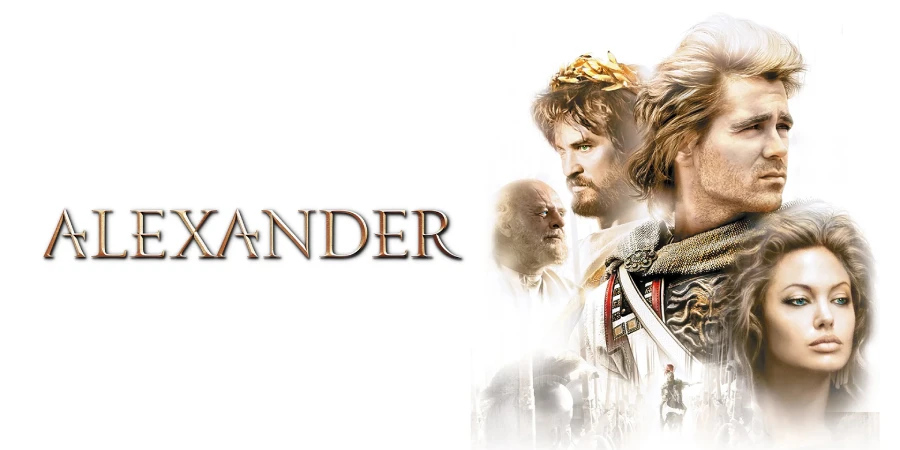

Oliver Stone spent over a decade trying to bring Alexander the Great to screen, and the result is one of the most polarizing blockbusters of the 2000s: a three-hour-plus epic that critics savaged on release but that rewards a second look precisely because it refuses to make its subject likable. Colin Farrell plays Alexander as a man cracked open by his parents’ war for his soul, and Stone frames nearly every battle as a consequence of that psychological wound. The film flopped hard in North America but found its audience internationally, and Stone kept cutting and recutting it, producing multiple versions that tell meaningfully different stories.
Detailed Summary
Ptolemy Frames the Story
An elderly Ptolemy (Anthony Hopkins) narrates from Alexandria, decades after Alexander’s death. He sits surrounded by scrolls and maps, speaking directly to a scribe. This framing device signals immediately that what we are watching is a constructed memory, not objective history.
Ptolemy openly admits that historians lie. Stone plants this caveat early, giving himself room to interpret freely. It also quietly positions the entire film as one man’s act of myth-making.
Young Alexander and His Parents
We meet young Alexander growing up between two ferocious personalities. His mother Olympias (Angelina Jolie), a Macedonian queen obsessed with snakes and divine prophecy, tells him he is the son of Zeus, not Philip. His father Philip II (Val Kilmer) is a scarred, one-eyed warrior king who drinks too much and loves his son fiercely but brutally.
Olympias handles snakes in her bedchamber while the boy watches, wide-eyed. Stone shoots these scenes in warm amber and gold, making the maternal world feel like a fever dream. Philip’s world is torchlit and rough, all leather and wine.
Young Alexander also befriends Hephaistion, and the film makes clear early that this bond runs deeper than friendship. Stone draws a direct line between Alexander’s divided parentage and his divided capacity for love.
Aristotle’s Lessons
Christopher Plummer appears as Aristotle, tutoring young Alexander and his companions at Mieza. Plummer brings effortless authority to a limited role. His Aristotle tells Alexander that Asia is a land of barbarians waiting to be civilized, planting the ideological seed that will drive decades of conquest.
These scenes are quiet but consequential. Stone uses them to establish Alexander’s intellectual ambition alongside his military one. Conquest, in this film, is always also a philosophical project.
Philip’s Murder and Alexander’s Ascension
Philip II is assassinated at a wedding celebration, stabbed by a bodyguard. Alexander is watching from above when it happens. The film strongly implies, though never confirms, that Olympias orchestrated the killing.
Alexander’s reaction is stunned and complicated. He mourns Philip even as he steps immediately into power. Stone shoots his coronation in cold blue light, a deliberate contrast to the warm amber of his childhood.
The Battle of Gaugamela
This is the film’s centerpiece military sequence, depicting Alexander’s decisive defeat of Darius III of Persia. Stone shoots it with a deliberately chaotic energy: the camera spins, horses collide, the sky is choked with dust. Color desaturation makes the battlefield feel genuinely hellish.
Alexander charges directly at Darius, cutting through the Persian center. Darius flees his own chariot. It is one of the few moments where Farrell’s Alexander looks fully in control, and Stone holds on his face as the realization of victory hits him.
What makes Gaugamela work best is the sound design. The battle begins with near-silence broken only by the creak of the Macedonian phalanx advancing, before erupting into overwhelming noise. That contrast earns the chaos that follows.
Babylon and the Question of Sexuality
After Gaugamela, Alexander enters Babylon in triumph. Here the film introduces Bagoas (Francisco Bosch), a Persian eunuch who becomes Alexander’s lover. Stone does not shy away from this relationship, though he gives it less screen time than the Hephaistion dynamic.
Rosario Dawson appears as Roxane, a Bactrian princess Alexander marries in a politically and personally turbulent scene. Their wedding night is shot with genuine menace; Roxane produces a knife, and what follows reads more like a power struggle than a romance.
The Death of Cleitus
One of the film’s most dramatically charged scenes: Alexander, drunk at a banquet, murders his general Cleitus (Gary Stretch) after Cleitus mocks him and accuses him of abandoning Macedonian values for Persian ones. Alexander runs him through with a spear.
The horror hits Alexander immediately. He collapses over the body, weeping. Farrell plays this as a full breakdown, and it is among his best work in the film. Stone frames it tightly, the torchlight flickering, Alexander’s face blotched red from drink and grief.
This scene matters because it shows Alexander destroying the things he loves most. Cleitus was one of Philip’s men, a link to everything Alexander cannot stop grieving. Killing him is almost a symbolic act of self-destruction.
India and the Mutiny at the Hydaspes
Alexander pushes his army into India, crossing the Hydaspes River to fight King Porus. The battle sequence here deploys war elephants to terrifying effect. Stone shoots the elephants from low angles, making them feel monstrous and unstoppable.
Alexander takes a serious chest wound during the fighting. He nearly dies. His generals, including Ptolemy, beg him to stop the advance eastward.
His men finally refuse to go further. This moment of mutiny is framed not as betrayal but as exhaustion. Stone gives the soldiers’ grievances genuine weight. Alexander’s speech to them, trying to reignite their vision, lands as desperate rather than inspiring, and that is a deliberate, smart choice.
Hephaistion’s Death
Alexander’s closest companion Hephaistion (Jared Leto) dies in Ecbatana, apparently from fever. Alexander is not present when it happens. He arrives to find Hephaistion already gone.
Farrell’s response is the emotional summit of the film. He does not rage theatrically. He sits beside the body and goes quiet, a performance built on stillness. Stone holds the camera at a respectful distance.
Alexander orders extravagant mourning rites and reportedly executes Hephaistion’s physician for failing to save him. Stone treats this not as cruelty but as a man incapable of processing loss through any means except action.
Movie Ending
Alexander returns to Babylon after Hephaistion’s death, already hollowed out. His generals are conspiring against him, worried about succession and about his increasingly erratic behavior. He has announced plans for a new campaign into Arabia, and almost no one around him believes it will happen.
At a banquet in Babylon, Alexander drinks heavily. He falls dangerously ill shortly after, and the film frames this as a turning point with no return. His body, punished by two decades of campaigning and at least a dozen serious wounds, simply stops. Stone does not show a dramatic death scene. Instead, Ptolemy’s narration carries us through it, describing how Alexander lingered for days as his generals gathered, each angling for a piece of what he had built.
When asked who should inherit his empire, Alexander reportedly said “the strongest.” This line lands in the film with quiet devastation. It is the answer of a man who built everything on personal will and cannot imagine any other organizing principle.
Ptolemy closes his narration by reflecting on what Alexander actually achieved and what it cost everyone around him. He describes the world Alexander opened up: trade routes, cultural exchange, cities named Alexandria stretching from Egypt to Central Asia. Then he admits that Alexander died at thirty-two, that his empire immediately fractured, and that none of his heirs survived long.
Stone refuses a triumphant finale. Babylon after Alexander feels emptied out. The film’s final images return to the elderly Ptolemy, still dictating, still constructing the myth. It is a melancholy ending that asks whether conquest leaves anything permanent behind. Stone’s answer, built into every frame, seems to be: the myth lasts, but the man destroyed everything he touched.
Are There Post-Credits Scenes?
No. Alexander has no post-credits scene. When the credits roll, the film is done. Stone was not working in a franchise model, and the film’s elegiac tone makes any post-credits addition unthinkable.
Type of Movie
Alexander is a historical epic with strong elements of psychological drama and tragedy. Stone is less interested in spectacle than in portraying how a specific psyche shapes history. That makes it a different beast from most sword-and-sandal films.
The tone shifts considerably across the film’s runtime. Battle sequences are visceral and chaotic. Domestic scenes between Alexander and his parents feel almost like Greek drama. The India section tips toward nightmare. Stone never fully resolves these tonal differences, which is part of what divided critics.
Cast
- Colin Farrell – Alexander the Great
- Anthony Hopkins – Ptolemy
- Angelina Jolie – Olympias
- Val Kilmer – Philip II of Macedon
- Jared Leto – Hephaistion
- Rosario Dawson – Roxane
- Christopher Plummer – Aristotle
- Francisco Bosch – Bagoas
- Gary Stretch – Cleitus
- Brian Blessed – Ptolemy’s wrestling trainer / Antigonos
- Jonathan Rhys Meyers – Cassander
- Nick Dunning – Attalus
Film Music and Composer
Vangelis composed the score, his first collaboration with Stone. The choice is unexpected and largely brilliant. Vangelis blends ancient instrumentation with his signature synthesizer work, producing something that sounds genuinely foreign to Hollywood epic conventions.
Choral passages dominate the battle sequences, giving Gaugamela an almost religious dread. His theme for Alexander himself is spare and melancholy, more lament than fanfare. It is one of the most underrated scores of that decade.
Vangelis is best known for Chariots of Fire and Blade Runner, both landmark scoring achievements. His work on Alexander never received the same attention, which is a genuine oversight by awards bodies and listeners alike.


Filming Locations
Principal photography took place in Morocco, which doubled for Persia and the Central Asian campaigns. The Atlas Mountains provided landscapes of appropriate scale and aridity. Stone and cinematographer Rodrigo Prieto made strong use of the harsh light there.
Thailand served as the location for the India sequences, providing dense jungle canopy and rivers that gave the Hydaspes battle its oppressive, claustrophobic atmosphere. Moving from the open Moroccan plains to Thai jungle visually maps Alexander’s psychological deterioration.
Scenes set in Macedonia were shot in England, using studio facilities and controlled sets to create the enclosed, domestic world of Alexander’s childhood. The deliberate artificiality of these sets gives Olympias’s scenes a theatrical, almost stage-like quality that suits her character.
Awards and Nominations
Alexander received a Razzie nomination for Worst Picture and picked up other Razzie attention on release, which tells you more about the critical climate of 2004 than about the film’s actual quality. It did not receive major mainstream awards recognition.
Behind the Scenes Insights
- Stone spent roughly fifteen years attempting to mount the production, going through multiple scripts and potential collaborators before finally shooting in 2003 and 2004.
- Colin Farrell had to bleach his hair blonde for the role, a transformation he reportedly found physically uncomfortable throughout the extended shoot.
- Stone shot in Morocco during extreme heat, with cast and crew dealing with temperatures that disrupted daily schedules and affected the horses used in battle sequences.
- Stone released three distinct versions of the film: the original theatrical cut, a Director’s Cut, and Alexander Revisited: The Final Cut, which runs considerably longer and restructures major sections including a more explicit treatment of Alexander’s sexuality.
- Angelina Jolie is only about a year older than Colin Farrell, making her playing his mother an unusual casting choice that Stone defended as intentional, meant to emphasize Olympias’s ageless, almost mythological quality.
- Rodrigo Prieto used different color palettes for different geographic and emotional zones in the film, a deliberate system that Stone wanted audiences to feel even if they could not consciously articulate it.
- Val Kilmer wore extensive facial prosthetics and a blind eye piece to create Philip’s battle-damaged appearance.
Inspirations and References
Stone drew heavily from Robin Lane Fox‘s biography Alexander the Great, published in 1973. Lane Fox served as a historical consultant on the production and reportedly rode with the cavalry during the Gaugamela sequence as part of his deal.
Stone also cited Mary Renault‘s historical novels, particularly Fire from Heaven and The Persian Boy, as formative influences on how he approached Alexander’s relationships with Hephaistion and Bagoas. Renault’s sympathetic, psychologically detailed portrayal of Alexander shaped much of the film’s emotional architecture.
Greek tragedy, especially Sophocles and Euripides, clearly informs the family dynamics. Philip and Olympias function almost as Oedipal archetypes. Stone never pretends otherwise.
Alternate Endings and Deleted Scenes
Stone’s multiple cuts represent some of the most significant post-release restructuring in modern Hollywood history. Alexander Revisited: The Final Cut opens differently, restructures the chronology to begin with Gaugamela rather than Ptolemy’s narration, and substantially expands the India sequences.
The theatrical cut reduced or softened several scenes involving Alexander’s relationships with male companions. Later cuts restored this content and placed it more centrally. The difference between versions is not merely one of length but of thematic emphasis.
A number of scenes extending the Babylon sequences and Alexander’s final days were trimmed from the theatrical release. Stone felt they disrupted pacing, though their absence arguably made Alexander’s decline feel abrupt to first-time viewers.
Book Adaptations and Differences
Alexander is not a direct adaptation of any single book. Stone drew from multiple historical and literary sources rather than adapting one text. The film is best described as an original screenplay informed by extensive historical research.
Where Robin Lane Fox’s biography is meticulous about military campaigns and geography, Stone compresses and invents freely for dramatic purposes. The emotional and psychological dimensions owe more to Renault’s fiction than to any academic source. Historians have noted numerous factual liberties, including composite characters and reordered chronology.

Memorable Scenes and Quotes
Key Scenes
- Olympias with the snakes: Young Alexander watches his mother handle serpents in her bedchamber, the candlelight catching the gold bracelets on her arms. She smiles at him with absolute certainty that he is divine. It is unsettling and hypnotic in equal measure.
- Gaugamela charge: Alexander on horseback, his white cloak visible from every angle, cutting diagonally through the Persian center while his infantry holds the flanks. The sequence is built around a single sustained crescendo that does not release until Darius runs.
- The killing of Cleitus: Torch shadows on the banquet walls, spilled wine on the floor, and Farrell roaring in Greek before going completely still as the spear lands. The silence after Cleitus falls is the loudest moment in the film.
- Alexander by Hephaistion’s body: Farrell sits, does not speak, and barely moves. Leto is absent from the frame. Stone keeps the camera back, refusing to punctuate the grief with music for a long beat.
- The mutiny speech in India: Alexander in the rain, his chest wound visible, addressing men who will no longer follow him. Farrell drops the heroic register completely and sounds like a man pleading rather than commanding.
Iconic Quotes
- “None are braver than those who fight for their honor and their home. But none shine brighter than those who fight for a dream.” (Alexander)
- “He could not conquer his own nature.” (Ptolemy, in narration)
- “When you see me in battle, stay close to me. Do not let me die an ordinary death.” (Alexander to Hephaistion)
- “To the strongest.” (Alexander, when asked who inherits his empire)
Easter Eggs and Hidden Details
- Robin Lane Fox, the historian and biographer who served as a consultant, appears as a cavalry rider in the Gaugamela sequence. He negotiated a riding role as part of his consulting agreement.
- Stone embedded color-coded lighting shifts across the film: warm amber for Macedonia and childhood, cold blue for power and conquest, desaturated grey-green for battle, and deep amber-red for Babylon’s decadence. Pay attention to how a scene’s palette shifts as Alexander’s mental state deteriorates.
- The snakes Olympias handles are consistent throughout her scenes. Stone and the props team used real snakes, and Jolie reportedly insisted on doing her own handling.
- Alexander’s shield bears the Macedonian star. Watch how Stone frames it in Gaugamela: it catches the light at the exact moment Alexander commits to his charge, a small visual cue for a narrative turning point.
- The map sequences narrated by Ptolemy use a visual style that echoes ancient Macedonian cartography rather than modern graphic design, a subtle period choice that most viewers miss entirely.
Trivia
- Stone considered the project for so long that at various points different directors, including Martin Scorsese and Baz Luhrmann, were rumored to be attached to competing Alexander projects.
- A group of Greek lawyers reportedly threatened legal action over the film’s portrayal of Alexander’s sexuality, generating significant press coverage before the film even opened.
- Farrell prepared for the role by studying ancient sources and working extensively with a dialect coach to develop a specific accent that differentiated Macedonian characters from Persian ones.
- Stone shot the film in sequence as much as logistically possible, which is unusual for a production of this scale, because he wanted Farrell’s physical and emotional fatigue to register authentically on screen.
- The theatrical cut was edited down significantly from Stone’s original assembly cut. His frustration with that process drove him to produce multiple subsequent versions.
- Vangelis composed and recorded the score largely after filming wrapped, working from a locked cut rather than temp music, which is less common in large-scale productions.
- Despite its poor North American performance, Alexander performed strongly in parts of Europe and Asia, and its international gross substantially offset domestic losses.
Why Watch?
Watch it for Farrell’s performance in the India section, where he plays a man whose vision has outrun any human capacity to sustain it. His Alexander in those final campaign scenes is exhausted and furious and genuinely frightening, and no other sword-and-sandal film gives its conqueror that particular shade of broken. Stone’s flawed, messy, deeply personal film gets something true about what drives men to catastrophic ambition, and that specific truth is worth three hours of your time.
Director’s Other Movies
- Platoon (1986)
- Wall Street (1987)
- Born on the Fourth of July (1989)
- The Doors (1991)
- JFK (1991)
- Heaven and Earth (1993)
- Natural Born Killers (1994)
- Nixon (1995)
- Any Given Sunday (1999)
- World Trade Center (2006)
- W. (2008)
- Snowden (2016)