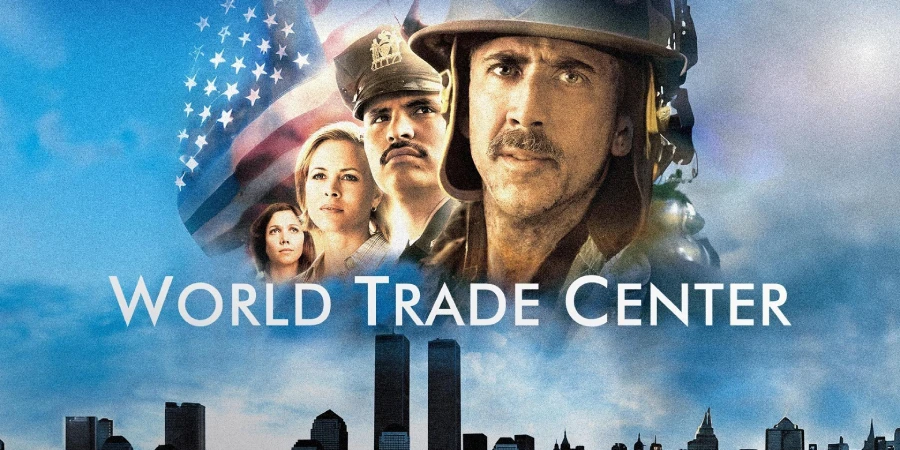

Oliver Stone made a 9/11 film that is almost aggressively restrained, and that restraint is the whole argument. Rather than staging spectacle, he buried two Port Authority officers under rubble and held the camera there for most of the runtime. Nicolas Cage and Michael Pena play real men, John McLoughlin and Will Jimeno, who survived the collapse of the World Trade Center towers, and the film earns its emotion through claustrophobia and quiet rather than patriotic montage.
Detailed Summary
The Morning Commute
The film opens on an ordinary Tuesday morning. John McLoughlin, a Sergeant with the Port Authority Police Department, rides the Staten Island Ferry and heads into duty. Will Jimeno, a newer officer, goes through his morning routine with his pregnant wife Allison.
Stone lingers on the mundane: coffee, traffic, locker room chatter. Nothing signals catastrophe. That deliberate ordinariness makes the first impact hit harder.
The First Tower Is Struck
McLoughlin and his men watch a shadow pass over a Manhattan street. They look up. Nobody quite registers what they are seeing. A massive explosion follows, and ash begins to fall like snow.
Stone does not show the plane hitting. He shoots the reaction instead: faces tilted upward, confusion shifting into horror. It is the correct choice, and one of the film’s most quietly assured directorial decisions.
Entering the Towers
McLoughlin assembles a volunteer team to enter the North Tower and assist with evacuation. Jimeno is among those who step forward. They gear up, load equipment carts, and push through the lobby while civilians stream out in the opposite direction.
Stone shoots the lobby sequence with oppressive overhead lighting and a strange, funeral stillness. Everyone inside seems to sense something is terribly wrong but keeps moving anyway.
The Collapse
Before McLoughlin’s team reaches the upper floors, the South Tower collapses. The concussive force tears through the North Tower’s base. Men scatter. McLoughlin orders everyone into an elevator shaft for protection.
Only five officers make it in time. Then the North Tower comes down. Massive debris fills the shaft, burying the men in layers of concrete and steel. McLoughlin and Jimeno are the only two who remain conscious.
Trapped in the Rubble
This is where the film commits. For a long stretch, the story lives entirely in a narrow pocket of space underground. McLoughlin is pinned flat on his back, unable to move almost any part of his body. Jimeno has slightly more room but cannot free himself either.
They talk to stay awake and alive. Jimeno sees a vision of Jesus carrying a water bottle, a detail drawn directly from his real account. Stone stages it straight, without apology or irony, and it works.
The Families at Home
Stone cuts between the rubble and the families waiting for news. Donna McLoughlin, played by Maria Bello, watches television in a kind of catatonic dread. Allison Jimeno, played by Maggie Gyllenhaal, moves between grief and fierce refusal to accept the worst.
Bello quietly carries a very underwritten role. Her best scene comes when she finally hears John’s voice through a rescuer’s radio and has to hold herself together enough to speak. The restraint on her face in that moment is doing enormous work.
Dave Karnes Enters the Story
Dave Karnes, a Marine veteran and civilian accountant, watches the news coverage from his office in Connecticut. Something moves him to act. He gets a military haircut, puts on his old uniform, and drives to Ground Zero.
Karnes talks his way past checkpoints and enters the pile alone. He moves through smoke and silence, calling out for survivors. Michael Shannon plays Karnes with a straight-backed intensity that borders on eerie, and the film leans into that quality deliberately.
The Rescue
Karnes hears Jimeno’s voice beneath the rubble. He radios for help. A rescue team works through the night to free Jimeno first, cutting and moving concrete piece by piece while the pile around them continues to shift dangerously.
Jimeno is pulled out hours after Karnes first made contact. McLoughlin’s rescue takes even longer and requires more extensive digging. Both men are brought out alive, but McLoughlin is in critical condition.
Movie Ending
McLoughlin emerges from the rubble in the early hours of September 12th. His rescue is slower and more technically complex than Jimeno’s. Stone shoots the moment without score-swelling theatrics: men in hard hats working by floodlight, a body being carefully passed hand over hand through a tunnel in the debris.
Both men are taken to hospitals and survive. The film then jumps ahead in brief epilogue text and shots. Jimeno and Allison’s daughter is born healthy. McLoughlin undergoes multiple surgeries and long rehabilitation but eventually walks again. Karnes re-enlists in the Marine Corps.
Stone ends on the men themselves, alive, with their families. He resists any impulse to zoom out to a political statement or a sweeping aerial shot of downtown Manhattan. The choice to stay small and personal right through the final frame is exactly why the ending lands.
What audiences often wonder about is whether the film treats Karnes as a hero or a symbol. Stone does both, carefully. Karnes is clearly presented as extraordinary, but the film keeps him slightly unknowable. Shannon never softens the character into easy warmth, and that friction gives the ending genuine texture rather than simple uplift.
Are There Post-Credits Scenes?
No. World Trade Center has no post-credits scene of any kind. After the epilogue text, the film ends. Stay if you want to absorb the score, but nothing additional follows.
Type of Movie
World Trade Center is a survival drama based on true events. Its tone is somber, intimate, and deliberately unglamorous. Stone suppresses his usual maximalist instincts almost entirely, which makes this one of his most unusual films tonally.
There are elements of disaster cinema here, but the film resists that genre’s momentum. It is less interested in the scale of destruction than in the specific experience of two men in a hole.
Cast
- Nicolas Cage – Sergeant John McLoughlin
- Michael Pena – Officer Will Jimeno
- Maria Bello – Donna McLoughlin
- Maggie Gyllenhaal – Allison Jimeno
- Michael Shannon – Dave Karnes
- Stephen Dorff – Scott Strauss
- Jay Hernandez – Dominick Pezzulo
- Viola Davis – Judy Jonas
Film Music and Composer
Craig Armstrong scored the film. Armstrong is a Scottish composer known for his work on Moulin Rouge! and Love Actually, and his orchestral writing tends toward emotional directness rather than complex thematic development.
His score for World Trade Center stays sparse through the underground sequences, using silence and low tones to keep the claustrophobia intact. It swells carefully during the rescue and the epilogue but never overwhelms. The restraint matches Stone’s direction.


Filming Locations
Production did not film at Ground Zero itself. Much of the shoot took place on sets built to recreate the rubble conditions, giving the production team control over the confined spaces where Cage and Pena spent a significant portion of filming.
Exterior and establishing scenes used various New York City locations. Stone’s team worked to recreate the atmosphere of lower Manhattan on that specific morning, including the unusual quality of light and the street layouts near the World Trade Center site.
Shooting on controlled sets rather than at the actual site was both a practical and a respectful decision. The rubble sets were built to precise specifications so the physical experience for the actors reflected, as closely as possible, what McLoughlin and Jimeno actually endured.
Awards and Nominations
World Trade Center received limited recognition from major awards bodies. It earned some critics circle attention, but no significant Oscar nominations followed.
Behind the Scenes Insights
- Nicolas Cage and Michael Pena spent significant time lying in confined set pieces to prepare physically for the rubble sequences. The physical restriction was real, not simulated through camera angles alone.
- Oliver Stone met extensively with John McLoughlin and Will Jimeno before and during production. Both real men were involved as consultants and visited the set.
- Stone described the project publicly as a departure from his more politically charged work, framing it as a human story rather than a political one.
- Michael Shannon’s role as Dave Karnes was relatively small in screen time but became one of the film’s most discussed performances after release.
- Maggie Gyllenhaal prepared by spending time with the real Allison Jimeno.
- The production took pains to represent the Port Authority Police Department accurately, consulting with officers about equipment, procedure, and culture.
Inspirations and References
The film draws directly from the real survival of John McLoughlin and Will Jimeno, two Port Authority Police Department officers who were among only twenty survivors pulled from the rubble of the World Trade Center site.
Jimeno’s account of his vision of Jesus carrying a water bottle is included in the film as he reported it. Stone did not dramatize or embellish that detail; he simply put it on screen as Jimeno described it.
Dave Karnes is also a real person whose actions that day are documented. His decision to drive to Ground Zero in uniform and search the pile independently is not a dramatic invention.
Alternate Endings and Deleted Scenes
No officially released deleted scenes or alternate endings have been documented for World Trade Center. Stone has not released an extended cut. The theatrical version appears to be the definitive version of the film.
Book Adaptations and Differences
World Trade Center is not based on a book. It was developed from accounts given by McLoughlin, Jimeno, and their families directly to screenwriter Andrea Berloff. No source novel or memoir served as the formal basis for the screenplay.

Memorable Scenes and Quotes
Key Scenes
- The shadow passing over the street before the first impact, shot from ground level with no explanation given to the audience.
- Jimeno’s vision of Jesus, presented without comment or cutaway, standing quietly in the rubble light with a water bottle.
- Maria Bello’s reaction when she hears John’s voice on the rescuer’s radio. Her whole face fights to stay composed while she processes what she is hearing.
- Dave Karnes walking through the smoke and wreckage alone at night, calling out into the silence. Shannon moves through the frame with unnerving stillness.
- Jimeno being pulled through the tunnel of debris, the camera staying tight on his face as he moves toward open air for the first time in hours.
- McLoughlin’s emergence from the rubble in the early hours of September 12th, lit by floodlights, passed carefully from hand to hand.
Iconic Quotes
- Jimeno: “We need the guys who know what they’re doing.”
- Karnes: “God gave me a gift to find people.”
- McLoughlin: “We’re the lucky ones.”
Easter Eggs and Hidden Details
- Stone cast real Port Authority officers in background roles during the early sequences, which gives those scenes an authenticity that professional extras would not have provided.
- Karnes’s haircut scene in Connecticut is brief but deliberate. Stone holds on it long enough to signal the character’s self-mythology without a word of dialogue explaining it.
- The overhead lighting in the World Trade Center lobby sequence creates an almost ecclesiastical quality, a visual choice that makes the space feel more like a cathedral than a commercial building in its final minutes.
- Jimeno’s radio, which plays a role in early communication attempts, is the same model used by Port Authority officers at the time.
Trivia
- World Trade Center was the second major Hollywood film about the September 11 attacks to be released, following Paul Greengrass’s United 93 earlier in 2006.
- Nicolas Cage reportedly found filming the underground sequences physically grueling, spending hours in rigid positions on set pieces that restricted movement.
- Oliver Stone is a Vietnam War veteran, and his military background shaped how he approached the logistics and psychology of men under extreme duress.
- Viola Davis appears in a small but memorable role despite having relatively limited screen time. Her presence is typically the most efficiently used few minutes in any film she appears in.
- The real Will Jimeno appeared publicly to support the film and called the production respectful of his experience.
- Andrea Berloff’s screenplay was her first major produced feature credit. She would go on to write Straight Outta Compton.
Why Watch?
Nicolas Cage gives one of his least-discussed and most genuinely committed performances here, spending the bulk of the film completely still, communicating entirely through voice and the muscles of his face. Stone’s decision to shrink a world-historical event down to one shaft of concrete and two barely visible men is a directorial bet that pays off. If you have only seen Stone’s louder, more combative films, this one will recalibrate your sense of his range.
Director’s Other Movies
- Platoon (1986)
- Wall Street (1987)
- Born on the Fourth of July (1989)
- JFK (1991)
- Natural Born Killers (1994)
- Nixon (1995)
- Any Given Sunday (1999)
- Alexander (2004)
- W. (2008)
- Snowden (2016)
Recommended Films for Fans
- United 93 (2006)
- Extremely Loud and Incredibly Close (2011)
- Rescue Dawn (2006)
- Alive (1993)
- Lone Survivor (2013)
- Zero Dark Thirty (2012)
- Patriots Day (2016)