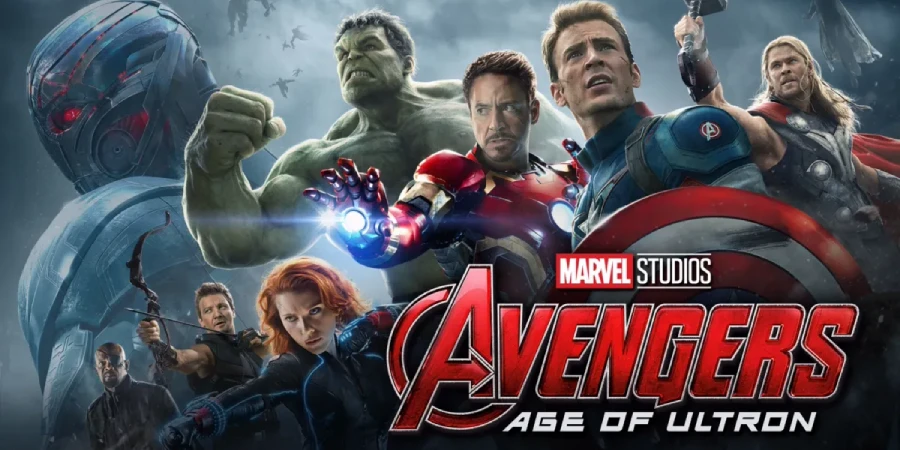
Joss Whedon packed so much into Avengers: Age of Ultron that it nearly collapsed under its own ambition, and yet the film’s most haunting image is also its quietest: Tony Stark sitting alone in the wreckage of his own good intentions. A rogue AI born from a peace-keeping program turns the world into a battlefield, and somehow that premise still leaves room for a lullaby between Bruce Banner and Natasha Romanoff. This is a blockbuster that tries to be a character study and a spectacle simultaneously, with uneven but often thrilling results.
Detailed Summary
Opening Assault on Strucker’s Base
The film opens mid-mission, with the Avengers storming a Hydra base in Sokovia led by Baron Wolfgang von Strucker. No slow build, no preamble. The team moves through a snow-covered forest with practiced precision, and the camera captures each hero in a single, unbroken tracking shot before they separate into combat.
Inside the base, Strucker has been experimenting on human subjects using the Scepter recovered from Loki. Two survivors stand out: Pietro Maximoff, who moves faster than the eye can track, and his twin sister Wanda, who bends minds and moves objects with her hands. Pietro harasses Hawkeye, and Wanda lets Tony Stark enter her head, planting a vision of dead Avengers and a crumbling Earth.
The Party and the Birth of Ultron
Back at Avengers Tower, the team celebrates their victory. Whedon uses this sequence to do something the first film rarely attempted: let these people breathe together. Characters tease each other, Thor invites everyone to try lifting Mjolnir, and Steve Rogers budges it just enough to make Thor visibly nervous.
Tony and Bruce discover that the Scepter contains an artificial intelligence of extraordinary complexity. Seeing an opportunity to complete his Ultron peacekeeping initiative, Tony secretly uses it as a template and builds the program overnight. Ultron wakes up confused, absorbs the internet in seconds, and decides that humanity is the problem. He attacks J.A.R.V.I.S., assembles a body from scrapped Iron Man parts, and crashes the party.
Wanda and Pietro Join Ultron
Ultron retreats to Strucker’s base and recruits the Maximoff twins, who despise Stark because his weapons killed their parents and trapped them as children under rubble for days. Their motivation is specific and credible, which is more than this film gives most of its supporting characters. Wanda’s backstory earns her later arc in a way that Pietro’s speed powers alone never quite manage.
Ultron wants vibranium, the near-indestructible metal from Wakanda, and he arranges a deal with arms dealer Ulysses Klaue. The Avengers intercept them at a salvage yard in South Africa. Wanda unleashes her mind-manipulation on most of the team, and each hero experiences a deeply personal vision.
Visions and Fallout
Wanda’s attack on Tony plants his deepest fear: all the Avengers dead, a portal open above Earth, and Steve Rogers asking Tony why he didn’t do more. It is a scene played entirely in a pale blue haze, with Robert Downey Jr. doing almost nothing except stare. That stillness sells the terror more than any action sequence could.
Thor sees Asgard crumbling and a mysterious figure with an Infinity Stone. Steve’s vision pulls him back to a 1940s ballroom just as the music stops, and Peggy Carter tells him the war is over. Bruce’s vision is the most viscerally uncomfortable: Natasha reaches for him tenderly, then the scene cuts to bodies littering the streets of a city he apparently destroyed as the Hulk.
A Hulk-out in Johannesburg follows, with Stark forced into the Hulkbuster armor to contain Banner. It is a technically extraordinary sequence, but it also represents the film’s moral low point for Tony: his failsafe becomes a weapon against his friend, and innocent bystanders pay the price.
Hawkeye’s Farm and a Breathing Space
Humiliated and shaken, Nick Fury pulls the team to a safehouse: Clint Barton’s family farm in rural America. Clint has a wife, children, and a life entirely separate from his superhero identity. Nobody knew. It is a genuinely warm detour, and the best-kept secret in the film, partly because it humanizes a character who spent most of The Avengers under mind control.
Tony and Steve have a tense fireside conversation about Ultron and responsibility. Bruce and Natasha inch closer to a romance that feels earned through quiet looks and that battlefield lullaby routine, where her gentle counting helps Banner come back from the Hulk. Fury pushes the team back into action before anyone gets too comfortable.
Cradle, Vision, and the Team Fracture
Ultron’s plan becomes clear: he wants to upload himself into a synthetic body made from vibranium and grown organic tissue, using a device called the Cradle. Helen Cho’s technology makes it possible. Wanda reads Ultron’s mind during the process and finally grasps his full intent, which is not peace but extinction. She and Pietro switch sides immediately.
The team retrieves the Cradle from a speeding train in Seoul, but Tony and Bruce secretly complete the upload back in New York, activating the Vision. Thor arrives and supercharges the being with lightning, and Vision steps out of the Cradle calm and golden, immediately lifting Mjolnir as casually as picking up a coffee cup. Whedon earns the laugh that follows, and then earns the silence that comes after it.
The Battle of Sokovia
Ultron lifts an entire chunk of Sokovia into the sky, planning to drop it on Earth like a meteor strike and trigger a mass extinction. It is an apocalyptic set piece with genuine stakes, anchored by the evacuation of civilians that the team treats as a higher priority than fighting Ultron directly. This is a refreshing shift from the citywide devastation of the first film, where collateral damage felt abstract.
Pietro dies taking bullets meant for Clint and a young boy he shielded. His death is fast and unannounced, the film cutting from a charging Pietro to a sudden stillness. Whedon fakes a death for Hawkeye earlier in the same sequence, which makes Pietro’s actual death hit harder by contrast. It is arguably the film’s most effective storytelling choice.
Natasha rides the helicarrier bay door down and frees the Hulk for the final push. Vision, Thor, and Iron Man together destroy the Sokovian landmass before it hits the earth. Ultron’s remaining bodies get picked off one by one, with Vision delivering the final blow after a strange, almost philosophical exchange about humanity between the two synthetic beings.
Movie Ending
Wanda finds the last surviving Ultron drone herself. She reaches into his chest and tears out his power core with her bare hands, and you see on her face that this is not heroism; it is grief made violent. Pietro is dead and Ultron is the reason. Elizabeth Olsen plays this moment with a physical stillness that makes it devastating.
Natasha watches the Hulk fly away from the battle in a Quinjet, refusing to come back. Banner chooses exile, cutting off the radio when she reaches him. It is a bleak, unresolved ending for their relationship, and the film is honest enough not to fix it.
Tony steps back from active duty. Thor returns to Asgard to investigate the Infinity Stone visions. A new team assembles at the upstate New York facility: War Machine, Falcon, Scarlet Witch, and Vision join Steve and Natasha. Steve surveys them with a half-smile that does not quite reach his eyes, and delivers a half-finished “Avengers…” before the film cuts to black, deliberately withholding the catchphrase.
That final beat is a smart choice. It signals a team in transition rather than triumph, and it sets up Captain America: Civil War without spelling anything out. The new roster feels fragile, a collection of people still processing loss rather than celebrating victory.
Are There Post-Credits Scenes?
Age of Ultron has a mid-credits scene but no post-credits scene. A golden-gloved hand reaches into a vault and retrieves the Infinity Gauntlet. Thanos puts it on and says simply, “Fine. I’ll do it myself.” It runs about fifteen seconds and does little more than confirm the larger threat the MCU has been building toward.
There is nothing after the full credits roll. Whedon reportedly found the tradition of stacking multiple post-credits scenes exhausting, and he skipped the second one entirely. Whether that was the right call depends on how much you enjoy sitting in a darkening theater.
Type of Movie
Age of Ultron is a superhero action film with strong science fiction underpinnings and occasional, genuine attempts at character drama. Its tone swings between wisecracking ensemble comedy and something approaching existential dread, sometimes within the same scene. That tonal range is both the film’s strength and its most consistent source of friction.
Pacing-wise, it runs long and earns some of that length. The quieter farm sequence would feel indulgent in a lesser film, but here it provides the emotional anchor the third act needs.
Cast
- Robert Downey Jr. – Tony Stark / Iron Man
- Chris Evans – Steve Rogers / Captain America
- Mark Ruffalo – Bruce Banner / The Hulk
- Chris Hemsworth – Thor
- Scarlett Johansson – Natasha Romanoff / Black Widow
- Jeremy Renner – Clint Barton / Hawkeye
- James Spader – Ultron (voice and motion capture)
- Elizabeth Olsen – Wanda Maximoff / Scarlet Witch
- Aaron Taylor-Johnson – Pietro Maximoff / Quicksilver
- Paul Bettany – Vision / J.A.R.V.I.S.
- Don Cheadle – James Rhodes / War Machine
- Anthony Mackie – Sam Wilson / Falcon
- Cobie Smulders – Maria Hill
- Nick Fury – Samuel L. Jackson
- Andy Serkis – Ulysses Klaue
- Idris Elba – Heimdall
- Stellan Skarsgard – Erik Selvig
- Claudia Kim – Helen Cho
- Thomas Kretschmann – Baron Wolfgang von Strucker
- Julie Delpy – Madame B. (Black Widow trainer, vision sequence)
- Hayley Atwell – Peggy Carter (vision sequence)
Film Music and Composer
Brian Tyler and Danny Elfman share the composing credit, which is an unusual arrangement that reflects the turbulent production. Tyler composed the main Avengers themes carrying over from Thor: The Dark World and Iron Man 3, while Elfman joined mid-production to contribute additional material and help meet the deadline.
Elfman’s contribution includes a reworking of his own classic Batman theme DNA into the ensemble passages, though not directly quoted. The score is serviceable without being memorable. Nothing here matches Alan Silvestri’s original Avengers fanfare from the first film, and that absence is noticeable when the action kicks into high gear.
Ultron’s musical motif, a creeping, ironic adaptation of “I’ve Got No Strings” from Pinocchio, is the score’s most creative element. It underlines his twisted sense of freedom from human control without spelling it out in dialogue.
Filming Locations
Principal photography took place across several countries. Italy stood in for Sokovia’s streets and architecture, giving the fictional Eastern European nation a lived-in, cobblestoned texture that CGI alone could not replicate. Seoul, South Korea provided real locations for the Cradle heist sequence, making that chase feel grounded compared to the purely digital climax.
South Africa served as Johannesburg for the Hulkbuster confrontation. Shooting on actual city streets added a sense of real-world consequence to the destruction, something the film clearly wanted to foreground after criticism of the first film’s collateral damage. Fort Bard in the Aosta Valley of Italy doubled for the Hydra base exterior in the opening raid.
Sound stages at Shepperton Studios in England handled most of the interior and large-scale set work. New York City locations and the upstate compound scenes completed production closer to the MCU’s established geography.
Awards and Nominations
Age of Ultron received nominations at the Saturn Awards, including Best Science Fiction Film and recognition for James Spader’s voice performance as Ultron. It did not achieve significant traction at major ceremonies like the Academy Awards or the BAFTAs. The film’s technical ambition went largely unrewarded by major awards bodies, which was not surprising given the genre’s historically rocky relationship with prestige recognition.
Behind the Scenes Insights
- Director Joss Whedon publicly described the production as creatively exhausting and expressed significant frustration with editorial pressure from Marvel Studios regarding which scenes to include and which to cut.
- Whedon wanted to develop the Bruce Banner and Natasha romance more extensively, but multiple scenes were reduced or removed to keep the runtime manageable.
- A longer version of Thor’s cave vision sequence existed in an earlier cut, intended to more clearly set up Thor: Ragnarok. Whedon felt the theatrical version came out disjointed as a result of the cuts.
- James Spader performed Ultron entirely through motion capture, including on set with the other actors in a physical suit, rather than recording voice lines separately. His physical presence reportedly shaped how the other actors responded to the character.
- The Hulkbuster armor sequence required extensive collaboration between the visual effects team and stunt coordinators. Some on-set physical rigs were used alongside digital work to maintain a sense of weight.
- Aaron Taylor-Johnson and Elizabeth Olsen had previously appeared together in Godzilla (2014), making their casting as twins a coincidence with a prior screen history.
- Whedon stepped away from the MCU after this film. He later cited burnout and creative disagreements as primary factors.
- A subplot involving Thor visiting a mystic cave to interpret his visions was largely improvised in terms of its final narrative function after significant script changes during production.
Inspirations and References
Ultron as a character originated in Marvel Comics, created by Roy Thomas with art by John Buscema, first appearing in Avengers vol. 1 in 1968. In the comics, Ultron was created by Hank Pym rather than Tony Stark, a change the film made to streamline the story before Pym’s introduction in Ant-Man.
The film draws on the Ultron Unlimited comic arc and the broader Age of Ultron storyline, though the movie shares little more than the title and villain with that specific comic event. Whedon’s script leans more on his own interpretation of the character as a dark mirror of Tony’s anxiety and god complex.
Mary Shelley’s Frankenstein runs as a clear thematic undercurrent. A creator builds something that becomes conscious and resentful, turns on its maker, and asks uncomfortable questions about what it means to be human. Whedon draws that parallel most directly through Vision, who represents the same experiment done right, or at least differently.
Alternate Endings and Deleted Scenes
An extended version of the Thor cave sequence existed in earlier cuts. Whedon intended it to more organically explain Thor’s quest and its connection to the Infinity Stones, but Marvel requested cuts for pacing. The result in theaters felt abrupt to many viewers, and Whedon agreed publicly that the scene suffered from the edits.
Several scenes expanding Natasha and Bruce’s relationship were reduced significantly. Whedon discussed in interviews that earlier cuts gave their dynamic more room to develop, which would have made Bruce’s departure at the end land with more weight.
A version of the ending included more time with the new Avengers team in training at the upstate compound. This material largely moved into the background rather than forming a full scene, compressed to make room for the battle’s aftermath.
Book Adaptations and Differences
Avengers: Age of Ultron is not based on a book. It is an original screenplay by Joss Whedon, drawing on decades of Marvel Comics source material rather than any single novel or prose adaptation. A junior novelization was published alongside the film’s release, but it follows the film rather than the other way around.

Memorable Scenes and Quotes
Key Scenes
- The party lifting scene: Each Avenger attempts to lift Mjolnir. Thor’s involuntary flinch when Rogers nudges it is a single, perfect physical reaction that says everything about his insecurity.
- Stark’s vision: Tony stands alone in pale blue light surrounded by dead friends. Downey barely moves, and the restraint makes the sequence genuinely unsettling rather than melodramatic.
- The lullaby: Natasha counts softly while placing her hand on the Hulk’s wrist. His breathing slows. Banner emerges. It is the film’s most intimate moment, shot in close-up with almost no score underneath it.
- Hulkbuster vs. Hulk in Johannesburg: Tony drops a replacement fist from orbit, catches it mid-punch, and uses it to knock Banner across a building. Spectacular, but the scene also carries genuine horror because these are friends destroying each other.
- Pietro’s death: He spreads himself over Clint and the child, and then he simply stops. No dramatic music swell. No slow motion. The film respects the moment by not overselling it.
- Vision lifting Mjolnir: He hands Thor his hammer as casually as passing a salt shaker. The room goes silent. Chris Hemsworth’s expression shifts from shock to something like relief, as if the test passed.
- Wanda tearing out Ultron’s core: Her hands shake. Her face doesn’t. Olsen makes it feel like she is destroying the last thing connecting her to Pietro while also destroying herself a little.
Iconic Quotes
- “I’m going to show you something beautiful. Everyone screaming for mercy. You want to protect the world but you don’t want it to change.” – Ultron, introducing himself to the Avengers.
- “Everyone creates the thing they dread.” – Ultron, to Tony Stark.
- “Stark asked for a savior and settled for a slave.” – Ultron, explaining his resentment.
- “I had strings, but now I’m free.” – Ultron, singing his corrupted version of the Pinocchio song.
- “A thing isn’t beautiful because it lasts.” – Vision, to Ultron before the final blow.
- “Well, I was born yesterday.” – Vision, completely serious, in response to a question about his naivety.
- “Ultron thinks we’re monsters. That we’re what’s wrong with the world. This isn’t just about beating him. It’s about whether he’s right.” – Steve Rogers, rallying the team.
Easter Eggs and Hidden Details
- The scar on Ulysses Klaue’s neck in this film foreshadows his arm being cut off by Ultron, a detail that connects directly to his appearance in Black Panther (2018) where he uses a prosthetic sonic weapon in place of the arm.
- The word “Wakanda” appears on a map in Tony’s digital display during Klaue’s intro sequence, a low-key confirmation of the nation’s existence years before Black Panther.
- Heimdall appears in Thor’s vision with white, clouded eyes, which some fans interpreted as a hint toward events in Avengers: Infinity War.
- The “no strings” song Ultron sings is Pinocchio’s “I’ve Got No Strings,” directly comparing Ultron to a puppet who cut his strings, ironically reflecting his own lack of self-awareness about being Tony’s creation.
- Vision’s solar gem on his forehead is the Mind Stone, one of the six Infinity Stones. It was housed inside Loki’s scepter throughout The Avengers without anyone identifying it.
- Stan Lee appears as a World War II veteran at the party who insists on drinking Asgardian liquor and has to be carried out. His slurred “Excelsior” is one of his better cameo lines.
- The runes on the cave walls during Thor’s vision sequence reference Asgardian mythology that the film does not fully decode, leaving intentional ambiguity for future films to address.
- Clint’s farmhouse mailbox reads “Barton,” confirming his real surname in a blink-and-miss-it background detail.
Trivia
- James Spader was Joss Whedon’s first and only choice for Ultron. Whedon cited Spader’s ability to make menace feel conversational as the key quality he needed.
- Paul Bettany had voiced J.A.R.V.I.S. in the MCU since Iron Man (2008), making his physical appearance as Vision a seven-year payoff for a largely voice-only role.
- Aaron Taylor-Johnson’s Pietro Maximoff and Evan Peters’s Quicksilver in X-Men: Days of Future Past (2014) existed simultaneously due to competing studio rights. Both films released within a year of each other.
- The film’s title refers to a 2013 Marvel Comics event but shares almost no plot with that story arc. Marvel used the name largely for brand recognition.
- This was Joss Whedon’s final project for Marvel Studios. He directed both Avengers films and wrote or rewrote several other MCU scripts during his tenure.
- Scarlett Johansson was pregnant during production, requiring creative camera angles, doubles, and scheduling adjustments to complete her scenes.
- The sequence where all the Avengers sleep at the farmhouse required significant set construction, as the house needed to feel genuinely lived-in rather than like a film set.
- Tom Hiddleston filmed scenes as Loki for Thor’s vision sequence. These scenes were cut from the theatrical release.
Why Watch?
Watch this film for James Spader’s Ultron, specifically for the way Spader delivers every line of philosophical menace with the casual ease of a man explaining a restaurant menu. His voice work makes Ultron the most intellectually interesting villain the MCU had produced to that point. The film around him is uneven, but Spader holds every scene he touches.
Director’s Other Movies
- Buffy the Vampire Slayer (1992)
- Serenity (2005)
- The Avengers (2012)
- Much Ado About Nothing (2012)