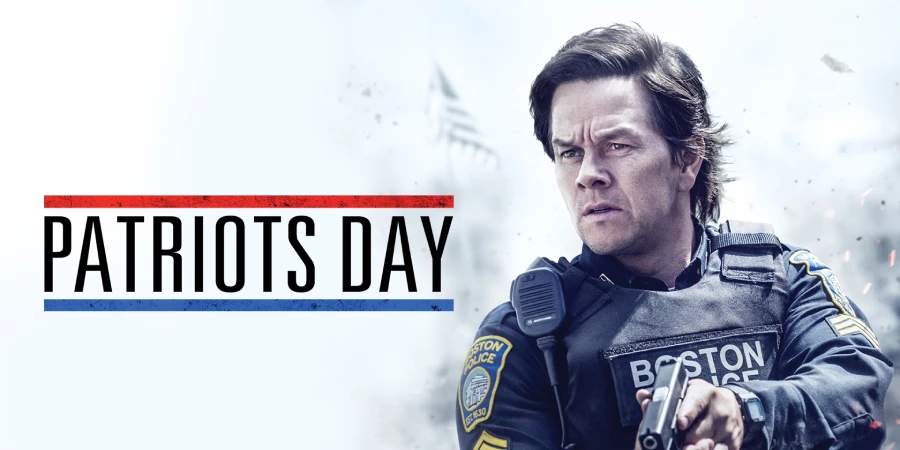

Peter Berg’s Patriots Day drops you into the chaos of April 15, 2013, and never really lets you breathe. Mark Wahlberg plays a composite Boston cop named Tommy Saunders, planted at the finish line when the bombs go off, then dragged through the four-day manhunt that followed. Berg shot this film with the same documentary urgency he brought to Lone Survivor and Deepwater Horizon, mixing real surveillance footage with dramatized sequences until the seams blur on purpose. This is a film about a city that refused to fall apart, and Berg argues that case with every cut.
Detailed Summary
A City Waking Up
Berg opens with a portrait of Boston on Marathon Monday morning. We meet several characters whose lives will intersect with the bombing: a young couple, a transit officer, an MIT police officer, and Tommy Saunders, nursing a knee injury and serving his assignment at the finish line as a form of disciplinary punishment.
These early scenes feel almost leisurely. Berg lingers on ordinary moments, a couple arguing about sunscreen, a college student kissing his girlfriend goodbye, because he wants us to understand exactly what gets shattered in a few minutes.
The Bombing
Just past 2:49 PM, two pressure cooker bombs detonate near the finish line. Berg does not cut away. He puts the camera low, shows the smoke rolling across Boylston Street, and holds on the aftermath long enough to be uncomfortable. Real surveillance footage cuts into the dramatized chaos, and the combination lands like a gut punch.
Tommy, knocked off his feet, staggers up and starts pulling people out of the smoke. Wahlberg plays the moment with physical shock rather than heroic clarity. His hands shake. His voice cracks when he starts giving orders. That choice is the best performance decision in the film.
The Investigation Begins
FBI Special Agent Richard DesLauriers, played by Kevin Bacon, arrives to take federal command of the investigation. He and Boston Police Commissioner Ed Davis, played by John Goodman, circle each other with polite professional tension. DesLauriers wants to control the information. Davis wants to protect his city.
Tommy gets pulled into the investigation because he was physically present at the finish line and might have seen something. His composite knowledge becomes a narrative device for moving through the evidence rooms, the surveillance feeds, and the analytical grind of trying to identify two men in a crowd of hundreds of thousands.
Identifying the Suspects
Analysts comb through thousands of hours of footage. Berg shoots these scenes with genuine procedural tension. People stare at screens, argue about pixels, and zoom in on a backpack carried by a young man in a white cap. Slowly, Dzhokhar Tsarnaev and Tamerlan Tsarnaev come into focus.
When the FBI releases the images publicly on Thursday, April 18, the film shifts gear. Up to this point, Berg has kept the brothers at a slight remove, but now their story starts running parallel to the investigation. We have already seen them at home, seen Tamerlan’s controlling manner, seen Dzhokhar’s apparent passivity. The parallel structure makes what comes next feel inevitable rather than surprising.
The Murder of Officer Sean Collier
On the night of April 18, Tamerlan and Dzhokhar approach MIT police officer Sean Collier sitting in his patrol car. They shoot him multiple times. Berg stages this scene with brutal abruptness. There is no drawn-out confrontation. Collier barely has time to register what is happening before he is killed.
Jake Picking plays Collier as warm and decent in his brief earlier scenes, which makes the murder genuinely painful rather than just plot mechanics. Berg earns the emotional weight here by not rushing the setup.
The Carjacking
Dun Meng, a Chinese entrepreneur, gets carjacked by the Tsarnaev brothers. He sits in the front passenger seat while Tamerlan drives and Dzhokhar follows in a second car. Tamerlan tells Dun Meng, with apparent casualness, that he and his brother were responsible for the marathon bombing.
This sequence generates some of the film’s sharpest tension. Tamerlan allows Dun Meng to use his cell phone to text, assuming he cannot communicate in English. Dun Meng keeps his hands still, keeps his voice flat, and waits. His escape at a gas station in Cambridge becomes one of the most quietly intense scenes in the movie.
The Watertown Shootout
Dun Meng’s escape triggers the confrontation in Watertown. Police converge on the brothers in a residential street, and what follows is one of the most chaotic firefights committed to a Hollywood film in years. Pipe bombs fly through the darkness. An officer gets dragged under a car. The screen fills with muzzle flash and screaming and overlapping radio traffic.
Tamerlan takes multiple gunshots and gets tackled by officers. Dzhokhar, attempting to flee, drives directly over his brother. Tamerlan dies at the scene. Berg shoots this moment without slow motion, without music, without emphasis. It happens fast and ugly, exactly the way it happened in reality.
The Manhunt and Lockdown
Massachusetts Governor Deval Patrick orders a lockdown of the Boston metro area on April 19. The city goes still. Berg cuts between Dzhokhar hiding wounded in a boat in a Watertown backyard and the surreal emptiness of locked-down Boston streets. The contrast is deliberately disquieting.
A homeowner named David Henneberry notices blood and a disturbed tarp on his boat. He calls police. What follows is a standoff involving negotiators, gunfire exchanged from inside the boat, and eventually Dzhokhar being pulled out alive, wounded, and too weak to stand.
Movie Ending
Dzhokhar gets taken into custody, and Berg does something unexpected with the final act. He slows down completely. After relentless momentum, the film breathes out. Tommy walks through a recovering Boston, the city not triumphant exactly, but still moving.
Berg then shifts to real footage. The actual survivors, the actual officers, the actual investigators speak directly to camera. They talk about Boston, about why they stayed, about what they want people to remember. This is a deliberate structural choice that some critics found sentimental, but it works because Berg earns it. He has spent two hours showing the specificity of individual human cost. The testimonials do not feel grafted on; they feel like a direct continuation.
Dun Meng appears in this footage and smiles when he talks about his escape. His calmness is more affecting than any composed film score moment. The film ends on the word “love,” spoken by multiple voices, which would be embarrassing in a lesser film. Berg gets away with it because he has shown, scene by scene, what that word is carrying.
Are There Post-Credits Scenes?
Patriots Day has no post-credits scene. Berg wraps his documentary-style coda before the credits begin. Once the real survivor footage ends, the film is done.
Type of Movie
Patriots Day sits in the genre of procedural thriller with strong docudrama elements. It functions simultaneously as a chase film, a police procedural, and a tribute documentary. The tone stays grounded throughout, never sliding into action-movie glorification despite sequences that could easily tip that way.
Berg keeps the emotional register mostly restrained, which makes the moments of grief hit harder when they arrive. Think less Hollywood disaster film and more journalistic reconstruction with a Hollywood cast.
Cast
- Mark Wahlberg – Sergeant Tommy Saunders
- John Goodman – Commissioner Ed Davis
- Kevin Bacon – Special Agent Richard DesLauriers
- J.K. Simmons – Sergeant Jeffrey Pugliese
- Michelle Monaghan – Carol Saunders
- Alex Wolff – Dzhokhar Tsarnaev
- Themo Melikidze – Tamerlan Tsarnaev
- Jimmy O. Yang – Dun Meng
- Jake Picking – Officer Sean Collier
Film Music and Composer
Trent Reznor and Atticus Ross composed the score. Both are Nine Inch Nails collaborators with Oscar-winning experience from The Social Network. Their work here leans toward ambient tension rather than conventional orchestral scoring.
Electronic pulses and low drones build pressure without telegraphing emotion, which suits Berg’s docudrama approach precisely. The score stays under the film rather than over it. During the Watertown shootout, the music mostly drops away, letting the sound design carry the scene, and that restraint is one of the most effective choices on the soundtrack.

Filming Locations
Production filmed extensively in the Greater Boston area. The filmmakers recreated the Boylston Street bombing site with considerable detail, though some sequences were shot on dressed-up streets nearby rather than the exact finish line location.
Watertown, Massachusetts, where the shootout actually occurred, also hosted filming. Shooting in the real locations gave the film a texture that studio approximations rarely achieve. You can feel the neighborhood geography in those night scenes, the tight residential streets that made the firefight so dangerous.
Some interior scenes were shot in Georgia, a common production cost decision, but the location work in Massachusetts remains the film’s visual backbone.
Awards and Nominations
Patriots Day received some critics circle attention but did not make a significant mark during awards season. Berg and Wahlberg were largely passed over by the major guilds and the Academy.
Behind the Scenes Insights
- Peter Berg consulted extensively with real Boston Police officers, FBI agents, and survivors before and during production.
- Many real first responders visited the set. Some served as consultants throughout the shoot.
- Mark Wahlberg, a Boston native, pushed hard to get this film made and co-produced it.
- Berg and Wahlberg had previously collaborated on Lone Survivor and Deepwater Horizon, making Patriots Day their third consecutive film about American disasters and survival.
- Jimmy O. Yang prepared for the carjacking sequence by speaking with Dun Meng directly.
- Alex Wolff, who plays Dzhokhar, spoke about the psychological difficulty of inhabiting the role and was careful not to humanize the character beyond what the script required.
- Berg incorporated real surveillance footage from the investigation, with permission, into the dramatized sequences.
Inspirations and References
Patriots Day draws directly from real events surrounding the Boston Marathon bombing of April 15, 2013. The film consulted multiple journalistic accounts of those four days, including reporting from the Boston Globe.
The book Boston Strong by Casey Sherman and Dave Wedge provided a key source framework for the narrative. Sherman and Wedge conducted hundreds of interviews with survivors, first responders, and investigators, and that reporting ground the film’s procedural detail.
Alternate Endings and Deleted Scenes
No officially released alternate endings or deleted scene packages have been made public for Patriots Day. Berg has spoken in interviews about keeping the film tightly structured, which suggests significant cutting happened in post-production, but no specific deleted scenes have surfaced publicly.
Book Adaptations and Differences
Patriots Day draws from Boston Strong by Casey Sherman and Dave Wedge rather than adapting it directly. The film is not a strict adaptation; it is a dramatization that uses the book as one of several research sources.
The most significant creative departure is Tommy Saunders himself. He is a composite character invented for the film, blending experiences and perspectives from multiple real officers and investigators. Real figures like Commissioner Davis, Sergeant Pugliese, and Agent DesLauriers appear under their actual names, which creates an odd dual register: some characters are real people, some are fictional constructs placed alongside them.
Memorable Scenes and Quotes
Key Scenes
- The bombing sequence: Berg holds on Boylston Street for several seconds after detonation before cutting to the aftermath, creating a silence that punches harder than any sound design could.
- Dun Meng’s escape from the gas station: he walks slowly to the attendant’s window, keeping his body language calm, then sprints and screams simultaneously once he clears the pump island.
- The Watertown shootout: pipe bombs arcing through streetlight, officers crouching behind car doors, radio traffic colliding with gunfire, shot entirely without glamour.
- Tamerlan getting run over by Dzhokhar: Berg cuts away before showing the full impact, which is more disturbing than showing it directly would have been.
- The final real-footage testimonials: actual survivors speaking plainly, without dramatic music, about choosing to stay in Boston.
Iconic Quotes
- “I love this city. And I will do whatever I have to do to protect it.” (Tommy Saunders)
- Tamerlan to Dun Meng, after admitting to the bombing: “Did you hear about that? That was us.” Delivered with a casualness that makes it genuinely chilling.
Easter Eggs and Hidden Details
- Berg inserted real surveillance photos and news footage at multiple points, often cutting between real images and their dramatized counterparts within the same sequence.
- The film briefly shows the actual photo of Dzhokhar in his white cap, mirroring the real FBI release image almost exactly.
- Several background extras in the marathon scenes were real Boston Marathon runners who had participated in the 2013 race.
- The street geography in the Watertown shootout was reconstructed to match the actual block where the confrontation occurred, including specific driveways and parked cars.
Trivia
- Mark Wahlberg grew up in Dorchester, a Boston neighborhood, giving his affection for the city a personal rather than performed quality.
- Peter Berg is the only director to make three consecutive films (with Wahlberg) about modern American tragedies: Lone Survivor, Deepwater Horizon, and Patriots Day.
- J.K. Simmons, playing Sergeant Pugliese, worked directly with the real Jeffrey Pugliese during preparation. Pugliese was one of the officers who tackled Tamerlan Tsarnaev during the Watertown firefight.
- The film’s release date in December 2016 was timed to coincide with awards season consideration, though the campaign did not gain significant traction.
- Commissioner Ed Davis served as a producer consultant on the film and appears briefly in the closing real-footage segment.
Why Watch?
Watch it for the carjacking sequence alone. Jimmy O. Yang keeps Dun Meng’s terror entirely internal, communicating panic through stillness rather than performance, and his gas station escape is more gripping than most films manage in a full third act. Berg’s decision to stay procedural and resist spectacle is what separates this from dozens of disaster-film imitations.
Director’s Other Movies
- Friday Night Lights (2004)
- The Kingdom (2007)
- Hancock (2008)
- Battleship (2012)
- Lone Survivor (2013)
- Deepwater Horizon (2016)