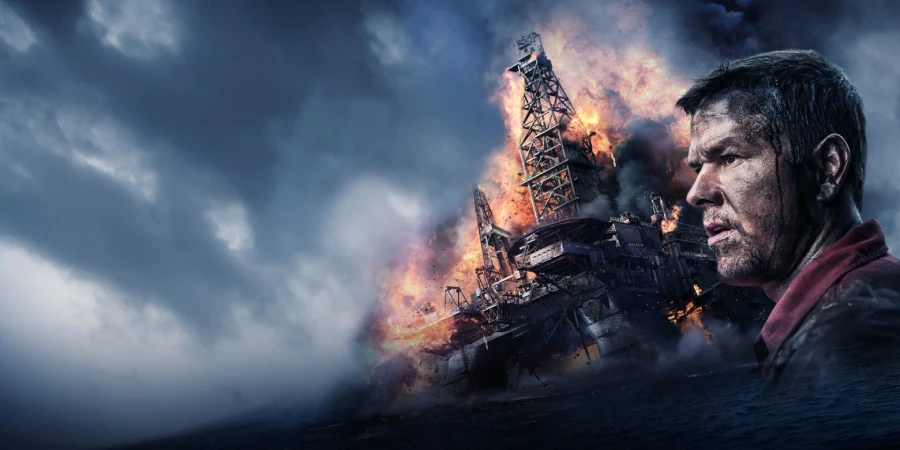

Eleven men died on the Deepwater Horizon oil rig on April 20, 2010, and director Peter Berg makes sure you feel every one of those deaths. This 2016 film does not flinch from the mechanical failure, the corporate negligence, or the fire that burned for days on the Gulf of Mexico.
Mark Wahlberg plays Mike Williams, a real chief electronics technician who survived and later testified before Congress. Berg shoots the disaster with such physical immediacy that the rig itself feels like a living thing coming apart around you.
Detailed Summary
Setting the Stage: Life Before the Blowout
We meet Mike Williams at home with his wife Felicia (Kate Hudson) and daughter Sydney. Sydney does a school presentation using a ketchup bottle to explain oil pressure, and Berg plants this detail deliberately. It will rhyme with what happens later when the drill pipe vomits mud across the rig floor.
Mike, Felicia, and Sydney share an easy, warm morning. Berg lingers on small domestic moments: a kiss, a lunch packed, a drive to the helipad. These scenes work hard to make you care before everything burns.
Arrival on the Rig and Early Warning Signs
Mike flies out to the Deepwater Horizon with Jimmy Harrell (Kurt Russell), the offshore installation manager, and company man Vidrine (John Malkovich). Tension surfaces immediately. BP executives have pushed the drilling schedule past safe limits, and the negative pressure test on the well has produced troubling readings.
Harrell and his team want to run more tests. Vidrine pushes back, citing costs and delays. Malkovich plays Vidrine with a slippery, pleasant menace; his Louisiana accent and his calm insistence that everything is fine make him the film’s most chilling presence.
Technician Andrea Fleytas (Gina Rodriguez) monitors systems on the bridge. She is the first to notice that something is wrong with the well data. Her warnings get acknowledged and then quietly dismissed.
The Negative Pressure Test Dispute
Berg dedicates real screen time to the argument over the negative pressure test. Harrell wants to trust his gut and his instruments. BP’s representatives argue the anomalous readings are a “bladder effect,” a technical explanation that conveniently supports moving forward.
This sequence is one of the film’s best. Berg stages it as a slow-burn procedural, and the jargon never feels like homework because the human stakes are clear. You watch experienced men get overruled by money, and that is as frightening as any monster movie.
The Blowout Begins
Mud starts shooting up the drill pipe. Then it hits the rig floor. Then the gas kicks. Berg shoots this escalation in a kind of horrified real time, each system failing in sequence, each alarm adding to the roar. Dewey Revette (Robert Walker Branchaud) is on the drill floor when it erupts.
Mike is in the shower when the explosion hits. A glass panel shatters inward, driving shards into his face. Wahlberg plays the disorientation with stumbling physicality rather than heroic composure, and it is the right call. He looks genuinely terrified.
The Rig in Full Chaos
Fire erupts across multiple decks. The blowout preventer, the last mechanical fail-safe, does not activate. Berg makes clear this is not a surprise to anyone who knew the equipment’s condition. Pieces of the rig rain down. Electrical systems fail and surge unpredictably.
Harrell gets knocked off his feet early and spends part of the sequence bloodied and dazed. Russell gives Harrell a gruff authority that makes his helplessness hurt more. You expect this man to fix things, and he cannot.
Andrea Fleytas activates the distress signal against orders, a small act of defiance that helps direct rescue vessels. Rodriguez plays the moment quietly, just a hand on a switch and a jaw set tight. It is more effective than any speech.
Survival and Escape
Mike navigates the burning rig to find Andrea and help get survivors to the lifeboats. He tears metal with his bare hands at one point, and Berg earns the spectacle by grounding it in the geography of the rig we have been learning for an hour. We know which ladder leads where, so the chase through smoke means something.
Harrell, partially blinded by glass, leads a group of workers to the side of the rig and they jump into the burning water below. This is based on real accounts. Berg does not glamorize it; the jumps are chaotic and desperate.
Mike eventually leaps from the rig himself, into oil-slicked water surrounded by fire. He finds a life ring and waits. Coast Guard vessels arrive and pull survivors aboard.


Movie Ending
Eleven workers do not make it out. Berg names them in a title card, and their names carry weight that no amount of visual spectacle can match. Mike, Andrea, and Harrell survive. Vidrine and the BP representatives also survive, which the film clearly frames as an injustice.
Mike reaches Felicia by phone from a rescue vessel, and Wahlberg’s voice breaks on the call. It is a short scene, maybe ninety seconds, and it hits harder than any of the fire sequences. Berg knows when to stop.
Back home, Mike is shaken and physically damaged. He has lost friends. Sydney watches her father with the quiet worry of a child trying to understand something she cannot name. The ketchup bottle from the opening comes full circle; Sydney’s innocent explanation of oil pressure now reads like dramatic irony so precise it aches.
A closing segment shows real news footage and congressional testimony. Berg does not bury the corporate accountability angle. He makes sure you leave the theater knowing that BP’s cost-cutting decisions killed eleven people, and that Mike Williams sat in front of Congress and said so out loud.
Are There Post-Credits Scenes?
Deepwater Horizon has no post-credits scene. Berg closes on the memorial tribute to the eleven men who died. Staying through the credits adds nothing plot-wise, but the tribute is worth the extra two minutes of your time.
Type of Movie
This is a disaster drama with strong procedural and survival thriller elements. It sits closer to films like Apollo 13 than to a summer blockbuster, even though it carries a blockbuster scale. Berg keeps the tone serious throughout, treating the event as a tragedy rather than an action spectacle.
There are sequences of genuine technical suspense before the first explosion. That procedural first act is what separates this from cheaper disaster films. Berg is interested in how the catastrophe happened, not just in what it looked like.
Cast
- Mark Wahlberg – Mike Williams
- Kurt Russell – Jimmy Harrell
- John Malkovich – Donald Vidrine
- Gina Rodriguez – Andrea Fleytas
- Kate Hudson – Felicia Williams
- Dylan O’Brien – Caleb Holloway
- Brad Leland – Robert Kaluza
- Ethan Suplee – Jason Anderson
Film Music and Composer
Steve Jablonsky composed the score. Jablonsky is a frequent Berg collaborator; he also scored Lone Survivor and Battleship. His work here is deliberately restrained in the early acts, with low drones and sparse electronic textures that build unease without tipping into melodrama.
During the disaster sequences, the score largely pulls back and lets the sound design carry the scene. That is the right choice. When oil rig machinery tears itself apart, a loud orchestral swell would feel cheap. Jablonsky’s restraint is one of the film’s most underrated technical decisions.


Filming Locations
Principal photography took place in New Orleans, Louisiana and surrounding areas. Berg and his production team built a massive partial replica of the Deepwater Horizon rig in a tank facility. The scale of the practical set is striking; much of what you see on screen is a real physical structure, not a digital backdrop.
Shooting in Louisiana gave the production access to the actual Gulf Coast geography and light. That flat, hazy horizon behind the rig feels authentic. You sense the real distance between that platform and dry land, which makes the survival sequences feel genuinely precarious.
Awards and Nominations
Deepwater Horizon received two Academy Award nominations: one for Best Film Editing and one for Best Sound Editing. Both nominations acknowledged the technical craft driving the disaster sequences. The film did not win in either category.
Behind the Scenes Insights
- Berg and Wahlberg met with Mike Williams and other survivors extensively before filming. Williams consulted on the script and visited the set.
- The production built a partial, full-scale replica of the Deepwater Horizon‘s drill floor and deck sections. Practical fire effects were used on set during filming.
- Wahlberg trained in oil rig procedures to understand what his character actually did on the platform day to day.
- Gina Rodriguez prepared for her role partly by studying the real Andrea Fleytas’s congressional testimony and accounts of her actions during the disaster.
- Berg has said he felt a responsibility to the families of the eleven men who died, and that framing the film as a tribute rather than a thriller was a conscious production-wide decision.
- Kurt Russell wore contacts throughout filming to simulate the eye injuries his character sustains during the blowout.
Inspirations and References
Berg based the film directly on a 2010 New York Times article by David Barstow, David Rohde, and Stephanie Saul, titled “Deepwater Horizon’s Final Hours.” That article drew on survivor accounts, corporate communications, and technical records to reconstruct the night of April 20, 2010.
Matthew Sand and Matthew Michael Carnahan adapted the material into a screenplay. Berg has cited the New York Times piece as the primary source document that shaped both the procedural first act and the factual framing of BP’s role in the disaster.
Alternate Endings and Deleted Scenes
No officially documented alternate endings or significant deleted scenes have been released or confirmed for Deepwater Horizon. Berg’s public statements suggest the cut he released was close to his intended film. No extended edition has been announced.
Book Adaptations and Differences
Deepwater Horizon is not based on a book. It draws from journalistic reporting and survivor testimony, as noted above. No novel or memoir served as the source material, so there is no book-to-screen comparison to make here.


Memorable Scenes and Quotes
Key Scenes
- Sydney’s ketchup bottle presentation: A daughter explains well pressure with a condiment bottle. Berg uses it as foreshadowing that pays off with brutal efficiency.
- The negative pressure test argument: Harrell and Vidrine face off in a conference room. Malkovich delivers his “bladder effect” explanation with a smile that does not reach his eyes.
- Mud erupts on the drill floor: The first physical sign that the well is blowing out. Berg shoots it at floor level; gray slurry fills the frame before anyone fully understands what is happening.
- Mike in the shower: Glass explodes inward from the initial blast. Wahlberg’s face is cut and bleeding, and he presses himself against a wall in a way that looks like a man genuinely calculating whether to panic.
- Andrea activates the distress signal: Against direct orders, she flips the switch. Rodriguez plays it with almost no expression, which makes it more defiant than any shouted scene could have been.
- The jump into burning water: Workers leap off the side of the rig into oil-covered sea. Berg holds on the fire around them rather than cutting away, forcing the audience to sit with the horror of the choice.
- Mike’s phone call to Felicia: A barely-held-together voice on a rescue boat. Hudson breaks on her end of the call. It is the emotional peak of the film and it runs under two minutes.
Iconic Quotes
- Jimmy Harrell: “No more of this. We’re done.”
- Mike Williams (to Felicia, on the phone): words that dissolve into crying rather than sentences, which is more honest than any scripted line could be.
Easter Eggs and Hidden Details
- The ketchup bottle in Sydney’s school presentation deliberately mirrors the mechanics of a blowout: pressure build, inadequate sealing, catastrophic release. Berg set this up as a visual rhyme with the disaster rather than a coincidence.
- Crew uniforms and equipment markings on set were sourced from actual oil industry suppliers to match authentic rig gear from 2010.
- The opening shot of an oil-darkened pelican references one of the most widely circulated images from the real-world spill’s aftermath, establishing the film’s environmental stakes before a single character speaks.
- Watch the background on the bridge during the early scenes: instrument readings shown on screens correspond to the kinds of anomalies the real crew actually observed before the blowout.
Trivia
- The real Mike Williams appeared in an interview on 60 Minutes shortly after the disaster, which helped bring national attention to the human side of the story and eventually contributed to the film being made.
- Berg and Wahlberg previously collaborated on Lone Survivor (2013), another film based on a real American tragedy involving survival against catastrophic odds.
- The production used real industrial fire rigs and burned actual fuel on set during the disaster sequences. Stunt coordinators worked closely with the effects team to choreograph actor movements through practical fire.
- Malkovich based his Louisiana accent on research into the region’s distinct Cajun-inflected dialect rather than a generic Southern American accent.
- The film was released on October 7, 2016, about six and a half years after the actual disaster on April 20, 2010.
- Berg screened an early cut of the film for survivors and families of the victims before its wide release.
Why Watch?
Watch this film for the twenty minutes before anything explodes. Berg’s slow-build procedural, in which experienced workers get steamrolled by corporate pressure in a conference room, is scarier than anything involving fire. Malkovich’s Vidrine, pleasant and relentless, is the most effectively written villain in any disaster film of the decade.
Director’s Other Movies
- Friday Night Lights (2004)
- The Kingdom (2007)
- Hancock (2008)
- Lone Survivor (2013)
- Patriots Day (2016)
- Mile 22 (2018)
- Infinite (2021)
Recommended Films for Fans
- Lone Survivor (2013)
- Apollo 13 (1995)
- Sully (2016)
- The 33 (2015)
- Backdraft (1991)
- Patriots Day (2016)
- Bohemian Rhapsody (2018)