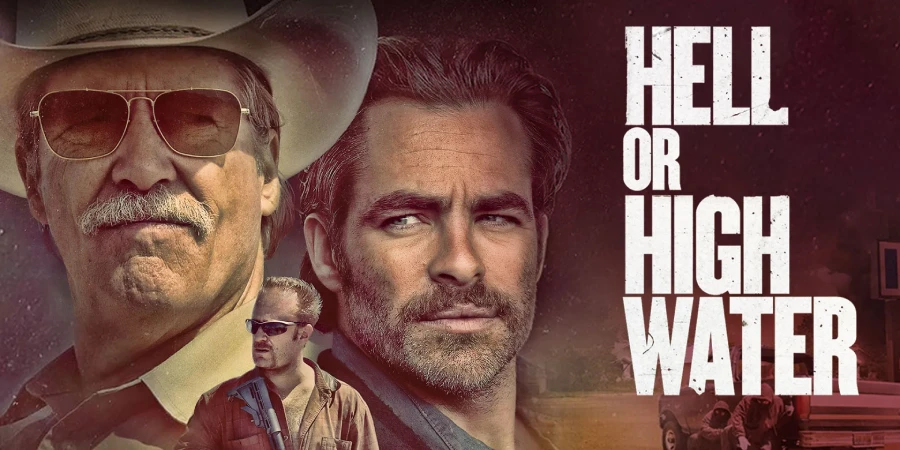

Two brothers rob banks to save their family ranch, and a Texas Ranger spends the whole movie being right about everything except what matters most. Hell or High Water is a film about defeat wearing the mask of victory, shot in the bleached, foreclosed landscape of West Texas where the land itself looks like it gave up years ago. David Mackenzie directs Taylor Sheridan’s script with a grip that never loosens, and the result is one of those rare crime films where you root for everyone and feel guilty about it. Every scene earns its place.
Detailed Summary
Opening Robberies: Toby and Tanner Hit the Ground Running
The film opens with brothers Toby Howard (Chris Pine) and Tanner Howard (Ben Foster) robbing a small-branch Midland Texas Bank in the early morning. They take only the small bills from the tellers, leaving the ATM and vault untouched. It is a deliberately limited score, and that precision tells you immediately that Toby is running a plan.
Tanner is the wilder element. He pistol-whips a guard who moves too slowly, and you can see Toby wince. Their dynamic is established in that single moment: Tanner courts chaos, Toby tolerates it only as a necessary tool.
Marcus Hamilton and Alberto Parker Enter the Picture
Texas Ranger Marcus Hamilton (Jeff Bridges) and his partner Alberto Parker (Gil Birmingham) catch the case. Marcus is weeks from retirement and makes no effort to hide his boredom with the assignment. He and Alberto drive across West Texas, trading insults about each other’s heritage, and those scenes are some of the sharpest writing in the film.
Marcus needles Alberto constantly about his Comanche and Mexican ancestry. Alberto gives it right back. What sounds like cruelty is actually affection between two men who have spent years in each other’s company. Bridges plays Marcus as a man filling silence with noise because he dreads what quiet retirement looks like.
Toby’s Motive Becomes Clear
Toby’s plan sharpens as the film reveals his situation. His mother recently died, leaving behind a ranch loaded with debt owed to Midland Texas Bank. Oil has been discovered on the property. If the bank forecloses, the bank profits from the oil. Toby intends to rob enough money from the bank’s own branches to pay off the loan before foreclosure.
He plans to put the ranch in a trust for his estranged sons. It is a scheme equal parts desperate and meticulous. Toby is not a career criminal; he is a man who identified exactly one opportunity to give his children something he never had.
The Casino Laundering Step
Toby and Tanner drive their stolen cash to a Native American casino, where they gamble it to receive clean chips and then cash out. This detail is smart screenwriting: it explains how they plan to pay off a mortgage with unmarked bills without triggering suspicion at the bank. It also places the film squarely in a conversation about who owns land, who loses it, and how money moves through systems designed to favor the powerful.
Tanner’s Recklessness Escalates
At a later robbery, Tanner detonates a dye pack and gets dye on some bills. More dangerously, he shoots at a pursuing police officer when things get tense, shattering the brothers’ rule of minimal violence. Toby is furious. Tanner shrugs it off with the ease of someone who has never fully believed he would survive to old age anyway.
Foster’s performance in these moments is the most underrated element of the whole film. He plays Tanner not as a movie villain but as a man genuinely unbothered by mortality, and that quality makes him both the story’s greatest threat and its most tragic figure.
The Plan Nears Completion
Toby calculates they need one more robbery to cover the full debt. He wants to hit the largest branch, the Midland Texas Bank in Post, Texas. Tanner agrees. Marcus and Alberto have been piecing together the pattern and are closing in on the right geography.
Toby tries to warn Tanner off the final job. He has enough money; he wants to walk away. Tanner insists on finishing together.
The Post Bank Robbery: Everything Falls Apart
The Post robbery goes catastrophically wrong. A bank customer, armed and carrying legally under Texas law, opens fire on the brothers as they exit. Other armed citizens join in. In the resulting gunfight, Tanner shoots and kills Alberto Parker.
A second civilian dies in the crossfire. Toby is wounded. The brothers flee in different vehicles and agree to meet at a prearranged location in the hills.


Movie Ending
Tanner reaches the rendezvous point first and sends Toby away, telling him to take the horses and go. Tanner knows law enforcement will arrive and he knows he cannot outrun them. He climbs into the rocky hills with a rifle and begins shooting at the approaching officers, buying Toby time to escape. Marcus confronts the situation from the ground below.
Tanner dies in the hills, killed in the firefight. He went out the way he always seemed to expect: guns out, no surrender. Foster plays the final moments with zero sentimentality. There is no big speech. He just fights until he stops.
Toby completes the plan. He pays off the mortgage, establishes the trust for his sons, and effectively launders the crime into a legal asset. When Marcus visits him weeks later at the ranch, Toby has technically gotten away with it. Legally, Marcus has nothing on him.
Their final conversation on Toby’s porch is the best scene in the film. Marcus tells Toby he knows exactly what happened. Toby does not deny it. Both men sit with the weight of what cannot be proven, what cannot be undone, and what was lost. Marcus lost his partner. Toby lost his brother. Neither man got what he actually wanted.
Toby offers to confess if Marcus can guarantee his sons inherit the ranch regardless. Marcus cannot make that guarantee and they both know it. Marcus leaves with nothing, and Toby stays with everything he planned for but nothing he loves.
That final porch scene is the film’s real argument: winning by Toby’s terms still looks a lot like losing. Pine plays it with his jaw tight and his eyes somewhere between grief and defiance, and it lands harder than any shootout in the film.
Are There Post-Credits Scenes?
Hell or High Water has no post-credits scenes. When the film ends, it ends. Given the tone, a post-credits tag would have been absurd anyway.
Type of Movie
This is a neo-Western crime thriller with strong dramatic and character-study elements. Its tone sits somewhere between elegiac and tense, never fully relaxing into either genre comfort. Think less action movie, more slow-burn tragedy wearing a heist film’s clothes.
Cast
- Jeff Bridges – Marcus Hamilton
- Chris Pine – Toby Howard
- Ben Foster – Tanner Howard
- Gil Birmingham – Alberto Parker
- Katy Mixon – Jenny Ann
- Dale Dickey – Elsie
Film Music and Composer
Nick Cave and Warren Ellis composed the score. Their collaboration here is spare and dusty, built from drones, slide guitar textures, and a general sense of something slowly running out. It suits the landscape and the characters perfectly.
Cave and Ellis have worked together on multiple film scores, including The Assassination of Jesse James by the Coward Robert Ford and Wind River. Their approach avoids conventional dramatic swells. Instead of telling you how to feel, the score just sits there, like the heat.
Contributed songs throughout the film include work from artists rooted in Americana and Texas roots music, which keeps the film grounded in a specific regional identity rather than a generic “country” aesthetic.


Filming Locations
Principal photography took place in New Mexico, standing in for West Texas. Towns including Albuquerque, Santa Fe, and various rural stretches of the state provided the visual grammar of economic abandonment that the script requires.
Director David Mackenzie and cinematographer Giles Nuttgen leaned into the landscape as a character. Storefronts with handwritten “Going Out of Business” signs, abandoned lots, and dust-blown highways carry as much thematic freight as any line of dialogue. The choice to shoot in real, unadorned locations rather than dressing up studio space gives the film a documentary credibility.
West Texas and New Mexico share enough geography that the substitution reads as authentic. Payday loan ads and debt-consolidation billboards visible throughout the production were real, not props, which says everything about the film’s setting.
Awards and Nominations
Hell or High Water received four Academy Award nominations, including Best Picture, Best Supporting Actor for Jeff Bridges, Best Film Editing, and Best Original Screenplay for Taylor Sheridan. It did not win in any category.
The film also received nominations from the BAFTA, the Screen Actors Guild, and the Writers Guild of America, among others. Sheridan’s screenplay was widely considered the frontrunner in its category and the loss still generates debate in certain film circles.
Behind the Scenes Insights
- Taylor Sheridan wrote the script as the second installment of what he called a modern frontier trilogy, preceded by Sicario and followed by Wind River.
- Director David Mackenzie is Scottish, and his outsider perspective on American economic despair was cited by Sheridan as part of what attracted him to Mackenzie for the project.
- Jeff Bridges improvised much of the banter between Marcus and Alberto, with Gil Birmingham riffing back. The chemistry feels lived-in because much of it genuinely was.
- Chris Pine prepared for the role by spending time in Texas and researching the foreclosure crisis and predatory lending practices that devastated rural communities after 2008.
- Ben Foster and Pine are close friends in real life, which they both credited for the ease of their brotherly dynamic on screen.
- Giles Nuttgen shot much of the film in natural light, keeping the visual palette honest and flat rather than romanticized.
Inspirations and References
Taylor Sheridan drew directly from the 2008 financial crisis and the wave of predatory lending and bank foreclosures that hit rural American communities especially hard. The moral logic of Toby’s scheme, robbing the bank that is robbing him, reflects real anger felt by real people in those years.
Sheridan has cited classic Westerns as a general influence on his frontier trilogy, but the film’s DNA is equally rooted in social realism. The Cormac McCarthy tradition of West Texas as a moral landscape also hovers over the material, particularly in how violence arrives without ceremony and leaves permanent damage.
The film also engages with the history of Indigenous land dispossession in the region, primarily through Alberto’s perspective and a recurring visual motif of land that has changed hands through force across centuries.
Alternate Endings and Deleted Scenes
No widely documented alternate endings or significant deleted scenes have been confirmed for this film. Mackenzie and Sheridan have discussed the film extensively in interviews without referencing major cut material. The ending appears to have been part of the screenplay from early drafts.
Book Adaptations and Differences
Hell or High Water is an original screenplay, not based on a novel or any prior published work. Taylor Sheridan wrote it directly for the screen. No book comparison applies here.

Memorable Scenes and Quotes
Key Scenes
- The opening robbery, shot in quiet early-morning light, where the brothers move with practiced calm and a waitress stares at them with something closer to resignation than fear.
- Marcus and Alberto at the diner, where a waitress memorably refuses to take their order away and tells them the T-bone is the only thing worth eating. Katy Mixon walks away with that scene completely.
- Tanner driving recklessly down a dirt road while Toby stares out the window, and the camera holds on Toby’s face long enough that you read about ten different feelings without a word being spoken.
- The Post bank robbery collapsing into civilian gunfire, with armed Texans shooting from parking lots while the brothers try to escape, capturing something genuinely specific about that landscape and its culture.
- Tanner’s last stand in the rocky hills, filmed without heroic framing, just a man disappearing into terrain with a rifle.
- The final porch scene between Marcus and Toby, two men who understand each other completely and can do absolutely nothing about it.
Iconic Quotes
- “You ever notice how much of this state looks like it’s already been plundered?” – Alberto Parker
- “I’ve been poor my whole life. So were my folks. It’s like a disease, passing from generation to generation.” – Toby Howard
- “You’re dying, and you’re angry about it.” – Alberto Parker, to Marcus
- “I ain’t never been caught.” – Tanner Howard
Easter Eggs and Hidden Details
- The payday loan and debt-consolidation signs visible throughout the film were real existing signage, not production design. Mackenzie kept them in frame deliberately.
- Graffiti visible on a wall early in the film reads “Three tours in Iraq but no bailout for people like us,” a piece of actual found text that Mackenzie chose not to remove because it articulated the film’s theme so directly.
- Tanner’s prison tattoos are visible in several scenes and were designed to reflect his specific criminal history, giving his character a biographical texture that the script only gestures at.
- The Comanche Nation background Alberto references when talking about land and loss connects the modern foreclosure story to centuries of dispossession in the same geography, a parallel Sheridan builds quietly rather than announcing.
- The specific bank chain the brothers target throughout, Midland Texas Bank, holding the predatory loan and then being robbed branch by branch with its own money, functions as a closed loop of ironic justice that the script never breaks to comment on directly.
Trivia
- Hell or High Water was produced for a relatively modest budget and earned significantly more at the global box office, making it one of the stronger commercial success stories for adult-skewing dramas in its release year.
- Taylor Sheridan was an actor before becoming a screenwriter, known for his role on the television series Sons of Anarchy.
- David Mackenzie’s previous film before this was Starred Up, a British prison drama, making his transition to Texas neo-Western a striking pivot that paid off completely.
- Gil Birmingham, who plays Alberto, also appeared in Sheridan’s Wind River, continuing a working relationship with the writer.
- Chris Pine’s performance here is widely regarded as among his strongest dramatic work, shifting him in critics’ minds away from the blockbuster roles he was primarily known for at the time.
- Nick Cave and Warren Ellis composed the score in their established collaborative mode, recording quickly and intuitively rather than writing to picture in a conventional session process.
- Ben Foster has spoken publicly about his commitment to fully inhabiting characters, and his preparation for Tanner reportedly included research into the psychology of people with high risk tolerance and violent histories.
Why Watch?
Watch this film specifically for Ben Foster, who builds a complete human being out of a character that lesser films would flatten into a liability or a joke. His Tanner understands his own ending and walks toward it without a single false note. Pine matches him beat for beat, and Bridges delivers a performance that uses every year on his face. That porch scene alone is worth your evening.
Director’s Other Movies
- Starred Up (2013)
- Perfect Sense (2011)
- Young Adam (2003)
- Outlaw King (2018)
- Fuze (2025)