
Jacques Demy made a musical about coincidence, longing, and the cruel gap between love imagined and love realized, and somehow made it feel like pure sunshine. The Young Girls of Rochefort arrives in a blaze of pastel color and choreographed joy, yet hides a genuinely melancholic soul underneath all that dancing. Twin sisters dream of Paris, a painter searches for his muse, and everyone keeps missing each other by mere minutes. It is one of cinema’s most beautiful arguments for fate, and also for terrible timing.
Detailed Summary
Rochefort Wakes Up: Introducing the Town and Its Dreamers
The film opens in the port town of Rochefort, bursting with color and choreography from its very first frames. A traveling fair arrives by ferry, and the carnies immediately fill the streets with movement and music. This opening sequence establishes Demy’s central conceit: life in Rochefort operates somewhere between reality and musical fantasy.
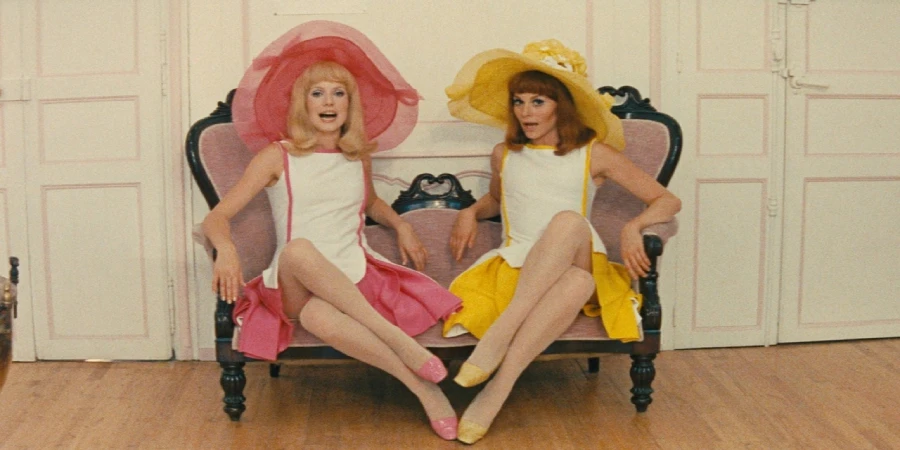
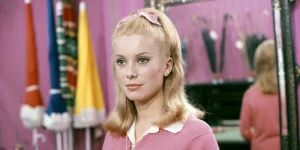
We meet Delphine and Solange, twin sisters played by real-life sisters Catherine Deneuve and Françoise Dorléac. Delphine teaches dance, and Solange teaches piano while composing her own music on the side. Both sisters share an aching desire to leave Rochefort for Paris, where they believe their real lives are waiting.
Their mother, Yvonne, runs a café and harbors her own romantic regret. She parted ways years ago with a man she loved because she refused to take his surname, Dame, which combined with her own first name would have made her Yvonne Dame (in French, une vieille dame, meaning “an old woman”). It is a small, absurd reason, and Demy presents it with knowing wit.
The Carnies and the First Web of Connections
The two carnival impresarios, Etienne and Bill, quickly fall for Delphine and Solange respectively. They propose that the sisters perform with their troupe at an upcoming festival in Paris. For the twins, this feels like the opportunity they have been waiting for.
Meanwhile, the film begins laying its network of near-misses. Characters orbit each other constantly without quite connecting. Demy choreographs these missed encounters with the precision of a Swiss watch and the cruelty of a romantic fatalist.
Maxence: The Sailor Who Paints His Dream Woman
One of the film’s most poignant threads involves Maxence, a young sailor and painter stationed near Rochefort. He has painted a portrait of his ideal woman from pure imagination. That imagined woman looks exactly like Delphine, though the two have never met.
Maxence openly yearns to find this woman and leave his military posting behind. He carries his portrait around like a kind of romantic manifesto. His storyline gives the film its most dreamlike quality, pushing its central theme of predestined love to an almost surreal extreme.
Guillaume and Solange: Music as Connection
A music publisher named Guillaume Lancien passes through Rochefort and hears Solange’s composition. He immediately recognizes her talent and expresses serious interest in her work. For Solange, this encounter feels like the professional breakthrough she has long sought.
Guillaume and Solange share a musical rapport that quickly becomes personal. Their scenes together carry a warmth that contrasts with the more wistful, near-miss quality of Delphine’s storyline. However, even this connection stays frustratingly incomplete for much of the film.
Andy Miller and the Wrong Twin
An American musician named Andy Miller, played by Gene Kelly, arrives in Rochefort. He encounters Delphine and is immediately charmed by her. Interestingly, Andy and Yvonne once knew each other, though neither initially realizes the other is in town.
Andy’s presence adds an American musical-theatre energy to the film that Demy clearly relishes. Kelly brings his unmistakable grace to the role, and his dance sequences feel like a love letter to the Hollywood musicals that inspired Demy in the first place. Moreover, Andy’s storyline weaves into Yvonne’s past in a way that gives the mother her own romantic resolution.
The Murder in the Background
Demy makes a startling tonal choice by threading a genuine crime story through the film’s cheerful fabric. A young woman has been murdered in Rochefort, and her dismembered body discovered. The victim’s name was Lola, the same name as a character from Demy’s earlier film.
Gossip about the murder ripples through the café and the town without ever derailing the musical’s upbeat momentum. Consequently, the murder functions almost like a dark undertow beneath the bright surface. It reminds the audience that the world contains real violence, even inside a pastel fantasy.
Yvonne and the Revelation of Monsieur Dame
As connections slowly surface, Yvonne gradually realizes that Simon Dame, the father of the twins, is the same man Andy has mentioned. Andy, it turns out, knows Simon. Yvonne’s long-held regret about abandoning the relationship crystallizes into something urgent.
Simon Dame, for his part, has spent years regretting the same separation. He still loves Yvonne. Their storyline runs parallel to the twins’ adventures, giving the film a generational symmetry: two sets of people who belong together but keep failing to find each other.
The Festival Approaches and Decisions Must Be Made
As the traveling fair prepares to leave for Paris, the twins face a real choice. Etienne and Bill want them to come along, which would mean leaving their students, their mother, and their familiar life behind. Solange feels the pull of Guillaume, and Delphine feels an inexplicable, almost mystical restlessness.
Demy builds the tension not through dramatic confrontation but through accumulation. Each small scene adds another layer of longing. In contrast to the bright choreography, the emotional undercurrent grows heavier as departure day approaches.

Movie Ending
Solange leaves Rochefort with the carnival troupe, heading toward Paris and a future that finally seems to match her ambitions. Guillaume follows her, and their connection deepens into something real. Her musical talent finds its audience, and her romantic life moves forward simultaneously.
Delphine, however, stays behind. She misses Maxence almost entirely throughout the film, their paths crossing only in the most glancing ways. At the very last moment, as Maxence finally leaves Rochefort on military transfer, Delphine spots him on the road. They share a brief, electric look of recognition, as if both instinctively understand they have been searching for each other.
Maxence stops his vehicle, and Delphine runs toward him. They embrace, and the film ends on this reunion without dwelling on its aftermath. Demy refuses to oversell the moment. He presents it as both an arrival and an open question, a meeting that comes heartbreakingly late but arrives nonetheless.
Meanwhile, Yvonne and Simon Dame reunite. Andy Miller helps broker this reunion simply by existing at the intersection of both their lives. The mother’s decade-long romantic wound closes in a few quiet, emotional beats that feel earned precisely because the film has spent its entire runtime building toward them.
The ending works because Demy never promises everything. Solange gets Paris and love. Delphine gets the man from the painting, but only at the last possible second. Yvonne gets Simon back, but only after years of unnecessary loss. Consequently, joy and sorrow share the same frame, which is exactly where Demy always wanted them.
Are There Post-Credits Scenes?
The Young Girls of Rochefort contains no post-credits scene. The film ends as the credits begin, and there is nothing additional waiting for patient viewers. For a 1967 French musical, the very concept would have been entirely foreign.
Type of Movie
This is a musical romantic drama, though it leans so heavily into visual fantasy that it also qualifies as a work of poetic realism with surrealist touches. Demy blends the conventions of the classic Hollywood musical with a distinctly French emotional register.
In tone, the film is simultaneously exuberant and melancholic. It celebrates love while mourning how rarely people actually connect. That tonal complexity is precisely what separates it from lighter, more straightforwardly cheerful musicals.
Cast
- Catherine Deneuve – Delphine Garnier
- Françoise Dorléac – Solange Garnier
- Gene Kelly – Andy Miller
- Danielle Darrieux – Yvonne Garnier
- Michel Piccoli – Simon Dame
- Jacques Perrin – Maxence
- Georges Chakiris – Etienne
- Grover Dale – Bill
Film Music and Composer
Michel Legrand composed the score for The Young Girls of Rochefort, and it represents one of his most celebrated achievements. Every musical number serves the emotional architecture of the film rather than existing as simple entertainment. Legrand wrote melodies that feel simultaneously sunny and bittersweet, which perfectly matches Demy’s worldview.
Notable pieces include the opening Chanson des jumelles, the twins’ exuberant declaration of their dreams. Maxence’s song about his ideal woman ranks among the most hauntingly romantic moments in the entire score. Furthermore, Legrand’s orchestration has an almost physical warmth to it, layering brass, strings, and woodwinds in ways that feel genuinely cinematic.
Legrand collaborated closely with Demy on multiple films, and their partnership produced some of the most distinctive musical cinema of the 1960s. His work here earned significant recognition and helped establish him as one of the leading film composers of his generation.


Filming Locations
Demy shot the film almost entirely in the actual city of Rochefort, in western France along the Charente river. He chose the real location partly for its architecture and partly because the town’s long, straight streets were ideal for large-scale choreography. In addition, Rochefort’s pastel buildings required very little set dressing to become the film’s iconic visual backdrop.
The production painted many of the town’s facades in bright, heightened colors to create the film’s distinctive visual palette. Local residents participated in the background choreography. Shooting in the real Rochefort gave the film a grounded authenticity that balanced its more fantastical musical elements.
The transporter bridge of Rochefort, the pont transbordeur, appears prominently in the film. It has since become closely associated with the movie and remains a point of local pride. The filming transformed the town into something that exists between documentary and dream.
Awards and Nominations
Michel Legrand received considerable recognition for his score. The film itself performed strongly at the French box office and earned positive critical attention internationally, though it did not accumulate a lengthy formal awards record compared to some of its contemporaries.
Behind the Scenes Insights
- Demy specifically wrote the roles of Delphine and Solange for Catherine Deneuve and Françoise Dorléac, taking advantage of their real sisterly bond to add genuine warmth to their scenes.
- Gene Kelly was a longtime admirer of French cinema and accepted the role partly as a tribute to the Hollywood musicals that Demy so clearly revered.
- Demy and his regular collaborator Michel Legrand worked from completed musical tracks during filming; actors and dancers performed to pre-recorded playback, which was standard French practice at the time.
- The large-scale street choreography required extensive coordination with Rochefort’s city authorities and local residents, many of whom appear in the background sequences.
- Tragically, Françoise Dorléac died in a car accident in June 1967, just months after the film’s release in March of that year. She was 25 years old. The film consequently became a bittersweet memorial to her talent and her real bond with Deneuve.
- Demy painted the streets of Rochefort himself, in collaboration with his art department, to achieve the film’s saturated pastel look.
Inspirations and References
Demy drew openly and lovingly from the tradition of the Hollywood musical, particularly the MGM productions of the 1940s and 1950s. Casting Gene Kelly was not incidental; it was a direct act of homage to that tradition. Films like An American in Paris and Singin’ in the Rain clearly shaped Demy’s visual and emotional ambitions.
Beyond Hollywood, Demy referenced his own earlier work. The murdered woman named Lola connects directly to his 1961 film Lola, part of his ongoing project of building an interconnected universe across his filmography. Moreover, the film’s meditation on coincidence and missed connection reflects Demy’s persistent philosophical preoccupation with fate and chance in romantic life.
Alternate Endings and Deleted Scenes
No widely documented alternate endings or significant deleted scenes from The Young Girls of Rochefort have entered the public record. Demy was known for meticulous pre-production planning, which tended to limit on-set deviation from his scripts. The ending audiences see appears to represent his original and only serious intention for the film.
Book Adaptations and Differences
The Young Girls of Rochefort is not based on a book or any prior literary source. Jacques Demy wrote the original screenplay and all lyrics himself. The film is a wholly original creation, born directly from his imagination and his passion for the musical form.


Memorable Scenes and Quotes
Key Scenes
- The opening arrival of the carnival by ferry, with dozens of dancers filling the Rochefort streets in a burst of color and choreography that immediately establishes the film’s register.
- Maxence singing about his ideal woman while holding the portrait that looks exactly like Delphine, one of cinema’s most quietly devastating expressions of romantic longing.
- The twins performing Chanson des jumelles, their joyful declaration that Paris waits for them and that their real lives have not yet begun.
- Andy Miller and Delphine dancing together in the street, a sequence that channels pure Hollywood musical energy through a distinctly French sensibility.
- The final scene on the road, where Delphine and Maxence finally see each other and she runs toward him as the film ends.
- Yvonne and Simon’s quiet reunion, which carries enormous emotional weight precisely because it arrives so late and so simply.
Iconic Quotes
- “La vie est belle, quand on y pense.” (Life is beautiful, when you think about it.) A sentiment the film earns rather than assumes.
- Maxence describing his painted ideal: the passage where he lists her qualities as if reading from a dream he cannot quite believe is real.
- Solange’s declaration that music is the only language she has ever fully trusted, which functions as both personal confession and artistic manifesto.
Easter Eggs and Hidden Details
- The murdered woman named Lola directly references Demy’s 1961 debut feature Lola, part of a continuous thread connecting his films into a shared universe.
- Several street signs and background details in Rochefort reference fictional characters and addresses from Demy’s other films, rewarding attentive viewers familiar with his broader work.
- The colors of Delphine and Solange’s costumes mirror each other throughout the film, subtly reinforcing their twinhood even in scenes where they appear separately.
- Gene Kelly’s presence carries its own Easter egg quality: his role as an American musician in a French port city echoes his character in An American in Paris, which Demy worshipped.
- The surname Dame and Yvonne’s refusal to become Yvonne Dame is a linguistic joke embedded so naturally into the plot that non-French speakers often miss its full weight.
Trivia
- Catherine Deneuve and Françoise Dorléac were the only real-life sisters to co-star as sisters in a major French film production of that era.
- Demy completed the film in his trademark style of having all dialogue and song performed to pre-recorded tracks, meaning actors lip-synced their own voices recorded in a studio beforehand.
- Gene Kelly performed all his own dance sequences, despite being in his mid-fifties at the time of filming.
- The film was shot in widescreen to accommodate its large choreographic sequences, giving Demy room to capture the full scale of his street-level dance numbers.
- Michel Legrand reportedly composed the entire score very rapidly, working in close creative collaboration with Demy at every stage of the process.
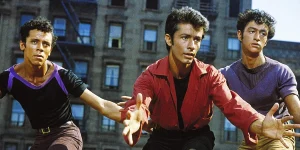
- Georges Chakiris, who plays Etienne, was best known internationally for his Oscar-winning role in West Side Story (1961), another piece of casting that signals Demy’s love of the Hollywood musical tradition.
- The film’s release in March 1967 made Françoise Dorléac’s death just three months later all the more shocking for French audiences who had just watched her dance and sing on screen.
Why Watch?
The Young Girls of Rochefort offers something genuinely rare: a musical that earns its joy by acknowledging sorrow. Its visual beauty, Michel Legrand’s extraordinary score, and the performances of Deneuve and Dorléac make it essential viewing. Moreover, knowing the tragic biographical context surrounding Dorléac adds a layer of emotional resonance that no amount of critical writing can fully prepare you for.
Director’s Other Movies
- Lola (1961)
- Bay of Angels (1963)
- The Umbrellas of Cherbourg (1964)
- Donkey Skin (1970)
- A Slightly Pregnant Man (1973)
- Lady Oscar (1979)
- A Room in Town (1982)
- Parking (1985)
- Three Seats for the 26th (1988)
Recommended Films for Fans
- The Umbrellas of Cherbourg (1964)
- An American in Paris (1951)
- Singin’ in the Rain (1952)
- West Side Story (1961)
- Lola (1961)
- La La Land (2016)
- Funny Face (1957)
- A Room in Town (1982)