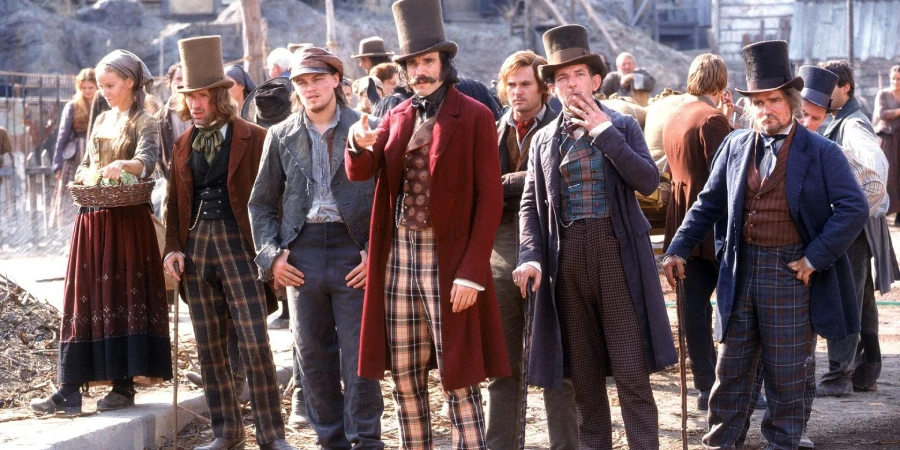

Martin Scorsese spent twenty-five years trying to get this film made, and you can feel every one of those years in the opening shot: a one-eyed man strapping on his weapons in a candlelit underground warren before leading his gang into a frozen street brawl so brutal it ends with a child watching his father bleed out in the snow. Gangs of New York is not a clean revenge story. It is a film about how America was built on violence, tribalism, and selective memory, and it refuses to let any of its characters, or its audience, feel comfortable about that.
Detailed Summary
The Priest’s Fall: The Five Points Prologue
It is 1846. Priest Vallon, leader of the Dead Rabbits gang, prepares his young son Amsterdam for battle. He hands the boy a small knife, then leads his Irish Catholic gang out of their underground home beneath the Five Points district of Manhattan.
Waiting for them is Bill “The Butcher” Cutting, the leader of the Nativist gang called the Native Americans. Bill is a showman and a killer: he wears a top hat, a butcher’s apron, and a glass eye painted with an American eagle. The two gangs clash in a savage, choreographed street fight in the snow.
Priest Vallon wins a one-on-one confrontation with Bill early in the melee, drawing real blood. Bill recovers, gains the upper hand, and kills Vallon with a short blade. Amsterdam watches his father die. Bill holds Vallon’s razor with respect, keeps it as a trophy, and orders Amsterdam taken away rather than killed, a mercy that will define everything that follows.
Hellgate Reform School and the Return
Young Amsterdam spends sixteen years in Hellgate, a brutal reform institution. He comes out hardened and obsessed with one purpose: revenge against Bill the Butcher. He returns to the Five Points alone, concealing his identity.
He reconnects with Johnny, an old acquaintance from the neighborhood, and begins embedding himself in the world Bill controls. He also encounters Jenny Everdeane, a pickpocket and con artist with her own complicated history with Bill.
Amsterdam Infiltrates Bill’s Circle
Amsterdam earns Bill’s trust gradually and methodically. He saves Bill’s life during a public assassination attempt, and Bill responds by folding Amsterdam into his inner circle like a surrogate son. The film is smart enough to let this relationship breathe and grow genuinely complicated.
Bill teaches Amsterdam about power, loyalty, and the nature of the Five Points. He takes him to the theater, shows him how to run a neighborhood through fear and respect. Amsterdam begins to feel something he did not expect: genuine admiration for the man he came to kill.
Jenny Everdeane and the Love Triangle
Amsterdam and Jenny begin a romance. Jenny is no passive figure here; she is enterprising, sharp, and has her own scars connected to Bill. She was informally his ward for a period, which gives her relationship with Amsterdam an extra layer of danger.
Johnny, jealous and erratic, eventually betrays Amsterdam to Bill. He tells Bill who Amsterdam really is. It is the pivot the whole film has been building toward.
Bill’s Punishment and Amsterdam’s Humiliation
Bill’s reaction to the betrayal reveals his character completely. He does not kill Amsterdam outright. Instead, he brands Amsterdam’s cheek with a hot knife in front of the entire Five Points, a public act of dominance and symbolic fatherhood twisted into something monstrous. He makes Amsterdam watch Johnny die, punishing the informant as well as the betrayed.
Amsterdam survives, broken and scarred. Jenny nurses him back to health. The humiliation does not destroy his will; it clarifies it.
The Dead Rabbits Reformed
Amsterdam rebuilds the Dead Rabbits with help from McGloin and other loyalists. He also forges an alliance with Boss Tweed, the Tammany Hall politician played with magnificent oiliness by Jim Broadbent. Tweed sees the Irish immigrant population as a voting bloc and wants leverage over Bill, who controls the neighborhood Tweed needs.
Amsterdam challenges Bill to a formal gang battle, using the old codes of the Five Points. Bill accepts. The date is set.
The Draft Riots Converge on Everything
The film’s final act layers the personal revenge plot onto the real historical event of the 1863 New York Draft Riots. President Lincoln’s Civil War conscription law hits New York, and the poor, mostly Irish working class explodes in fury. They cannot afford the three hundred dollars that buys a wealthy man out of the draft. The riots turn into race riots as mobs attack Black residents throughout the city.
Scorsese does not sanitize this. The rioters are Amsterdam’s own community. The film refuses to let the Irish immigrant narrative be purely heroic.
Movie Ending
Bill and Amsterdam face each other in the streets of the Five Points just as the Draft Riots reach full scale. Union warships in the harbor begin shelling Manhattan to suppress the uprising. Cannonballs tear through buildings. People scatter. The choreographed gang war that both men prepared for gets swallowed by chaos they cannot control.
Bill takes shrapnel from a cannon blast and goes down wounded. Amsterdam reaches him in the smoke and confusion. He stabs Bill, and Bill dies not in glorious single combat but amid rubble and artillery fire, almost incidentally, the city itself overwhelming the personal story both men thought they were living.
Jenny survives. Amsterdam buries his father’s razor with Bill’s body, placing the two men side by side in a mass grave. It is the most emotionally honest moment in the film: Amsterdam choosing to bury his obsession rather than triumphantly reclaim it. He acknowledges that Bill was, in a terrible way, the only father figure who shaped him after Vallon died.
The film closes with a time-lapse shot of the cemetery in lower Manhattan. Decades pass. The graves disappear under the growth of a modern city. The skyline of New York rises and fills the frame, including, in a final image, the twin towers of the World Trade Center. Martin Scorsese makes the point wordlessly: this blood-soaked foundation is what built everything that came after. Nobody remembers. The city forgot.
Are There Post-Credits Scenes?
No. Gangs of New York has no post-credits scene of any kind. When the closing montage ends and the credits roll, the film is done. Stay if you want to catch the music, but nothing narrative awaits you.
Type of Movie
Gangs of New York is a historical epic crime drama with strong elements of revenge thriller and period character study. Its tone is brutal and unsentimental, occasionally veering into mythological territory when Bill the Butcher is on screen.
It is not a comfortable film. Scorsese wants you to feel the dirt, the smell, and the tribal ugliness of mid-nineteenth century New York. The film clocks in at roughly two hours and forty minutes, and it earns most of that length, even if the second act sags slightly before the draft riots ignite the finale.
Cast
- Leonardo DiCaprio – Amsterdam Vallon
- Daniel Day-Lewis – Bill “The Butcher” Cutting
- Cameron Diaz – Jenny Everdeane
- Jim Broadbent – Boss Tweed
- John C. Reilly – Happy Jack Mulraney
- Henry Thomas – Johnny Sirocco
- Liam Neeson – Priest Vallon
- Brendan Gleeson – Walter “Monk” McGinn
- Gary Lewis – McGloin
- Roger Ashton-Griffiths – P.T. Barnum
Film Music and Composer
Howard Shore composed the score for Gangs of New York, but the soundtrack is as famous for its song selections as for its orchestral work. U2 contributed “The Hands That Built America,” written specifically for the film, which plays over the closing credits and earned award attention.
Shore’s score layers period-appropriate instrumentation, fiddle-driven folk textures, and low brass to build something that feels both ancient and urban. Scorsese also uses source music aggressively throughout, including Peter Gabriel’s “Signal to Noise,” which plays over the draft riots sequence and creates an anachronistic, almost dream-logic effect that works better than it has any right to.
The choice to use modern music over a period film was a deliberate provocation. Scorsese was not making a museum piece, and the score choices signal that from the start.

Filming Locations
Almost the entire film was shot at Cinecittà Studios in Rome, Italy. Production designer Dante Ferretti constructed an enormous recreation of Five Points Manhattan on the studio’s backlot, reportedly one of the largest sets ever built in European cinema at the time.
Shooting in Rome rather than New York was partly practical and partly creative. Building a period-accurate version of a demolished nineteenth-century neighborhood required construction from scratch, and Cinecittà offered the space and infrastructure to do it.
Some location work was done in New York, but the immersive, tactile quality of the Five Points world comes almost entirely from Ferretti’s constructed environment. Walking through that set, you genuinely believe the mud underfoot.
Awards and Nominations
Gangs of New York received ten Academy Award nominations, including Best Picture, Best Director, and Best Original Screenplay. It won none of them, losing Best Picture to Chicago that year, which remains one of the more debated Oscar outcomes of the 2000s.
Daniel Day-Lewis received a Golden Globe nomination for his performance. The film also earned nominations from BAFTA and various critics circles, particularly for Day-Lewis and Ferretti’s production design.
Behind the Scenes Insights
- Scorsese first conceived the project in the 1970s after reading Herbert Asbury’s book. It took roughly twenty-five years of development before production finally began.
- Daniel Day-Lewis stayed in character as Bill the Butcher throughout the shoot, reportedly practicing knife-throwing daily and refusing to break his accent or demeanor on set.
- Leonardo DiCaprio and Scorsese clashed during production over the direction of Amsterdam’s character. DiCaprio reportedly wanted more interiority and complexity, while Scorsese kept pulling toward spectacle.
- The film’s budget ballooned significantly during production, partly because of the scale of Ferretti’s sets and partly because of extensive reshoots.
- Producer Harvey Weinstein pushed hard for a shorter cut and reportedly had ongoing battles with Scorsese over the final edit. The theatrical cut reflects compromises on both sides.
- Liam Neeson’s role as Priest Vallon is relatively brief by screen time, but Scorsese insisted on casting someone with enough presence to make the character’s death feel like a genuine loss.
- Day-Lewis reportedly listened to Eminem during breaks to stay in an aggressive headspace for Bill’s most violent scenes.
Inspirations and References
The primary source material is Herbert Asbury’s 1927 non-fiction book The Gangs of New York. Asbury chronicled the criminal underworld of nineteenth-century Manhattan with lurid, journalistic detail. His portraits of gang leaders, neighborhood politics, and street violence gave Scorsese his initial framework.
Asbury’s book is not a strict history. Scholars have noted that it blends fact with legend, which suited Scorsese’s purposes perfectly. He was after myth, not a documentary record.
Scorsese also drew on his own deep knowledge of classical Hollywood Westerns. Bill the Butcher is constructed partly as a frontier outlaw figure, a gunfighter analog who rules through spectacle and personal mythology. The Five Points functions as a frontier town, which gives the film its genre DNA.
Alternate Endings and Deleted Scenes
Several scenes were cut or shortened in post-production, largely due to pressure to reduce the runtime. An extended version of the gang battle prologue existed, with more detail on the Dead Rabbits and Native Americans as factions before the fight begins.
Scorsese shot material developing Amsterdam’s time at Hellgate reform school in more depth. The theatrical cut condenses this significantly, which is arguably one reason Amsterdam feels slightly underwritten compared to Bill.
A longer cut of the film circulated in discussions between Scorsese and Miramax, reportedly running closer to three and a half hours. No official extended cut has ever been released publicly. What audiences have seen is the result of genuine editorial conflict between the director and the studio.
Book Adaptations and Differences
The film takes The Gangs of New York by Herbert Asbury as a jumping-off point rather than a faithful adaptation. Asbury’s book has no single protagonist and no revenge narrative threading through it. Amsterdam Vallon and Priest Vallon are invented characters, not figures from Asbury’s documentation.
Bill the Butcher is loosely inspired by a real historical figure, William Poole, a Nativist gang leader who operated in New York in the 1850s. The real Poole’s life diverges significantly from the film’s version.
Scorsese and screenwriters Jay Cocks, Steven Zaillian, and Kenneth Lonergan used Asbury’s world as atmosphere and backdrop, then built a personal story inside it. The book’s value to the film is its texture and detail, not its narrative.

Memorable Scenes and Quotes
Key Scenes
- The Opening Battle: Shot in near-silence punctuated by the crunch of weapons on flesh, the prologue establishes tone immediately. Scorsese frames it almost like a ritual, not a brawl, two armies performing a violent ceremony in the snow.
- Bill’s Knife-Throwing Demonstration: Bill throws knives at a spinning woman in a carnival act while delivering a monologue about his father dying in the Civil War. Day-Lewis never raises his voice. His stillness is more frightening than any shouting could be.
- Amsterdam’s Branding: Bill holds Amsterdam’s face with one hand and draws a blade across his cheek with the other, slow and deliberate, while crowds watch. The camera stays close on DiCaprio’s eye, which does not look away.
- The Draft Riots Sequence: Cannonballs begin landing as the gang war starts. The personal story and national history collide in smoke and fire, and Scorsese shoots it with a wide chaos that makes you feel genuinely lost inside the violence.
- Bill’s Death: Not the climax either man deserved, which is entirely the point. A piece of shrapnel wounds Bill, and Amsterdam finishes him in the rubble. It is anti-heroic and deflating in the best way.
Iconic Quotes
- “I don’t see what the point is of leaving a man alive when he should be dead.” – Bill the Butcher
- “I know your name. I know where you sleep. I know what you had for supper.” – Bill the Butcher
- “My father gave his life making this country what it is. Murdered by the British, he was. Murdered by his own countrymen. Murdered by the state.” – Bill the Butcher
- “Thank God I die a true American.” – Bill the Butcher
Easter Eggs and Hidden Details
- The glass eye Bill wears, painted with an eagle, was reportedly inspired by a real detail from accounts of mid-nineteenth century New York gang culture, though Scorsese stylized it significantly.
- Dante Ferretti’s Five Points set included historically researched period signage, street layouts, and architectural details derived from photographs and maps of the actual neighborhood, which was demolished during urban renewal in the late nineteenth century.
- The knife Priest Vallon uses and that Bill keeps as a trophy appears briefly in Bill’s possession in multiple scenes, always visible in his belt or on his table, a recurring visual reminder of what Amsterdam is there to reclaim.
- P.T. Barnum appears briefly as a character, connecting the film’s world to the real historical entertainment culture of mid-century New York.
- The final time-lapse sequence over the graves was reportedly inspired by a real cemetery, Washington Square Park, which sits atop a historic burial ground in lower Manhattan.
Trivia
- The film’s production was already underway when the September 11 attacks occurred in 2001. The final image of the twin towers in the closing montage was not removed; Scorsese kept it as an intentional resonance with the film’s themes about forgetting and destruction.
- Daniel Day-Lewis trained extensively in butchery for the role, learning to handle meat cleavers and knives with professional proficiency.
- Cameron Diaz was not Scorsese’s original choice for Jenny. The role went through several casting considerations before Diaz was confirmed.
- The film was in development long enough that at various points, Robert De Niro was attached to play Bill the Butcher before Day-Lewis came on board.
- Scorsese and Jay Cocks worked on the original screenplay for years before bringing in Steven Zaillian and Kenneth Lonergan for rewrites during production.
- The five-minute opening battle sequence reportedly took several weeks to shoot because of the scale of the set, the number of extras, and the complex choreography involved.
Why Watch?
Watch this film for Daniel Day-Lewis, who constructs Bill the Butcher from the ground up: the way his weight shifts when he throws a knife, the soft voice he uses precisely when he is most dangerous, the almost tender respect he shows a dead enemy. No other performance in this film, and arguably few performances in American cinema from this decade, come close to matching what he does here.
Director’s Other Movies
- Mean Streets (1973)
- Taxi Driver (1976)
- Raging Bull (1980)
- GoodFellas (1990)
- The Age of Innocence (1993)
- Casino (1995)
- Bringing Out the Dead (1999)
- The Aviator (2004)
- The Departed (2006)
- Shutter Island (2010)
- Hugo (2011)
- The Wolf of Wall Street (2013)
- Silence (2016)
- The Irishman (2019)
- Killers of the Flower Moon (2023)