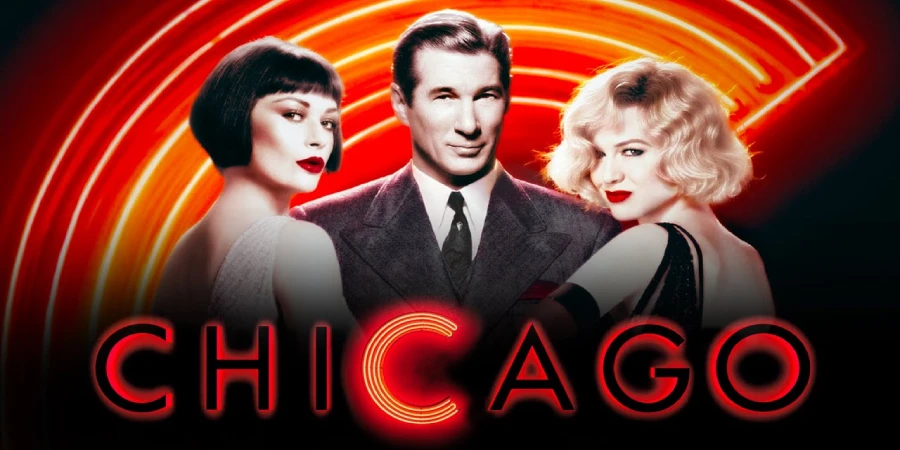

Murder, jazz, and shameless spectacle collide in one of the most gloriously cynical films ever made about fame. Chicago (2002) does not simply adapt the beloved stage musical; it weaponizes it, turning every song into an indictment of a society that cheers for killers as long as they look good doing it. Director Rob Marshall brought Broadway back to Hollywood with a vengeance, and the result won six Academy Awards. This film earns every sequin.
Detailed Summary
Roxie Hart’s Dream and a Very Bad Night
We open in 1920s Chicago, where Roxie Hart (Renee Zellweger) watches her idol, the dazzling Velma Kelly (Catherine Zeta-Jones), perform at a jazz club. Roxie desperately wants that spotlight for herself. Meanwhile, she is sleeping with a furniture salesman named Fred Casely (Dominic West), who has promised to launch her performing career.
Fred, however, was lying about his showbiz connections all along. When Roxie confronts him and he tries to leave, she shoots him dead. Her husband, the hapless Amos Hart (John C. Reilly), initially takes the blame, confessing to police out of love.
Velma Kelly’s Parallel Story
Velma Kelly has already arrived at the Cook County Jail before Roxie does. She killed her husband and her sister after catching them together. Velma is a seasoned performer and a celebrity prisoner, fully comfortable using her notoriety as currency.
In contrast, Roxie arrives as a nobody. Velma sees her as competition almost immediately. Their rivalry drives much of the film’s central tension.
Mama Morton and the Jail as a Business
Matron Mama Morton (Queen Latifah) runs the jail like a personal enterprise. She offers favors, comfort, and access to the press in exchange for gifts and money. Her showstopping number, “When You’re Good to Mama,” lays out her transactional worldview with cheerful bluntness.
Mama connects Roxie with the city’s most celebrated defense attorney, Billy Flynn (Richard Gere). Flynn costs a fortune, but Amos scrapes together the money. His motivation is pure love; everyone else’s is pure self-interest.
Billy Flynn Takes the Case
Billy Flynn has never lost a murder case. He is a master manipulator who treats his clients like marionettes, as illustrated in the film’s brilliant “We Both Reached for the Gun” number. In that sequence, Roxie sits on his knee like a ventriloquist’s dummy while he speaks for her during a press conference.
Flynn constructs a sob story for Roxie, rebranding her as a naive girl who shot a man in self-defense. He feeds the story to Mary Sunshine (Christine Baranski), a sentimental newspaper reporter who laps it up completely. The press goes wild.
Roxie Becomes a Star
Roxie claims she is pregnant to generate more public sympathy, a lie Flynn happily amplifies. Her celebrity grows rapidly. She steals Velma’s spotlight, her photographer, and even her hat, much to Velma’s fury.
Moreover, Roxie begins to genuinely believe her own myth. She fantasizes about fame constantly, and the film expresses those fantasies through elaborate musical numbers that exist only in her imagination. Reality, on the other hand, is considerably grimmer.
Velma’s Desperation and the “Cell Block Tango”
Early in the film, Velma and the other women in jail perform the iconic “Cell Block Tango,” each prisoner narrating how she killed her man. Every story involves some version of the man deserving it. The number is darkly funny, choreographically stunning, and morally slippery in the best possible way.
As Roxie’s star rises, Velma’s fades. Velma even approaches Roxie with a desperate proposal: the two should revive Velma’s old double act and perform together. Roxie dismisses her coldly.
The Trial Begins
Roxie’s trial becomes a full-on media circus. Flynn performs for the jury as much as for the courtroom. He plants fake tears, manufactures outrage, and keeps Roxie looking sympathetic at every turn.
Consequently, the prosecution struggles to land any serious blows. The facts of the case are almost irrelevant; public narrative is what Flynn deals in. Amos, heartbreakingly, still believes Roxie loves him.
A New Celebrity Threatens Everything
Just as Roxie’s trial peaks, another woman commits a sensational crime and captures the front pages. Roxie’s coverage evaporates overnight. Flynn is forced to manufacture a dramatic courtroom moment to claw back public attention.
He stages a meltdown from Roxie on the stand, complete with a faked fainting spell. It works. Reporters rush back, cameras click, and Roxie reclaims her headline status.
The Verdict
Roxie is acquitted. The jury, completely seduced by Flynn’s performance and Roxie’s manufactured image, finds her not guilty. She walks out of the courtroom expecting adoring crowds and flashbulbs.
Instead, the press has already moved on to another sensational murder case. Roxie stands on the courthouse steps, invisible. Nobody cares anymore.

Movie Ending
Roxie hits rock bottom fast after the acquittal. She attempts a solo performing career and auditions for clubs, but nothing sticks. Fame, it turns out, requires constant feeding.
Meanwhile, Velma has been quietly working her own angles. After her own acquittal, she approaches Roxie again, this time with a revised and more urgent pitch. Both women understand something the film has been arguing all along: solo acts are forgettable, but a double act built on scandal is a product people will buy.
Roxie accepts. In the film’s final sequence, the two former rivals perform together on a glittering stage. They sing and dance, presenting a glamorized, fictionalized version of their crimes to an adoring audience. The crowd goes absolutely wild for them.
The kicker is that nothing has changed. Two women who committed murder walk free, celebrated as entertainers. Amos is forgotten. The victims are forgotten. The audience in the film cheers just as loudly as the real cinema audience has been cheering throughout. Rob Marshall makes that complicity impossible to ignore.
Notably, the final image positions Roxie and Velma as equals, which is its own quiet joke: Roxie spent the whole film trying to eclipse Velma, and yet the only way either of them survives is together. Fame is a shared delusion, and Chicago ends by making you celebrate it anyway.
Are There Post-Credits Scenes?
Chicago contains no post-credits scenes whatsoever. Once the curtain falls on Roxie and Velma’s final number, the film is done. You can leave your seat without missing anything.
Type of Movie
Chicago is a musical crime drama with strong elements of dark comedy and satire. Its tone balances theatrical exuberance with a genuinely cynical worldview. It celebrates spectacle while simultaneously mocking everyone who falls for it.
In contrast to many feel-good musicals, this film rewards its most manipulative characters. It is joyful and deeply uncomfortable at the same time, which is precisely what makes it so effective.
Cast
- Renee Zellweger – Roxie Hart
- Catherine Zeta-Jones – Velma Kelly
- Richard Gere – Billy Flynn
- Queen Latifah – Matron Mama Morton
- John C. Reilly – Amos Hart
- Christine Baranski – Mary Sunshine
- Dominic West – Fred Casely
- Colm Feore – Martin Harrison
- Taye Diggs – The Bandleader
Film Music and Composer
The musical score draws directly from the original stage musical, with music and lyrics by John Kander and Fred Ebb. Their collaboration produced some of Broadway’s sharpest, most sardonic songwriting. Danny Elfman handled the film’s original score and orchestrations.
Standout tracks include “All That Jazz,” “Cell Block Tango,” “Roxie,” and “Mr. Cellophane.” John C. Reilly’s performance of “Mr. Cellophane” is a particular emotional gut-punch, played almost entirely straight amid the film’s general flamboyance.
Furthermore, the sound design throughout treats the musical numbers as products of imagination rather than literal events, which allows the transitions between fantasy and reality to land with real impact.

Filming Locations
Chicago was shot almost entirely in Toronto, Canada, despite being set in 1920s Chicago. Production designers built elaborate period sets on soundstages rather than relying on location shooting. This approach gave the filmmakers total control over the film’s heightened, theatrical aesthetic.
The decision to shoot on controlled sets also supported the film’s core conceit: everything we see is a performance, a constructed illusion. Shooting on real Chicago streets would have grounded the film in a realism it actively wants to avoid.
Awards and Nominations
Chicago won six Academy Awards at the 75th Oscars, including Best Picture, Best Supporting Actress for Catherine Zeta-Jones, and Best Film Editing. It was the first musical to win Best Picture since Oliver! in 1969, a gap of more than three decades.
In addition, the film received nominations for Best Actress (Zellweger), Best Actor in a Supporting Role (Reilly and Gere), and Best Director for Rob Marshall. It also won the Golden Globe for Best Motion Picture (Musical or Comedy).
Behind the Scenes Insights
- Rob Marshall had directed the stage version of Chicago in a concert format before tackling the film, which gave him an unusually deep familiarity with the material.
- Richard Gere lobbied hard for the role of Billy Flynn and performed all his own dancing and singing, including the tap number “Razzle Dazzle.”
- Renee Zellweger trained extensively in dance and singing for the role and reportedly spent months in preparation before filming began.
- Catherine Zeta-Jones had a background in musical theatre, which gave her a significant head start over her co-stars in the performance sequences.
- All the musical numbers in the film represent events happening inside Roxie’s imagination, a framing device Marshall used to justify the stylized, theatrical presentation.
- The production design team created a visual world inspired by German Expressionism and 1920s cabaret aesthetics, specifically referencing the work of Bob Fosse.
- Queen Latifah received widespread praise for “When You’re Good to Mama,” a number she reportedly recorded very quickly due to her existing vocal strengths.
Inspirations and References
Chicago originates from a 1926 play of the same name by Maurine Dallas Watkins, a journalist who covered actual murder trials in Chicago during the early 1920s. Her play drew directly from real cases she had reported on, particularly those involving women who had killed their lovers and were subsequently acquitted.
The play was adapted into the stage musical in 1975 by Bob Fosse and Gwen Verdon, with Kander and Ebb’s score. Fosse’s original production is a direct and acknowledged blueprint for the film. The 2002 film therefore sits at the end of a long chain running from real courtroom drama through theatrical satire.
Furthermore, the film’s critique of media sensationalism and public gullibility feels as relevant in any modern era as it did in 1920s Chicago. That staying power is a core reason the material keeps being revived.
Alternate Endings and Deleted Scenes
No widely documented alternate ending exists for Chicago. Rob Marshall stayed closely aligned with the source material’s conclusion throughout production. The film’s ending mirrors both the stage musical and the cynical logic the story has built from its opening scene.
Some early planning reportedly involved experimenting with the degree of reality-versus-fantasy framing in certain numbers. However, no significant deleted musical sequences have been formally released or extensively documented in public interviews.
Book Adaptations and Differences
Chicago is not based on a novel. It adapts the 1975 Broadway stage musical, which itself adapts the 1926 play by Maurine Dallas Watkins. The most significant difference between the play and the film is the framing device: the film explicitly presents the musical numbers as Roxie’s fantasies, whereas the stage version presents them as direct theatrical performances addressed to the audience.
Watkins’ original play also carried a more explicitly journalistic anger, reflecting her personal experience covering those real trials. The musical and film soften that anger slightly by wrapping it in entertainment, which is, fittingly, part of the film’s own satirical argument.


Memorable Scenes and Quotes
Key Scenes
- “Cell Block Tango”: Each prisoner takes the stage to narrate her crime with choreographed fury; the sequence is visually spectacular and morally complex, establishing the film’s entire tone in one number.
- “We Both Reached for the Gun”: Billy Flynn operates Roxie like a puppet during a press conference, with reporters dancing along as willing participants in the manipulation.
- “Mr. Cellophane”: Amos sings about his own invisibility with heartbreaking sincerity; John C. Reilly plays it with zero irony, making it the film’s most genuinely moving moment.
- “Razzle Dazzle”: Flynn performs the trial itself as pure showmanship, explicitly arguing that dazzling an audience is more effective than telling the truth.
- The Courthouse Steps: Roxie walks free and expects adoring crowds; instead, the press is already gone, and she stands alone, briefly stripped of her illusions.
- The Final Double Act: Roxie and Velma perform together for an adoring crowd, completing the film’s argument that celebrity and crime are interchangeable products.
Iconic Quotes
- “Give ’em the old razzle dazzle, razzle dazzle ’em.” (Billy Flynn)
- “All I care about is love.” (Billy Flynn, transparently lying)
- “You know, a lot of people don’t realize what’s really going on. They view life as a bunch of unconnected incidences and things.” (Amos Hart)
- “They had it coming. They had it coming. They only had themselves to blame.” (The Cellblock Tango, ensemble)
- “In this town, murder’s a form of entertainment.” (Velma Kelly)
Easter Eggs and Hidden Details
- Several of the musical numbers visually reference the original Bob Fosse stage choreography, including the angular arm movements and the bowler hat iconography; these serve as deliberate tributes to the source production.
- Mary Sunshine’s character carries a plot twist that attentive viewers can spot early: her voice and mannerisms hint at her secret before the film explicitly reveals it.
- Roxie’s fantasy sequences use noticeably warmer and more saturated lighting than the “real world” scenes, creating a subtle visual cue for which reality you are watching.
- During “We Both Reached for the Gun,” the puppeteer metaphor extends to the reporters, who also move on strings; this detail implicates the media as equally manipulated and manipulating.
- Velma’s costumes throughout the film are slightly more elaborate and structured than Roxie’s, reflecting her status as an established performer versus Roxie’s aspirational newcomer identity.
- Amos is consistently framed in the background or edges of shots during crowd scenes, a visual reinforcement of his “Mr. Cellophane” invisibility theme.
Trivia
- Chicago was the first musical film to win the Academy Award for Best Picture in 34 years, breaking a long drought for the genre in Hollywood.
- John C. Reilly received an Oscar nomination for Best Supporting Actor, which surprised many observers who expected the film’s leads to dominate the acting categories.
- Both Richard Gere and Queen Latifah were also nominated for acting Oscars, giving the film four acting nominations in total.
- The stage musical had originally flopped at the box office when it premiered in 1975, only to become a cultural phenomenon during its 1996 Broadway revival.
- Renee Zellweger did not use a voice double; all her singing in the film is her own, recorded after extensive vocal training.
- Director Rob Marshall specifically decided early in development to never stage a musical number in literal reality; every song exists as fantasy or performance, never as spontaneous naturalistic singing.
- The film’s production designer drew heavily from German Expressionist cinema and the visual world of 1920s Weimar cabaret for the set and lighting design.
Why Watch?
Chicago is a razor-sharp satire disguised as a party, and it is one of the most perfectly constructed musicals ever put on film. Every number serves the story, every story beat serves the theme, and the theme lands harder now than it did in 2002. Watching it once is enough to understand why it won Best Picture; watching it twice is enough to see why it deserved to.
Director’s Other Movies
- Memoirs of a Geisha (2005)
- Nine (2009)
- Pirates of the Caribbean: On Stranger Tides (2011)
- Into the Woods (2014)
- Mary Poppins Returns (2018)
Recommended Films for Fans
- Moulin Rouge! (2001)
- Cabaret (1972)
- All About Eve (1950)
- Dreamgirls (2006)
- Sweeney Todd: The Demon Barber of Fleet Street (2007)
- Nashville (1975)
- Funny Girl (1968)