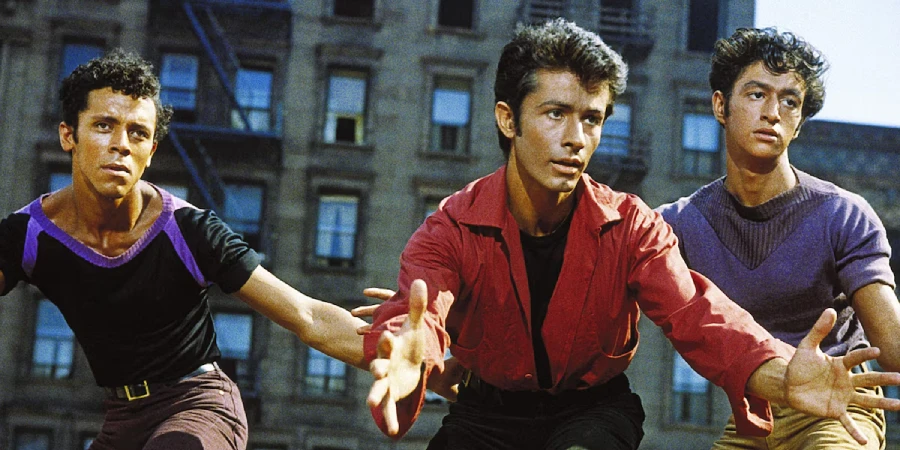

Few movies have the audacity to open with a helicopter shot of Manhattan and immediately declare themselves the definitive American tragedy. West Side Story (1961) takes Shakespeare’s Romeo and Juliet, transplants it into the gang-controlled streets of New York’s Upper West Side, and wraps the whole devastating story in some of the most electrifying music ever committed to film. It earns every one of its ten Academy Awards. This is a film that refuses to let you look away, even as it breaks your heart in the final reel.
Detailed Summary
The Jets and the Sharks Establish Their Turf
The film opens in near-silence, with an aerial view of New York City slowly descending into the streets of the Upper West Side. Two rival gangs control this territory: the Jets, a group of white ethnic youths led by the volatile Riff, and the Sharks, Puerto Rican immigrants led by the fierce Bernardo.
Their conflict plays out in a stunning, largely wordless dance sequence that establishes the rules of their world instantly. Every snap, kick, and shove communicates years of built-up resentment. Officer Krupke and Lieutenant Schrank break up the confrontation, but both sides know this is far from over.
Tony and Maria Meet at the Dance
Riff recruits his best friend and Jets co-founder, Tony, to attend a neighborhood dance that night. Tony has been drifting away from the gang, working at Doc’s drugstore and searching for something he cannot yet name. Riff needs him there as a show of strength against the Sharks.
At the gym, the two gangs occupy opposite sides of the dance floor. Then Tony and Maria, Bernardo’s younger sister who has just arrived from Puerto Rico, lock eyes across the room. Everything else dissolves. Their famous meeting through a chain-link fence barrier captures the simultaneous thrill and impossibility of their connection.
Bernardo tears them apart immediately. However, the damage is already done. Both Tony and Maria leave the dance irrevocably changed.
Balcony Scene and “Tonight”
Tony follows Maria to the tenement building where she lives, finding her on the fire escape above. Their courtship is breathless and instant. Together they sing “Tonight,” pledging themselves to each other with a conviction that neither gang allegiance nor family loyalty can compete with.
Maria makes Tony promise to stop any fight between the Jets and the Sharks. She trusts him completely. That trust will carry a heavy price before the night is over.
The War Council and Its Consequences
Riff challenges Bernardo to a war council at Doc’s drugstore. Both gangs agree that their rivalry will be settled in a fair rumble, one representative from each side, no weapons. Tony negotiates this arrangement, believing he has averted the worst outcome.
Meanwhile, Maria’s friend and Bernardo’s girlfriend, Anita, prepares Maria for her new life in America. Their spirited argument plays out in the celebrated “America” number, where Bernardo and the Shark men clash with Anita and the Shark women over whether America has delivered on its promises. Anita wins the argument with sheer charisma and unshakeable optimism.
The Rumble
Under the highway, the Jets and Sharks face off. Tony arrives determined to keep the peace. For a moment, it seems possible. Then Ice steps forward for the Jets, and Bernardo faces him. Insults fly, and Bernardo produces a knife.
Tony steps between them and pleads for calm. Bernardo mocks him savagely, goading Riff into losing control. Riff draws his own knife. In the struggle that follows, Bernardo fatally stabs Riff. Tony, maddened by grief, grabs Riff’s knife and kills Bernardo in a blind rage.
Sirens wail. Both gangs scatter into the darkness, leaving two bodies in the street. Tony flees, and the story’s tragic machinery locks into place.
Tony and Maria’s Night Together
Tony goes to Maria and confesses what he has done. In a moment that tests both characters to their limits, Maria chooses love over grief. She cannot absolve Tony, but she cannot abandon him either. Together they share a fantasy sequence imagining a world that accepts them, built around the soaring “Somewhere.”
Their night together is brief and bittersweet. Morning arrives, and with it the knowledge that reality is closing in fast.
Anita’s Betrayal and the Lie That Kills
Schrank finds Tony at Doc’s and presses him for information. Tony sends a message to Maria through Anita, asking Maria to meet him. Anita, still raw with grief over Bernardo’s death, agrees to carry the message despite her deep reservations.
At Doc’s, the Jets block Anita’s path, taunt her, and subject her to a brutal, degrading assault. In response to their cruelty, Anita delivers a false message: she tells Doc that Chino has shot and killed Maria. This lie, born from pain and humiliation, sets the final catastrophe in motion.

Movie Ending
Tony hears the lie and stumbles into the street, openly calling for Chino to find him and kill him too. He has lost the will to survive without Maria. Then he spots her across the playground, alive, running toward him. His face floods with disbelief and joy, and for one suspended second the film offers a miracle.
Chino shoots Tony from the shadows. Maria reaches him as he falls, and he dies in her arms within moments, managing only enough breath to tell her that their dream of “somewhere” is real. It is the cruelest possible reversal: hope arrives, and then it is immediately and irreversibly taken away.
Maria seizes the gun from Chino. She does not shoot anyone. Instead, she turns her fury on both gangs simultaneously, accusing Jets and Sharks alike of pulling the trigger through their hatred. Her speech cuts deeper than any bullet. Consequently, the two gangs stand in stunned silence.
In a gesture of fragile, hard-won peace, Jets and Sharks together lift Tony’s body and carry it away. Maria follows. Officer Schrank and the other adults watch, unable to do anything meaningful. The film ends not with resolution but with the hollow, aching weight of waste. Two young people who wanted nothing more than each other are destroyed by a world too rigid and too hateful to allow them to exist together.
What makes this ending so devastating is its refusal to grant comfort. There is no redemption arc for the gangs, no lesson that feels earned, and no suggestion that this sacrifice will change anything lasting. West Side Story insists on showing the full cost of tribalism, and it does not flinch.
Are There Post-Credits Scenes?
No, West Side Story (1961) contains no post-credits scenes. After the closing shot, the credits roll over silence. That silence is entirely intentional and arguably more powerful than any additional scene could be.
Type of Movie
West Side Story is a musical drama with strong tragic undertones. Its tone shifts deliberately between euphoric and devastating, often within the same sequence. In addition, it carries unmistakable elements of social commentary, addressing racism, immigration, and class tension with a directness unusual for Hollywood in 1961.
The film never lets its musical numbers function purely as entertainment. Each song advances character, deepens conflict, or foreshadows loss. It is, above all, a tragedy dressed in spectacular color.
Cast
- Natalie Wood – Maria
- Richard Beymer – Tony
- Russ Tamblyn – Riff
- Rita Moreno – Anita
- George Chakiris – Bernardo
- Simon Oakland – Lieutenant Schrank
- Ned Glass – Doc
- William Bramley – Officer Krupke
- Tucker Smith – Ice
- Tony Mordente – Action
- David Winters – A-Rab
- Eliot Feld – Baby John
- Bert Michaels – Snowboy
- Robert Banas – Joyboy
- Suzy Kaye – Rosalia
- Gina Trikonis – Graziella
- Carole D’Andrea – Velma
Film Music and Composer
Leonard Bernstein composed the original stage score, and his music remains one of the great achievements in American musical theater. For the film adaptation, music supervisor and conductor Johnny Green led the orchestrations alongside Saul Chaplin, with Irwin Kostal and Sid Ramin handling orchestral arrangements.
Bernstein’s score is startlingly sophisticated for a popular musical. He weaves jazz, Latin rhythms, and classical structure into a seamless whole. Notably, the tritone interval, sometimes called the “devil’s interval,” runs through key themes and subliminally reinforces the sense of dissonance and danger.
Standout tracks include “Tonight,” “Maria,” “America,” “Somewhere,” “Cool,” and “Gee, Officer Krupke.” Lyrics came from Stephen Sondheim, who was at the very beginning of his legendary career. The combination of Bernstein’s harmonic adventurousness and Sondheim’s sharp, emotionally precise words produced something genuinely irreplaceable.
Natalie Wood’s singing was dubbed by Marni Nixon, a fact kept secret during the film’s original release. Richard Beymer’s vocals were dubbed by Jimmy Bryant. Rita Moreno performed her own vocals, as did Russ Tamblyn for his spoken-song moments.

Filming Locations
Production used a combination of real New York City locations and studio sets built at Samuel Goldwyn Studios in Hollywood. The iconic opening sequence and several key exterior scenes filmed on location in Manhattan’s Upper West Side, specifically in the San Juan Hill neighborhood near what is now Lincoln Center.
There is a particular irony in that geography. The very neighborhood used to depict the Jets’ and Sharks’ turf was being demolished at the time of filming to make way for Lincoln Center, a cultural institution. In contrast to the fictional gang war on screen, a real displacement of working-class communities, many of them Puerto Rican, was happening simultaneously in the same streets.
That context adds a layer of painful authenticity to the film’s themes of belonging and erasure. Directors Robert Wise and Jerome Robbins captured the location footage early in the shoot, racing against the demolition crews. Studio interiors handled the dance sequences and most of the dramatically contained scenes, giving the filmmakers precise control over color, lighting, and choreography.
Awards and Nominations
West Side Story dominated the 34th Academy Awards in 1962, winning ten Oscars including Best Picture. It also won Best Director for Robert Wise and Jerome Robbins, who shared the award. Rita Moreno won Best Supporting Actress and George Chakiris won Best Supporting Actor.
Additional Oscar wins included Best Cinematography, Best Art Direction, Best Costume Design, Best Film Editing, Best Sound, and Best Scoring of a Musical Picture. The film also received a special honorary Oscar for Jerome Robbins, recognizing his choreographic contributions specifically. It remains one of the most decorated musicals in Oscar history.
At the Golden Globes, the film won Best Motion Picture (Musical or Comedy) and Best Supporting Actress for Rita Moreno. Its sweep across major awards ceremonies that year was essentially total.
Behind the Scenes Insights
- Jerome Robbins, who choreographed the original Broadway production, was fired partway through filming for going over budget and schedule. Robert Wise completed the film solo, yet both men shared the Best Director Oscar.
- The Jets and Sharks cast members were kept deliberately separated during production to build genuine animosity and group identity. They ate at different commissaries and were discouraged from socializing off set.
- Rita Moreno has spoken about the personal significance of playing Anita, noting that she drew on her own experiences as a Puerto Rican woman navigating Hollywood’s racial barriers.
- Natalie Wood struggled with the dancing requirements and was, in certain complex choreographic sequences, replaced by a dance double. The editing conceals this skillfully.
- The vibrant, stylized color palette was a conscious artistic decision by cinematographer Daniel L. Fapp, using saturated hues to distinguish the worlds of each gang and the fantasy sequences.
- Robbins rehearsed the cast for months before cameras rolled, drilling the choreography to a level of precision that was unusual even by Hollywood standards of the era.
- The gym dance sequence required extensive rehearsal and was filmed with multiple cameras to capture the kinetic energy of the choreography in full.
Inspirations and References
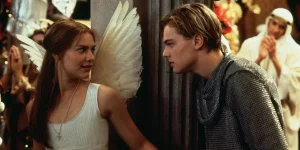
West Side Story draws its primary inspiration from William Shakespeare’s Romeo and Juliet, written around 1594 to 1596. The parallels are direct and intentional: Tony is Romeo, Maria is Juliet, Riff maps to Mercutio, Bernardo to Tybalt, and Anita to the Nurse. Even the false message that triggers the final tragedy mirrors Shakespeare’s plot point of the undelivered letter.
The stage musical premiered on Broadway in 1957, with book by Arthur Laurents, music by Bernstein, lyrics by Sondheim, and choreography and co-direction by Jerome Robbins. Robbins originally conceived the project years earlier as a story about Jewish and Catholic tensions in New York before shifting the focus to Puerto Rican immigration.
The film also reflects the broader social anxieties of postwar America: rapid urban demographic change, juvenile delinquency as a cultural panic, and the complicated politics of assimilation. Moreover, the choice to set the story in a neighborhood facing demolition gave the themes of displacement an almost documentary urgency.
Alternate Endings and Deleted Scenes
No significantly different alternate ending for the 1961 film is part of the documented public record. The filmmakers followed the stage musical’s conclusion closely, and the ending as released aligns with Arthur Laurents’s original theatrical script.
Some choreographed passages were shortened or cut in editing, particularly in the “Cool” number, which in the original stage production appears at a different point in the story. Jerome Robbins’s footage shot before his dismissal was used in the final film, and the transition between his work and Wise’s is generally considered seamless.
Book Adaptations and Differences
West Side Story is not based on a book. It originated as a stage musical, so traditional book-to-film comparison does not apply here. For the record, the musical’s script (referred to in theater as the “book”) was written by Arthur Laurents, and the film adaptation follows it very closely while expanding certain visual and kinetic elements that the stage could not achieve.
One notable structural difference: the placement of “Cool” and “Gee, Officer Krupke” shifted between the stage production and the film. The film places “Cool” after the rumble rather than before it, which slightly alters the dramatic pacing but arguably makes the Jets’ attempt to suppress emotion feel more pointed given what has just occurred.


Memorable Scenes and Quotes
Key Scenes
- The aerial opening shot descending from above Manhattan into the streets of the Upper West Side, establishing scope and beauty before the violence arrives.
- The gym dance, where Tony and Maria’s eyes meet across the room and the world literally blurs around them.
- The fire escape balcony scene, with Tony and Maria singing “Tonight” in the electric New York night.
- The “America” number, bursting with wit, color, and real ideological argument between Anita and Bernardo.
- The rumble under the highway, brutal and kinetic and heartbreaking, ending with two men dead in seconds.
- The “Somewhere” fantasy sequence, achingly tender and aware of its own impossibility.
- Anita’s assault at Doc’s drugstore, one of the most uncomfortable and important scenes in the film.
- Maria’s final speech over Tony’s body, turning grief into furious accusation directed at everyone still standing.
Iconic Quotes
- “Maria… I just met a girl named Maria.” (Tony, capturing infatuation in its purest, most ridiculous form)
- “Every time I look at you, I see what I want to be, and I feel what I want to feel.” (Tony to Maria)
- “Somewhere, there’s a place for us.” (the emotional and thematic heart of the entire film)
- “You all killed him! And my brother, and Riff. Not with bullets, or guns, with hate!” (Maria, in her devastating final address)
- “I am always honest!” (Anita, in “America,” landing the line with absolute conviction)
Easter Eggs and Hidden Details
- The color coding throughout the film is deliberate and consistent: the Jets wear cool blues, greens, and purples while the Sharks favor warmer reds and oranges, visually reinforcing their opposition even in crowd scenes.
- During the opening sequence, the shadow patterns cast on the playground pavement form shapes that subtly echo the later choreography of the gang confrontations.
- The tritone interval, which recurs in Bernstein’s score whenever danger or longing peaks, appears in the very first notes of the overture, signaling unease before a single frame of action appears.
- Jerome Robbins choreographed the finger-snapping opening with the specific intention of making it feel both casual and menacing, a deliberate subversion of what snapping fingers would normally suggest in everyday life.
- The fantasy sequence in “Somewhere” uses a distinctly different visual palette from the rest of the film, bathed in softer, more diffuse light, to signal that this world exists only in imagination.
- Officer Krupke and Lieutenant Schrank represent two different failures of authority: Krupke is oblivious and bumbling while Schrank is consciously cruel and prejudiced. Together they cover the full spectrum of institutional uselessness.
Trivia
- West Side Story won ten out of eleven Academy Awards for which it was nominated, one of the highest win rates in Oscar history.
- Rita Moreno is one of the rare EGOT winners (Emmy, Grammy, Oscar, Tony), and her Oscar for this film started that journey.
- Marni Nixon, who dubbed Natalie Wood’s singing, is one of the most prolific uncredited vocal performers in Hollywood history, also dubbing for Deborah Kerr in The King and I and Audrey Hepburn in My Fair Lady.
- George Chakiris had actually appeared in the London stage production of West Side Story, but in the role of Riff rather than Bernardo.
- The film runs approximately 152 minutes and includes an overture and an intermission, a throwback to the roadshow presentation format common in epic productions of the era.
- Stephen Sondheim initially did not want to write only lyrics; he wanted to compose music as well. Bernstein persuaded him to collaborate, and the partnership produced some of the finest song writing in American musical history.
- Jerome Robbins based elements of his choreographic style on his study of classical ballet, modern dance, and the street movement he observed in New York neighborhoods, giving the gang dances a unique physicality unlike any other Hollywood musical of the period.
- Spielberg’s 2021 remake cast actual Latina actors in the Puerto Rican roles, a direct response to the criticism that the 1961 film used non-Latino actors in key roles, including Natalie Wood herself.
Why Watch?
West Side Story earns its legendary status on every level: the choreography alone justifies the runtime, and Bernstein’s score ranks among the finest in American music. Rita Moreno’s performance as Anita is a masterclass in fire and heartbreak. Moreover, the film’s unflinching look at racism and belonging remains bracingly relevant. Few musicals have ever hit this hard or this beautifully.
Director’s Other Movies
- The Day the Earth Stood Still (1951)
- Executive Suite (1954)
- Somebody Up There Likes Me (1956)
- I Want to Live! (1958)
- The Sound of Music (1965)
- The Sand Pebbles (1966)
- Star Trek: The Motion Picture (1979)
Recommended Films for Fans
- Singin’ in the Rain (1952)
- An American in Paris (1951)
- Romeo and Juliet (1968)
- Cabaret (1972)
- Grease (1978)
- Chicago (2002)
- Moulin Rouge! (2001)
- West Side Story (2021)
- In the Heights (2021)