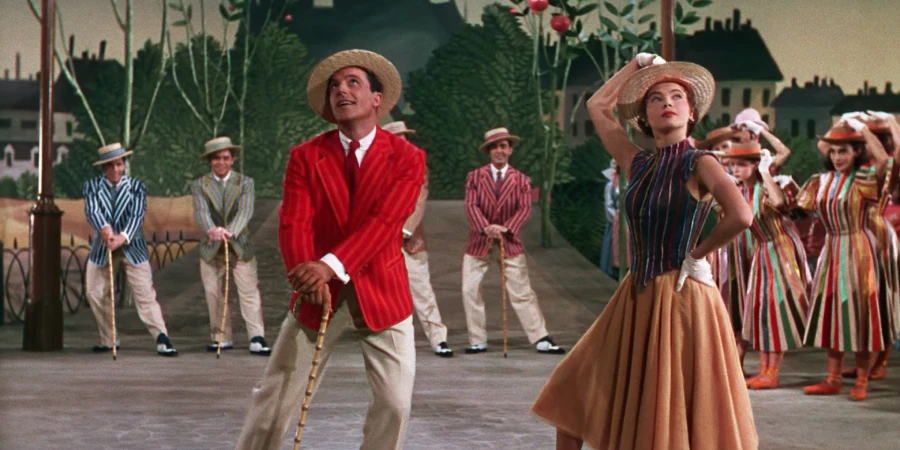

An American in Paris opens with a man talking directly to the camera, cheerfully explaining that he lives in Paris because he simply refuses to leave. That man is Jerry Mulligan, a struggling painter with more charm than money, and his breezy confidence sets the tone for one of Hollywood’s most lavishly romantic musicals. This 1951 MGM production, directed by Vincente Minnelli and starring Gene Kelly, closes with a 17-minute ballet sequence that cost more than most entire films of its era. It remains one of the most audacious creative gambles in studio history.
Detailed Summary
Jerry Mulligan Arrives in Postwar Paris
Jerry Mulligan is an American ex-GI who has stayed in Paris after World War II to pursue his dream of becoming a painter. He lives in a tiny, cleverly designed apartment that converts from bedroom to studio with minimal effort. His life is modest, his prospects uncertain, but his spirit is infectiously optimistic.
Jerry’s social circle includes Adam Cook, a fellow American and concert pianist who narrates parts of the film with dry, witty commentary. Adam observes Parisian life from a detached, ironic distance that contrasts sharply with Jerry’s headlong enthusiasm. Meanwhile, a third American in their orbit is Henri Baurel, a wealthy and charming Frenchman who performs as a singer and entertainer.
Milo Roberts and the Patronage Problem
At an outdoor art display, Jerry catches the attention of Milo Roberts, a wealthy American heiress with a sharp eye and an obvious romantic interest in Jerry. She offers to become his patron, funding his painting career and arranging exhibitions. Jerry, flattered but not entirely naive, accepts the professional arrangement while sensing her personal intentions.
Milo is not a villain. However, her generosity carries an emotional price tag that Jerry is unwilling to pay. Their dynamic creates a quiet tension underneath the film’s sunlit exterior.
Jerry Meets Lise
Jerry first spots Lise Bouvier at a cafe and pursues her with the kind of relentless, charming persistence that 1951 audiences found romantic. Lise resists his advances, initially cold and clearly hiding something. Nonetheless, Jerry keeps at it, and gradually a genuine warmth develops between them.
Their early scenes together crackle with playful energy. Kelly choreographs their flirtation with the same physical precision he brings to his dance numbers. Audiences sense immediately that Lise is the real story, even if the film has not revealed all her cards yet.
Adam, Henri, and the Coincidence at the Center
Adam eventually reveals that his closest French friend is Henri Baurel. Henri, for his part, confides in Adam that he is deeply in love with a girl he plans to marry. In addition, Jerry separately confesses to Adam that he has fallen hard for a mysterious girl named Lise.
Adam puts two and two together before the audience does. Lise is Henri’s girlfriend, the woman he intends to marry. Consequently, Adam finds himself trapped between two friends, knowing a collision is coming but unable to stop it.
Romance Deepens Despite the Obstacle
Jerry and Lise continue to meet secretly, their feelings intensifying with each encounter. She never fully explains her commitment to Henri, and the film implies a debt of loyalty and gratitude rather than passionate love on her part. Furthermore, Henri is genuinely kind and good, which complicates the audience’s sympathies considerably.
One of the film’s most famous sequences arrives here: Jerry teaching a group of neighborhood children to dance and sing “I Got Rhythm” beside the Seine. It is joyful, energetic, and utterly disarming. Kelly’s ease with the children feels completely natural rather than staged.
The Beaux Arts Ball
A lavish costume ball serves as the film’s emotional pressure cooker. Jerry and Lise share a magical, romantic night together, dancing and laughing as though their complications do not exist. For a brief stretch, the film allows them pure happiness.
At the ball, Jerry tells Lise he loves her. She does not deny her own feelings. However, she tells him they cannot be together, and she refuses to explain why, leaving him confused and hurt.
The Truth About Henri
After the ball, Adam finally tells Jerry the truth: Lise is engaged to Henri Baurel, the very friend Jerry knows and likes. Jerry is devastated, not just by the loss but by the irony of the situation. As a result, he spirals into a kind of quiet heartbreak that feels unusually grounded for a musical of this period.
Lise, meanwhile, has made her decision. She will honor her commitment to Henri and leave Paris with him. Her reasons remain somewhat opaque, but the implication is that Henri protected and supported her during the war years in ways she feels obligate her to stay.
The Ballet Sequence
Here is where An American in Paris makes its boldest move. After Jerry watches Lise leave with Henri, he retreats into a dreamlike fantasy: a 17-minute ballet sequence inspired by the paintings of French Impressionist and Post-Impressionist artists. Each segment reimagines Paris through a different artistic style, including the works of Henri Rousseau, Toulouse-Lautrec, Renoir, Van Gogh, and others.
Jerry and Lise dance through these imagined Parisian landscapes, their love fully realized in the world of fantasy even as reality keeps them apart. The sequence is visually stunning and emotionally complex, functioning as Jerry’s interior grief made spectacular and visible. Notably, it cost approximately $450,000 to produce, an extraordinary sum for the time.
Movie Ending
Jerry stands alone on the steps after the fantasy dissolves, the ballet’s euphoria fading back into the cold reality of loss. He stares out at a Paris street, quiet and still, resigned to what he believes is a permanent goodbye. Then something shifts.
Henri approaches Jerry at the bottom of those steps. In a brief but pivotal exchange, Henri reveals that he has released Lise from their engagement. He has understood, with characteristic generosity, that Lise’s heart belongs to Jerry. Henri steps aside willingly, without bitterness, which makes him one of the most gracious figures in the film.
Lise, who had been walking away with Henri toward their future, turns back. She runs toward Jerry. He sees her, races down the steps, and they meet in an embrace as the camera pulls back on the Paris street.
Crucially, the film does not explain Henri’s conversation with Lise in any explicit detail. Audiences simply see the result: a man who loved someone enough to let her go. On the other hand, some viewers have found the ending slightly too convenient, a tidy resolution to a genuinely thorny emotional situation.
What makes the ending resonate is its restraint. No big musical number closes the film. No triumphant reprise of a love song plays. Just two people running toward each other on a quiet Parisian street, which, after 17 minutes of spectacular fantasy, feels almost startlingly real.
Are There Post-Credits Scenes?
An American in Paris contains no post-credits scenes whatsoever. Post-credits scenes were not a feature of Hollywood filmmaking in 1951. The film ends cleanly after Jerry and Lise reunite, and the credits roll without additional footage.
Type of Movie
This film is a musical romance with strong elements of comedy and visual art-inspired fantasy. Its tone is warm, witty, and frequently lighthearted, but it does not shy away from genuine emotional stakes in its second half. In contrast to many musicals of its era, it carries an undercurrent of adult emotional complexity.
Minnelli treats the film as a visual canvas as much as a narrative one. Consequently, the genre classification of “musical” undersells how much the film operates as a piece of cinematic painting. It is glamorous, sophisticated, and deliberately artistic in its ambitions.
Cast
- Gene Kelly – Jerry Mulligan
- Leslie Caron – Lise Bouvier
- Oscar Levant – Adam Cook
- Georges Guetary – Henri Baurel
- Nina Foch – Milo Roberts
Film Music and Composer
Almost all the music in An American in Paris comes from the songbook of George Gershwin, composed well before the film was made. Musical direction and adaptation fell to Johnny Green and Saul Chaplin, who won Academy Awards for their work on the score. Gershwin’s compositions give the film a distinctly American jazz sensibility layered over its Parisian visual identity.
Key musical pieces include “An American in Paris” (the symphonic tone poem that anchors the ballet), “I Got Rhythm,” “‘S Wonderful,” and “Our Love Is Here to Stay.” The decision to use existing Gershwin material rather than commission new songs was producer Arthur Freed‘s, and it proved inspired. Furthermore, Gershwin’s music had already been associated with Paris in the popular imagination, making the marriage feel effortless.
Oscar Levant, who played Adam Cook, was himself a celebrated concert pianist in real life. His scenes performing Gershwin at the piano carry an authenticity that no purely dramatic actor could have matched.


Filming Locations
Despite being a film entirely set in Paris, An American in Paris was shot almost entirely on MGM studio lots in Culver City, California. Paris street scenes, cafe exteriors, and the Seine-side sequences were all elaborate studio constructions. This was standard MGM practice for expensive productions requiring total visual control.
The ballet sequence in particular demanded complete studio control, given its shifting artistic styles and complex lighting requirements. However, production designers worked from extensive photographic references of real Parisian neighborhoods and paintings. As a result, the film creates a Paris that feels emotionally true even if it is geographically fictional.
Some location photography of actual Paris streets was incorporated for background projection elements, lending occasional texture to the studio-built world. The overall effect is a heightened, idealized Paris, more dreamlike than documentary.
Awards and Nominations
An American in Paris won six Academy Awards at the 1952 ceremony, including Best Picture. Its other wins included Best Cinematography (Color), Best Art Direction (Color), Best Costume Design (Color), Best Film Editing, and Best Scoring of a Musical Picture.
The film also received a nomination for Best Director for Vincente Minnelli. Gene Kelly received an honorary Academy Award that same year, specifically acknowledging his versatility as an actor, singer, director, and dancer, partly in recognition of this film’s extraordinary dance work. Its Best Picture win remains one of the most discussed in Oscar history, notably because it beat A Streetcar Named Desire that year.
Behind the Scenes Insights
- Leslie Caron was discovered by Gene Kelly himself, who spotted her performing with the Ballet des Champs-Elysees in Paris. An American in Paris was her Hollywood debut.
- Producer Arthur Freed originally conceived the film as a vehicle to showcase the Gershwin catalog, and the story was constructed around the music rather than the other way around.
- Gene Kelly choreographed all his own dance sequences. His approach combined classical ballet technique with American vernacular dance, a signature fusion he developed throughout his MGM career.
- The 17-minute ballet sequence required six weeks of rehearsal and shooting. It remains one of the longest continuous dance sequences in Hollywood musical history.
- Director Vincente Minnelli brought his background as a Broadway set and costume designer to the production, giving him an unusually strong command of the film’s visual architecture.
- Oscar Levant‘s famous fantasy sequence, in which he imagines himself playing all the instruments and conducting at a Gershwin concert, was largely his own comedic creation, developed in collaboration with the writing team.
- The painting styles used in the ballet sequence were chosen collaboratively by Kelly and Minnelli, who spent weeks studying French Impressionist and Post-Impressionist works as visual reference.
Inspirations and References
George Gershwin composed his orchestral tone poem “An American in Paris” in 1928 after visiting Paris himself. That piece, and its spirit of American wonder at French culture, forms the thematic backbone of the entire film. Producer Arthur Freed built the project around Gershwin’s existing body of work as a tribute to the composer, who had died in 1937.
Minnelli’s visual references extend deeply into French painting. Specifically, the ballet draws on Henri Rousseau’s naive primitivism, Toulouse-Lautrec’s Montmartre energy, and Renoir’s impressionistic warmth, among others. Each artistic world shapes its corresponding dance sequence in color palette, movement style, and staging.
The postwar Paris setting also reflects a broader cultural moment: American artists and writers flooded Paris after World War II, seeking freedom and inspiration. Jerry Mulligan’s character embodies that real historical phenomenon rather than being a purely fictional invention.
Alternate Endings and Deleted Scenes
No widely documented alternate endings for An American in Paris have entered the public record. The film’s conclusion, with Henri releasing Lise and her running back to Jerry, appears to have been the intended and executed ending from early in production. MGM’s archive holds production materials, but no significant alternate cut of the finale has surfaced publicly.
Some early script discussions apparently explored making Henri a less sympathetic character, which would have made the love triangle more conventionally dramatic. However, the creative team decided a generous Henri made for a more sophisticated and emotionally interesting resolution. No deleted scenes from this version have been released in any widely available home media edition.
Book Adaptations and Differences
An American in Paris is not based on a book, novel, or stage play. It is an original screenplay written by Alan Jay Lerner, constructed specifically to showcase the Gershwin catalog. Lerner built the narrative from scratch, inspired by Gershwin’s music and the postwar American-in-Paris cultural moment rather than any pre-existing literary source.


Memorable Scenes and Quotes
Key Scenes
- “I Got Rhythm” street scene: Jerry teaches Parisian children the song using objects and gestures, cycling through different languages with infectious joy beside the Seine.
- The Beaux Arts Ball: Jerry and Lise dance together at a lavish costumed celebration, temporarily free of obligation and consequence, the film’s emotional high-water mark before heartbreak arrives.
- Oscar Levant’s fantasy concert: Adam imagines himself simultaneously performing, conducting, and applauding at a Gershwin concert, one of the most inventive comedic sequences in the film.
- The 17-minute ballet: Jerry dreams his love for Lise into a series of Impressionist paintings come to life, an audacious fusion of dance, painting, and emotional catharsis.
- The reunion on the steps: Henri tells Jerry silently, with dignity, that Lise is free, and she runs back across the Paris street in the film’s quiet, restrained finale.
Iconic Quotes
- “Back home everyone said I didn’t have any talent. They might be saying that here, too, if I could understand what they were saying.” Jerry Mulligan, opening the film with cheerful self-deprecation.
- “That’s quite a dress you almost have on.” Jerry to Milo at their first meeting, establishing his unguarded charm immediately.
- “Adam, I’m in trouble.” Jerry’s understated confession to Adam when he realizes the depth of his feelings for Lise.
Easter Eggs and Hidden Details
- Each segment of the ballet sequence precisely mirrors the color palette and compositional style of the specific painter it references; careful viewers can identify the shift from Rousseau to Lautrec to Renoir by color alone before any visual cue confirms the change.
- Adam Cook’s sardonic running commentary throughout the film echoes the voice and persona of real-life Oscar Levant, who was famous in Hollywood circles for his wit and neurotic self-deprecation; the character is essentially a thinly veiled version of the man playing him.
- Several of the Parisian street backdrops include small details, including signage and storefronts, that art directors modeled directly on specific blocks in Montmartre and Montparnasse from period photographs.
- The Toulouse-Lautrec segment of the ballet stages Jerry as a figure directly reminiscent of the dancer Jane Avril, one of Lautrec’s most famous subjects, a subtle nod that rewards viewers familiar with the paintings.
- Gershwin’s original 1928 orchestral score for “An American in Paris” included actual taxi horns tuned to specific pitches; the film’s musical adaptation preserves this distinctive sonic detail.
Trivia
- Leslie Caron was only 19 years old when filming began. Her ballet training gave her the technical foundation to match Kelly step for step throughout the film’s demanding choreography.
- Gene Kelly reportedly viewed An American in Paris as an opportunity to legitimize dance in cinema as a serious art form, comparable to ballet on the stage.
- The film’s Best Picture Oscar win over A Streetcar Named Desire remains controversial among film historians; many consider it one of the most surprising upsets in Academy Awards history.
- Arthur Freed’s unit at MGM, responsible for this film, also produced Singin’ in the Rain the following year, making 1951-1952 an astonishing back-to-back run for one producing team.
- Alan Jay Lerner, who wrote the screenplay, would go on to write the books and lyrics for My Fair Lady and Camelot, establishing himself as one of Broadway’s defining voices.
- Minnelli shot the film in Technicolor, using the process’s vivid saturation to make the Impressionist-inspired visuals feel like paintings in motion rather than photographic realism.
- Gene Kelly performed all his own stunts and dance sequences with no stunt double, including the physically demanding final ballet, shot largely without cuts to preserve the sense of continuous performance.
Why Watch?
Few films in Hollywood history commit as completely to pure visual ambition as this one does. Its 17-minute ballet alone justifies the viewing, a sequence so visually inventive and emotionally rich that it still astonishes modern audiences. Furthermore, Kelly and Caron generate genuine romantic chemistry, grounding the spectacle in something warm and human. Simply put, this is cinema as art made joyfully, defiantly entertaining.
Director’s Other Movies
- Meet Me in St. Louis (1944)
- Ziegfeld Follies (1945)
- The Clock (1945)
- The Pirate (1948)
- Father of the Bride (1950)
- The Band Wagon (1953)
- Brigadoon (1954)
- Lust for Life (1956)
- Gigi (1958)
Recommended Films for Fans
- Singin’ in the Rain (1952)
- The Band Wagon (1953)
- Funny Face (1957)
- Gigi (1958)
- On the Town (1949)
- Royal Wedding (1951)
- Moulin Rouge (2001)
- La La Land (2016)