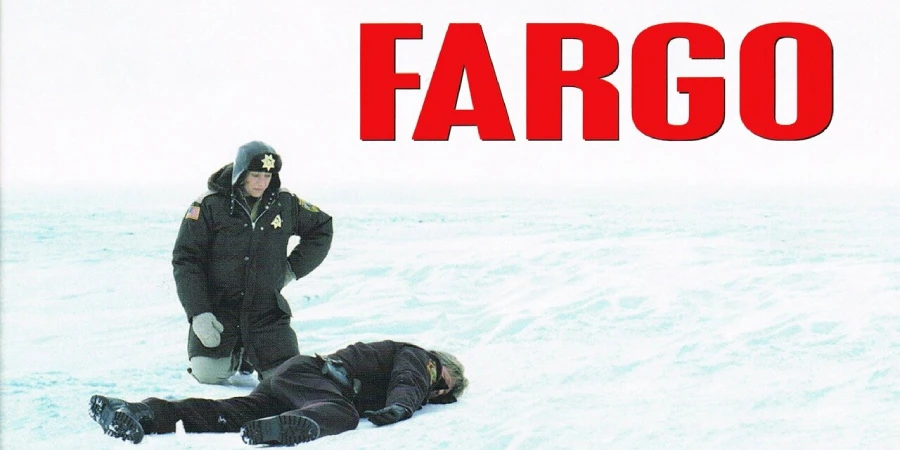

Few crime films dare to open with a disclaimer calling their story “true” and then spend two hours proving that human stupidity is more terrifying than any fictional monster. Fargo (1996), directed by Joel Coen and produced alongside Ethan Coen, is a masterclass in dark comedy and procedural dread, set against a blindingly white Minnesota winter. It gave us one of cinema’s greatest heroines, a woodchipper scene nobody forgets, and a villain so chillingly mundane he makes your skin crawl. This is a film that rewards close attention and punishes the squeamish.
Detailed Summary
Jerry Lundegaard Sets His Terrible Plan in Motion
Jerry Lundegaard, a desperate and financially cornered car salesman in Minneapolis, drives to Fargo, North Dakota, to hire two criminals to kidnap his own wife. His logic is almost laughably thin: he will collect a ransom from his wealthy father-in-law, Wade Gustafson, and use the money to solve his unnamed financial crisis. Jerry is not a mastermind; he is a sweating, stammering man who has made one catastrophic decision too many.
He recruits Carl Showalter and Gaear Grimsrud, two men who could not be more different. Carl talks constantly; Gaear barely speaks at all. In exchange for their services, Jerry promises them cash and a car. From the very first scene, the plan feels like it is already unraveling.
The Kidnapping Goes Wrong Immediately
Carl and Gaear travel to Minneapolis and abduct Jerry’s wife, Jean Lundegaard, from her home. Almost immediately, a routine traffic stop on a snowy highway turns fatal. Gaear shoots a state trooper, then murders two witnesses who happened to drive by at exactly the wrong moment. Three people are dead before the ransom call has even been made.
Meanwhile, Jerry tries to maintain the facade of a worried husband. He contacts Wade as planned, but Wade insists on handling the ransom exchange himself rather than letting Jerry do it. This completely derails Jerry’s scheme, since Jerry needed to pocket the money himself.
Marge Gunderson Takes the Case
Marge Gunderson, the heavily pregnant police chief of Brainerd, Minnesota, arrives at the triple homicide scene with calm, professional authority. She reads the crime scene quickly and accurately, identifying tire tracks and deducing that the killers were headed toward the Twin Cities. Marge is seven months pregnant, cheerful, and sharper than everyone around her. She is also the moral and emotional center of the entire film.
Her investigation brings warmth into an otherwise cold and brutal story. She interviews witnesses, tracks down leads, and maintains a loving, stable home life with her husband Norm, who paints ducks and enters art competitions. Their relationship is genuinely tender, and it grounds the film.
Jerry’s Plan Collapses Further
Wade refuses to stay out of the ransom drop. He shows up at the parking garage exchange himself, briefcase in hand, and Carl shoots him. Carl also takes a bullet to the face, leaving him furious and disfigured. He returns to the cabin where Gaear is holding Jean, and the situation deteriorates rapidly.
Jerry, meanwhile, tries desperately to manage his exposure. He stonewalls investigators, lies to his father-in-law’s associates, and attempts to cover his tracks. However, every move he makes only tightens the noose. His financial crimes at the dealership begin to surface, adding another layer of pressure.
Mike Yanagita and the Subplot That Matters More Than It Seems
Marge meets an old acquaintance, Mike Yanagita, during a trip to Minneapolis. He tells her a sad story about a deceased wife. Later, she learns his entire story was fabricated. This seemingly detached subplot actually sharpens Marge’s instincts; it reminds her that people lie even when there is no obvious reason to, which sends her back to reconsider Jerry’s suspicious behavior.
The Woodchipper
At the lake cabin, Gaear kills Jean and later kills Carl, disposing of Carl’s body in a woodchipper. Marge, following leads to the area, spots Gaear feeding the remains into the machine beside a frozen lake. She orders him to stop; he runs. She shoots him in the leg and apprehends him, loading him into the back of her police cruiser.
Her response to the carnage is not horror or triumph. It is quiet, exhausted bewilderment. She speaks directly to Gaear about how none of this was worth it, citing the beautiful day and the small amount of money involved. It is one of the most quietly devastating monologues in American cinema.

Movie Ending
Jerry Lundegaard gets caught at a roadside motel in a genuinely pathetic final act. Officers arrive and he tries to flee out a window in his underwear, scrambling across a snow-covered parking lot before being tackled. There is no dignity in his arrest, which feels entirely appropriate for a man whose entire scheme was built on self-deception.
Marge returns home to Norm, who has just learned that his duck painting will appear on a three-cent stamp. She congratulates him warmly, even though it is the lower-denomination stamp rather than the prestigious one. This small domestic moment carries enormous emotional weight, because it frames the entire film’s argument: a quiet, honest life is worth more than any amount of money people kill each other over.
Notably, the film ends not with a dramatic flourish but with two people lying in bed in the dark, talking softly about their unborn child. In contrast to every act of greed and violence that preceded it, this ending feels almost radical in its simplicity. Fargo argues, without sentimentality, that decency is its own reward.
Audiences often wonder whether Jean Lundegaard’s death happens on-screen. It does not; her fate is implied rather than shown, which makes it no less devastating. Similarly, Carl’s murder at Gaear’s hands happens off-screen, reinforcing how casually violent Gaear is. The film trusts its audience to understand that the worst moments do not always require explicit depiction.
Are There Post-Credits Scenes?
Fargo contains no post-credits scenes. The film ends and the credits roll without any additional footage. This was standard practice for films of its era, and the Coens had no interest in such conventions regardless.
Type of Movie
Fargo operates primarily as a crime thriller with deep veins of dark comedy running through it. It also functions as a character study and, in its quieter moments, something close to a domestic drama. The tone shifts fluidly between bleakly funny and genuinely disturbing, sometimes within the same scene.
Its pacing is deliberate rather than frenetic. The Coens build tension through mundane detail rather than action set pieces, making every moment of violence feel abrupt and consequential. This tonal control is a signature of their filmmaking.
Cast
- Frances McDormand – Marge Gunderson
- William H. Macy – Jerry Lundegaard
- Steve Buscemi – Carl Showalter
- Peter Stormare – Gaear Grimsrud
- Harve Presnell – Wade Gustafson
- John Carroll Lynch – Norm Gunderson
- Kristin Rudrüd – Jean Lundegaard
- Steve Park – Mike Yanagita
Film Music and Composer
Carter Burwell composed the score for Fargo, as he has done for virtually every Coen Brothers film. His main theme draws heavily from a Norwegian folk song, The Lost Sheep, lending the soundtrack a mournful, sparse quality that perfectly mirrors the frozen landscape. Burwell’s orchestrations tend toward minimalism, using small motifs to create large emotional spaces.
The score avoids conventional thriller music entirely. Instead, it feels elegiac, almost like a lament for the senseless loss that the film depicts. This restraint amplifies the film’s emotional impact considerably.


Filming Locations
Despite the title, very little of Fargo was actually shot in Fargo, North Dakota. Most principal photography took place in Brainerd, Minnesota, and around the Minneapolis-Saint Paul metro area. The production also filmed extensively in Bemidji, Minnesota, and parts of North Dakota near the Fargo area.
The locations are not incidental; they are integral. The flat, featureless snowscapes function almost as a character, emphasizing the isolation and moral emptiness of the world Jerry inhabits. Furthermore, the cold itself becomes a constant presence, slowing movement and making every outdoor scene feel hostile.
Cinematographer Roger Deakins shot the film in a deliberately wide, open style, using the vast white exteriors to make the human figures look small and exposed. This visual approach reinforces one of the film’s central themes: people are fragile, and their schemes even more so.
Awards and Nominations
Fargo earned seven Academy Award nominations, winning two: Best Actress for Frances McDormand and Best Original Screenplay for Joel and Ethan Coen. It also won the Palme d’Or for Best Director at the Cannes Film Festival in 1996, awarded to Joel Coen.
The film received nominations for Best Picture, Best Director, Best Supporting Actor (William H. Macy), Best Cinematography, and Best Film Editing. McDormand’s win was widely considered one of the most deserved of the decade. Consequently, her performance as Marge became the benchmark against which all future Coen protagonists were measured.
Behind the Scenes Insights
- The Coens wrote the role of Marge Gunderson specifically for Frances McDormand, Joel Coen’s wife. They tailored the character’s warmth and intelligence to her particular strengths as a performer.
- William H. Macy lobbied intensely for the role of Jerry Lundegaard, reportedly telling the Coens he would be devastated if they cast someone else. His persistence paid off.
- Production faced extreme weather challenges. Temperatures on location regularly dropped far below freezing, making outdoor scenes physically grueling for cast and crew.
- Peter Stormare prepared for Gaear’s near-total silence by maintaining minimal communication with his co-stars during filming, particularly with Steve Buscemi.
- Roger Deakins used anamorphic lenses to capture the wide, flat landscapes, giving the film a scope that contrasted sharply with its intimate, small-scale story.
- The woodchipper scene, now iconic, was shot in genuinely freezing conditions. The physical and logistical challenges of that single sequence were considerable.
Inspirations and References
Fargo opens with a title card claiming it is based on a true story. This claim is fictitious; the Coens invented it deliberately to create a particular frame of mind in the audience. They wanted viewers to feel the weight of real-world consequence rather than the safety of pure fiction.
The Coens have cited various true crime cases as loose inspirations for the film’s general atmosphere, though no single case directly maps onto the plot. The American Midwest itself was a primary creative source; the filmmakers wanted to explore how extreme violence erupts within ordinary, polite communities. In addition, the film engages with a long tradition of noir crime fiction, subverting many of its genre conventions.
Alternate Endings and Deleted Scenes
No confirmed alternate endings for Fargo exist in the public record. The Coens are famously private about their editing process and rarely discuss cut material in detail. As a result, no significant deleted scenes have been officially released or documented.
The film as released is considered the Coens’ definitive vision. They have not released director’s cuts or extended editions of Fargo, which aligns with their general approach to their body of work.
Book Adaptations and Differences
Fargo is not based on a book. It is an original screenplay written by Joel and Ethan Coen. Therefore, there are no source text comparisons to draw. The “true story” framing device in the film is a creative choice, not a reference to any published account.

Memorable Scenes and Quotes
Key Scenes
- The opening drive to Fargo through a completely white, featureless blizzard, establishing the film’s tone instantly
- The roadside triple murder, where Gaear’s sudden, casual violence sets the stakes of the entire film
- Marge’s first arrival at the crime scene, reading tire tracks and footprints with quiet, confident precision
- The parking garage ransom exchange, where Wade’s stubbornness gets him killed and Carl takes a bullet to the face
- Marge’s confrontation with Jerry at the dealership, where his nervous tics and evasions practically scream guilt
- The woodchipper scene, which remains one of cinema’s most unsettling and darkly absurd images
- Marge’s monologue to Gaear in the police cruiser, asking quietly why he did it all for a little money
- The final bedroom scene between Marge and Norm, tender and utterly unheroic in the best possible way
Iconic Quotes
- “And I guess that was your accomplice in the woodchipper.” (Marge Gunderson)
- “There’s more to life than a little money, you know. Don’t you know that? And here ya are, and it’s a beautiful day.” (Marge Gunderson)
- “I’m not gonna debate you, Jerry.” (Wade Gustafson)
- “We’re doin’ pretty good.” (Norm Gunderson, on the stamp)
- “I’m cooperating here!” (Jerry Lundegaard, almost every time he is cornered)
Easter Eggs and Hidden Details
- The name “Gustafson” appears in several Coen Brothers films; they reuse names and minor references across their work as a running in-joke for attentive viewers.
- Gaear is almost always shown eating. Every scene in which he appears features him consuming something, a subtle visual joke about his animal appetites and total lack of interior life.
- The three-cent stamp subplot involving Norm’s duck painting is a deliberate callback to the film’s opening dedication: “For Hank Lange.” Small, unglamorous contributions still matter.
- Jerry’s frequent use of the phrase “yeah” as a stalling tactic is a scripted character detail; it appears dozens of times and signals his constant state of improvised deception.
- The vast emptiness of the Minnesota landscapes mirrors the moral vacancy of characters like Jerry and Carl, a visual metaphor the Coens embed without drawing attention to it.
- Carl buries most of the ransom money in the snow along a fence line, marking it with an ice scraper. This buried money is later referenced in the Fargo television series as a recurring mythology element.
Trivia
- Frances McDormand wore a prosthetic pregnancy belly throughout filming. She has said the physical constraint actually helped her find Marge’s particular gait and posture.
- Steve Buscemi’s character Carl is famously talkative, while Peter Stormare’s Gaear speaks only about a dozen lines across the entire film.
- The film was shot in approximately 58 days, a relatively tight schedule for a production of its scope and weather-related complexity.
- Despite winning the Palme d’Or at Cannes, Fargo was not selected as the American entry for the Academy Award for Best Foreign Language Film, since it is an English-language production.
- William H. Macy based aspects of Jerry’s physical nervousness on his own experience with anxiety, channeling genuine discomfort into the character’s sweaty, fidgeting performance.
- The Coen Brothers wrote the screenplay in a remarkably short time. They have described it as one of the easier scripts they have produced, given how clearly they could hear the characters’ voices from the start.
- Joel and Ethan Coen grew up in Minnesota, which gave them firsthand knowledge of the regional accent, social manners, and landscape that define the film’s world.
Why Watch?
Fargo is simply one of the finest American films of the 1990s, offering a rare combination of genuine wit, moral seriousness, and breathtaking craft. Frances McDormand’s Marge Gunderson ranks among cinema’s most fully realized characters, and the film around her is equally exceptional. Moreover, it proves that a story about good people doing good work can be just as compelling as any tale of glamorous villainy.
Director’s Other Movies
- Blood Simple (1984)
- Raising Arizona (1987)
- Miller’s Crossing (1990)
- Barton Fink (1991)
- The Hudsucker Proxy (1994)
- The Big Lebowski (1998)
- O Brother, Where Art Thou? (2000)
- No Country for Old Men (2007)
- Burn After Reading (2008)
- True Grit (2010)
- Inside Llewyn Davis (2013)
- Hail, Caesar! (2016)
- The Ballad of Buster Scruggs (2018)