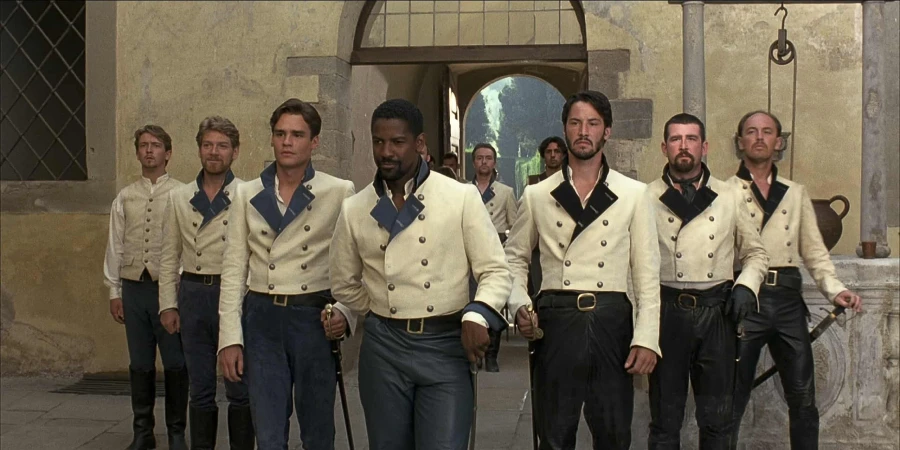
Kenneth Branagh took Shakespeare’s sunniest comedy and turned it into a full-blooded, wine-soaked celebration of love, deception, and spectacularly bad decision-making. Shot in the Tuscan countryside with a cast that looks like it is genuinely having the time of its life, this 1993 adaptation strips away the dusty academic reverence and replaces it with something warm, fast, and completely alive. Every frame insists that Shakespeare was always meant to feel this good. It is, frankly, one of the most purely enjoyable Shakespeare films ever committed to celluloid.
Detailed Summary
A Triumphant Arrival in Messina
Soldiers return victorious to the estate of Leonato, governor of Messina. Among them are the noble Don Pedro, the young soldier Claudio, and the sharp-tongued Benedick. Their arrival sets the entire household buzzing with excitement.
Almost immediately, Benedick and Beatrice, Leonato’s niece, resume their ongoing war of words. Their bickering is too specific, too charged, and too joyful to be simple hostility. Everyone around them can see what they cannot.
Claudio Falls Hard and Don Pedro Steps In
Claudio confesses to Don Pedro that he has fallen deeply in love with Hero, Leonato’s daughter. Don Pedro, charming and generous, offers to woo Hero on Claudio’s behalf during the evening’s masked ball. It is a well-intentioned plan that immediately invites trouble.
Meanwhile, Don John, Don Pedro’s illegitimate and deeply resentful brother, learns of Claudio’s feelings. Don John decides to sabotage the match purely out of spite. His motivation is not complex; he simply hates happiness that he cannot control.
The Masked Ball and Don John’s First Scheme
At the masked ball, Don Pedro successfully woos Hero for Claudio. However, Don John intercepts Claudio and, pretending to mistake him for Benedick, claims Don Pedro is wooing Hero for himself. Claudio briefly believes it and spirals into jealousy.
Don Pedro clears up the misunderstanding quickly. Consequently, Leonato gives his blessing, and Claudio and Hero become engaged. The romantic plot resolves almost as fast as the obstacle arrived, which is entirely intentional.
The Great Conspiracy to Unite Benedick and Beatrice
Don Pedro hatches a far more entertaining scheme: trick Benedick and Beatrice into falling in love by convincing each that the other is already secretly devoted to them. Everyone enthusiastically joins in. This is the comedic engine that drives the entire film.
Benedick overhears Don Pedro, Claudio, and Leonato staging a loud conversation in the garden about how desperately Beatrice loves him. Branagh’s physical comedy here is genuinely extraordinary. Benedick contorts himself through bushes and nearly drowns in a bird bath trying not to be detected.
In contrast, Hero and her attendant Margaret stage a similar conversation for Beatrice’s benefit. Beatrice listens from behind a fountain and is equally undone. Both characters immediately resolve to return the other’s supposed love, convinced they are nobly responding to genuine feeling.
Don John’s Devastating Deception
Don John escalates his scheming before Claudio and Hero’s wedding. He tells Claudio and Don Pedro that Hero is unfaithful. To prove it, he arranges for them to watch Borachio, his confederate, at Hero’s window at night, speaking intimately with a woman they believe to be Hero.
In reality, the woman is Margaret, who participates unknowingly. Claudio and Don Pedro are convinced. Both men decide to publicly shame Hero at the altar the next morning.
The Catastrophic Wedding Scene
At the altar, Claudio publicly denounces Hero in brutal terms. He returns her to her father, accusing her of being unchaste and corrupt. Don Pedro supports his claim, and Hero faints from the shock.
Leonato initially believes the accusation and erupts in shame and fury at his own daughter. Only Beatrice, Friar Francis, and Benedick retain any faith in Hero. Friar Francis proposes a plan: announce that Hero has died from the shock of the accusation.
His reasoning holds that grief will soften Claudio’s heart and buy time to discover the truth. Leonato reluctantly agrees. Hero’s death is announced, and the formal mourning begins.
Benedick Chooses a Side
In one of the film’s most emotionally loaded moments, Beatrice challenges Benedick to prove his love by demanding he kill Claudio. Benedick must choose between his closest friendship and his loyalty to Beatrice and to justice. He chooses Beatrice and confronts Claudio with a formal challenge.
This scene transforms the film’s tone completely. What began as a romantic comedy now carries genuine moral weight. Benedick’s decision reveals that his love is not just witty banter; it carries real cost.
Dogberry Fumbles Toward the Truth
Meanwhile, the bumbling constable Dogberry and his watch have accidentally arrested Borachio and his companion Conrade overnight. Borachio drunkenly boasts about his deception to Conrade, and the watchmen overhear everything. However, Dogberry’s comically incompetent attempts to report this to Leonato nearly bury the vital information entirely.
Eventually, Borachio confesses directly and implicates Don John. The truth surfaces not through noble investigation but through sheer comedic accident. Don John, sensing exposure, has already fled Messina.
Movie Ending
Claudio, stricken with guilt when Borachio confesses publicly, agrees to Leonato’s condition: he must marry Leonato’s “niece,” a woman he has never seen, as penance for destroying Hero. He accepts without complaint, which is about as close to genuine remorse as a man of his era could demonstrate.
At the second wedding ceremony, the veiled woman is revealed to be Hero herself, very much alive. Claudio’s shock and relief are enormous. Hero forgives him, the ceremony proceeds, and the couple reconciles in full view of everyone who witnessed her earlier humiliation.
Simultaneously, Benedick and Beatrice are caught out: both discover that the other’s love letters (which each claimed to have written only out of pity for the other’s supposed devotion) are produced as evidence. Their brilliant self-defenses collapse immediately. They surrender to each other with tremendous good humor, choosing to stop fighting and start living.
News arrives that Don John has been captured. Benedick, in a wonderfully characteristic move, waves off any immediate punishment and insists they dance first. The film ends with an explosion of music, dancing, and sunlight. It is a conclusion that earns every note of its joy because the film never pretended the road there was without real pain.
Furthermore, the ending works precisely because it does not erase the damage Claudio caused. Hero forgives him, but the audience remembers. Branagh keeps both the celebration and the sting in play at the same time, which is exactly what Shakespeare intended.
Are There Post-Credits Scenes?
No post-credits scenes exist in this film. Branagh closes on the dancing and celebration, and the credits roll over that same festive energy. Nothing follows.
Type of Movie
This is a romantic comedy with genuine dramatic weight. Branagh pitches the tone as warm and sun-drenched but never trivial. Moments of real cruelty and grief punctuate the laughter without destroying it.
In contrast to many Shakespeare adaptations that treat comedy as lightweight, Branagh treats every genre note seriously. As a result, the film functions equally well as a romance, a comedy, and a brief but cutting examination of honor and shame.
Cast
- Kenneth Branagh – Benedick
- Emma Thompson – Beatrice
- Kate Beckinsale – Hero
- Robert Sean Leonard – Claudio
- Denzel Washington – Don Pedro
- Keanu Reeves – Don John
- Michael Keaton – Dogberry
- Richard Briers – Leonato
- Brian Blessed – Antonio
- Imelda Staunton – Margaret
- Phyllida Law – Ursula
- Ben Elton – Verges
- Gerard Horan – Borachio
- Richard Clifford – Conrade
Film Music and Composer
Patrick Doyle composed the score, continuing his close collaboration with Branagh that produced some of the most beloved film music of the early 1990s. Doyle’s work here is light, Mediterranean in flavor, and built around a central theme of romantic yearning that never tips into sentimentality.
Notably, the song Sigh No More opens the film, sung by a woman relaxing in the Tuscan sun before the soldiers arrive. Doyle composed the setting for the original Shakespeare lyric, and it establishes the film’s entire emotional key in under two minutes. It is a remarkable piece of scene-setting.
Doyle is Scottish-born and trained in classical music before his film career took hold. His recurring partnership with Branagh produced scores for several Shakespeare adaptations, and his work here remains among his warmest and most accessible.

Filming Locations
Principal photography took place at Villa Vignamaggio, a 14th-century estate in the Chianti region of Tuscany, Italy. Branagh chose the location for its authentic Renaissance atmosphere and its extraordinary natural beauty. The vineyards, gardens, and stone architecture do enormous work in grounding the play’s world.
Moreover, the choice of a real working Tuscan estate rather than a constructed set gives the film a tactile, lived-in quality that studio work rarely achieves. Sunlight bounces off actual stone. Vines are actually growing. The location is not decorative; it actively participates in the film’s mood.
Interestingly, Villa Vignamaggio has historical connections to the Renaissance period itself, which makes Branagh’s choice feel less like a location scout decision and more like a deliberate act of historical imagination.
Awards and Nominations
Emma Thompson received a BAFTA nomination for her performance as Beatrice. Patrick Doyle’s score also received attention from various critics’ bodies. However, the film did not secure major awards wins at the largest ceremonies, which remains one of cinema’s more puzzling oversights.
Behind the Scenes Insights
- Branagh assembled the cast through a combination of longtime collaborators and Hollywood stars specifically to broaden the film’s commercial appeal beyond traditional Shakespeare audiences.
- Keanu Reeves faced significant criticism for his performance as Don John, with many reviewers finding his American accent and delivery jarring against the ensemble. Branagh defended his casting publicly.
- Michael Keaton’s interpretation of Dogberry was largely improvised in character; his eccentric physical choices were his own and divided critical opinion sharply.
- Branagh and Emma Thompson were married at the time of filming, which many critics noted added genuine warmth and credibility to Benedick and Beatrice’s history together.
- The opening sequence, in which the women bathe and the soldiers ride in on horseback, was designed deliberately to signal that this would be a physical, sensory, and uninhibited production.
- Branagh adapted the text himself, cutting it significantly for pace while retaining all the major plot beats and most of the famous speeches.
- Shooting in the Tuscan summer heat reportedly made conditions physically demanding, particularly for scenes requiring full period costume.
Inspirations and References
The film adapts William Shakespeare’s stage play Much Ado About Nothing, written around 1598 to 1599. Shakespeare himself drew on earlier Italian sources, including prose tales from Matteo Bandello’s Novelle, for the Hero and Claudio deception plot.
Branagh’s specific inspiration for the visual style came from his love of Italian Renaissance painting and his desire to make Shakespeare feel as instinctively Mediterranean as it actually is. He wanted audiences to feel the heat, the wine, and the idleness of a society between wars.
Similarly, earlier screen adaptations of the play informed Branagh’s choices, particularly in how he approached the pacing of the Benedick and Beatrice scenes, which he wanted to feel spontaneous rather than recited.
Alternate Endings and Deleted Scenes
No widely documented alternate endings or significant deleted scenes have entered the public record for this production. Branagh’s editorial approach on this film was tight and purposeful, and no substantial cut material has been discussed in major interviews or supplements.
Some trimming of Shakespeare’s original text occurred during the screenplay adaptation process, but this involved condensing scenes rather than filming and removing alternate narrative conclusions.
Book Adaptations and Differences
This film adapts a stage play, not a novel. Shakespeare’s Much Ado About Nothing is the source text, and Branagh remains broadly faithful to its structure and language. His main interventions are cuts for pace and the addition of visual storytelling that the stage cannot provide.
One notable shift involves the opening: Branagh adds the visual sequence of the women bathing and the soldiers’ arrival as a cinematic prologue that the play cannot stage. This expansion earns its place immediately. It sets up character dynamics before a single line of dialogue lands.
Memorable Scenes and Quotes
Key Scenes
- Benedick hiding in the garden, contorting through bushes and nearly submerging himself in a fountain to avoid detection while eavesdropping on the staged conversation about Beatrice’s love.
- Beatrice listening from behind the garden fountain as Hero and Margaret discuss Benedick’s supposed devotion, her expression shifting from skepticism to genuine emotion.
- Claudio’s public denunciation of Hero at the altar, shot in harsh daylight with nowhere to hide, making the cruelty feel as exposed and raw as possible.
- Beatrice telling Benedick to kill Claudio, her voice breaking between rage and grief, transforming the film’s comic register in a single moment.
- The final revelation of Hero alive and veiled at the second wedding ceremony, and Claudio’s stunned recognition.
- The closing celebration, a full explosion of dancing, music, and sunlight that functions as a collective exhale after the film’s emotional journey.
Iconic Quotes
- “I do love nothing in the world so well as you. Is not that strange?” (Benedick to Beatrice)
- “Kill Claudio.” (Beatrice to Benedick, two words that carry the full weight of the film’s dramatic shift)
- “I had rather hear my dog bark at a crow than a man swear he loves me.” (Beatrice)
- “Sigh no more, ladies, sigh no more, men were deceivers ever.” (from the opening song, setting the film’s central irony immediately)
- “For which of my bad parts didst thou first fall in love with me?” (Benedick to Beatrice in their final reconciliation)
Easter Eggs and Hidden Details
- Villa Vignamaggio is reputed to be the birthplace of Lisa Gherardini, the woman believed by some historians to have been the model for Leonardo da Vinci’s Mona Lisa. Branagh almost certainly knew this when choosing the location.
- Dogberry’s watch carries absurdly inadequate weapons and equipment, a visual joke that underscores how laughably unqualified they are to serve as law enforcement.
- During the masked ball sequence, several characters wearing masks make eye contact with people who should theoretically not recognize them, a visual wink at the play’s repeated joke that disguise is both effective and completely transparent.
- Patrick Doyle makes a cameo appearance in the film as Balthasar, the musician who performs Sigh No More at Don Pedro’s request. Composer and composer character are one and the same.
- Branagh frames many of the garden eavesdropping scenes with architectural symmetry, placing the listening character in a formally balanced composition to visually reinforce how carefully these traps were set.
Trivia
- This was Kate Beckinsale’s feature film debut, making her entrance into cinema as one of Shakespeare’s most put-upon heroines.
- Denzel Washington and Keanu Reeves, playing brothers, were both significant Hollywood stars at the time of filming, and their casting generated considerable pre-release attention.
- Branagh shot the film in roughly six weeks, an extremely tight schedule for a period production of this scope.
- Emma Thompson won the Academy Award for Best Actress for The Remains of the Day the same year this film released, making 1993 a remarkable year for her professionally.
- The film was produced partly through Branagh’s own production company, giving him significant creative control over the final cut.
- Branagh insisted on having the entire cast learn their lines completely before arriving on set, so that the rehearsal period in Tuscany could focus on performance rather than text.
- Michael Keaton based elements of his Dogberry characterization on observations of real people, resulting in a performance that feels almost entirely disconnected from the surrounding film, which is arguably exactly correct for the character.
Why Watch?
Few Shakespeare adaptations match this film’s ability to make four centuries of language feel like something happening right now, in real sunlight, between real people. Branagh and Thompson alone would justify the viewing, but every frame rewards attention. This is joyful, humane filmmaking that also carries genuine emotional teeth.
Director’s Other Movies
- Henry V (1989)
- Dead Again (1991)
- Peter’s Friends (1992)
- Mary Shelley’s Frankenstein (1994)
- Hamlet (1996)
- Love’s Labour’s Lost (2000)
- Sleuth (2007)
- Thor (2011)
- Cinderella (2015)
- Murder on the Orient Express (2017)
- Belfast (2021)
- Death on the Nile (2022)
Recommended Films for Fans
- Henry V (1989)
- Romeo + Juliet (1996)
- Hamlet (1996)
- A Midsummer Night’s Dream (1999)
- 10 Things I Hate About You (1999)
- Destination Wedding (2018)
- Shakespeare in Love (1998)
- Much Ado About Nothing (2012)
- Sense and Sensibility (1995)