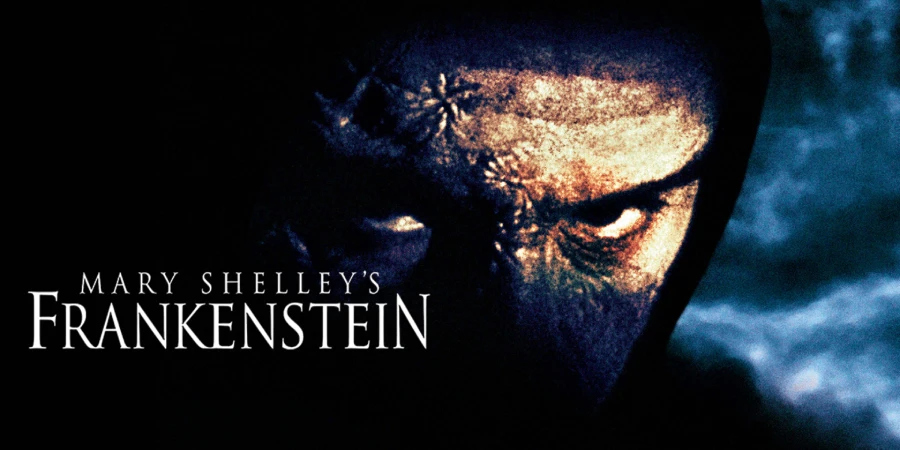

Mary Shelley’s Frankenstein (1994) does something most horror films refuse to attempt: it takes the monster seriously. Directed by Kenneth Branagh and starring Robert De Niro as the Creature, this ambitious adaptation swings hard for tragedy and occasionally lands the blow. It is messy, operatic, and deeply earnest, which makes it far more interesting than its mixed critical reception suggests.
Detailed Summary
The Arctic Framing Device
Captain Robert Walton (played by Aidan Quinn) leads an Arctic expedition when his ship becomes trapped in ice. He encounters a frostbitten, obsessed man pursuing something across the frozen wasteland. That man is Victor Frankenstein, and he agrees to tell Walton his story before it is too late.
This framing device mirrors the novel closely. It places the entire narrative inside a dying man’s confession, giving every scene a weight of inevitability.
Victor’s Origins and Education in Geneva
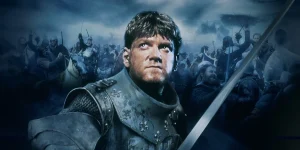
Victor Frankenstein (Kenneth Branagh) grows up in Geneva surrounded by wealth, family, and the loving presence of his adopted sister Elizabeth (Helena Bonham Carter). His mother dies in childbirth, and that loss burns itself into his psyche. From that moment, Victor wages a private war against death itself.
He heads to Ingolstadt University where he studies under Professor Waldman (John Cleese, in a surprisingly restrained performance). Waldman’s notes on reanimation ignite Victor’s obsession. Moreover, Waldman’s murder by a deranged patient gives Victor access to those forbidden research materials.
The Creation Scene
Victor builds his Creature from stitched-together corpses, obsessively assembling a body in a chaotic laboratory filled with tanks of amniotic fluid. He uses electric eels as a power source, a vivid and memorably grotesque visual choice. In contrast to earlier film versions, this creation sequence is wet, visceral, and deeply uncomfortable to watch.
When the Creature lurches to life, Victor recoils in horror. He abandons his creation immediately, fleeing the lab. Consequently, the Creature enters the world utterly alone, without guidance or compassion.
The Creature’s Education and Suffering
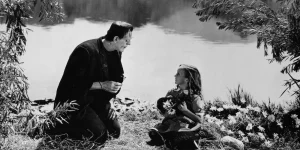
The Creature survives alone, eventually sheltering near a family called the De Laceys. He secretly observes them for months, learning language, reading, and human emotion by watching their daily lives. This section of the film carries the story’s real emotional core.
He reads Paradise Lost and begins to identify with the fallen Adam, abandoned by his creator. He finally reveals himself to the blind father, hoping for acceptance. However, the family returns and drives him away in terror, destroying his one chance at connection.
The Creature Confronts Victor
Broken and furious, the Creature tracks Victor to the Alps. Their confrontation on the ice is the film’s moral centerpiece. The Creature demands that Victor acknowledge his responsibility and create a companion for him.
Victor initially refuses, but he eventually agrees. He returns to his work, promising to build a female companion. That promise becomes the pivot point on which every remaining tragedy turns.
William’s Murder and Justine’s Execution
Before Victor can fulfill his promise, the Creature kills William, Victor’s young brother. He plants evidence on Justine, an innocent servant, who is consequently hanged for the crime. Victor knows the truth but stays silent, paralyzed by guilt and fear of exposure.
This sequence establishes the Creature not as a mindless monster but as a being capable of calculated cruelty born from genuine pain. Furthermore, it shows Victor’s cowardice at its most damning.
Victor Breaks His Promise
Victor begins constructing a female Creature, using Justine’s corpse as the physical basis. He works in the Scottish Highlands, haunted by what he is doing. At the last moment, he destroys his creation, fearing a race of monsters.
The Creature witnesses this betrayal and swears revenge. His warning is chilling and direct: he will be with Victor on his wedding night. Victor hears this as a threat against himself. He is catastrophically wrong.
Elizabeth’s Death and Victor’s Descent
Victor and Elizabeth marry. On their wedding night, the Creature murders Elizabeth by tearing out her heart. Victor is left screaming over her body in one of the film’s most operatically brutal moments.
Grief and rage now fully consume Victor. He refuses to accept her death. Instead, he carries her body back to his laboratory and attempts to reanimate her.
Movie Ending
Victor succeeds in reanimating Elizabeth, but the result is horrifying for everyone involved. She wakes confused, her stitched-together face reflecting multiple bodies used in her reconstruction. Both Victor and the Creature reach for her simultaneously, each claiming her as theirs.
Elizabeth, overwhelmed and unable to process what she has become, grabs a torch and sets herself on fire. She burns to death in front of both men. This moment, arguably the film’s most devastating, functions as the story’s true moral conclusion: tampering with death produces only more suffering.
Victor pursues the Creature into the Arctic, which returns us to Walton’s framing narrative. Victor dies aboard Walton’s ship, his obsession finally extinguished along with his body. He never achieves peace, never receives absolution, and never fully acknowledges the scale of his responsibility.
Walton and his crew find the Creature mourning over Victor’s body. The Creature, notably, does not celebrate. He has lost the only being who shared his strange existence, however bitterly. In the film’s final image, the Creature builds a funeral pyre on the ice and presumably burns alongside his creator, choosing death over continued isolation.
This ending closely follows Shelley’s novel and lands its point firmly: creator and creation are mirror images, bound together until destruction. Neither man nor monster can exist without the other, and neither can survive without consequence.
Are There Post-Credits Scenes?
Mary Shelley’s Frankenstein contains no post-credits scenes whatsoever. The film ends on the Arctic pyre, and the credits roll without any additional footage. You can safely leave when the ice fades to black.
Type of Movie
This film occupies a specific and unusual tonal space: it is a gothic horror drama with strong elements of tragedy and romantic melodrama. Branagh approaches the material the way he approaches Shakespeare, with maximum theatrical intensity. Some find this exhausting; others find it thrilling.
In contrast to the Universal monster movies of the 1930s, this version actively resists camp. It aims for emotional devastation rather than simple fright. The tone is relentlessly serious, occasionally tipping into self-parody without ever quite intending to.
Cast
- Kenneth Branagh – Victor Frankenstein
- Robert De Niro – The Creature
- Helena Bonham Carter – Elizabeth
- Tom Hulce – Henry Clerval
- Aidan Quinn – Captain Robert Walton
- Ian Holm – Alphonse Frankenstein
- John Cleese – Professor Waldman
- Robert Hardy – Professor Krempe
- Cherie Lunghi – Caroline Frankenstein
- Richard Briers – De Lacey
Film Music and Composer
Patrick Doyle composed the score, continuing his fruitful collaboration with Kenneth Branagh. Doyle brings a sweeping, romantic sensibility to the music, favoring large orchestral forces and emotionally direct themes. His work here mirrors the film’s operatic ambitions.
Notable cues accompany the creation sequence and the Arctic finale, where Doyle’s music swells to genuinely moving effect. He studied at the Royal Scottish Academy of Music and Drama and had previously scored Branagh’s Henry V and Much Ado About Nothing. His background in theatrical music suits this material perfectly.
Filming Locations
Principal photography took place at Shepperton Studios in England, where the elaborate laboratory and interior sets were constructed. The production design team built the amniotic-fluid creation chamber entirely on a soundstage. This controlled environment allowed for the precise technical work the creation sequence demanded.
Exterior scenes used locations across Scotland and the Swiss Alps, reinforcing the story’s European gothic atmosphere. The ice-bound Arctic sequences were achieved through a combination of location work and studio photography. Consequently, the film maintains a consistent visual coldness even in its warmest moments.
Awards and Nominations
Mary Shelley’s Frankenstein received a nomination for Best Makeup at the Academy Awards but did not win. Its reception was largely critical rather than celebratory on the awards circuit, and it did not make a significant mark during the 1994 to 1995 awards season.
Behind the Scenes Insights
- Robert De Niro spent considerable time working with makeup artists to develop the Creature’s scarred, stitched appearance, sitting for extensive prosthetic sessions before filming began.
- Kenneth Branagh both directed and starred in the film simultaneously, a demanding dual role that he described as one of the most physically and mentally exhausting experiences of his career.
- De Niro reportedly prepared for the role by studying the movement patterns of people with physical disabilities, wanting the Creature’s physicality to feel genuine rather than theatrical.
- Producer Francis Ford Coppola brought the project together following the commercial and critical success of his own gothic adaptation, Bram Stoker’s Dracula (1992).
- Helena Bonham Carter later expressed some frustration with how Elizabeth was written, feeling the character existed primarily to serve Victor’s emotional arc rather than her own.
- The creation sequence required weeks of filming and involved a significant amount of practical effects work, with Branagh himself slipping and sustaining a minor injury during one of the more physically demanding shots.
Inspirations and References
Mary Shelley published Frankenstein; or, The Modern Prometheus in 1818, and that novel serves as the film’s direct source material. Branagh and screenwriter Steph Lady worked with Frank Darabont on the screenplay, aiming to restore elements that earlier adaptations had discarded. Their primary inspiration was fidelity to Shelley’s themes of responsibility, isolation, and the ethics of creation.
Shelley herself drew on John Milton’s Paradise Lost, Enlightenment scientific debates, and the galvanism experiments of Luigi Galvani, all of which the film references directly. The film also implicitly engages with Coppola’s Bram Stoker’s Dracula as a template for serious literary horror adaptation. Furthermore, Branagh’s theatrical background informed his decision to treat the material as classical tragedy rather than genre entertainment.
Alternate Endings and Deleted Scenes
No widely documented alternate ending exists for Mary Shelley’s Frankenstein. The film’s conclusion aligns closely with Shelley’s source novel, suggesting the filmmakers committed to that ending from early in production.
Some scenes involving the De Lacey family were reportedly trimmed during editing to maintain pacing. Additionally, certain sequences developing Henry Clerval’s friendship with Victor were shortened, which reduced Tom Hulce’s screen time noticeably. These cuts weakened the emotional impact of Clerval’s eventual fate.
Book Adaptations and Differences
Mary Shelley’s Frankenstein adapts the 1818 novel directly and restores several key elements that earlier film versions famously omitted. The De Lacey subplot, the Arctic framing device, and the Creature’s eloquence all appear here in recognizable form. In contrast to the Boris Karloff version, this Creature speaks, reasons, and philosophizes at length.
However, the film introduces the reanimated Elizabeth subplot, which does not appear in Shelley’s novel. In the book, Elizabeth simply dies and stays dead. Branagh’s addition amplifies the horror and gives Victor an extra layer of monstrousness, but it diverges from Shelley’s intentions in a significant way.
Similarly, the film compresses the Creature’s self-education timeline and simplifies several of Victor’s early academic relationships. Some of Shelley’s most interesting epistolary structure is necessarily lost in translation to the screen. On the whole, though, this remains one of the more faithful adaptations of the source material.
Memorable Scenes and Quotes
Key Scenes
- The creation sequence, with Victor and the Creature thrashing in a sea of amniotic fluid, remains one of the most visually audacious scenes in 1990s horror cinema.
- The Creature’s first approach to the blind De Lacey, tentative and desperate for acceptance, delivers the film’s most genuinely heartbreaking moment.
- Elizabeth’s self-immolation after her reanimation, grabbing a torch and ending her own tormented second life, lands as the story’s moral gut-punch.
- The Alpine confrontation between Victor and the Creature, conducted against spectacular mountain scenery, gives both actors space to articulate their competing moral positions.
- Victor’s silent grief over his dead mother in the early scenes establishes his psychological wound with economy and clarity.
Iconic Quotes
- “Did you ever consider the consequences of your actions? You gave me life, and then you left me to die.” (The Creature to Victor)
- “I do know that for the sympathy of one living being, I would make peace with all.” (The Creature)
- “Nothing is so painful to the human mind as a great and sudden change.” (The Creature)
- “I shall be with you on your wedding night.” (The Creature to Victor)
Easter Eggs and Hidden Details
- The book the Creature reads in secret near the De Lacey household is Paradise Lost, a direct lift from the novel that also functions as a thematic key to the Creature’s self-image as a fallen, abandoned being.
- Professor Waldman’s journals, briefly visible on screen, contain diagrams and notations that echo real Enlightenment-era anatomical illustrations, grounding the story in its historical scientific context.
- Victor’s laboratory contains electric eels in glass tanks, a visual nod to galvanism and the real scientific debates that inspired Shelley’s original novel.
- The reanimated Elizabeth’s stitched face incorporates elements suggesting multiple bodies, a subtle visual confirmation of the ethical horror Victor has committed without fully acknowledging it.
- Captain Walton’s ship is named Petrel in the film, consistent with the novel’s framing, and eagle-eyed viewers can spot the name on the vessel’s hull during Arctic sequences.
Trivia
- Robert De Niro was reportedly drawn to the role because he wanted to play a character who was simultaneously monstrous and deeply sympathetic, qualities he felt were rare in mainstream horror films.
- Kenneth Branagh was only in his early thirties when he directed and starred in the film, making his ambition to tackle such large-scale material all the more striking in retrospect.
- John Cleese, best known for comedy, actively pursued the role of Waldman and delivered a performance so restrained that many viewers initially fail to recognize him.
- Francis Ford Coppola’s involvement as producer was partly motivated by his interest in creating a series of prestige literary horror adaptations under his production banner.
- Patrick Doyle recorded the score with a full orchestra, deliberately avoiding synthesizers to maintain a period-appropriate acoustic texture throughout the film.
- Helena Bonham Carter and Kenneth Branagh began a real-life romantic relationship during production, a fact that adds an interesting dimension to their on-screen chemistry as Victor and Elizabeth.
- The film’s title explicitly credits Mary Shelley rather than simply using the character’s name, a deliberate choice to signal fidelity to the source and distinguish the film from earlier adaptations.
Why Watch?
Mary Shelley’s Frankenstein offers something genuinely rare: a mainstream horror film that treats its monster as a tragic intellectual and its hero as a deeply flawed egotist. Robert De Niro’s performance alone justifies the runtime. For fans of gothic literature, operatic drama, or serious horror, this film remains a compelling and underrated entry in the genre.
Director’s Other Movies
- Henry V (1989)
- Dead Again (1991)
- Peter’s Friends (1992)
- Much Ado About Nothing (1993)
- In the Bleak Midwinter (1995)
- Hamlet (1996)
- Love’s Labour’s Lost (2000)
- Cinderella (2015)
- Belfast (2021)
Recommended Films for Fans
- Bram Stoker’s Dracula (1992)
- Interview with the Vampire (1994)
- Sleepy Hollow (1999)
- The Bride of Frankenstein (1935)
- Crimson Peak (2015)
- Victor Frankenstein (2015)
- Penny Dreadful (2014)