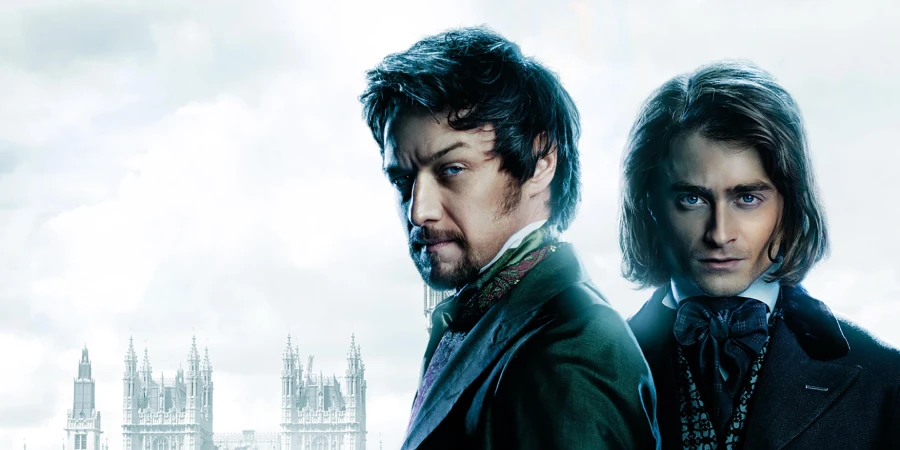

Nobody asked for a Frankenstein retelling narrated by the hunchback Igor, yet somehow that exact premise is the most interesting thing about Victor Frankenstein (2015). Director Paul McGuigan and screenwriter Max Landis take Mary Shelley’s gothic masterpiece and shatter it like a lab specimen jar, reconstructing it through the wide eyes of a circus freak turned brilliant medical student. It is messy, ambitious, and deeply strange, which makes it far more watchable than its box office performance suggests.
Detailed Summary
Igor’s Origins: From Circus Freak to Medical Prodigy
We meet Igor (Daniel Radcliffe) not as the traditional shambling assistant but as a nameless hunchback living in squalor beneath a circus. He has no name, no identity, and no friends, yet he has taught himself anatomy by obsessively studying medical books scavenged from the trash.
His intellect draws the attention of Victor Frankenstein (James McAvoy), a wildly charismatic medical student who attends the circus and witnesses Igor diagnosing a fellow performer’s injury with startling precision. Victor sees potential and engineers Igor’s escape during a chaotic circus accident involving a trapeze artist named Lorelei (Jessica Brown Findlay).
Igor saves Lorelei’s life using his anatomical knowledge, cementing Victor’s fascination. Victor drains the fluid from Igor’s infected cyst, straightens his back with a brace, and essentially creates a new person from the broken one. In return, Igor becomes Victor’s flatmate and research partner.
The Flatmate Arrangement and Early Experiments
Victor’s flat is a wonderland of grotesque science, filled with preserved body parts, mechanical contraptions, and the general aura of a man who has never once considered legal consequences. He gives Igor the name “Igor” almost as an afterthought, pulling it from a missing flatmate whose disappearance becomes a running subplot.
Meanwhile, Inspector Turpin (Andrew Scott) begins investigating the pair after a body is stolen from a university lecture. Turpin is a devout, morally rigid man who senses immediately that something deeply wrong is happening inside Victor’s laboratory. His pursuit of the two men drives much of the film’s thriller momentum.
Victor introduces Igor to his wealthy benefactor, Finnegan (Freddie Fox), a reckless aristocrat who funds their research with a specific goal: he wants to bring the dead back to life. Victor and Finnegan share a history rooted in Victor’s time at a prestigious medical school, where Victor’s rebellious genius earned him enemies as readily as admirers.
Gordon: The Prototype That Goes Terribly Wrong
Gordon is the first major experiment, a chimpanzee-like creature assembled from multiple animal parts and reanimated using electrical current. Victor and Igor unveil Gordon at a university function, hoping to demonstrate proof of concept to potential supporters.
Gordon, however, immediately goes berserk. He attacks the audience, kills several people, and sends the event into screaming chaos before Victor destroys him. Consequently, the experiment is both a scientific success and a catastrophic public failure.
Gordon’s rampage confirms Turpin’s worst suspicions and tightens the noose around Victor and Igor. It also clarifies the film’s central tension: Victor’s brilliance operates completely outside the boundaries of ethics, consequences, or basic common sense.
Igor’s Loyalty and His Growing Doubts
Igor reconnects with Lorelei, who has left the circus and carved out a more stable life for herself. Their romance develops quietly alongside the louder, more explosive main plot. Igor genuinely cares for her, and she grounds him emotionally in ways that Victor simply cannot.
As Victor’s obsession intensifies, Igor begins questioning the morality of their work. He voices his concerns to Victor more than once, arguing that creating life from death crosses a line that science should not cross. Victor, of course, dismisses every objection with the cheerful certainty of a man who has never lost an argument he actually cared about.
Victor’s backstory begins to emerge here. His younger brother died in childhood, and Victor has carried that grief like a stone ever since. His entire project is not purely about scientific achievement; it is fundamentally about defying death itself.
Scotland and the Full Creature
Finnegan funds an expedition to his remote Scottish castle, where Victor plans to complete his true masterwork: a full human-sized creature reanimated on a much larger scale. Igor accompanies him, torn between loyalty and a growing sense of dread.
Turpin follows them to Scotland, his obsession with stopping Victor matching the scientist’s own single-minded drive. Both men are, in their own ways, completely consumed by their missions. The film draws a quiet parallel between the inspector’s religious certainty and Victor’s scientific fanaticism.
Lorelei also travels to Scotland after learning of the danger Igor faces. Her presence gives Igor a reason beyond Victor’s vision to care about survival. In addition, she represents the ordinary human life that Igor could choose if he simply walked away from the laboratory.
Finnegan’s Betrayal and the Creature Awakens
Finnegan reveals his true motivation: he wants to resurrect his own dead son using the creature technology. He is not a patron funding science for its own sake; he is a grieving father willing to destroy anyone who stands between him and his goal.
Finnegan shoots Victor and takes control of the reanimation process, forcing the experiment forward without the careful calibration Victor would have applied. As a result, the creature wakes up in an unstable, violent state rather than the controlled awakening Victor imagined.
The creature is massive, powerful, and completely out of control. It kills Finnegan almost immediately, which is satisfying in a narratively tidy sort of way. Then it turns its attention outward, threatening everyone still alive in the castle.
Movie Ending
Igor steps up during the creature’s rampage and appeals to it directly, something no one else attempts. He uses his medical knowledge and his understanding of how the creature was built to find a way to stop it rather than simply fight it. Victor, wounded but still functional, works alongside Igor in these final moments.
Together they manage to destroy the creature, collapsing the unstable electrical system that sustains it. The castle itself suffers considerable damage during the chaos. Turpin arrives during or shortly after the climax, confronting the two men amid the wreckage.
Crucially, Turpin chooses not to arrest them. He has witnessed what unchecked obsession produces, and something in that sight softens his rigid certainty. He lets Victor and Igor walk away, a decision that feels earned given Andrew Scott’s careful performance throughout the film.
Victor and Igor part ways. Victor intends to continue his work somewhere else in the world, restless and unrepentant to the last. Igor, however, chooses Lorelei and a life outside the laboratory. The film closes on Igor’s narration, circling back to the opening framing device and reminding us that everything we watched was his story, not Victor’s.
What the ending ultimately argues is that Igor’s humanity is the true subject of the film. Victor Frankenstein is the engine driving the plot, but Igor is its soul. His choice to leave is presented as growth, a man who was once a nameless, caged thing deciding for the first time what kind of life he actually wants.
Are There Post-Credits Scenes?
Victor Frankenstein (2015) contains no post-credits scenes. Once the credits roll, there is nothing additional waiting for you. You can safely leave the theater, or stop the stream, without missing anything.
Type of Movie
This film occupies a specific and somewhat crowded niche: gothic horror-adventure with buddy-film energy. It carries the visual grammar of Victorian horror but delivers it with the pacing and wit of a bromance thriller. Think less hammer horror, more steampunk action movie.
Tonally, it is lighter than you might expect from a Frankenstein story. McAvoy plays Victor with such gleeful mania that many scenes feel comedic even when the content is disturbing. In contrast, Radcliffe anchors things in genuine emotional weight, creating an interesting tonal push-and-pull throughout.
Cast
- James McAvoy – Victor Frankenstein
- Daniel Radcliffe – Igor
- Jessica Brown Findlay – Lorelei
- Andrew Scott – Inspector Roderick Turpin
- Freddie Fox – Finnegan
- Charles Dance – Rupert Frankenstein (Victor’s father)
- Mark Gatiss – Barnaby
- Spencer Wilding – The Creature
Film Music and Composer
Craig Armstrong composed the score for Victor Frankenstein. Armstrong is a Scottish composer with extensive experience in large-scale dramatic scoring, having worked on films including Moulin Rouge! and Love Actually. His background in orchestral and electronic fusion suits the film’s hybrid tone well.
The score leans heavily into sweeping orchestral drama, underscoring the film’s gothic ambitions even when the visuals go for spectacle over atmosphere. Armstrong uses strings and brass to amplify Victor’s scenes, giving them a sense of grandeur that the character himself would absolutely approve of.
Notable moments in the score accompany the Gordon sequence and the Scottish castle climax. However, the music rarely breaks into truly memorable standalone tracks; it functions primarily as atmospheric support rather than an independently striking listen.
Filming Locations
Principal photography took place primarily in the United Kingdom, with significant shooting in and around London. The production used studio facilities alongside real Victorian-era architecture to establish the film’s 19th-century setting without relying entirely on CGI environments.
Scotland provided the dramatic landscape for the film’s third act, which required isolated, imposing scenery to match Finnegan’s castle. The rugged Scottish countryside delivers that sense of gothic remoteness effectively, making the final confrontation feel appropriately cut off from the civilized world.
London’s existing Victorian-era buildings and streets grounded the earlier sections of the film in a recognizable historical reality. In addition, the use of real locations rather than entirely constructed sets gave the actors physical environments to respond to, particularly valuable in a film so dependent on energy and spontaneity.
Awards and Nominations
Victor Frankenstein did not receive major awards recognition or nominations from prominent industry bodies. Its performance at the box office and with critics did not translate into awards season attention.
Behind the Scenes Insights
- Screenwriter Max Landis specifically structured the script around Igor as the point-of-view character, deliberately inverting the traditional Frankenstein narrative focus.
- Daniel Radcliffe underwent significant physical preparation for the role, including working with movement coaches to develop Igor’s posture and physicality both before and after the back brace correction.
- James McAvoy reportedly embraced the manic energy of Victor enthusiastically, describing the character as someone who lives permanently at an emotional and intellectual 11 out of 10.
- Director Paul McGuigan had previously worked with Radcliffe’s co-star Andrew Scott on the television series Sherlock, which likely contributed to the smooth working dynamic on set.
- The production designed Victor’s laboratory as a functioning, logical space, with props and equipment that had internal consistency rather than simply looking impressive.
- The Gordon creature required a combination of practical costume work and visual effects; the production prioritized having a physical performer on set wherever possible to give the cast something real to react to.
Inspirations and References
Mary Shelley’s 1818 novel Frankenstein; or, The Modern Prometheus is the foundational source material. However, Max Landis’s script takes significant liberties with Shelley’s text, using it as a launching pad rather than a blueprint. The Igor character as a central narrator has no real equivalent in Shelley’s original novel.
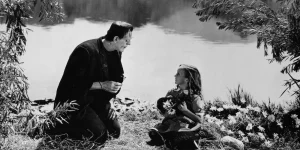
Classic Universal horror films, particularly Frankenstein (1931) and Bride of Frankenstein (1935), inform the film’s visual language and character archetypes. Igor as a hunchbacked assistant became a Hollywood invention rather than a Shelley creation, and the film leans into that cinematic tradition deliberately.
Furthermore, the buddy-film dynamic between Victor and Igor draws from a long tradition of mismatched intellectual partnerships in popular fiction. The Holmes-and-Watson model is clearly present, particularly given that several key cast and crew members had direct connections to Sherlock at the time of production.
Alternate Endings and Deleted Scenes
No officially documented alternate endings or notable deleted scene packages have been widely confirmed for Victor Frankenstein. The film’s disappointing theatrical run did not generate the level of home media supplementary content that a larger release might have produced.
Some early script drafts by Max Landis reportedly explored a darker conclusion for Victor, though the final film opts for an ambiguous but relatively hopeful separation between the two leads. Specific details of those draft differences have not been thoroughly documented in publicly available sources.
Book Adaptations and Differences
Victor Frankenstein draws from Mary Shelley’s Frankenstein; or, The Modern Prometheus but departs from it substantially. Shelley’s novel contains no character named Igor; that invention belongs to Hollywood tradition. Moreover, Shelley’s Victor Frankenstein is a far more tragic, self-aware figure than McAvoy’s fizzing, extroverted version.
In Shelley’s novel, the creature is articulate, philosophical, and genuinely sympathetic. The film’s creature, by contrast, is a violent, barely-controlled weapon. That shift fundamentally changes the moral argument at the story’s center.
Shelley’s novel frames Victor’s project as a cautionary tale about human overreach, told with deep melancholy. The film retains that theme in a diluted form but wraps it in adventure-film packaging. Consequently, the philosophical weight that makes the novel enduring is largely traded for kinetic entertainment.

Memorable Scenes and Quotes
Key Scenes
- Igor’s liberation from the circus: Victor engineers a chaotic, thrilling escape that immediately establishes the film’s anarchic tone and the chemistry between the two leads.
- The cyst drainage scene: Grotesque, oddly funny, and bizarrely intimate, this scene cements the strange friendship at the film’s core more effectively than almost anything else.
- Gordon’s rampage at the university: A genuinely exciting set piece that delivers on the film’s monster-movie promise while also functioning as a turning point for the plot.
- Victor’s backstory revelation: McAvoy’s delivery of Victor’s grief over his dead brother is one of the film’s most unexpectedly sincere moments, cutting through the surrounding chaos.
- Igor appealing to the creature: Radcliffe carries this climactic moment with quiet intensity, using Igor’s anatomical knowledge as an emotional and practical tool simultaneously.
Iconic Quotes
- “You know this story. You’ve always known it. But what you don’t know is the other side.” (Igor, opening narration)
- “There is nothing you can comprehend about what I am capable of.” (Victor Frankenstein)
- “You were not born. You were built, and if you are built, you can be fixed.” (Victor to Igor)
Easter Eggs and Hidden Details
- Victor’s missing flatmate, the original “Igor” whose identity Victor hands to our protagonist, is a meta-joke about the name’s borrowed, secondhand nature in the Frankenstein myth.
- Inspector Turpin’s religious devotion positions him as a mirror image of Victor: both men are fanatics, one serving God and one serving science, neither capable of moderation.
- The Gordon creature’s design incorporates multiple animal species visually, a nod to the patchwork construction described in Shelley’s novel even though the specific animal used differs from the source material.
- Victor’s lab contains visual references to real 19th-century electrical experimentation equipment, grounding the fantastical science in period-accurate imagery.
- Lorelei’s name carries mythological resonance: in German folklore, the Lorelei is a siren figure associated with dangerous beauty and distraction from one’s course, which fits her narrative function as the human life calling Igor away from Victor’s world.
Trivia
- Daniel Radcliffe and Andrew Scott both had strong ties to beloved British franchises before this film, Radcliffe through Harry Potter and Scott through Sherlock, giving the production an unusual density of franchise-adjacent talent.
- Max Landis wrote the script with the explicit goal of making Igor the protagonist, a reversal he described publicly as the film’s central creative gamble.
- The film was released in November 2015 and performed poorly at the box office, earning significantly less than its production budget during its theatrical run.
- Charles Dance plays Victor’s cold, disapproving father, continuing a pattern in Dance’s career of portraying formidable patriarchal authority figures.
- Mark Gatiss, who appears as Barnaby, is also a writer on Sherlock, adding another layer to the production’s unofficial Sherlock alumni gathering.
- The film takes place in a Victorian London that prioritizes atmosphere and energy over strict historical accuracy, functioning more as a stylized version of the era than a faithful recreation.
Why Watch?
Fans of charismatic performances and gothic spectacle will find plenty to enjoy here, particularly McAvoy’s absolutely unhinged commitment to every single scene. Radcliffe delivers a genuinely moving performance that anchors the film’s emotional core in ways that deserve more credit than the film received. For anyone who loves ambitious genre filmmaking that swings big even when it misses, this is a rewarding watch.
Director’s Other Movies
- Wicker Park (2004)
- Lucky Number Slevin (2006)
- Push (2009)
Recommended Films for Fans
- Mary Shelley’s Frankenstein (1994)
- Young Frankenstein (1974)
- The League of Extraordinary Gentlemen (2003)
- Van Helsing (2004)
- Dorian Gray (2009)
- I, Frankenstein (2014)