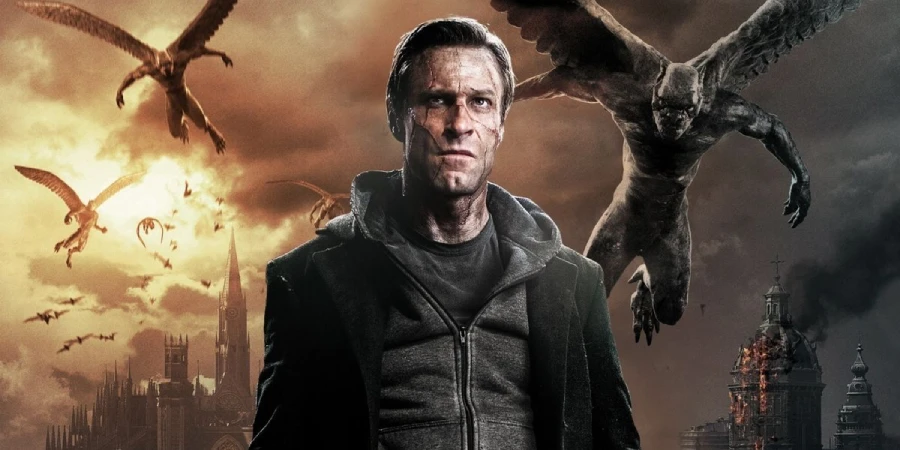

Few films have the audacity to take Mary Shelley’s immortal monster, dress him in a leather trench coat, and pit him against warring armies of gargoyles and demons in a neon-soaked gothic city. I, Frankenstein (2014) does exactly that, with absolute conviction and zero apology. It is a film that critics savaged and audiences largely ignored, yet it carries a strange, pulpy energy that demands at least one honest look. Consider this that look, spoilers and all.
Detailed Summary
The Origin: Adam’s Violent Beginning
The film opens with a swift retelling of the classic Frankenstein origin story. Victor Frankenstein creates his creature, rejects him, and dies pursuing him across the Arctic. The creature buries Victor, and almost immediately, demons attack, attempting to drag the creature’s body into Hell.
Gargoyles intervene and defeat the demons. Their leader, Naberius, is thwarted from claiming this unusual prize. The creature survives his first supernatural encounter without even fully understanding what he has stumbled into.
Brought Before the Gargoyle Order
Gargoyle queen Leonore brings the creature before her order, revealing that gargoyles serve as soldiers of God against demonic forces. She names the creature Adam, acknowledging that he is, after a fashion, a created being deserving of identity. Adam receives two electrum-tipped batons, weapons capable of descending demons.
Leonore warns Adam that Naberius and his demon horde will always want him, because his existence holds a dangerous secret. Adam, however, is not interested in belonging to anyone’s war. He leaves, choosing isolation over allegiance.
Two Centuries of Solitude and Violence
Adam spends roughly 200 years wandering and killing demons whenever they attack him. He operates alone, answering to no one. His survival skills are extraordinary, but his emotional life remains hollow.
Meanwhile, the demon prince Naberius, hiding in the human world under the identity of billionaire Charles Wessex, has been orchestrating a massive secret project. He funds a scientific research facility dedicated to reanimating corpses. His ultimate goal slowly becomes clear across the film’s midsection.
Terra and the Science of Reanimation
Naberius employs scientist Terra Wade, a brilliant researcher who believes she is simply advancing legitimate science. She works to solve the puzzle of reanimating dead tissue, unaware of her employer’s demonic nature. Her research is, in fact, the key to Naberius’s entire scheme.
Adam eventually crosses paths with Terra and recognizes that she is not a villain. Her work, however, directly threatens the balance between the human world and the supernatural war raging invisibly around it.
Naberius’s Master Plan Revealed
The plan Naberius has been constructing for centuries finally comes into focus. He has amassed a vast army of empty, reanimated human corpses, essentially hollow shells without souls. His intention is to use Victor Frankenstein’s original journal, the very blueprint of Adam’s creation, to perfect the reanimation process and then have demons possess these bodies en masse.
This would give demonic forces physical form in the human world on an enormous scale. Consequently, Hell’s army could walk openly among humans, launching an unstoppable invasion. Adam’s body, and the journal, are the two pieces Naberius needs to complete this terrifying puzzle.
Adam Captured and the Stakes Escalate
Demons eventually capture Adam and bring him before Naberius. Naberius reveals the full scope of his plan to Adam directly, with the casual confidence of someone who believes victory is inevitable. Adam, naturally, refuses to cooperate.
Naberius has the journal and has already begun filling his reanimated army. He needs Adam’s specific physiological makeup to finalize the perfected reanimation formula. The clock ticks toward catastrophe as the gargoyle order and demon forces converge on Wessex’s tower.

Movie Ending
Inside Naberius’s tower, the final confrontation erupts on a massive scale. Gargoyles storm the building while demons defend it, and Adam fights his way through waves of possessed bodies toward Naberius himself. Terra, now fully aware of the supernatural truth, works to shut down the reanimation chambers from within the facility.
Adam faces Naberius in direct combat. Naberius sheds his human disguise and reveals his true demonic form, a genuinely grotesque transformation that the film commits to fully. The fight is brutal and visually spectacular by the film’s own standards.
Adam ultimately defeats Naberius by descending him, sending the demon prince back to Hell in a burst of fire and light. With Naberius destroyed, the demon army collapses. The remaining demons scatter or are descended by the gargoyles, and the immediate threat to humanity evaporates.
Terra survives, and the two share a moment of quiet connection. Adam, however, faces the deeper question the film has been circling from its opening minutes: does he have a soul? Leonore confirms that he does, because God would not have left a being without one standing as a guardian between humanity and Hell for two centuries.
In the final moments, Adam chooses to remain in the world as its protector, accepting the identity Leonore gave him at the film’s beginning. He stands on a rooftop, batons in hand, surveying the city. It is a deliberately heroic image, positioning Adam not as a monster but as something closer to an unlikely guardian angel. The film ends on that note of grim, solitary purpose.
Are There Post-Credits Scenes?
I, Frankenstein does not include any post-credits scenes. Once the credits roll, the story is complete. There is no tease for a sequel or additional universe-building content waiting at the end.
Type of Movie
I, Frankenstein sits squarely in the supernatural action genre, with heavy doses of dark fantasy and gothic horror aesthetics. Its tone is relentlessly serious, almost stubbornly so, which is part of what makes it such a fascinating curiosity. It plays everything straight, treating its leather-clad Frankenstein monster as a genuine tragic hero rather than a self-aware joke.
In contrast to similar films that wink at the audience, this one never breaks its own earnest spell. Whether that counts as a strength or a weakness depends entirely on the viewer’s appetite for commitment to a preposterous premise.
Cast
- Aaron Eckhart – Adam Frankenstein (the creature)
- Bill Nighy – Naberius / Charles Wessex
- Yvonne Strahovski – Terra Wade
- Miranda Otto – Leonore, Queen of the Gargoyle Order
- Jai Courtney – Gideon
- Kevin Grevioux – Dekar
- Aden Young – Victor Frankenstein
- Bruce Spence – Zuriel
Film Music and Composer
Reinhold Heil and Johnny Klimek composed the film’s score together. The two have a longstanding creative partnership, perhaps best known for their work on Cloud Atlas (2012). Their score for this film leans into heavy, propulsive electronic and orchestral elements that suit the film’s relentless kinetic energy.
The music rarely pauses for quiet reflection, mirroring Adam’s own inability to rest. It is functional and atmospheric rather than particularly memorable on its own, but it serves the action sequences well.
Filming Locations
Principal photography for I, Frankenstein took place primarily in Melbourne, Australia. The production used Melbourne’s diverse architectural landscape to create the unnamed gothic city at the film’s center. Notably, the city’s blend of older European-influenced buildings and modern structures gave the setting its convincing timeless quality.
Shooting in Australia also made practical financial sense, as the country offered strong production infrastructure and competitive incentives. The result is a city that feels genuinely ancient and contemporary at the same time, which supports the film’s mythology of a centuries-long hidden war.
Awards and Nominations
I, Frankenstein did not receive any significant awards recognition and picked up no major nominations from mainstream industry bodies. Critics largely dismissed it, and awards circuits followed suit.
Behind the Scenes Insights
- Aaron Eckhart underwent significant physical training to portray Adam’s physicality convincingly, building a notably muscular frame for the role.
- Director Stuart Beattie wrote the screenplay himself, adapting the graphic novel he felt a strong personal connection to from first reading.
- Kevin Grevioux, who appears in the film as Dekar, also created the original graphic novel on which the film is based, giving the production an unusual direct line to the source material’s creator.
- The gargoyle and demon visual effects required extensive pre-visualization work, as the entire supernatural conflict had to feel grounded within a recognizable urban environment.
- Bill Nighy brought his characteristic dry authority to Naberius, a quality the production leaned into when designing the character’s human disguise as a polished, corporate villain.
- The film’s production design drew heavily on Gothic architecture references to establish the gargoyle order’s cathedral headquarters as a genuine sacred space within the story.
Inspirations and References
The film adapts Kevin Grevioux’s graphic novel of the same name. Grevioux, also a co-creator of the Underworld franchise, brought a similar sensibility to this project: supernatural factions in conflict, hidden from humanity, with a reluctant protagonist caught between them. That DNA is unmistakable on screen.
Mary Shelley’s Frankenstein (1818) obviously provides the foundational mythology. However, the film uses Shelley’s novel primarily as a launching pad, borrowing the creature’s origin and Victor’s journal as plot devices rather than engaging deeply with the novel’s philosophical themes.
The broader visual and tonal influences include films like Underworld (2003) and Blade (1998), both of which popularized the idea of gothic supernatural action in contemporary urban settings. I, Frankenstein fits comfortably in that lineage.
Alternate Endings and Deleted Scenes
No officially confirmed alternate endings or significant deleted scenes have been publicly detailed for I, Frankenstein. The studio did not release an extended cut or director’s cut with additional footage. Furthermore, no substantial behind-the-scenes documentation of major cut sequences has surfaced in interviews or home release special features.
Book Adaptations and Differences
I, Frankenstein adapts the graphic novel of the same name by Kevin Grevioux, published in 2013 by Darkstorm Comics. The film follows the graphic novel’s core premise and structure closely, which makes sense given that Grevioux himself was involved in the production. The central conflict between gargoyles and demons, Adam’s identity struggle, and Naberius’s reanimation scheme all originate directly from the source material.
The film does expand certain sequences for cinematic scale and adds more screen time for supporting characters like Terra Wade. In addition, the visual spectacle of the final battle in the film exceeds what the graphic novel’s page count could convey, though the narrative beats remain largely faithful.
Memorable Scenes and Quotes
Key Scenes
- Adam’s first encounter with demons at Victor Frankenstein’s grave, immediately establishing the supernatural world and his place in it.
- Leonore naming the creature Adam in the gargoyle cathedral, a quiet moment that carries real emotional weight amid all the action.
- Naberius shedding his human disguise to reveal his true demonic form during the final confrontation, a visual payoff the film builds toward deliberately.
- Adam fighting through the reanimation lab, descending demon after demon in rapid succession, showcasing the film’s full action choreography.
- The final rooftop shot of Adam standing guard over the city, batons at his sides, framing him explicitly as a protector rather than a monster.
Iconic Quotes
- “I was not born. I was made.” (Adam, establishing his fundamental otherness early in the film)
- “You are the key to the survival of all demonkind.” (Naberius, to Adam, spelling out the stakes of the central conflict)
- “I name you Adam.” (Leonore, in the gargoyle cathedral, giving the creature his identity)
Easter Eggs and Hidden Details
- The cathedral headquarters of the gargoyle order features stone carvings that closely mirror actual Gothic architectural details found in medieval European cathedrals, grounding the supernatural setting in recognizable historical aesthetics.
- Naberius’s corporate persona as Charles Wessex is presented with deliberate blandness: his offices are sterile and modern, visually contrasting with the ancient war he is actually conducting beneath the surface.
- Adam’s twin electrum batons are always shown on his person even during quiet scenes, a consistent visual reminder that he never truly leaves the war behind, even when he wants to.
- Victor Frankenstein’s journal, a key plot device, is designed to look appropriately aged and hand-written, reinforcing the film’s insistence that its mythology stretches back centuries.
- Kevin Grevioux, the graphic novel’s creator, appears on screen as Dekar, a gargoyle soldier, essentially giving the source material’s author a direct presence within the adaptation itself.
Trivia
- Aaron Eckhart has spoken about genuinely enjoying the physical demands of the role, viewing the training as one of the more rewarding aspects of the production.
- Director Stuart Beattie is perhaps better known as a screenwriter, having contributed to Pirates of the Caribbean: The Curse of the Black Pearl (2003); I, Frankenstein was one of his early directorial efforts.
- The film was produced by the same team behind the Underworld franchise, which explains its very similar visual and tonal approach to supernatural urban action.
- Despite a relatively modest budget, the film achieved a considerable volume of visual effects shots, focusing the resources on the descent and ascent sequences where demons and gargoyles transform.
- Both Bill Nighy and Kevin Grevioux had prior experience with this specific subgenre: Nighy starred in the Underworld films, and Grevioux co-created them.
- The film’s global box office return was roughly equal to its production budget, making it a commercial disappointment for the studio.
Why Watch?
If you have any affection for early-2000s supernatural action films, I, Frankenstein scratches exactly that itch without pretending to be anything more. Aaron Eckhart commits fully to a genuinely strange role, and Bill Nighy elevates every scene he occupies. It is gloriously serious about its own absurdity, and that sincerity makes it oddly compelling.
Director’s Other Movies
- Tomorrow, When the War Began (2010)
Recommended Films for Fans
- Underworld (2003)
- Blade (1998)
- Van Helsing (2004)
- Legion (2010)
- Victor Frankenstein (2015)
- Constantine (2005)
- Priest (2011)