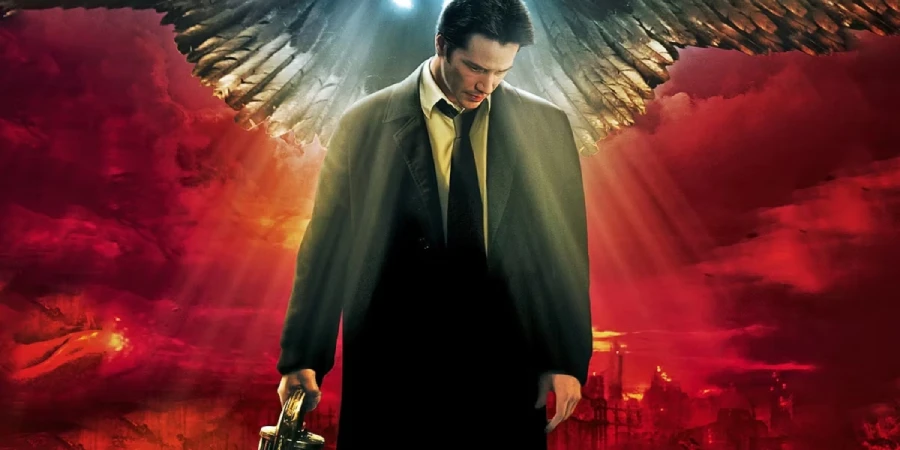

Keanu Reeves plays a man who can literally see demons walking among us, and somehow that is the least strange thing about Constantine. This 2005 supernatural thriller takes one of DC’s most beloved comic antiheroes and drops him into a rain-soaked, demon-infested version of Los Angeles. Director Francis Lawrence crafted a film dense with theology, occult mythology, and genuine dread. It flopped with critics on release, yet built a passionate cult following that refuses to let it die.
Detailed Summary
John Constantine and His Curse
John Constantine (Keanu Reeves) is a supernatural detective of sorts operating in Los Angeles. He was born with the ability to perceive both angels and demons in their true form, a gift he neither wanted nor asked for.
His life took a devastating turn when, as a teenager, the visions overwhelmed him and he attempted suicide. That act of self-destruction damned his soul, and now he knows with certainty that Hell owns him when he dies.
Consequently, Constantine spends his days exorcising half-breed demons who violate the sacred rule against directly influencing the human world. He does this not out of goodness, but as a desperate bargain, hoping God will grant him entry to Heaven in exchange for his services.
A Suicide Opens the Story
Meanwhile, in Mexico, a man discovers a mysterious artifact wrapped in a Nazi flag buried in the ground. This artifact is the Spear of Destiny, the lance said to have pierced Christ at the crucifixion, and its discovery sets a catastrophic chain of events in motion.
Back in Los Angeles, a young woman named Isabel Dodson apparently jumps from the roof of a psychiatric hospital. Her twin sister, Angela Dodson (Rachel Weisz), a detective for the LAPD, refuses to accept that Isabel died by suicide.
Angela’s faith matters here: she knows Isabel was deeply religious, and suicide would have condemned her soul. She therefore cannot let the death go unexplained and begins investigating despite resistance from everyone around her.
Constantine Meets Angela
Angela crosses paths with Constantine while investigating a demonic incident connected to her sister’s death. She initially treats him with skepticism, which is completely understandable given that he talks about demons as if they commute to work.
However, strange and violent events keep pulling them together. A full-breed demon attacks Angela, confirming that something far larger than a simple suicide is unfolding.
The Rules of the Game
Constantine explains the cosmic framework to Angela and, by extension, the audience. God and Satan made a wager of sorts, and neither side can directly interfere with humanity; they can only influence and tempt through agents called half-breeds.
Full-breed demons are strictly forbidden from crossing into the human world. Constantine has made enemies on both sides because he keeps deporting half-breeds back to Hell against their will.
Balthazar and the Growing Threat
Balthazar (Gavin Rossdale), a half-breed demon working for the enemy, attacks Constantine directly. This escalation signals that Constantine has stumbled onto something genuinely dangerous, not just another routine exorcism.
Constantine defeats Balthazar and extracts information through a brutal psychic interrogation. He learns that someone on the demonic side is attempting something that should be impossible: breaking the rules of the wager entirely.
Midnight and the Half-Angel
Papa Midnite (Djimon Hounsou) runs a neutral supernatural club where both sides coexist under a truce. He serves as a gatekeeper between worlds and wants nothing to do with whatever Constantine is stirring up.
Constantine also has a tense history with Gabriel (Tilda Swinton), an androgynous angel who appears periodically but offers no real help. Gabriel’s cold detachment feels ominous throughout, even before the full reveal.
Isabel’s Message from Hell
Constantine agrees to help Angela by sending her briefly into Hell to witness what her sister experienced. This sequence is visually stunning: Hell in this film is a scorched, silent mirror of Los Angeles, populated by crawling demons and burning wind.
Angela sees Isabel trapped there and receives a crucial message. Isabel was communicating something about the Spear of Destiny and a plan involving Mammon, the son of Satan himself.
The Plot Against Humanity
Someone is working to bring Mammon physically into the human world. Mammon would then conquer Earth from within, bypassing the rule against direct demonic intervention because his entrance would be forced by a human agent acting of free will.
In addition, the Spear of Destiny is the key to this ritual. Its power can override the cosmic rules entirely, making it the most dangerous object on the planet.
Gabriel’s Betrayal
Constantine eventually uncovers the shocking truth: Gabriel is the one orchestrating Mammon’s arrival. Not a demon, but an angel, has turned against humanity.
Gabriel’s motive is chilling in its logic. Humanity, in Gabriel’s view, has grown lazy and complacent because life is too easy. Gabriel wants to unleash Mammon so that humans will have to earn their salvation through genuine suffering and struggle.
Gabriel has therefore manipulated Isabel, using her psychic abilities, into crossing into Hell to retrieve Mammon. Isabel’s death was not a suicide; Gabriel murdered her by compelling her to fall.

Movie Ending
Gabriel uses the Spear of Destiny and Angela’s body as a conduit to begin the ritual to summon Mammon. Constantine arrives too late to stop Gabriel physically; the angel overpowers him with ease.
Facing certain death and knowing his soul is damned anyway, Constantine makes a final, extraordinary choice. He slits his wrists, deliberately dying in order to stand before Lucifer (Peter Stormare) himself and make a direct appeal.
Lucifer appears in one of cinema’s most memorable devil portrayals: barefoot, wearing a white suit, dripping casual menace. Constantine begs Lucifer to send Mammon back to Hell, arguing that Mammon’s rise would upset the balance that Lucifer himself benefits from.
Lucifer recognizes the logic and intervenes, dragging Mammon back. He then kills Gabriel, stripping the angel of immortality as punishment for the betrayal of cosmic law.
Lucifer then turns to Constantine, prepared to personally collect his long-promised soul. However, Constantine does something no one expects: he forgives Chas (Shia LaBeouf), his young assistant who died earlier in the film, genuinely and selflessly.
That single act of pure selflessness is enough. God intervenes, pulling Constantine upward toward Heaven in a beam of light. Lucifer, furious at losing his prize, does something remarkable out of spite: he heals Constantine’s wrists, revives him, and cures his terminal lung cancer, all to ensure Constantine lives a long, healthy life and has more time to sin his way back to Hell.
Constantine wakes up on the pavement, cancer-free for the first time in years. He quits smoking, commits to a better life, and gives Angela the Spear of Destiny to keep safe.
In the final moments, Chas reappears as an angel, ascending to Heaven with wings, rewarded for his years of loyal service to Constantine’s mission. It is a quiet, genuinely touching moment that reframes the entire apprentice-mentor dynamic.
The ending matters because it subverts the expected heroic sacrifice. Constantine wins not through power or cleverness, but through one moment of genuine grace. Lucifer’s petty revenge, ironically, becomes the gift Constantine never earned through effort.
Are There Post-Credits Scenes?
Constantine does not include a post-credits scene in the traditional sense. However, the Chas reveal as a winged angel technically functions as a final kicker following the main narrative resolution, so stay through the immediate ending sequence.
No additional footage follows the full credits roll. Audiences who stayed in theaters expecting a bonus scene after the credits left disappointed.
Type of Movie
Constantine operates primarily as a supernatural action thriller with heavy elements of dark fantasy and theological horror. Its tone sits somewhere between a noir detective story and an occult blockbuster.
The film is notably more somber and philosophical than most early-2000s action releases. It takes its mythology seriously and never winks at the audience about how ridiculous the premise sounds.
Cast
- Keanu Reeves – John Constantine
- Rachel Weisz – Angela Dodson / Isabel Dodson
- Shia LaBeouf – Chas Kramer
- Tilda Swinton – Gabriel
- Djimon Hounsou – Papa Midnite
- Peter Stormare – Lucifer
- Gavin Rossdale – Balthazar
- Pruitt Taylor Vince – Father Hennessy
- Max Baker – Beeman
Film Music and Composer
Brian Tyler and Klaus Badelt co-composed the score for Constantine. Their collaboration produced a dense, atmospheric soundtrack that blends orchestral weight with dark electronic textures.
Brian Tyler has since become one of Hollywood’s most prolific composers, contributing scores to major franchise films. His work on Constantine remains one of his earlier, more tonally restrained efforts.
The score leans heavily on low, grinding strings and ominous brass to underline the film’s theological dread. It rarely celebrates; it broods, which suits Constantine’s worldview perfectly.

Filming Locations
Constantine filmed primarily in Los Angeles, California. The choice is significant because the film treats Los Angeles as a kind of spiritual battleground, a city glamorous on the surface and rotting underneath.
Several iconic LA landmarks appear in altered or stylized forms. The hellish mirror-version of LA seen during Angela’s visit to Hell uses the city’s real geography to make the nightmare feel familiar and therefore more unsettling.
Shooting in actual Los Angeles gave the production a gritty authenticity. Moreover, the perpetual overcast skies and rain-soaked streets the filmmakers cultivated stood in sharp contrast to LA’s sunny reputation, reinforcing Constantine’s bleak worldview.
Awards and Nominations
Constantine received limited recognition from major awards bodies. It earned a few nominations in technical and genre-specific categories but did not win any significant awards during its release cycle.
Behind the Scenes Insights
- Director Francis Lawrence made his feature film debut with Constantine, having previously directed music videos.
- Keanu Reeves reportedly lost significant weight for the role to give Constantine a gaunt, worn-down physical presence.
- Tilda Swinton was cast specifically because her naturally androgynous appearance made Gabriel feel genuinely otherworldly without heavy costuming.
- Peter Stormare spent only one day on set filming his Lucifer scenes, yet his performance became the most discussed element of the entire film.
- The production built elaborate practical sets for the Hell sequences rather than relying entirely on digital environments.
- Gavin Rossdale, lead singer of the band Bush, had no substantial acting experience before being cast as Balthazar.
- Francis Lawrence drew heavily on the visual style of graphic novels when designing the film’s aesthetic, even though the script departed significantly from the source material.
Inspirations and References
Constantine draws its central character from DC/Vertigo Comics, specifically the Hellblazer comic series created by Alan Moore, Steve Bissette, and John Totleben in 1985. The character first appeared in Swamp Thing before getting his own long-running solo title.
The film loosely adapts the Hellblazer story arc Original Sins and draws elements from several other story arcs without faithfully reproducing any single one. The screenplay by Kevin Brodbin and Frank Cappello picks and chooses mythological elements freely.
Theologically, the film references Gnostic ideas about the nature of good, evil, and free will. In addition, the Spear of Destiny has roots in genuine Christian mythology and has appeared across countless works of fiction and folklore.
Alternate Endings and Deleted Scenes
Several scenes trimmed from the final cut involved Father Hennessy receiving more screen time and a more developed arc exploring his alcoholism and his eventual demonic murder. His character feels slightly underdeveloped in the theatrical release as a result.
An alternate version of the ending reportedly showed a slightly different confrontation between Lucifer and Constantine, with different emphasis on the cancer-healing moment. The theatrical version tested better with audiences.
Various deleted scenes surfaced in home release extras, offering additional world-building around Papa Midnite’s backstory and Constantine’s early career as an exorcist.
Book Adaptations and Differences
Constantine is not based on a single book but on the DC/Vertigo comic series Hellblazer. The differences between the film and its source material are substantial and were a major point of contention among comic fans.
In Hellblazer, John Constantine is British, blond, working-class, and deeply rooted in British occult history. The film transplants him to Los Angeles, makes him American in presentation (despite Reeves being Canadian), and strips out much of the class-conscious political edge that defined the comic.
Furthermore, Hellblazer Constantine is a morally complex con artist who manipulates everyone around him, including his allies. The film softens this considerably, making Reeves’s version more conventionally heroic by comparison.
On the other hand, the film does capture Constantine’s fundamental self-loathing and his transactional relationship with both good and evil, which are core traits of the comic character.


Memorable Scenes and Quotes
Key Scenes
- Constantine’s opening exorcism, where he forces a young girl’s demon back to Hell using a mirror and sheer force of will, establishes his cold, professional approach immediately.
- Angela’s visit to Hell, a scorched and silent Los Angeles stripped of everything living, stands as the film’s most visually striking sequence.
- Constantine slitting his wrists and descending to meet Lucifer face to face, gambling everything on a cosmic technicality, is the film’s dramatic peak.
- Peter Stormare’s entrance as Lucifer, dripping fluid from his hands, barefoot on white floors, is arguably one of the most memorable devil portrayals in film history.
- Chas ascending as a winged angel in the final scene provides an unexpected emotional punch that reframes his entire role in the story.
- Gabriel revealing the true plan and beating Constantine nearly to death subverts audience expectations completely; the angel is the villain.
Iconic Quotes
- “I Constantine. John Constantine. Asshole.” (Constantine introducing himself with characteristic self-deprecation)
- “God’s a kid with an ant farm, lady. He’s not planning anything.”
- “You’re fucked, John. You’re really fucked.” (Lucifer to Constantine, delivered with cheerful menace by Stormare)
- “I’ve been to Hell, Detective. I know it when I see it.”
- Gabriel: “It’s called the grace of God, Mr. Constantine. Because He doesn’t care. And neither do I.”
Easter Eggs and Hidden Details
- The Spear of Destiny wrapped in a Nazi flag is a direct nod to the real-world legend that Adolf Hitler possessed the spear and believed it granted invincibility.
- Constantine’s custom shotgun is designed to fire holy water rounds, a detail that rewards attentive viewers who notice the unusual ammunition early in the film.
- Papa Midnite’s club features decorative elements drawn from real Voodoo and Yoruba religious traditions, grounding his character in actual spiritual practice.
- Gabriel’s costuming and presentation deliberately reference traditional androgynous angel iconography from Renaissance painting, where angels were neither male nor female.
- The version of Hell shown in the film mirrors real Los Angeles geography closely enough that locals can recognize specific streets and intersections in their burned-out forms.
- Constantine’s lung cancer is a direct reference to the comics, where Constantine’s smoking habit became a central plot point in one of Hellblazer‘s most famous story arcs.
- A golden cat appears briefly in the background of Midnite’s club, a reference to supernatural guardians in several occult traditions.
Trivia
- Nicolas Cage was previously considered for the role of Constantine before Keanu Reeves was cast.
- The film was budgeted at approximately 100 million dollars and earned around 230 million dollars worldwide, making it a modest box office success despite mixed critical reception.
- Shia LaBeouf has spoken positively about his experience on the film in interviews and has expressed interest in a potential sequel or return to the character.
- Director Francis Lawrence went on to direct several entries in The Hunger Games franchise, becoming one of Hollywood’s most commercially successful franchise directors.
- The film sat in development for years before Francis Lawrence was attached, with various directors and scripts cycling through the project.
- Keanu Reeves wore dark contact lenses throughout filming to give Constantine a harder, more haunted look than Reeves’s naturally expressive eyes would have provided.
- A sequel has been discussed for years; as of recent announcements, a follow-up project has been confirmed with Keanu Reeves attached to return.
- Peter Stormare prepared for his single day of filming as Lucifer by studying the character extensively and working with Francis Lawrence on a very specific, non-theatrical interpretation of evil.
Why Watch?
Constantine delivers a genuinely unique blend of theological ambition, striking visuals, and committed performances that few supernatural action films have matched since. Peter Stormare’s Lucifer alone is worth the runtime. Moreover, the film rewards repeat viewing with its layered mythology and quietly emotional final act. It is a rare blockbuster that actually believes in its own ideas.
Director’s Other Movies
- I Am Legend (2007)
- Water for Elephants (2011)
- The Hunger Games: Catching Fire (2013)
- The Hunger Games: Mockingjay Part 1 (2014)
- The Hunger Games: Mockingjay Part 2 (2015)
- Red Sparrow (2018)
- The Hunger Games: The Ballad of Songbirds and Snakes (2023)
Recommended Films for Fans
- Hellboy (2004)
- Se7en (1995)
- The Prophecy (1995)
- Spawn (1997)
- Van Helsing (2004)
- Stigmata (1999)
- The Ninth Gate (1999)
- Fallen (1998)
- Blood Creek (2009)
- Ghost Rider (2007)