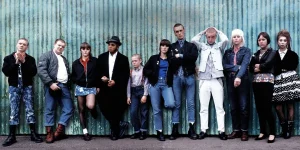

Emir Kusturica’s Underground does not simply tell a story; it detonates one. This three-hour Palme d’Or-winning Yugoslav epic traps its characters beneath the earth for decades while history rewrites itself above them, using black comedy and grotesque spectacle to indict nationalism, war, and the lies people tell to survive. It is one of the most ambitious films ever made in European cinema, and also one of the most polarizing. Buckle up.
Detailed Summary
Belgrade, 1941: The Party Before the Bombs
Marko Dren and Petar “Blacky” Popara are best friends, black-market hustlers, and Communist Party members living loud in pre-occupation Belgrade. Their lives revolve around drinking, carousing, and Blacky’s pet orangutan. Kusturica immediately establishes their world as carnivalesque and excessive, and that excess is entirely intentional.
Blacky is hopelessly in love with Natalija, an actress who enjoys the attention of both men. Marko, however, schemes quietly and watches everything. Their friendship already carries the seeds of betrayal.
When Nazi bombs begin falling on Belgrade in April 1941, the film lurches from celebration to catastrophe without pausing for breath. Kusturica refuses to separate joy from destruction; they arrive together, as they often do in history.
The Underground Bunker and the Great Deception
Marko organizes a large group of family members, neighbors, and friends to move into a vast underground cellar beneath his house. He frames this as a wartime necessity, a way to protect the community from the German occupation above. In reality, Marko uses the bunker to run an arms manufacturing operation that profits him enormously.
Blacky gets shot and imprisoned by the Nazis early on, and Marko rescues him, cementing his status as a hero. However, Marko also takes Natalija for himself during this period. He feeds her a story about Blacky’s death, and she eventually accepts his love, or his version of it.
Here is where the film’s central cruelty unfolds: Marko never tells the underground community that the war ended in 1945. He keeps them laboring and believing that Nazis still prowl the streets above. Meanwhile, he sells their weapons on the black market and rises to become a powerful figure in Tito’s Yugoslavia. The deception is monstrous, and Kusturica plays it for both laughs and horror.
Blacky’s Escape and the Theater of War
Blacky eventually escapes the bunker, believing he is still fighting World War II. He surfaces into 1960s Yugoslavia and immediately attacks a film set, convinced the German soldiers he sees are real occupiers. Consequently, he causes enormous chaos before anyone can explain reality to him.
This sequence is one of the film’s most brilliant set pieces. It literalizes the idea that people manipulated by power cannot distinguish reality from performance. Furthermore, it implicates cinema itself in the manufacture of false histories.
Blacky gets captured and eventually institutionalized. His son Jovan, born in the bunker, also surfaces and faces a world he was never prepared for. On the other hand, Marko continues his comfortable life above ground, celebrated as a war hero and a Communist loyalist.
The Wedding, the Chaos, and the Collapse
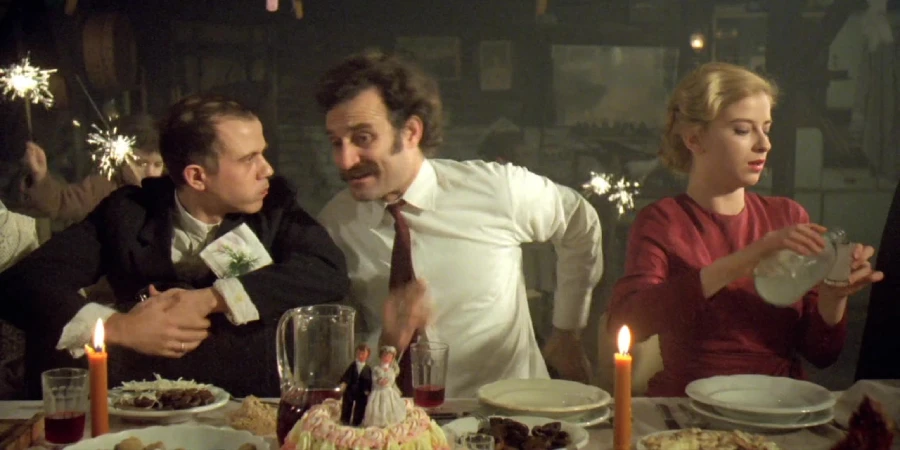
Jovan falls in love and attempts to hold a wedding. Blacky, increasingly unhinged but always magnetic, participates in the celebration. The wedding sequence escalates into one of Kusturica’s signature vortexes of music, dancing, animals, and sudden violence.
A tank crashes through walls. People die and resurrect symbolically. The film refuses to let any moment of joy exist without catastrophe shadowing it. In addition, the line between celebration and war becomes completely blurred, which is precisely Kusturica’s point about Yugoslav history.
The 1990s: Yugoslavia Tears Itself Apart
The final act jumps to the early 1990s and the actual wars of Yugoslav dissolution. Blacky, now a warlord, fights in the conflict with the same blind passionate fury he has always carried. Marko, meanwhile, has reinvented himself as a war profiteer yet again, selling weapons to multiple sides.
Natalija, trapped between these two men her entire life, meets a grim end during the violence. Marko and his wife Vera flee the country as war criminals. Blacky continues fighting, seemingly incapable of existing outside of conflict. Moreover, the underground community, now fully released into the world, disperses into a Yugoslavia that no longer exists.

Movie Ending
In the final minutes, Blacky kills himself. He walks into a river and simply keeps walking until the water swallows him. It is not a dramatic death; it is an exhausted one, the act of a man who has run out of wars to fight and lies to believe in.
Marko dies in a tunnel collapse shortly before, buried under the very underground he built to imprison others. Kusturica gives him no redemption and no escape; the architect of the great deception gets crushed by his own architecture. It is blunt, almost allegorical, and entirely satisfying in its ruthlessness.
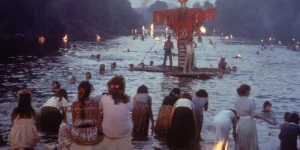
Then the film does something extraordinary. In a dream-like epilogue, all the dead characters reunite on a floating piece of land that breaks away from Yugoslavia and drifts across the water. They celebrate, they dance, they feast. Children play. The brass band plays on.
This floating island sequence functions as a collective afterlife, a mythological space outside of history where Yugoslavia’s people can exist without its politics. Kusturica frames it as deeply mournful and strangely joyful at the same time. It is the film’s thesis made visual: the people endure, even as the country that shaped them disappears beneath the weight of its own contradictions.
Notably, a voiceover closes the film with a statement about a country that no longer exists, addressed directly to the audience. It transforms the entire film into an act of grieving. Underground does not mourn Communism or Tito or Yugoslavia as a political entity; it mourns the human beings who were told stories and believed them, and who danced and loved and died inside those stories anyway.
Are There Post-Credits Scenes?
Underground contains no post-credits scenes. The epilogue on the floating island functions as the film’s true emotional conclusion, and Kusturica lets that image speak for itself. Nothing follows the credits.
Type of Movie
Underground operates across several genres simultaneously, which is part of what makes it so difficult to categorize and so easy to remember. At its core, it is a historical epic covering roughly fifty years of Yugoslav history from World War II through the 1990s wars of dissolution.
However, it also functions as a black comedy, a political satire, a war film, and a magical realist fable. Kusturica blends these registers without apology. The tone shifts constantly: raucously funny one moment, genuinely horrifying the next, and achingly elegiac by the end.
Cast
- Miki Manojlovic – Marko Dren
- Lazar Ristovski – Petar “Blacky” Popara
- Mirjana Jokovic – Natalija
- Slavko Stimac – Ivan
- Ernst Stotzner – Franz
- Srdjan Todorovic – Jovan
- Milena Pavlovic – Vera
Film Music and Composer
Goran Bregovic composed the score for Underground, and his contribution is inseparable from the film’s identity. Bregovic draws heavily from Balkan brass traditions, Romani music, and Serbian folk forms. The result is a score that sounds simultaneously like a wedding and a funeral, often at the exact same moment.
The brass band that appears throughout the film is not just a musical device; it functions as a character. It follows the action, intrudes on private moments, and refuses to let silence exist. In addition, this relentlessness mirrors the film’s argument that history never pauses to let people grieve.
Bregovic had previously collaborated with Kusturica on Time of the Gypsies, and their working relationship produced some of the most distinctive film music in European cinema. His work on Underground cemented his international reputation as a composer who treats Balkan musical traditions as a serious artistic vocabulary.


Filming Locations
Production primarily took place in Belgrade, Serbia, and surrounding areas, with additional shooting in Prague. Using Belgrade grounded the film in the physical reality of the city it depicts, lending the wartime sequences an authentic texture that studio work could not have achieved.
The underground bunker sets were constructed as elaborate practical environments, designed to feel genuinely claustrophobic and yet large enough to house an entire community for decades. Consequently, the set design itself reinforces the film’s themes: a world that is both a prison and a home.
Prague provided certain period exteriors that Belgrade could not easily supply. The choice to blend real locations with constructed spaces mirrors the film’s central preoccupation with the boundary between reality and fabrication.
Awards and Nominations
Underground won the Palme d’Or at the 1995 Cannes Film Festival, one of cinema’s most prestigious honors. The win was not without controversy; some critics and filmmakers objected to what they perceived as the film’s ambiguous or sympathetic treatment of Serbian nationalism during the ongoing Yugoslav wars. The debate around the Palme d’Or award became part of the film’s cultural history.
Behind the Scenes Insights
- Kusturica reportedly worked with a live orchestra on set during certain scenes, using the music to drive the emotional and physical energy of the performers in real time.
- The production was extraordinarily long and physically demanding; cast and crew spent months working in the underground bunker sets.
- Lazar Ristovski prepared extensively for the role of Blacky, building a physical presence and emotional volatility that Kusturica described as essential to the film’s energy.
- The film was originally conceived as a television miniseries, which explains its sprawling three-hour runtime. A shorter theatrical cut also exists.
- Kusturica faced significant personal and professional backlash during production due to political interpretations of the script, and he publicly discussed feeling isolated during this period.
- The famous tank sequence required considerable practical engineering and coordination, as a real tank moved through constructed sets that needed to collapse convincingly.
Inspirations and References
Kusturica and co-writer Dusan Kovacevic drew directly from Yugoslav history, specifically the German occupation of 1941, the Tito-era Communist state, and the dissolution of Yugoslavia in the early 1990s. The film compresses and mythologizes real events rather than dramatizing any single documented story.
Kovacevic had previously written a stage play called The Powder Keg, and the collaborative relationship between him and Kusturica shaped much of the screenplay’s sardonic, theatrical sensibility. Their shared Yugoslav background gave the material an insider’s bitterness that a foreign perspective could not have produced.
The magical realist elements reflect the influence of writers like Gabriel Garcia Marquez, whose work Kusturica has cited as important to his artistic development. Furthermore, the film’s treatment of collective memory and national myth connects it to a broader European tradition of postwar literary and cinematic reckoning.
Alternate Endings and Deleted Scenes
No widely documented alternate ending exists for Underground. However, the television miniseries version of the film runs significantly longer than the theatrical cut and contains additional scenes that develop secondary characters and subplot threads more fully.
Specific deleted scenes have not been extensively catalogued in public production records. The television version is considered by some scholars to be the more complete artistic statement, as certain narrative threads feel compressed in the theatrical cut.
Book Adaptations and Differences
Underground is not based on a novel. The screenplay originated as an original work by Kusturica and Kovacevic, though it draws from their collective knowledge of Yugoslav history and cultural memory rather than any single literary source.

Memorable Scenes and Quotes
Key Scenes
- The opening bombing of Belgrade, where celebration and destruction collide in a single overwhelming sequence.
- Blacky emerging from the bunker and attacking a film set, believing he is still fighting World War II.
- The underground wedding sequence, which escalates from joy into surreal violence involving a tank.
- Marko and Vera fleeing across a war-torn landscape as the country they helped build collapses around them.
- Blacky walking silently into the river in the film’s closing act.
- The floating island epilogue, where all dead characters reunite in a mythological afterlife celebration.
Iconic Quotes
- “Once upon a time, there was a country.” (closing voiceover, which frames the entire film as a fable)
- Marko’s various speeches about sacrifice and the party, which reveal how ideological language masks personal ambition.
- Blacky’s furious declarations during the film-set attack, where his sincerity makes the comedy genuinely uncomfortable.
Easter Eggs and Hidden Details
- The brass band that follows characters throughout the film mirrors a real Balkan tradition of hired bands at both weddings and funerals, reinforcing the film’s refusal to separate celebration from mourning.
- Kusturica includes a recurring motif of clocks and time-keeping devices in the underground sequences; notably, these are always wrong or stopped, visualizing the community’s disconnection from real history.
- The film set that Blacky attacks in the 1960s sequence is staging a partisan war film, a direct commentary on how Yugoslavia officially mythologized its own resistance history through cinema.
- Marko’s physical appearance grows increasingly prosperous and polished as the decades pass, a visual record of how collaboration with power rewards those who lie well.
- Animals appear throughout the film, including the orangutan and various zoo creatures, functioning as symbols of instinct uncorrupted by political manipulation.
Trivia
- The film’s Palme d’Or win at Cannes in 1995 sparked a public debate involving French intellectual Bernard-Henri Levy, who criticized the film as pro-Serbian propaganda; Kusturica denied this interpretation vigorously.
- Kusturica announced his retirement from filmmaking shortly after the controversy surrounding Underground, though he later returned to directing.
- Goran Bregovic and Kusturica later had a public falling-out over creative credits, and their collaboration effectively ended after this film.
- The television version of Underground runs approximately five hours, making it one of the longest works in Kusturica’s career.
- Lazar Ristovski’s performance as Blacky earned him significant international recognition and is frequently cited as one of the great physical performances in 1990s European cinema.
- Kusturica shot portions of the film during the actual ongoing wars in the former Yugoslavia, giving the production an unsettling proximity to the events it depicts.
Why Watch?
Few films attempt what Underground achieves: a full mythological reckoning with a nation’s self-destruction, told through black comedy, brass bands, and raw human grief. It is exhausting, funny, infuriating, and genuinely moving, sometimes within the same scene. No other film captures how people survive history by lying to themselves and each other with such devastating precision.
Director’s Other Movies
- Do You Remember Dolly Bell? (1981)
- When Father Was Away on Business (1985)
- Time of the Gypsies (1988)
- Arizona Dream (1993)
- Black Cat, White Cat (1998)
- Life Is a Miracle (2004)
- Promise Me This (2007)
- On the Milky Road (2016)
Recommended Films for Fans
- Time of the Gypsies (1988)
- Black Cat, White Cat (1998)
- Come and See (1985)
- The Tin Drum (1979)
- Life Is Beautiful (1997)
- The Battle of Algiers (1966)
- Fanny and Alexander (1982)
- Before the Rain (1994)