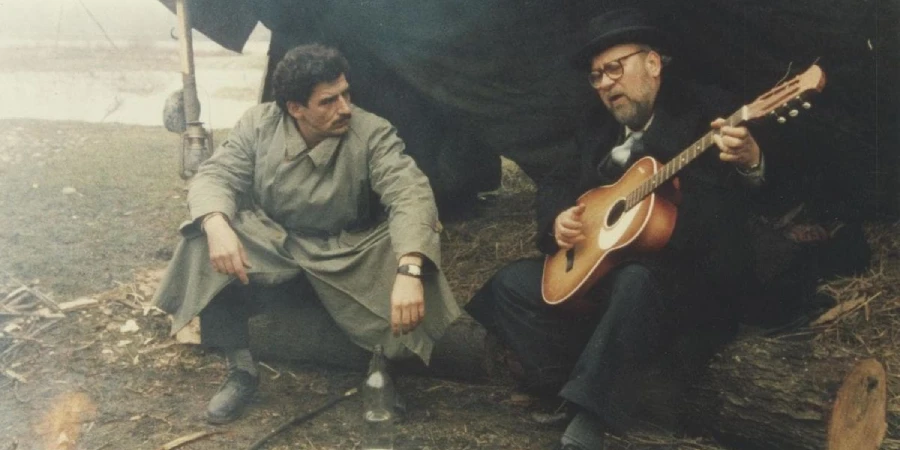

Few films manage to portray political terror through the innocent, bewildered eyes of a child with such devastating precision. When Father Was Away on Business, directed by Emir Kusturica, filters the brutal realities of Stalinist Yugoslavia through the perspective of young Malik, a boy too small to understand why his father keeps disappearing. It won the Palme d’Or at Cannes in 1985, announcing Kusturica as one of cinema’s most vital voices. This film is funny, heartbreaking, and quietly furious all at once.
Detailed Summary
A Family Secret Hidden in Plain Sight
Set in early 1950s Yugoslavia, the story unfolds during the period following Tito’s break with Stalin, when informants reported neighbors, friends, and even family members for ideological disloyalty. Malik, a young boy of about six, narrates events he does not fully comprehend, giving the film its distinctive tragicomic texture. His father, Mesa, is a charming, womanizing, politically careless man living in Sarajevo.
Mesa makes a casual, offhand remark about a political cartoon that his brother-in-law, Zijo, overhears. Zijo, motivated partly by jealousy over a woman both men desire, reports Mesa to the authorities. This single act of petty betrayal sets the entire family catastrophe in motion.
Father Goes Away on “Business”
Malik’s mother, Sena, tells the children that their father has gone away on business. In reality, the state has sent Mesa to a labor camp as punishment for his perceived disloyalty to the communist party line. Malik accepts this explanation with a child’s unquestioning trust, and the film gains much of its power from that gap between adult reality and childhood innocence.
Mesa ends up in Zvornik, working under humiliating conditions. He begins an affair with a local woman there, because his appetites never fully dim even under political punishment. Meanwhile, back in Sarajevo, Sena struggles to hold the household together with quiet, steely dignity.
Malik’s World Expands and Contracts
Malik navigates boyhood with a sleepwalking habit that becomes one of the film’s recurring motifs. His episodes of sleepwalking carry a symbolic weight, suggesting a child literally walking through a world he cannot wake up to understand. He develops a tender, awkward crush on an older girl, grounding the story in the universally recognizable textures of childhood.
The family eventually relocates to be closer to Mesa during his internal exile. This move forces everyone into a strange limbo, neither fully punished nor fully free. Malik observes everything with wide, serious eyes, storing impressions he will only process much later in life.
The Weight of Complicity
Zijo’s role as informant quietly poisons the family dynamic throughout the film. He attends family gatherings, eats at their table, and behaves as though nothing happened. Kusturica refuses to make him a cartoon villain; instead, Zijo embodies the ordinary human capacity for self-serving betrayal, which makes him far more unsettling.
Sena clearly suspects the truth about who reported her husband. However, she swallows her rage and keeps functioning, because survival demands it. This silent knowledge between characters creates a suffocating undercurrent beneath the film’s more playful surface moments.
Mesa Returns
Eventually, Mesa completes his period of internal exile and returns to the family. His homecoming is not triumphant or tender in any simple way. He comes back changed in some respects yet fundamentally the same in others, still charming, still selfish, still irresistible to his long-suffering wife.
The family absorbs his return as families absorb most things: imperfectly, with unspoken grievances left to quietly fester. Life resumes a surface normality that everyone knows is fragile. Malik watches his father return the same way he watched him leave, as a witness to adult mysteries he cannot decode.

Movie Ending
Malik grows older through the film’s final stretch, and the audience watches childhood innocence eroding at the edges. He learns, gradually and incompletely, that his father was not away on business in any conventional sense. The knowledge does not arrive as a single dramatic revelation; it seeps in slowly, the way most painful truths do for children.
In the film’s closing passages, Malik delivers a soccer ball kick that mirrors an earlier moment, creating a quiet circular structure. Life continues, the political machinery grinds on, and the family survives without ever fully reckoning with what happened to them. Kusturica refuses a cathartic resolution, because none existed in real Yugoslav life during that period.
What makes the ending so quietly devastating is Malik’s voiceover, which reflects on these events from a slight narrative distance. He never fully condemns his uncle Zijo, never fully forgives his father, and never fully understands his mother’s endurance. That unresolved complexity is precisely the point: history leaves people fractured, and children carry those fractures into adulthood.
Specifically, the final image reinforces the film’s central irony. Everything looks ordinary on the surface, and nothing is ordinary underneath. Kusturica trusts his audience to sit with that discomfort rather than offering easy resolution.
Are There Post-Credits Scenes?
When Father Was Away on Business contains no post-credits scenes. It is a 1985 Yugoslav art film, operating in a completely different cinematic tradition from the franchise filmmaking that popularized such sequences. Watch through to the end for the film itself; nothing follows the credits.
Type of Movie
This film occupies the territory between political drama and coming-of-age story, with strong threads of dark comedy running throughout. Its tone shifts fluidly, moving from absurdist humor to genuine sorrow within the same scene. Kusturica works in a tragicomic register that feels distinctly Eastern European in its sensibility.
In contrast to films that treat Stalinist repression with heavy, unrelenting gravity, this one finds moments of warmth and even laughter. That tonal complexity is a deliberate choice, not an inconsistency. It mirrors how ordinary people actually lived through political trauma: not in constant anguish, but in a mixture of fear, love, humor, and survival.
Cast
- Moreno D’E Bartolli – Malik
- Miki Manojlovic – Mesa
- Mirjana Karanovic – Sena
- Mustafa Nadarevic – Zijo
- Mira Furlan – Ankica
Film Music and Composer
Zoran Simjanovic composed the score for the film. His music draws on Yugoslav folk traditions while maintaining an intimacy that suits the story’s domestic focus. Simjanovic had a long working relationship with Kusturica, and his contributions here feel deeply embedded in the film’s emotional architecture rather than layered on top of it.
Moreover, the soundtrack uses accordion-driven melodies that carry both warmth and melancholy simultaneously. This musical duality reinforces the film’s tonal complexity. Music in Kusturica’s films is never mere decoration; it functions as another voice in the storytelling.

Filming Locations
Principal photography took place in Sarajevo and Zvornik, both located in what was then the Socialist Federal Republic of Yugoslavia, now in Bosnia and Herzegovina. Sarajevo’s streets and apartment buildings give the film an authentic texture that no studio recreation could replicate. The city feels lived-in and specific, grounding the political abstractions in concrete geography.
Zvornik functions in the film as a place of internal exile, smaller and more provincial than Sarajevo. Shooting on location there reinforced the sense of displacement that Mesa and his family experience. Consequently, the physical environments carry genuine narrative meaning rather than simply providing backdrop.
Awards and Nominations
When Father Was Away on Business won the Palme d’Or at the 1985 Cannes Film Festival, one of cinema’s most prestigious honors. It also received a nomination for the Academy Award for Best Foreign Language Film. These recognitions confirmed Kusturica’s arrival on the international stage and gave the film a global audience far beyond Yugoslavia.
Behind the Scenes Insights
- Kusturica drew on personal family memories and stories from his parents’ generation to shape the film’s atmosphere of political fear mixed with ordinary domestic life.
- Working with a child lead, Moreno D’E Bartolli, required Kusturica to build scenes around natural, unforced performance rather than technical precision; the boy’s reactions are frequently improvised in feel.
- Abdulah Sidran wrote the screenplay, and his collaboration with Kusturica produced a script that balances political specificity with universal emotional resonance.
- The production aimed for a documentary-like authenticity in its depiction of early 1950s Yugoslav domestic life, using period-accurate costumes and set dressing throughout.
- Kusturica was in his early thirties when he made this film, and its success at Cannes transformed his career trajectory almost overnight.
Inspirations and References
Abdulah Sidran based the screenplay on his own semi-autobiographical writing, drawing directly from experiences and observations of life under Tito’s Yugoslavia during the Stalinist purges of the early 1950s. The film reflects the historical reality of the Informbiro period, when Yugoslav citizens faced persecution for perceived sympathy with the Soviet Cominform after Tito’s 1948 split with Stalin.
Furthermore, the choice to filter history through a child’s perspective echoes a tradition of European cinema that uses childhood innocence as a lens for political critique. Films like Germany Year Zero and later Cinema Paradiso share this narrative strategy, though each film arrives at it from a distinct cultural context.
Alternate Endings and Deleted Scenes
No documented alternate endings or significant deleted scenes for When Father Was Away on Business appear in widely available production records or interviews. The film as released reflects Kusturica and Sidran’s intended vision. Kusturica has not publicly discussed major excised material from this production in sources readily available for verification.
Book Adaptations and Differences
This film is not based on a single published novel. Abdulah Sidran wrote an original screenplay, though it drew on his own autobiographical experiences and previously written material. There is no source novel to compare against the film’s narrative choices.



Memorable Scenes and Quotes
Key Scenes
- Malik’s repeated sleepwalking episodes, which function as the film’s central metaphor for a child navigating a world of adult secrets he cannot consciously access.
- The scene in which Zijo reports Mesa to the authorities, presented with chilling casualness rather than dramatic fanfare, making the betrayal feel mundane and therefore more terrifying.
- Mesa’s arrival at the labor camp in Zvornik, where the gap between the official language of the state and the human reality of his situation becomes painfully clear.
- Sena’s quiet, controlled scenes of domestic endurance, particularly moments where her knowledge of Zijo’s betrayal simmers just beneath her composed surface.
- Mesa’s eventual return to the family, handled without sentimentality, as everyone struggles to simply resume life without processing what happened.
Iconic Quotes
- “When father was away on business…” – Malik’s recurring framing device, which accumulates irony with each repetition as the audience understands what Malik does not.
- Sena’s terse, controlled responses to questions about Mesa’s absence, each one a small masterclass in saying everything by saying nothing.
Easter Eggs and Hidden Details
- Malik’s sleepwalking visually echoes the idea of an entire society moving through political terror in a kind of collective unconscious state, too afraid or too conditioned to fully wake up to what surrounds them.
- Zijo’s friendly, unremarkable behavior at family gatherings functions as a subtle commentary on how collaborators and informants existed invisibly within ordinary social life during this period.
- The soccer ball that Malik kicks appears at both the film’s opening and closing, creating a structural circle that quietly suggests the cyclical nature of political oppression across generations.
- Period details in clothing and domestic objects are carefully calibrated to the early 1950s, grounding fantastical or absurdist moments in a specific, verifiable historical reality.
Trivia
- When Father Was Away on Business was Yugoslavia’s first film to win the Palme d’Or at Cannes.
- Kusturica shot the film relatively early in his directing career, making the Cannes victory a particularly remarkable achievement for someone so young in the profession.
- The film’s Yugoslav title is Otac na sluzbenom putu, which translates literally as “Father on a Business Trip,” preserving the child’s innocent framing of events.
- Mira Furlan, who plays Ankica in the film, later became internationally known to Western audiences through her role in the television series Lost.
- Abdulah Sidran’s screenplay won considerable critical praise alongside Kusturica’s direction, with many critics noting that the two collaborators’ sensibilities aligned almost perfectly.
- Despite its deeply Yugoslav setting and subject matter, the film resonated internationally because political repression, family silence, and childhood innocence are genuinely universal experiences.
Why Watch?
This film earns its Palme d’Or reputation every single minute of its runtime. It finds humor, warmth, and sorrow inside the same frame without cheapening any of those emotions. Kusturica and Sidran show how political history does not happen to nations in the abstract; it happens to families, and children carry the weight of it long after the politicians move on.
Director’s Other Movies
- Do You Remember Dolly Bell? (1981)
- Time of the Gypsies (1988)
- Arizona Dream (1993)
- Underground (1995)
- Black Cat, White Cat (1998)
- Life Is a Miracle (2004)
- Promise Me This (2007)
- On the Milky Road (2016)
Recommended Films for Fans
- Underground (1995)
- Cinema Paradiso (1988)
- The Tin Drum (1979)
- Come and See (1985)
- Au Revoir les Enfants (1987)
- Time of the Gypsies (1988)
- Fanny and Alexander (1982)
- The White Ribbon (2009)