
Emir Kusturica does not make movies so much as he unleashes them. Black Cat, White Cat is a whirlwind of Romani music, riverside chaos, and characters so vivid they feel like they leaped off a carnival poster. Released in 1998, this Serbian comedy became an instant cult classic, earning Kusturica his second Venice Film Festival prize. Few films pack this much anarchic joy into two hours.
Detailed Summary
Matko’s Desperate Deal
Matko Destanov is a small-time con artist and petty smuggler living along the Danube with his teenage son, Zare. Life is chaotic, cheerful, and almost entirely unproductive. Matko dreams of one big score that will finally elevate him above the river mud.
His opportunity arrives through Grga Pitic, an aging, universally beloved criminal patriarch who agrees to fund a fuel-smuggling scheme. Matko borrows money from Grga’s dangerous associate, Dadan, a flamboyant gangster with an impressive collection of sunglasses and a catastrophically short temper. In addition, Matko promises more than he can deliver, which sets the entire disaster in motion.
The Smuggling Scheme Collapses
Matko’s plan involves diverting a fuel shipment along the river. However, the deal goes spectacularly wrong almost immediately. A rival group intercepts the cargo, and Matko ends up losing both the shipment and Dadan’s money.
Grga Pitic suffers a stroke during the fallout and falls into a catatonic state. He sits in his chair, motionless but technically alive, while the world collapses around his family. Meanwhile, Matko scrambles to figure out how to repay a debt he has absolutely no means of covering.
Dadan’s Outrageous Proposal
Dadan arrives with a solution that is less a negotiation and more a hostage situation. He proposes that Matko’s son Zare marry Dadan’s sister, Afrodita. Afrodita is described, generously, as a woman of strong personality and considerable physical presence, standing far taller than virtually everyone around her.
Zare, for his part, is already desperately in love with Ida, a young woman from another Romani family. Consequently, the forced engagement sends him into a panic. Dadan insists on the arrangement regardless, viewing the marriage as both a debt settlement and a way to finally offload his unmarried sister.
Grga Zagubljen’s Return
Grga Pitic’s grandson, Grga Zagubljen (whose name translates roughly as “Grga the Lost”), arrives on the scene. He is also in love with Ida, which creates a direct collision with Zare’s own romantic ambitions. Grga Zagubljen is a dreamer, gangly and awkward, but genuinely charming in his haplessness.
Notably, Grga Zagubljen and Zare strike an unlikely alliance rather than becoming enemies. Both young men recognize that neither of them wants what Dadan is forcing onto them. Their partnership gives the film its emotional core beneath all the absurdist noise.
Afrodita’s Own Rebellion
Afrodita is not simply a punchline. Kusturica gives her genuine agency within the chaos. She does not want to marry Zare any more than Zare wants to marry her, and she makes her feelings known in increasingly dramatic fashion.
Furthermore, Afrodita has her own romantic interest in a dwarf named Djordje, a tiny, good-natured man who works at the family compound. Their mutual affection is played completely sincerely, which makes it one of the film’s most surprisingly sweet subplots. Kusturica treats the relationship with warmth rather than mockery.
Grga Pitic’s Miraculous Recovery
Old Grga Pitic spends most of the film in his catatonic stupor while a goat eats through the side of his car and a pig slowly devours his beloved automobile from the outside in. His stillness functions almost as the calm eye of a hurricane. Everything spirals around him.
His recovery arrives at the most dramatically convenient possible moment. Grga suddenly snaps back to consciousness, full of energy and fury, just as events reach their breaking point. His return gives the film its climactic pivot.
Movie Ending
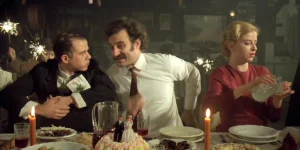
Zare and Ida manage to get married, as do Afrodita and Djordje, in a double wedding that resolves both romantic storylines simultaneously. Dadan, thoroughly outmaneuvered, finds himself powerless to stop either union. His elaborate scheme to control everyone around him collapses under the weight of its own absurdity.
Grga Pitic’s full return to vitality coincides with the wedding celebration, and the entire community erupts into one of cinema’s most gloriously unhinged party sequences. Brass bands play, people dance on rooftops, animals wander through the festivities, and the Danube itself seems to celebrate. In contrast to the film’s earlier anxiety and desperation, the finale feels like a genuine release valve.
Matko’s debt effectively dissolves within the general chaos of family reconciliation. Nobody seems particularly interested in accounting once the music starts. Kusturica signals clearly that in this world, joy is a more powerful force than obligation.
Dadan suffers a humiliation proportional to his earlier arrogance. His authority crumbles, his plan fails, and he ends the film diminished rather than destroyed. Kusturica keeps even the villain within the film’s fundamentally comic register, which matters enormously to the tone.
Old Grga Pitic, meanwhile, dances with startling vigor for a man who spent half the film unconscious. His resurrection functions as the film’s most joyful visual joke. Life, Kusturica insists, reasserts itself no matter how many disasters pile up around it.
Are There Post-Credits Scenes?
Black Cat, White Cat does not include any post-credits scenes. Once the final wedding celebration ends, the film is done. You are free to sit with the music still ringing in your head.
Type of Movie
This is a screwball comedy with strong elements of magical realism. It operates in the tradition of folk farce, where ordinary human greed collides with unstoppable communal energy. Kusturica filters everything through a Romani cultural lens that gives the film a texture entirely its own.
On the other hand, calling it purely a comedy undersells the film’s emotional sincerity. It treats love, family loyalty, and community with genuine tenderness beneath the chaos. The tone sits somewhere between a carnival and a fairy tale.
Cast
- Bajram Severdzan – Matko Destanov
- Florijan Ajdini – Zare Destanov
- Branka Katic – Ida
- Sabri Sulejman – Grga Pitic
- Srdan Todorovic – Dadan
- Salija Ibraimova – Afrodita
- Adnan Bekir – Grga Zagubljen
- Predrag Lakovic – Djordje
Film Music and Composer
Emir Kusturica co-composed the score alongside his band, The No Smoking Orchestra. Kusturica formed the band in Sarajevo years before making the film, and their sound is inseparable from his cinematic identity. Their music blends Romani brass traditions with punk energy and folk melody.
The soundtrack is not background decoration; it actively drives scenes forward. Brass instruments barrel through emotional moments with almost aggressive enthusiasm. Moreover, the live performance energy of the music gives every sequence a sense of barely contained explosion.
Notable musical moments include the extended wedding celebration sequence, where multiple brass ensembles seem to compete for sonic dominance. No single track functions as a quiet underscore. Everything in this film’s score pushes forward at maximum velocity.
Filming Locations
Kusturica shot the film primarily along the Danube River, using locations in Serbia. Specifically, the riverside communities and ramshackle settlements visible throughout the film ground the story in a very particular geography. This landscape of floating platforms, rusted machinery, and muddy riverbanks is not just a backdrop; it is a character.
Kusturica also shot portions in Vojvodina, the northern Serbian province known for its flat plains and multicultural communities. The location choice reinforces the film’s themes of marginalized communities living outside mainstream society. Furthermore, the physical environment of decay and improvised living mirrors the characters’ own relationship with rules and order.
Awards and Nominations
Kusturica won the Silver Lion for Best Director at the 1998 Venice Film Festival for this film. It represents his second major Venice recognition, cementing his place as one of European cinema’s most distinctive voices.
Behind the Scenes Insights
- Kusturica has described the film as a deliberate return to joy after the emotionally grueling experience of making Underground (1995), which generated significant political controversy.
- Many of the non-professional performers in crowd and celebration scenes were actual members of Romani communities from the filming regions.
- The No Smoking Orchestra performed much of the music live on set rather than recording it separately in post-production, which contributed to the raw, spontaneous energy of key scenes.
- Animals, including pigs, geese, and goats, appear throughout the film in functional story roles. Kusturica reportedly insisted on using real animals rather than trained substitutes for key gags.
- The scene involving the car being consumed by a pig reportedly required considerable patience and was achieved practically without digital assistance.
- Kusturica structured the film loosely to allow improvisation during shooting, which gave the ensemble cast room to develop physical comedy in the moment.
Inspirations and References
Kusturica drew openly from Romani folk culture and oral storytelling traditions. He has cited the energy of Romani weddings and celebrations as central to his visual imagination for this film. The communal, performative nature of those events shaped the film’s entire third act.
In addition, the film connects thematically to a broader tradition of Eastern European folk comedy, where social hierarchies collapse under the pressure of human appetite, love, and music. Kusturica’s earlier films, particularly Time of the Gypsies (1988), established the cultural and stylistic vocabulary he refines here. Black Cat, White Cat feels in many ways like the comedic counterpart to that film’s tragedy.
Alternate Endings and Deleted Scenes
No officially documented alternate endings or significant deleted scenes appear to exist in the public record for Black Cat, White Cat. Kusturica has not publicly discussed substantial cut content for this particular film. The released version appears to represent his intended final cut.
Book Adaptations and Differences
Black Cat, White Cat is an original screenplay, not an adaptation of any book or previously published work. Kusturica developed the story himself, building on his own creative universe and cultural observations. No source novel or short story exists for comparison.
Memorable Scenes and Quotes
Key Scenes
- The pig slowly consuming Grga Pitic’s car over the course of the film, functioning as an extended visual gag that pays off repeatedly throughout the narrative.
- Dadan’s introductory scene, where his absurd vanity and sudden violence establish his character as both comic and genuinely threatening.
- Grga Pitic’s sudden awakening from his catatonic state, timed perfectly against the surrounding chaos of the wedding preparations.
- The double wedding finale, featuring simultaneous brass bands, dancing on rooftops, and a crowd celebration that feels genuinely uncontrollable.
- Afrodita and Djordje’s tender moments together, which consistently undercut the film’s broader farcical energy with unexpected sincerity.
- Zare and Grga Zagubljen’s alliance scene, where two romantic rivals recognize their shared situation and choose cooperation over competition.
Iconic Quotes
- “My grandfather used to say: life is simple. You eat, sleep, drink and love. Everything else is trouble.”
- “A black cat, a white cat. Who cares about the color as long as it catches mice.” (a line referencing the film’s title and its core philosophy of pragmatic joy)
Easter Eggs and Hidden Details
- The title itself references a famous saying often attributed to Deng Xiaoping about pragmatism over ideology, applied here to romantic and social chaos rather than economics.
- Grga Pitic’s motionless presence throughout the middle section of the film mirrors the narrative stasis of the plot itself; nothing can truly move forward until he wakes up.
- Several background animals appear in multiple scenes, suggesting the compound is a contained, self-referential world where the same chaos recycles endlessly.
- The Danube River appears consistently in the background of outdoor scenes, functioning as a visual reminder of the characters’ liminal existence between belonging and drifting.
- Dadan’s sunglasses change between scenes, a subtle visual joke about his obsessive vanity that rewards attentive viewers.
Trivia
- This was Kusturica’s follow-up to the deeply controversial Underground (1995), and he has said he wanted to make something purely celebratory in response to that film’s political storm.
- The film runs approximately two hours and ten minutes, a relatively restrained length by Kusturica’s standards given his tendency toward epic runtimes.
- Kusturica shot the film in a relatively short production period, relying on the loosely structured script to keep things moving quickly on set.
- The No Smoking Orchestra’s profile grew significantly following the film’s international release and festival success.
- Several international critics initially struggled to categorize the film precisely because it blends folk comedy, magical realism, and musical performance so freely.
- Srdan Todorovic, who plays Dadan, became one of the most recognized faces from the film internationally, despite playing a secondary villain rather than the protagonist.
Why Watch?
Black Cat, White Cat delivers pure, raucous, big-hearted cinema with zero apologies. Kusturica builds a world so alive it practically leaps off the screen, carrying you through its chaos on a wave of brass music and genuine warmth. Few comedies anywhere commit this fully to joy as an artistic statement. It is a film that insists life is worth celebrating even when everything is falling apart.
Director’s Other Movies
- Do You Remember Dolly Bell? (1981)
- When Father Was Away on Business (1985)
- Time of the Gypsies (1988)
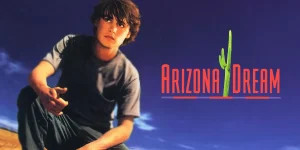
- Arizona Dream (1993)
- Underground (1995)
- Life Is a Miracle (2004)
- Promise Me This (2007)
- On the Milky Road (2016)
Recommended Films for Fans
- Time of the Gypsies (1988)
- Underground (1995)
- Latcho Drom (1993)
- The Band’s Visit (2007)
- Amarcord (1973)
- Leningrad Cowboys Go America (1989)
- The Full Monty (1997)
- Jamon Jamon (1992)