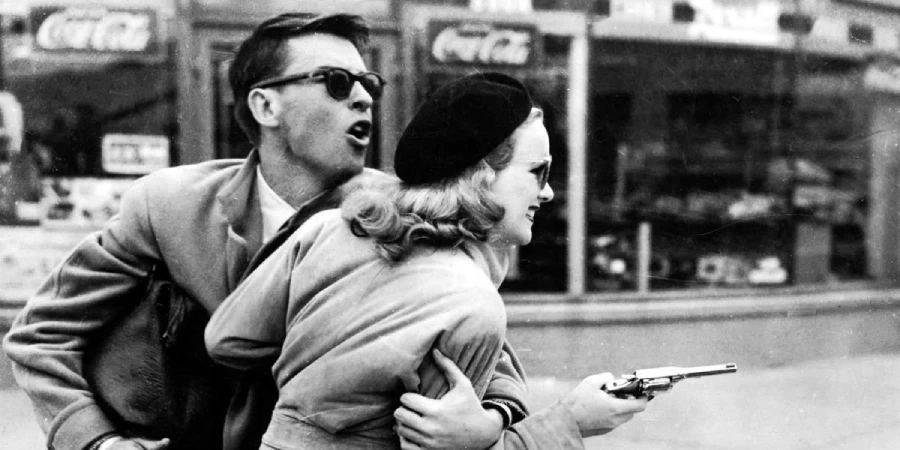

Gun Crazy is one of the most electrically charged crime films ever made, built on the idea that love and guns are equally lethal obsessions. Bart Tare and Annie Laurie Starr blaze across postwar America in a spiral of robbery, passion, and moral collapse that feels shockingly modern even today. Director Joseph H. Lewis shot much of it on a shoestring budget, yet the result punches far above its weight class.
Detailed Summary
Young Bart and His Dangerous Fascination
We meet Bart Tare as a boy, smashing a hardware store window to steal a pistol in a rainstorm. He loves guns with an almost mystical intensity, but he cannot bring himself to kill even a small animal. This tension, loving weapons but rejecting violence, defines every choice he makes for the rest of his life.
After reform school and a stint in the Army, adult Bart returns to his small hometown. He is charming, skilled with firearms, and fundamentally decent. However, that decency sits dangerously close to a personality that craves excitement and cannot say no.
Annie Laurie Starr and the Carnival
Bart visits a traveling carnival and locks eyes with Annie Laurie Starr, the sharpshooter act. She is glamorous, reckless, and radiates a predatory confidence that stops Bart cold. A public shooting competition between them becomes one of cinema’s great pieces of foreplay, all flying bullets and charged glances.
Bart wins the contest and gets hired by the carnival. The carnival owner, Packett, is clearly obsessed with Laurie and deeply threatened by Bart’s arrival. Consequently, he fires Bart and tries to keep Laurie for himself.
Laurie chooses Bart. They marry quickly, driven more by chemistry than deliberation. Moreover, Laurie makes no secret of what she wants: money, excitement, and a life without limits.
The Slide Into Crime
Married life on Bart’s meager savings burns out fast. Laurie pushes constantly for more, and Bart, desperate to hold onto her, agrees to their first robbery. They hit a small-town bank, and the rush proves intoxicating for both of them.
Lewis films their early robberies with a scrappy, documentary energy. In one extraordinary sequence, the camera sits in the back seat of their car for a long, uncut take as they pull off a payroll robbery in Montrose, California. It feels alarmingly real, almost like found footage decades before the term existed.
As a result, their crimes escalate. They become minor celebrities in the press, their names linked romantically even as the law closes in.
Cracks in the Partnership
Bart remains reluctant to hurt anyone. Laurie carries no such hesitation. Their values diverge more sharply with each job, and Bart periodically tries to pump the brakes, suggesting they quit while they can. Laurie dismisses every attempt.
Packett resurfaces, and the couple joins him in a scheme to rob the Armour meat-packing plant where Laurie once worked. Bart hates the plan but goes along with it. During the robbery, Laurie murders two people in cold blood, and everything changes irreversibly.
Fugitives and the Final Road
Bart is horrified by the killings. He and Laurie go on the run, but the romantic partnership now carries a corpse-weight neither of them can ignore. Police and press intensify their pursuit, and Bart’s old friends and sister become tangled in the investigation.
Bart reaches out to his childhood friends, Clyde Boston and Dave Allister, hoping they might help him surrender Laurie peacefully. Instead, Laurie discovers the plan. She plays on Bart’s love to keep him running, and he, unable to abandon her, follows.
Movie Ending
Bart and Laurie flee into the marshlands near his hometown, hunted by a large posse. Clyde and Dave are among the lawmen tracking them. The fog rolls thick and cold across the reeds, swallowing the landscape in a grey half-light that feels like doom made visible.
Laurie and Bart crouch in the fog as the posse tightens around them. She raises her gun, ready to shoot the approaching men, including the two friends Bart has known since childhood. Bart cannot let her kill again. He shoots Laurie himself, moments before the posse opens fire and kills him.
Both die in the marsh, together in death as they were in crime. The ending refuses sentiment. There is no redemption arc, no last-minute escape, and no tearful farewell speech. Lewis simply lets the fog close over them, and the film ends.
What makes this conclusion so powerful is its inevitability. Bart’s fatal flaw was never the guns; it was his inability to walk away from Laurie. Furthermore, Laurie’s flaw was never cruelty alone; it was her refusal to value any life, including her own. Their destruction is entirely self-authored, and the film makes sure we know it.
Audiences most often wonder whether Bart truly loved Laurie or was simply co-dependent and controlled. The film suggests both are true simultaneously. He loved her completely, and that love made him complicit in everything she did.
Are There Post-Credits Scenes?
Gun Crazy contains no post-credits scenes of any kind. It is a 1950 film, and the concept did not exist in Hollywood at the time. When the story ends, the film ends.
Type of Movie
Gun Crazy sits squarely in the film noir and crime thriller traditions. It carries all the hallmarks: a doomed protagonist, a dangerous femme fatale, moral ambiguity, and a fatalistic trajectory toward destruction.
In tone, it moves between romantic intensity and cold dread. Joseph H. Lewis keeps things lean and kinetic, never lingering when he can cut or push forward instead. The result lands somewhere between a fever dream and a police report.
Cast
- John Dall – Bart Tare
- Peggy Cummins – Annie Laurie Starr
- Berry Kroeger – Packett
- Morris Carnovsky – Judge Willoughby
- Anabel Shaw – Ruby Tare
- Harry Lewis – Sheriff Clyde Boston
- Nedrick Young – Dave Allister
- Trevor Bardette – Sheriff Boston (older)
Film Music and Composer
Victor Young composed the score for Gun Crazy. Young was one of Hollywood’s most prolific and respected composers during the studio era, with dozens of major film scores to his name. His work here is notably restrained, letting tension build through silence and ambient sound as much as through music.
The score leans into romanticism for the Bart-and-Laurie sequences, then shifts toward something tighter and more ominous as the crimes accumulate. This contrast reinforces the film’s central argument: that passion and violence occupy the same emotional frequency.
Filming Locations
Much of Gun Crazy was shot on location across Southern California, a choice driven largely by budget constraints. However, those constraints produced something remarkable: a gritty, sun-bleached realism that studio sets could never have matched.
The famous single-take robbery sequence was filmed on the streets of Montrose, California. Lewis used a hidden camera in the backseat of the car to capture real pedestrians reacting to the actors, giving the scene an unscripted, documentary texture.
The final marsh sequence was shot in a Southern California location chosen for its atmospheric fog and dense reeds. That landscape actively contributes to the feeling of entrapment and inevitable doom that closes the film.
Awards and Nominations
Gun Crazy received little awards attention upon its original release, largely overlooked by major ceremonies of the time. Its reputation grew slowly over decades, and it is now widely recognized by critics and film historians as a landmark of American noir, though that recognition came long after the awards season had moved on.
Behind the Scenes Insights
- Director Joseph H. Lewis worked with an extremely tight budget, which pushed him toward creative solutions that ended up defining the film’s visual style.
- Peggy Cummins was a Welsh-born actress who had originally been cast in Forever Amber before being replaced; Gun Crazy became her most celebrated English-language role.
- The long single-take robbery scene in Montrose was largely improvised on the day of shooting, with Lewis giving the actors minimal direction and trusting the camera to capture what happened.
- Producer Frank King used the pseudonym “MacKinlay Kantor” on the screenplay credit initially; the actual screenplay credit later correctly attributed work to Dalton Trumbo, who wrote it under a front name due to the Hollywood blacklist.
- Dalton Trumbo was one of the Hollywood Ten, blacklisted writers who could not use their own names on screen; Gun Crazy was among his pseudonymous credits.
- Lewis encouraged John Dall and Peggy Cummins to develop genuine chemistry off-screen, believing their real rapport would translate directly to their scenes together.
- The carnival sequences were shot with a real traveling carnival crew, adding further authenticity to an already grounded production.
Inspirations and References
Gun Crazy drew its most direct inspiration from a 1940 short story also titled Gun Crazy, written by MacKinlay Kantor and published in The Saturday Evening Post. Kantor’s story established the core premise: a boy with an obsessive relationship to guns who finds himself drawn into crime through a relationship with a dangerous woman.
The real-life crime spree of Bonnie Parker and Clyde Barrow clearly shadowed the film’s development. In contrast to later Bonnie-and-Clyde adaptations, Gun Crazy focuses less on folk-hero mythology and more on the psychological dependency that drives two people to self-destruction together.
The film also belongs to a postwar American anxiety about masculinity, violence, and the returning soldier struggling to fit back into civilian life. Bart’s character embodies that unease directly.
Alternate Endings and Deleted Scenes
No documented alternate endings for Gun Crazy have entered the public record. Given the film’s tight budget and fast production schedule, elaborate alternate sequences were unlikely to have been shot in the first place.
Similarly, no significant deleted scenes have been widely documented or released. The film as it stands is generally considered to represent Lewis’s complete vision, constraints and all.
Book Adaptations and Differences
Gun Crazy is based on MacKinlay Kantor’s short story of the same name, not a full novel. The story provided the foundational character of Bart and his gun obsession, but the screenplay expanded the plot significantly.
Dalton Trumbo’s adaptation introduced Laurie Starr as a far more developed and explicitly dangerous femme fatale. In the original story, the female character is less central and less predatory. Trumbo’s version essentially made Laurie co-equal to Bart as a driving force of the narrative.
Furthermore, the carnival setting, the single-take robbery, and the marsh finale all belong to the screenplay rather than the source material. Trumbo and Lewis built a substantially original film on a relatively slim foundation.
Memorable Scenes and Quotes
Key Scenes
- The carnival shooting competition between Bart and Laurie, which doubles as their courtship and establishes their dynamic instantly.
- The long single-take payroll robbery in Montrose, filmed from the back seat of their getaway car with real townspeople in the background.
- Laurie’s cold-blooded murder of two witnesses during the Armour plant robbery, which shatters any remaining ambiguity about who she is.
- Bart and Laurie dividing their money in a cheap motel room while the radio announces their names as wanted fugitives; the mundane setting against the dramatic news creates a quietly devastating contrast.
- The final foggy marsh sequence, where Bart shoots Laurie to prevent her killing his friends, and the posse’s gunfire follows immediately.
Iconic Quotes
- “We go together, Bart. I don’t know why. Maybe like guns and ammunition go together.” (Laurie, articulating the film’s central metaphor with blunt poetry.)
- “I want things.” (Laurie, cutting through any romantic illusion about her motivations.)
- “Laurie, I said no killing. That’s one thing I won’t do.” (Bart, drawing a line that the film will force him to cross.)
Easter Eggs and Hidden Details
- During the single-take robbery scene, a real local police officer can be spotted in the background, unaware the scene was being filmed; Lewis kept the take precisely because of these unscripted authentic details.
- Laurie’s cowgirl costume in the carnival act visually rhymes with her later criminal persona, suggesting her showmanship and her violence were always the same performance.
- Bart’s childhood scene establishes his reluctance to kill an animal early on; this detail pays off structurally in the final scene, where he finally does commit a killing, and it destroys him.
- The fog in the final marsh scene visually echoes the dreamlike quality Lewis employed in the carnival sequences, suggesting Bart never fully escaped the spell Laurie cast on him at their first meeting.
- Dalton Trumbo’s name does not appear on the original theatrical prints; the front name used was “Millard Kaufman,” a writer who agreed to lend his name to protect Trumbo during the blacklist period.
Trivia
- Gun Crazy was released under the alternate title Deadly Is the Female in some markets, a title that places far more explicit emphasis on Laurie as the dangerous agent of the story.
- Peggy Cummins reportedly learned to handle firearms extensively before production to ensure her carnival sharpshooter scenes looked completely convincing.
- Director Joseph H. Lewis was nicknamed “Wagon Wheel Joe” earlier in his career for his habit of framing shots through interesting foreground objects; Gun Crazy extends that visual inventiveness considerably.
- John Dall had previously appeared in Alfred Hitchcock’s Rope (1948), another film built around a character whose calm exterior conceals a capacity for lethal behavior.
- The film’s budget was so limited that Lewis and his crew sometimes had a single day to shoot sequences that larger productions would schedule over a week.
- Film scholars and critics, including those associated with the French New Wave, cited Gun Crazy as a major influence on the lovers-on-the-run genre that Breathless and later Badlands would explore.
- Gun Crazy was selected for preservation in the United States National Film Registry by the Library of Congress, recognizing it as culturally, historically, and aesthetically significant.
Why Watch?
Gun Crazy offers something rare: a crime film that genuinely believes in its characters while watching them burn. Peggy Cummins delivers one of noir’s great performances, ferocious and magnetic in equal measure. In addition, the technical audacity of Lewis’s filmmaking, especially that backseat single-take robbery, still feels startling. This is the movie that invented a template dozens of later films followed.
Director’s Other Movies
- The Big Combo (1955)
- My Name Is Julia Ross (1945)
- Terror in a Texas Town (1958)
- The Halliday Brand (1957)
Recommended Films for Fans
- Bonnie and Clyde (1967)
- They Live by Night (1948)
- Breathless (1960)
- Badlands (1973)
- Double Indemnity (1944)
- Natural Born Killers (1994)
- Rope (1948)
- Out of the Past (1947)