Few films have dared to sit at the dinner table with Adolf Hitler and watch him eat. Downfall does exactly that, and the result is deeply unsettling. Oliver Hirschbiegel locks us inside the Berlin bunker for the final days of the Third Reich. As a result, we get one of the most claustrophobic war films ever made.
Detailed Summary
A Secretary Gets the Job: November 1942
We begin in East Prussia at the Wolf’s Lair. A nervous 22-year-old named Traudl Humps auditions to become Hitler’s personal secretary. She botches her typing test, but Hitler gently lets her try again.
That small moment of warmth matters. It explains how an ordinary young woman could grow loyal to a monster.
Hitler’s Birthday Under Fire: April 20, 1945
Then the story jumps ahead two and a half years. Soviet artillery now shells the heart of Berlin, and Hitler turns 56. Traudl, now married and named Junge, still works for him beneath the Reich Chancellery.
Heinrich Himmler and other top Nazis urge Hitler to leave the city. He refuses. Meanwhile, Himmler quietly plans his own outreach to the Western Allies.
Armies That Exist Only on Maps
Hitler moves divisions around his map table with total confidence. His generals, however, know those units are shattered or gone. Nobody has the courage to tell him plainly.
Above ground, we follow Peter Kranz, a boy in the Hitler Youth. He destroys Soviet tanks and receives a medal from Hitler himself. His father, who lost an arm in the war, begs him to come home, but Peter calls him a coward.
In addition, we meet Ernst-Günther Schenck, an SS doctor who ignores orders to evacuate. He stays behind and treats the wounded in gruesome makeshift hospitals.
The Steiner Meltdown
Hitler pins all his hopes on a counterattack by General Felix Steiner. On April 22, the generals admit that Steiner never attacked because he lacked the men. Hitler clears the room of everyone except Keitel, Jodl, Krebs, and Burgdorf.
What follows is the most famous rant in cinema. He screams about betrayal, cowardice, and failure while the staff listens outside the door. Finally, he slumps in his chair and says it aloud: the war is lost.
He vows to stay in Berlin and shoot himself. Consequently, the mood in the bunker shifts from denial to doom.
Parties, Telegrams, and Betrayals
Eva Braun responds to the gloom by throwing a wild party upstairs in the Chancellery. A shell blast cuts the dancing short. Her forced cheerfulness is one of the film’s creepiest touches.
Soon, Hermann Göring sends a telegram asking to take over leadership. Hitler reads it as treason and strips him of every office.
Albert Speer arrives for a final goodbye. He confesses that he ignored Hitler’s orders to destroy German infrastructure. Hitler says almost nothing, and a single tear rolls down his cheek.
The Goebbels Family Moves In
Joseph and Magda Goebbels bring their six children into the bunker. The kids sing for “Uncle Hitler” in a scene that plays like a nightmare recital. Magda begs Hitler to flee Berlin, and she collapses when he refuses.
Later, news arrives that Himmler has offered surrender to the Allies. Hitler explodes again. He orders the execution of Himmler’s liaison, Hermann Fegelein, who also happens to be Eva Braun’s brother-in-law.
Eva pleads for Fegelein’s life. Hitler doesn’t budge, and a firing squad shoots him.
A Wedding and a Will
With Soviet troops only blocks away, Hitler dictates his final testament to Traudl. Afterward, he marries Eva Braun in a brief midnight ceremony.
He also asks Dr. Werner Haase about the most reliable way to die. Haase recommends cyanide combined with a pistol shot. To test the poison, they give a capsule to Hitler’s beloved dog, Blondi.
Movie Ending
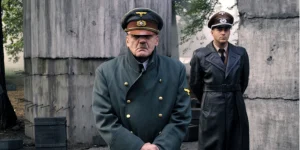
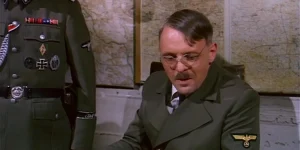
Hitler eats a last quiet meal with his secretaries and his cook. After lunch, he shakes hands with his staff and gives Magda Goebbels his own golden party badge. He and Eva retreat behind a steel door. Hirschbiegel keeps the camera outside, so we only hear the shot.
Aides carry both bodies up to the Chancellery garden. They douse them in petrol and burn them while shells fall nearby. A final Nazi salute over the flames sums up the madness.
Inside, something small but telling happens. Staff members light cigarettes, which Hitler had always forbidden.
What comes next is the hardest scene to watch. Magda sedates her six children with a sleeping draught. Once they sleep, she crushes a cyanide capsule between each child’s teeth, one by one.
Afterward, she calmly plays solitaire. Joseph and Magda walk up to the garden, where he shoots her and himself.
Why does she do it? Earlier, she declares that her children should not grow up in a world without National Socialism. Magda represents fanaticism in its purest form, a belief that devours its own family.
Generals Krebs and Burgdorf shoot themselves as well. Helmuth Weidling negotiates the surrender of Berlin and broadcasts the news. Others attempt a breakout led by Wilhelm Mohnke.
Traudl joins that group. When Soviet soldiers surround them, she walks straight through the enemy lines. Peter Kranz, who has found his parents dead, takes her hand.
Together, they find a bicycle and ride out of the ruined city. On-screen text reveals the fates of the key figures.
Finally, the real Traudl Junge appears in documentary footage. She admits that youth was no excuse, and that she could have found out the truth. Ultimately, the film isn’t asking us to pity anyone; it’s asking how ordinary people looked away.
Are There Post-Credits Scenes?
No. Downfall has no mid-credits or post-credits scenes. The closing interview with the real Traudl Junge plays before the credits roll, so you can leave once they start.
Type of Movie
Downfall is a historical war drama with the soul of a chamber piece. Most of the action unfolds in cramped concrete corridors. Therefore, it often feels closer to a psychological thriller than a battlefield epic.
Its tone is cold, sober, and almost documentary-like. Hirschbiegel avoids melodrama and heroic music. In contrast, many Hollywood war films lean heavily on sentiment.
Cast
- Bruno Ganz – Adolf Hitler
- Alexandra Maria Lara – Traudl Junge
- Corinna Harfouch – Magda Goebbels
- Ulrich Matthes – Joseph Goebbels
- Juliane Köhler – Eva Braun
- Heino Ferch – Albert Speer
- Christian Berkel – Ernst-Günther Schenck
- Thomas Kretschmann – Hermann Fegelein
- Ulrich Noethen – Heinrich Himmler
- Matthias Habich – Werner Haase
- Michael Mendl – Helmuth Weidling
- André Hennicke – Wilhelm Mohnke
- Götz Otto – Otto Günsche
- Birgit Minichmayr – Gerda Christian
- Rolf Kanies – Hans Krebs
- Justus von Dohnányi – Wilhelm Burgdorf
- Thomas Thieme – Martin Bormann
- Donevan Gunia – Peter Kranz
Film Music and Composer
Stephan Zacharias composed the score. His music is sparse, mournful, and restrained. It never tells you how to feel, which suits the material perfectly.
Notably, the soundtrack also features Henry Purcell’s lament “When I am laid in earth” from Dido and Aeneas. During Eva Braun’s party, the period tune “Blutrote Rosen” spins on the gramophone. That cheerful melody against exploding shells creates a chilling contrast.
Zacharias has worked largely in German film and television. Downfall remains his best-known work internationally.

Filming Locations
Hirschbiegel’s crew shot much of the street fighting in St. Petersburg, Russia. Parts of that city resemble wartime Berlin closely. Modern Berlin, in contrast, looks far too rebuilt to pass for 1945.
Designers recreated the bunker interiors at Bavaria Studios in Munich. They kept the ceilings low and the rooms tight. Consequently, every frame feels cramped and airless.
Some scenes were also filmed in Berlin itself. That geography matters, because the story’s horror depends on how small Hitler’s world has become.
Awards and Nominations
Downfall earned an Academy Award nomination for Best Foreign Language Film. It lost to Spain’s The Sea Inside. However, it won the BBC Four World Cinema Award in 2005.
At home, the film and Bruno Ganz also collected national honors, including recognition at the Bavarian Film Awards.
Behind the Scenes Insights
- Bruno Ganz spent roughly four months preparing for the role.
- He studied a rare 1942 recording of Hitler speaking privately with Finnish leader Mannerheim. That tape captures Hitler’s normal conversational voice, not his podium shriek.
- Ganz also observed Parkinson’s patients to reproduce Hitler’s tremor.
- Producer Bernd Eichinger wrote the screenplay himself.
- The release sparked fierce debate in Germany about showing Hitler as a human being. Director Wim Wenders, for instance, criticized the approach.
- On the other hand, historian Ian Kershaw praised Ganz’s portrayal as remarkably convincing.
- Hirschbiegel has said he finds the internet parodies of the rant scene funny.
Inspirations and References
Two books form the backbone of the script. Joachim Fest’s Inside Hitler’s Bunker supplies the historical framework. Traudl Junge’s memoir Until the Final Hour provides the personal viewpoint.
Furthermore, the writers drew on Albert Speer’s Inside the Third Reich and other eyewitness accounts. Memoirs by Gerhard Boldt, Ernst-Günther Schenck, and Siegfried Knappe all contributed details.
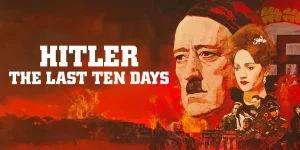
Junge’s closing interview comes from the 2002 documentary Blind Spot: Hitler’s Secretary. Earlier films covered similar ground, specifically Der letzte Akt (1955), Hitler: The Last Ten Days (1973), and The Bunker (1981).
Alternate Endings and Deleted Scenes
No alternate ending is known to exist. History had already written the final act, after all.
An extended version does exist, though. German television aired it in two parts, and it later reached home video. It adds extra bunker and street material, but it doesn’t change the story.
Book Adaptations and Differences
Downfall adapts nonfiction, so most events follow the historical record closely. Still, the film takes a few liberties.
Peter Kranz is a fictional character. He appears to be loosely inspired by real decorated Hitler Youth boys, such as Alfred Czech.
Similarly, Traudl’s bicycle escape with Peter is a dramatic invention. Her real journey out of Berlin was longer and far harsher.
Some historians also argue that the film treats Schenck and Mohnke too kindly. Specifically, it skips the darker allegations in their wartime records. Admittedly, a two-and-a-half-hour film can’t cover everything, but the omission is worth knowing.
Memorable Scenes and Quotes
Key Scenes
- Hitler’s volcanic rant after he learns Steiner never attacked.
- Speer’s confession and Hitler’s single silent tear.
- Eva Braun’s frantic party, interrupted by an artillery blast.
- The Goebbels children singing for Hitler in the bunker.
- Magda Goebbels poisoning her children one by one.
- Hitler decorating child soldiers in the Chancellery garden.
- Traudl and Peter cycling away from the ruins.
Iconic Quotes
Translations vary between subtitle tracks, so these are approximate.
- “Der Krieg ist verloren.” (“The war is lost.”) (Hitler)
- “Das war ein Befehl!” (“That was an order!”) (Hitler)
- “I feel no sympathy.” (Goebbels, on the suffering of German civilians)
- “It was no excuse to be young.” (The real Traudl Junge, in the closing interview)

Easter Eggs and Hidden Details
- Hitler often hides his trembling left hand behind his back, a nod to his suspected Parkinson’s disease.
- A portrait of Frederick the Great hangs in his quarters. Hitler idolized the Prussian king and stares at the painting in silence.
- The garden medal ceremony recreates some of the last known newsreel footage of Hitler.
- Staff members light cigarettes moments after his death. Hitler had banned smoking in his presence.
- Hitler lovingly admires Speer’s architectural model of a rebuilt Berlin while the real city burns above him.
- His meals are vegetarian, which matches historical accounts.
Trivia
- Bruno Ganz was Swiss, not German or Austrian.
- Alexandra Maria Lara was born in Bucharest, Romania.
- The rant scene became one of the internet’s most parodied clips. In 2010, Constantin Film had many of those videos removed from YouTube.
- Interestingly, Ulrich Matthes also played a priest imprisoned by the Nazis in The Ninth Day that same year.
- Thomas Kretschmann also appears in The Pianist and Valkyrie, again in German uniform.
- Rochus Misch, the real bunker telephone operator, was still alive when the film premiered.
- Traudl Junge died in February 2002, shortly after Blind Spot premiered.
- The theatrical cut runs about 156 minutes, and it grossed over $90 million worldwide.
Why Watch?
Downfall offers no heroes and no comfort, and that’s the point. Bruno Ganz delivers one of cinema’s great performances, terrifying because it feels human. Moreover, the film shows how loyalty and denial destroy people. It’s essential, gripping, and impossible to forget.
Director’s Other Movies
- Das Experiment (2001)
- Mein letzter Film (2002)
- Ein ganz gewöhnlicher Jude (2005)
- The Invasion (2007)
- Five Minutes of Heaven (2009)
- Diana (2013)
- 13 Minutes (2015)
Recommended Films for Fans
- Das Boot (1981)
- The Bunker (1981)
- Come and See (1985)
- The Zone of Interest (2023)
- Schindler’s List (1993)
- Stalingrad (1993)
- Conspiracy (2001)
- Hitler: A Film from Germany (1977)
- Letters from Iwo Jima (2006)
- The Pianist (2002)
- Sophie Scholl: The Final Days (2005)
- The Lives of Others (2006)
- Valkyrie (2008)