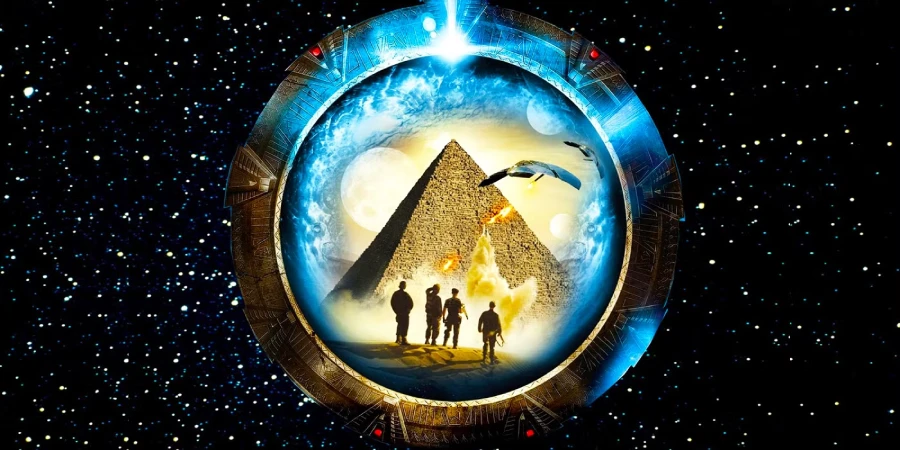

Few films have the audacity to rewrite human history, ancient mythology, and science fiction all at once, and pull it off with genuine blockbuster flair. Stargate (1994) does exactly that, proposing that the Egyptian gods were actually alien conquerors who enslaved humanity thousands of years ago. Director Roland Emmerich and writer Dean Devlin built an entire franchise from this single, gloriously absurd premise. It remains one of the most influential sci-fi adventures of the 1990s.
Detailed Summary
The Discovery at Giza, 1928
The film opens in 1928, where archaeologists in Giza unearth a massive circular stone artifact buried beneath the sand. A young girl watches as the object, clearly extraordinary, is hauled away. This prologue establishes the central mystery without revealing a thing about what the device actually does.
Daniel Jackson Enters the Picture
Dr. Daniel Jackson, played by James Spader, is a disgraced Egyptologist whose radical theories about the pyramids predate conventional archaeology by thousands of years. His colleagues mock him relentlessly, and his academic career is essentially finished. However, a mysterious woman named Catherine Langford recruits him for a secret government project.
Catherine brings Daniel to a military facility where the artifact from Giza has been studied for decades with no results. Daniel cracks the translation almost immediately, identifying a six-symbol coordinate system encoded on the device. His breakthrough sets the entire story in motion.
Opening the Stargate
Colonel Jack O’Neil, played by Kurt Russell, arrives at the facility as the mission commander. He carries a dark, private grief: his young son died in an accident involving Jack’s own service weapon. O’Neil is clearly not operating at full emotional capacity, and he carries a nuclear device with him, suggesting the mission has a fail-safe built into it from the start.
Daniel’s translation activates the Stargate, creating a stable wormhole for the first time in recorded history. A team of soldiers, along with Daniel, steps through. They emerge on the other side of the universe, on an alien desert world.
Arriving on Abydos
The team finds themselves stranded because Daniel cannot yet identify the return address. Meanwhile, they encounter a group of humans who look and speak like ancient Egyptians, clearly descendants of people transported through the gate millennia ago. These people live in fear of their gods, particularly a deity they call Ra.
Daniel bonds quickly with a young local man named Skaara and falls deeply in love with a woman named Sha’uri, who is later gifted to him by the village elders. In contrast to O’Neil’s closed-off demeanor, Daniel opens up completely to this community and genuinely wants to protect them.
Ra Reveals Himself
Ra is not a god. He is an alien, a member of a parasitic species that has taken over a human host, and he rules this planet through fear and forced labor. His enormous spacecraft arrives in orbit and descends to the planet’s surface. Ra’s soldiers, the Horus Guards, are fearsome enforcers dressed in ceremonial armor derived from Egyptian iconography.
Ra captures Daniel, O’Neil, and several of the soldiers. He reveals that he intends to send the nuclear device that O’Neil brought, now enhanced with alien technology, back through the Stargate to Earth. Ra wants to punish the world for having dared to use the gate at all.
Rebellion Begins
Daniel communicates with the enslaved Abydonians and helps them understand they have been deceived for generations. Skaara and the other young men of the village begin to organize resistance, learning to use the weapons O’Neil’s soldiers brought with them. This moment is genuinely moving, because it reframes the entire story as one of liberation rather than exploration.
O’Neil, meanwhile, begins to reconnect with his will to live. His bond with Skaara, who reminds him of his lost son, slowly pulls him back from the suicidal edge he arrived with. The character work here is subtle but effective.
The Battle for Abydos
The Abydonians and the soldiers mount a full assault on Ra’s pyramid ship. Consequently, the fighting spreads through the pyramid’s corridors and across the desert. Ra’s forces are formidable, but the rebels use surprise and intimate knowledge of the terrain to their advantage.
Ra attempts to flee with the bomb on board his ship, intending to detonate it over Earth after escaping. O’Neil and Daniel manage to beam the bomb directly onto Ra’s ship using his own transportation technology. The ship explodes in orbit, killing Ra definitively.

Movie Ending
With Ra destroyed, Abydos is free for the first time in thousands of years. Daniel chooses to stay behind on the planet, unwilling to leave Sha’uri and the community he has come to love. O’Neil and the surviving soldiers return through the Stargate to Earth.
O’Neil’s report to his superiors describes the mission as a success, with the Stargate on the other side having been destroyed. This is a lie he tells to protect Daniel and the Abydonians from further military interference. It is a remarkably selfless act for a character who arrived seemingly indifferent to his own survival.
The final image of Daniel reuniting with Sha’uri and embracing his new life on Abydos is genuinely warm. It underlines the film’s quiet argument that belonging matters more than returning home. Moreover, the closing moments hint strongly at the wider universe beyond Abydos, a universe the later television series would spend years exploring.
Audiences often wonder whether Ra is truly gone for good. Within the film itself, his death is unambiguous. His ship disintegrates completely. However, the franchise expanded significantly through the Stargate SG-1 television series, which introduced other Goa’uld System Lords and revealed that Ra was just one of many such alien rulers.
Are There Post-Credits Scenes?
Stargate contains no post-credits scenes. The film ends cleanly after its final emotional beat, with no teasers or sequel hooks hidden after the credits roll. In 1994, mid-credits and post-credits sequences were not yet the standard practice they later became.
Type of Movie
Stargate is a science fiction action-adventure film with strong threads of mythology, archaeology, and military drama woven through it. Its tone sits somewhere between earnest blockbuster spectacle and genuine world-building ambition. For instance, it takes its ancient Egypt mythology seriously enough to give the story real weight, even when the action gets loud.
On the other hand, it never loses its sense of fun. It is not a dark film; it is an optimistic one, ultimately built around liberation and human resilience.
Cast
- Kurt Russell – Colonel Jack O’Neil
- James Spader – Dr. Daniel Jackson
- Jaye Davidson – Ra
- Viveca Lindfors – Catherine Langford
- Alexis Cruz – Skaara
- Mili Avital – Sha’uri
- Leon Rippy – General W.O. West
- John Diehl – Lieutenant Kawalsky
- Erick Avari – Kasuf
- Carlos Lauchu – Anubis
Film Music and Composer
David Arnold composed the score for Stargate, and it is a genuinely spectacular piece of work. Arnold brought a sweeping, epic sensibility to the material, blending orchestral grandeur with Middle Eastern musical textures that perfectly underline the ancient Egypt setting. Notably, this score helped launch his career at the highest levels of Hollywood.
The main theme is immediately recognizable: bold, brass-driven, and ceremonial in its pacing. Arnold would subsequently go on to compose several James Bond film scores, beginning with Tomorrow Never Dies in 1997. His work on Stargate remains a fan favorite among film score enthusiasts.

Filming Locations
Principal photography took place largely in Yuma, Arizona, whose vast desert landscapes convincingly doubled for both Egypt and the alien world of Abydos. Yuma’s sand dunes are among the most expansive in North America, giving the film its authentic sense of scale and isolation. Furthermore, the location meant the production could shoot exterior scenes that felt genuinely vast without relying entirely on visual effects.
Some interior and studio sequences were filmed at MGM Studios in Los Angeles. The combination of real desert exteriors and controlled studio interiors gave the film a grounded visual consistency. In contrast to purely studio-bound productions, the practical location work gives Stargate a tactile, physical quality that holds up well.
Awards and Nominations
Stargate did not receive major awards recognition from mainstream bodies like the Academy Awards or the Golden Globes. David Arnold’s score, however, earned significant admiration within the film music community and helped raise his profile considerably.
Behind the Scenes Insights
- Roland Emmerich and Dean Devlin wrote the screenplay together and financed the initial development themselves before securing studio backing.
- Kurt Russell deliberately underplayed O’Neil, keeping the character quieter and more internalized than a typical action hero of the era.
- Jaye Davidson, who played Ra, had previously been nominated for an Academy Award for The Crying Game (1992). Stargate was his final film role.
- The Stargate prop itself was a massive, functional set piece; the production team built it large enough that actors could walk through its frame without any digital compositing for the basic structure.
- Emmerich has cited the film as his personal favorite among his own projects, valuing its contained story compared to his later large-scale disaster films.
- The hieroglyphic and costume designs went through extensive consultation to reflect authentic ancient Egyptian visual culture, even though the story is entirely fictional.
Inspirations and References
Emmerich and Devlin drew heavily from fringe archaeology theories, particularly the idea that the Egyptian pyramids could not have been built by human hands alone without outside assistance. This “ancient astronaut” concept had circulated in popular culture since at least the 1960s and was brought to wide public attention by books like Erich von Daniken’s Chariots of the Gods (1968).
The film also draws on classic adventure serial traditions, particularly the Indiana Jones model of archaeology-as-action. In addition, the military team dynamic echoes Vietnam-era and Cold War military cinema, giving O’Neil’s character a recognizable emotional template.
Egyptian mythology itself provided the story’s core vocabulary, including Ra as the sun god, Horus as his warrior aspect, and the visual language of the afterlife. Emmerich and Devlin reinterpreted these as alien cultural impositions rather than human-created belief systems.
Alternate Endings and Deleted Scenes
The theatrical cut of Stargate is close to Emmerich and Devlin’s original intentions. No dramatically different alternate ending has been officially released or widely documented. However, an extended cut of the film exists with additional scenes that flesh out character relationships, particularly between Daniel and the Abydonian community.
Some scenes developing the backstory of O’Neil’s son and his grief were trimmed to keep the pacing tight. These scenes, had they remained, would have made O’Neil’s emotional arc even more explicit. The theatrical version trusts the audience to read Kurt Russell’s performance, which works well.
Book Adaptations and Differences
Stargate is not based on a book. Emmerich and Devlin wrote an original screenplay. Novelizations of the film were subsequently published after its theatrical release, but these adapted the film rather than serving as its source material.
Memorable Scenes and Quotes
Key Scenes
- Daniel activating the Stargate for the first time, as the wormhole erupts outward in a massive kawoosh of energy before settling into its stable event horizon.
- Ra removing his helmet and revealing an alien entity inhabiting a young human host, a genuinely unsettling reveal that reframes everything the film has suggested about “gods.”
- Skaara and the Abydonian boys picking up Earth weapons and choosing to fight, a pivotal moment of agency in a story about liberation.
- O’Neil and Daniel beaming the nuclear bomb onto Ra’s escaping ship, turning Ra’s own technology against him.
- The final farewell between O’Neil and Daniel at the Stargate, with Daniel choosing to stay on Abydos.
Iconic Quotes
- “Give my regards to King Tut, asshole.” (O’Neil, to Ra’s forces)
- “I’ve been trying to tell you from the beginning. Ra is not a myth.” (Daniel Jackson)
- “If you don’t want this thing going off in your backyard, then you better let me do my job.” (O’Neil)
- “We brought enough firepower to take out an entire civilization.”
Easter Eggs and Hidden Details
- The six symbols Daniel uses to operate the Stargate are constellations, functioning as a coordinate system for interstellar travel, a concept the SG-1 series later expanded into an entire mythology.
- Ra’s soldiers use weapons styled after Egyptian ceremonial staffs, a visual choice that ties alien technology directly to objects already present in human archaeological records.
- Catherine Langford’s necklace features the Eye of Ra, a symbol she has worn since childhood after her father’s excavation. It quietly foreshadows the connection between Earth mythology and the alien presence.
- The dialect spoken by the Abydonians incorporates elements of ancient Egyptian linguistic reconstructions, giving the community an authentic historical texture.
- Ra’s ship, when viewed from certain angles, echoes the shape of the Great Pyramid of Giza, suggesting the pyramid was itself modeled on the spacecraft.
Trivia
- Stargate was a significant box office success, earning over $196 million worldwide against a production budget of approximately $55 million.
- The film spawned one of television’s longest-running sci-fi franchises, beginning with Stargate SG-1 in 1997, which ran for ten seasons.
- James Spader based his portrayal of Daniel Jackson partly on real Egyptologists and linguists, studying body language and speech patterns to give the character academic authenticity.
- Jaye Davidson negotiated a reportedly high salary for his role as Ra, which contributed to his decision to retire from acting afterward.
- Emmerich went on to make Independence Day (1996) with the same production team, reusing several creative and logistical approaches developed on Stargate.
- The gate’s distinctive chevron locking system became one of the most iconic sound and visual effects in 1990s science fiction.
- A theatrical sequel was planned but never produced; the franchise moved directly to television instead, with a recast and expanded story.
Why Watch?
Stargate delivers genuine adventure, a clever central premise, and two lead performances that work together beautifully. Russell and Spader bring complementary energies that keep the story grounded even when it goes full-on mythological spectacle. Furthermore, David Arnold’s score alone is worth the price of admission. It is a film that earns its blockbuster ambitions.
Director’s Other Movies
- Independence Day (1996)
- Godzilla (1998)
- The Patriot (2000)
- The Day After Tomorrow (2004)
- 10,000 BC (2008)
- 2012 (2009)
- White House Down (2013)
- Moonfall (2022)