
Few films have weaponized a single secret as effectively as Neil Jordan’s The Crying Game. Released in 1992, it pulled off something almost impossible: keeping its central twist out of public conversation long enough to blindside mass audiences worldwide. At its core, this is a film about identity, loyalty, and love in the most inconvenient circumstances imaginable. It is also, quietly, one of the most politically charged British films of its decade.
Detailed Summary
Fergus and Jody: An Unlikely Bond
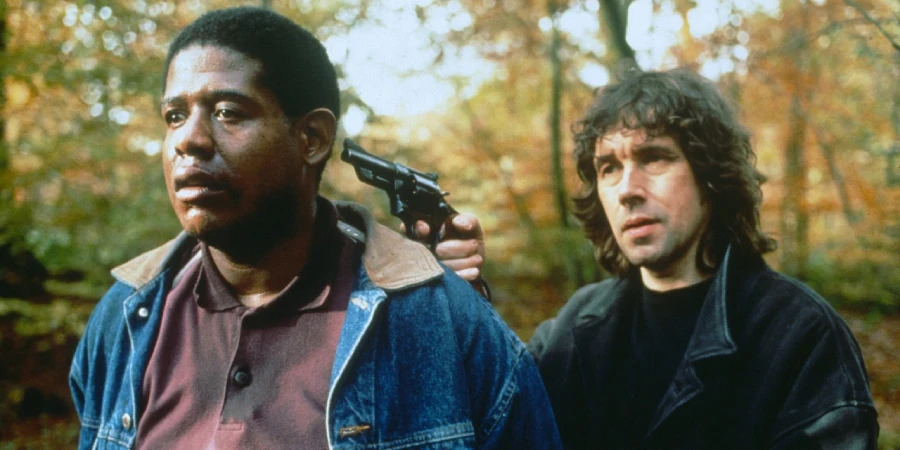
Fergus, played by Stephen Rea, is an IRA volunteer operating in Northern Ireland. He and his unit kidnap Jody, a Black British soldier played by Forest Whitaker, using a woman named Jude as bait at a fairground.
Jody is hooded, bound, and held hostage in a remote safehouse. However, Fergus finds himself drawn to the man, sharing conversations, feeding him, and treating him with a basic human dignity the situation does not exactly encourage.
Jody knows he is probably going to die. He talks about his girlfriend back in London, a hairdresser named Dil, and makes Fergus promise to find her if the worst happens. Fergus, against all professional instinct, agrees.
The Hostage Crisis Unravels
Fergus forms a genuine emotional connection with Jody during their time together. Consequently, when orders arrive to execute the soldier, Fergus cannot bring himself to pull the trigger.
He leads Jody out into a field instead, apparently intending to let him run. Jody bolts, and in a brutal stroke of irony, a British Army convoy runs him down before Fergus even has to make a final choice. Simultaneously, British forces raid the safehouse, killing most of the IRA unit.
Fergus escapes and goes to ground. He travels to London, adopts the alias Jimmy, and starts looking for Dil.
Jimmy Finds Dil
Fergus locates Dil at a bar called the Metro, where she is a regular. She is charming, flirtatious, and immediately magnetic. Fergus falls for her, hard and fast.
Meanwhile, he is also wrestling with guilt over Jody’s death, even though he did not technically cause it. Seeking out Dil feels like penance, but it quickly becomes something more complicated than that.
Their relationship deepens over several scenes. Fergus, now going by Jimmy, genuinely pursues her, and Dil responds warmly, though she keeps her own emotional walls carefully in place.
The Twist
This is the moment the film staked its entire marketing campaign on suppressing. When Fergus and Dil finally become intimate, he discovers that Dil is a transgender woman, specifically that she has not had gender-confirming surgery. Fergus recoils in shock and vomits.
For 1992, this was genuinely seismic storytelling. Jaye Davidson’s performance as Dil had given no broad signal that audiences were supposed to be “watching for something.” The film had played it completely straight.
Notably, the film does not treat this revelation as a punchline or a horror. It treats it as a test of Fergus as a human being. His discomfort is honest, but the story refuses to let him off the hook for it.
Complications Multiply
Fergus pulls back from Dil after the revelation, but he cannot fully walk away. In addition, his past catches up with him when Jude and Maguire, surviving IRA operatives, reappear in London and threaten him.
They want him to carry out an assassination. To ensure his cooperation, they threaten Dil. Fergus is now trapped between two worlds, neither of which he controls.
He cuts Dil’s hair short and dresses her in Jody’s old clothes, ostensibly to hide her from danger. It is a strange, layered moment; Dil now resembles the man whose memory brought them together in the first place.
The Assassination Plan Falls Apart
Fergus reluctantly prepares to carry out the IRA’s target killing. On the day of the operation, however, Dil interferes in a way nobody anticipated.
She has pieced together enough of what is happening to act. Dil shoots and kills Maguire before Fergus can go through with anything. As a result, the plan collapses entirely.
Jude arrives at Fergus’s flat furious and armed. Before she can harm Dil, Dil shoots and kills her too. Fergus, arriving moments later, takes the gun from Dil and instructs her to claim he did the shooting.

Movie Ending
Fergus takes the fall for both killings. He goes to prison, accepting the consequences without asking Dil for anything in return. It is a final act of love and protection, understated and completely convincing given everything the film has built.
Dil visits him in prison regularly. In their final scene together, she sits across from him in the visiting room and performs, affectionately and with quiet humor, the old joke Jody once told Fergus about the scorpion and the frog. It is the same story Jody shared during his captivity, about how creatures cannot escape their fundamental nature.
Fergus smiles. He understands the joke differently now. He chose to protect Dil, not because his nature compelled him toward violence, but because love, improbable and inconvenient, changed what his nature could be.
The film closes on that image: two people separated by glass, bound together by the ghost of a man they both loved, finding something genuine on the other side of extraordinary circumstances. It refuses a tidy happy ending, but it insists on an emotionally honest one. For audiences in 1992, it landed like a quiet thunderclap.
Are There Post-Credits Scenes?
The Crying Game contains no post-credits scenes. Credits roll clean, which suits the film’s restrained, literary tone perfectly. No stinger, no teaser, no additional footage.
Type of Movie
The Crying Game operates across several genres simultaneously, which is part of what makes it so difficult to categorize. It begins as a political thriller, pivots into a romantic drama, and folds in elements of film noir by its third act.
In terms of tone, it is melancholy and intimate, occasionally darkly funny, always morally serious. It never sensationalizes its subject matter, even when the material could easily tempt a lesser filmmaker in that direction.
Cast
- Stephen Rea – Fergus / Jimmy
- Jaye Davidson – Dil
- Forest Whitaker – Jody
- Miranda Richardson – Jude
- Adrian Dunbar – Maguire
- Jim Broadbent – Col
- Ralph Brown – Dave
- Tony Slattery – Deveroux
Film Music and Composer
Anne Dudley composed the film’s score, blending orchestral warmth with an undercurrent of unease that perfectly mirrors Fergus’s internal state. Her work is restrained, never telegraphing emotion too loudly.
The film’s most famous musical moment, however, belongs to Dave Berry’s 1964 recording of “The Crying Game,” the song by Geoff Stephens. It plays during a pivotal early scene and gives the film its title, its emotional keynote, and a layer of melancholy foreshadowing that rewards rewatchers.
Boy George recorded a new version of the song for the film’s release, and that version became a significant chart hit, extending the film’s cultural footprint well beyond the cinema.


Filming Locations
Principal photography took place in both Northern Ireland and London. The Northern Irish locations ground the film’s opening act in the political reality of the IRA conflict, giving the safehouse sequences an authentic, claustrophobic texture.
London serves as Fergus’s escape and reinvention. Shooting in real London neighborhoods, particularly around the bar and hair salon settings, gave the middle section of the film an everyday warmth that contrasts deliberately with the paranoia of the opening.
That geographical shift mirrors the film’s tonal shift. Moving from a rural Irish safehouse to a London barbershop is not just a change of scenery; it is a change of moral universe.
Awards and Nominations
The Crying Game received six Academy Award nominations, including Best Picture and Best Director for Neil Jordan. Jordan won the Oscar for Best Original Screenplay, the film’s only Academy Award win.
Jaye Davidson received a Best Supporting Actor Oscar nomination for his performance as Dil, a remarkable achievement for a debut screen role. The film also won BAFTA recognition and performed strongly at several critics’ circles across the United States and United Kingdom.
Behind the Scenes Insights
- Jaye Davidson had no prior acting experience before The Crying Game. Neil Jordan cast him after a mutual friend introduced them, reportedly after Davidson attended a party.
- Davidson was reportedly reluctant to take the role and agreed partly on the condition of a substantial fee. He made very few films afterward.
- Neil Jordan and the studio actively campaigned to suppress the film’s central twist before release, asking critics not to reveal it in reviews. This word-of-mouth strategy significantly boosted box office performance.
- Forest Whitaker spent significant time on set even during scenes where Jody was hooded, contributing to the authenticity of those sequences.
- Stephen Rea, who plays Fergus, was already a longtime collaborator with Neil Jordan, having appeared in several of Jordan’s earlier films.
- The film was made on a modest budget, which forced creative restraint that ultimately served the intimate tone of the story.
Inspirations and References
Neil Jordan drew on a 1958 short story by Frank O’Connor called Guests of the Nation for the film’s opening section. O’Connor’s story also deals with IRA men guarding a British soldier and forming an unexpected bond with him.
Jordan developed this foundation into something far more expansive, weaving in questions of gender identity, desire, and personal loyalty that O’Connor’s story never addresses. The scorpion-and-frog parable at the film’s emotional center is a well-known folk tale, and Jordan deploys it with precision.
In addition, the film reflects broader conversations happening in early 1990s British and Irish culture around identity politics, post-colonialism, and the ongoing conflict in Northern Ireland.
Alternate Endings and Deleted Scenes
No widely documented alternate endings for The Crying Game exist in the public record. Jordan’s final cut appears to reflect his original vision for how the story should close.
Similarly, no significant body of deleted scenes has entered public circulation or been discussed at length by the filmmakers in available interviews. The film’s relatively tight runtime suggests the edit was disciplined from early on.
Book Adaptations and Differences
The Crying Game is not based on a novel. Neil Jordan wrote an original screenplay, informed in part by Frank O’Connor’s short story but not a direct adaptation of any single literary source.
No novelization of the film appears to have been released to coincide with the film’s theatrical run.


Memorable Scenes and Quotes
Key Scenes
- Jody tells Fergus the scorpion-and-frog parable during his captivity, establishing the film’s central philosophical argument about nature and choice.
- Fergus leads Jody into the field in the film’s most agonizing sequence, only for Jody to be struck by the British Army vehicle in a moment of brutal, impersonal irony.
- Fergus and Dil’s first intimate encounter, culminating in the film’s central revelation, handled with a directness that refuses both shock-horror exploitation and easy sentimentality.
- Dil, dressed in Jody’s clothes and with her hair cut short, sitting quietly while Fergus processes what she represents to him now.
- Dil visiting Fergus in prison and completing the scorpion-and-frog joke, bringing the film’s thematic circle to a close with warmth and gentle humor.
Iconic Quotes
- “It’s in my nature.” (Jody, explaining the scorpion’s behavior, and by extension, the film’s central theme.)
- “I couldn’t help myself.” (Dil, in the prison scene, echoing the parable’s logic with a smile.)
- “You should’ve left me alone.” (Dil, to Fergus, capturing the film’s bittersweet core in four words.)
Easter Eggs and Hidden Details
- Jody wears a cricket whites outfit when he is first approached by Jude, a detail that quietly signals his outsider status in Northern Ireland and his fundamental innocence.
- The song “The Crying Game” plays early in the film, and its lyrics about illusion and loss foreshadow nearly every major plot development that follows.
- Dil’s bar, the Metro, functions as a space where conventional social rules are suspended. Its inclusive atmosphere is a deliberate contrast to the rigid ideological world Fergus has come from.
- The scorpion-and-frog story bookends the film precisely, appearing first from Jody’s mouth and finally from Dil’s, suggesting she now holds the emotional truth Jody once carried.
- Fergus’s alias, Jimmy, is notably generic, underlining his attempt to erase himself and start over as a blank, unnamed person.
Trivia
- The Crying Game was a significant box office overperformer, earning far more than its modest budget suggested it would, largely through sustained word of mouth built around the twist.
- Jaye Davidson’s Oscar nomination for Best Supporting Actor generated significant debate at the time about category placement, since Dil is arguably a lead role.
- Neil Jordan originally struggled to secure financing for the film. Channel 4 Films in the United Kingdom ultimately backed the project.
- Davidson’s relative disappearance from cinema after this film, aside from a prominent role in Stargate (1994), made him one of the most memorable one-film wonders in 1990s cinema.
- Boy George’s cover of “The Crying Game” reached the top ten in multiple countries, introducing millions of listeners to the film’s title and theme before they ever bought a ticket.
- Stephen Rea was nominated for the Academy Award for Best Actor for his performance as Fergus.
Why Watch?
The Crying Game earns its reputation not through its famous twist but through the compassionate intelligence surrounding that twist. It asks genuinely hard questions about identity, love, and moral responsibility, and it trusts its audience to sit with uncomfortable answers. Few thrillers from any era manage to be this emotionally precise. It is essential viewing.
Director’s Other Movies
- Angel (1982)
- The Company of Wolves (1984)
- Mona Lisa (1986)
- High Spirits (1988)
- We’re No Angels (1989)
- Interview with the Vampire (1994)
- Michael Collins (1996)
- The Butcher Boy (1997)
- In Dreams (1999)
- The End of the Affair (1999)
- Breakfast on Pluto (2005)
- Ondine (2009)
- Byzantium (2012)
Recommended Films for Fans
- Mona Lisa (1986)
- My Beautiful Laundrette (1985)
- Secrets & Lies (1996)
- The Talented Mr. Ripley (1999)
- Breakfast on Pluto (2005)
- Oldboy (2003)
- Priscilla, Queen of the Desert (1994)
- Bad Lieutenant (1992)