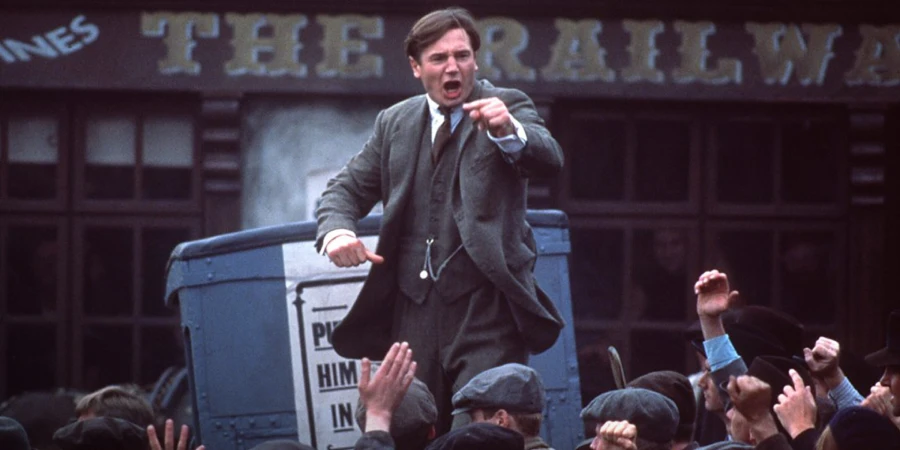
Neil Jordan’s Michael Collins arrives as one of cinema’s most uncompromising portraits of a revolutionary, refusing to soften its subject into a comfortable hero or condemn him as a simple villain. Liam Neeson commands every frame as the charismatic Irish nationalist who invented modern guerrilla warfare and paid for it with his life. Jordan shot this film in Ireland with a reported budget of around $25 million, and every penny shows. It is fierce, intimate, and genuinely heartbreaking.
Detailed Summary
The 1916 Rising and Its Aftermath
The film opens in the chaos of the 1916 Easter Rising, where Collins and his comrades, including Eamon de Valera, fight British forces in Dublin. British forces suppress the rebellion quickly, and the leaders face execution or imprisonment. Collins watches from Boland’s Mill as de Valera, played by Alan Rickman, survives because of his American citizenship.
Collins emerges from internment at Frongoch in Wales with a radical new conviction. Traditional pitched battles against the British Army are suicidal, he argues. Ireland needs a different kind of war entirely.
Building the Squad and the Intelligence War
Back in Dublin, Collins constructs a remarkable spy network from the ground up. He recruits ordinary men, clerks, postal workers, and porters, turning them into intelligence assets embedded inside British institutions. His closest associate in this work is Harry Boland, played with warm loyalty by Aidan Quinn.
Collins forms The Squad, a small team of assassins tasked with eliminating British intelligence officers. He personally identifies targets and plans operations with meticulous precision. Meanwhile, his friendship with Boland remains one of the film’s emotional anchors, even as both men fall for the same woman, Kitty Kiernan, played by Julia Roberts.
Bloody Sunday
The film builds to its most visceral sequence: Bloody Sunday, November 1920. Collins coordinates the simultaneous assassination of more than a dozen British intelligence officers across Dublin in a single morning. Jordan stages this sequence with brutal, clinical efficiency, cutting between multiple locations as The Squad carries out its work.
In retaliation, British forces enter Croke Park during a Gaelic football match and open fire on the crowd, killing civilians. The sequence is harrowing and angry. Jordan frames it as a deliberate war crime rather than a panicked response.
The Pressure Mounts
British authorities intensify their crackdown, deploying the notorious Black and Tans across Ireland. Collins operates almost openly, cycling through Dublin with extraordinary boldness, relying on the loyalty of ordinary Dubliners to shield him. His charisma functions as a kind of protective field.
De Valera returns from a fundraising tour of America and immediately clashes with Collins over strategy. Collins wants to continue the guerrilla campaign; de Valera favors conventional warfare that Collins regards as catastrophic. Their relationship, once built on mutual respect, begins to fracture.
The Truce and the Treaty
Britain offers a truce in 1921, and Collins travels to London to negotiate. De Valera, in a move that later haunts Collins, stays in Ireland and sends Collins to lead the delegation instead. Collins signs the Anglo-Irish Treaty in December 1921, securing a Free State for 26 counties but stopping short of a full Irish republic.
Collins knows the treaty is deeply imperfect. He famously describes it as signing his own death warrant. However, he believes it offers a stepping stone toward full independence rather than a surrender of the republican ideal.
Civil War and Betrayal
De Valera publicly repudiates the treaty, splitting the republican movement in two. Collins finds himself commanding the new Free State Army against former comrades. Harry Boland sides with the anti-treaty forces, and their friendship collapses under the weight of politics and rivalry over Kitty.
Boland is shot and killed by Free State soldiers, a loss that devastates Collins personally. The civil war grinds on with terrible cost. Collins grows visibly exhausted and morally hollowed out by fighting the very people he once led.
Movie Ending
Collins travels to County Cork in August 1922 to negotiate with anti-treaty forces, against the advice of his staff. He moves through his home county, stopping along the way, almost as if he senses this is a farewell. Jordan captures a melancholy tenderness in these final scenes that sets them apart from the rest of the film’s kinetic energy.
At Beal na Blath, Collins’s convoy is ambushed by anti-treaty republicans. His men want to drive through the ambush, as standard procedure dictates. Collins, characteristically, orders them to stop and fight.
In the firefight that follows, Collins is shot in the head and dies at the age of 31. Jordan shoots the moment quietly, almost gently. There is no dramatic death speech, just a sudden, irrevocable absence where a force of nature used to stand.
The film closes with a title card noting that Eamon de Valera went on to dominate Irish politics for decades, eventually serving as both Taoiseach and President. Jordan makes no accusation outright, but the implication hangs in the air: Collins died, and the man who sent him into danger prospered.
Audiences most often ask whether the film suggests de Valera ordered the ambush. Jordan leaves this deliberately ambiguous, which mirrors the genuine historical debate. What matters dramatically is that Collins trusted too deeply and died for it, while Ireland lost its most brilliantly unconventional mind.
Are There Post-Credits Scenes?
Michael Collins contains no post-credits scenes. After the title cards, the film ends completely. Jordan was not interested in epilogues or franchise-style tags; the story closes with Collins’s death and the quiet, damning political summary that follows.
Type of Movie
Michael Collins is a biographical historical drama with strong elements of a political thriller. Its tone shifts fluidly between rousing and elegiac, sometimes within the same scene. Jordan balances action sequences with intimate character moments, making it feel like both an epic and a personal story simultaneously.
In contrast to sanitized biopics, this film embraces moral complexity and refuses easy conclusions. It is rated R for violence and some language, and it earns that rating honestly.
Cast
- Liam Neeson – Michael Collins
- Alan Rickman – Eamon de Valera
- Aidan Quinn – Harry Boland
- Julia Roberts – Kitty Kiernan
- Stephen Rea – Ned Broy
- Ian Hart – Joe O’Reilly
- Richard Ingram – Tom Cullen
- John Kenny – Pat Broy
Film Music and Composer
Elliot Goldenthal composed the score for Michael Collins, and his work here stands among his finest. Goldenthal brings sweeping orchestral architecture to the film, using Irish melodic idioms without resorting to postcard-Ireland cliches. His music amplifies grief and grandeur in equal measure.
Notable cues underpin the Bloody Sunday sequence and Collins’s final drive through Cork with devastating effect. Goldenthal won the Golden Lion at Venice for his score, which reflects just how integral the music is to the film’s emotional power. He had previously composed scores for films like Interview with the Vampire and later won an Academy Award for Frida.
Filming Locations
Jordan shot the film primarily in Ireland, using Dublin locations that still carry the architectural memory of the period. Four Courts, the Custom House, and various Dublin streets appear throughout, grounding the story in authentic geography. Shooting in the actual city where these events occurred gives the film a remarkable sense of place.
Jordan also filmed in County Cork, including sequences near the actual site of the Beal na Blath ambush. For the Bloody Sunday Croke Park sequence, the production recreated the stadium crowd on a large scale. These location choices reinforce the film’s commitment to historical specificity rather than generic period atmosphere.
Awards and Nominations
Michael Collins won the Golden Lion at the 1996 Venice Film Festival, one of cinema’s most prestigious prizes. Liam Neeson received a Golden Globe nomination for Best Actor in a Drama. The film also received BAFTA nominations, including for Production Design.
Notably, despite its critical success and awards profile, it received no Oscar nominations, which surprised many observers at the time. The film’s commercial and critical reception in Ireland was particularly strong.
Behind the Scenes Insights
- Neil Jordan had been developing the Michael Collins project for over a decade before it finally went into production, reflecting his deep personal investment in the subject.
- Liam Neeson, himself from Northern Ireland, brought strong personal resonance to the role and has spoken about the emotional weight of playing Collins.
- Julia Roberts’s casting as Kitty Kiernan attracted significant controversy and media skepticism, with critics questioning whether an American star suited an Irish historical drama.
- Alan Rickman reportedly researched de Valera extensively, adopting specific physical mannerisms to distinguish his portrayal from a simple villain reading of the character.
- Jordan worked closely with Irish historians during script development to ensure the political sequences reflected genuine debate rather than simplified propaganda.
- The production employed hundreds of Irish extras, particularly for the Croke Park massacre sequence, which created a powerful sense of community investment in the film.
- Warner Bros. distributed the film internationally, giving it a wider release than most European historical dramas of the period could typically expect.
Inspirations and References
Jordan drew on extensive historical research, including works by biographers who had written about Collins and the Irish War of Independence. Tim Pat Coogan’s biography Michael Collins provided significant source material, particularly regarding Collins’s intelligence methods and personal relationships. Jordan has acknowledged Coogan’s work as central to his preparation.
The film also reflects broader influences from political cinema, particularly the work of directors who grapple with the moral costs of revolutionary violence. In addition, Jordan’s own Irish identity shaped his perspective on the material, giving the screenplay a perspective from inside the culture rather than an outside observer’s gaze.
Alternate Endings and Deleted Scenes
No officially released alternate ending exists for Michael Collins. Jordan has not publicly detailed significant deleted scenes that alter the film’s narrative. The theatrical cut represents his intended version of the story.
However, given the film’s decade-long development history, earlier drafts almost certainly explored different structural approaches. No extended cut or director’s cut has been released for home media.
Book Adaptations and Differences
Michael Collins is not a direct adaptation of any single book. Jordan wrote an original screenplay informed by multiple historical sources. Consequently, the usual framework of comparing a film to its source novel does not apply here.
Jordan’s screenplay takes dramatic license with certain events and compresses the timeline considerably for narrative clarity. The portrayal of de Valera as a calculating political survivor, for instance, is more pointed than most academic histories would support, and it remains a point of genuine debate among Irish historians.
Memorable Scenes and Quotes
Key Scenes
- The opening Easter Rising sequence, chaotic and disorienting, immediately establishes the film’s refusal to glamorize combat.
- Collins cycling through Dublin, waving at policemen who unknowingly protect him through sheer communal loyalty.
- The Bloody Sunday morning assassinations, edited with cold, methodical precision that makes the violence feel surgical rather than dramatic.
- The Croke Park massacre, where Jordan holds on civilian faces before the shooting starts, making the horror personal rather than statistical.
- Collins and Boland’s final confrontation, where friendship dissolves under the weight of political betrayal and romantic rivalry.
- Collins driving through Cork, greeting old friends, with Goldenthal’s score signaling that this journey is also a farewell.
- The ambush at Beal na Blath and Collins’s sudden, quiet death, stripped of any theatrical grandeur.
Iconic Quotes
- “I’ve signed my actual death warrant.” Collins speaks these words after signing the Anglo-Irish Treaty, one of cinema’s most chilling instances of foreshadowing a true historical fact.
- “We’re going to have to outfox them. They’ll always beat us at pitched battles, but we can be everywhere and nowhere at once.” Collins articulates his guerrilla philosophy early in the film, establishing the strategic core of everything that follows.
- “I hate them. Not for their brutality, but for making us brutal.” This line captures the film’s moral center: the corrosive effect of political violence on those who wield it.
Easter Eggs and Hidden Details
- Jordan includes period-accurate details in the Dublin street scenes, from shop signage to period vehicles, rewarding viewers who pay close attention to background dressing.
- The film subtly mirrors Collins’s own intelligence methods by having him appear in plain sight throughout, underscoring how his greatest camouflage was his apparent normalcy.
- De Valera’s body language and positioning in group scenes consistently place him slightly apart from others, a visual shorthand for his political separateness that Jordan maintains throughout.
- Kitty Kiernan’s costumes shift in color tone as the film progresses, moving from warmer to cooler shades as Collins’s circumstances grow darker.
- Several extras in crowd sequences are confirmed Irish republican history enthusiasts and re-enactors, bringing an additional layer of authenticity to the period scenes.
Trivia
- Liam Neeson reportedly lobbied hard for the role of Collins for years, citing a deep personal connection to Irish history.
- The film caused significant political controversy in Ireland upon release, with some politicians objecting to Jordan’s interpretation of de Valera’s role in Collins’s death.
- Julia Roberts received considerable media attention for her Irish accent work in the film; critical opinion on her performance remained divided.
- Warner Bros. reportedly expressed some concern about the film’s political content before committing to international distribution.
- Neil Jordan filmed the Croke Park massacre sequence using a combination of extras and carefully choreographed camera movements to suggest a much larger crowd than was physically present.
- Alan Rickman was a late addition to the cast, and his casting fundamentally shaped how Jordan approached the de Valera role in the final screenplay.
- Elliot Goldenthal recorded his score with orchestras in Ireland, incorporating local musicians to strengthen the cultural authenticity of the sound.
- The film’s opening weekend in Ireland outperformed many Hollywood blockbusters released that same season, reflecting the national significance of the subject matter.
Why Watch?
Few films balance political complexity and raw human feeling as successfully as Michael Collins. Neeson delivers a career-best performance, and Jordan’s direction is at its most assured and purposeful. Moreover, this film asks genuinely hard questions about what revolutionary violence costs the people who use it. It is essential cinema, full stop.
Director’s Other Movies
- Mona Lisa (1986)
- The Crying Game (1992)
- Interview with the Vampire (1994)
- The Butcher Boy (1997)
- In Dreams (1999)
- The End of the Affair (1999)
- Breakfast on Pluto (2005)
- Ondine (2009)
- Byzantium (2012)
- Greta (2018)
Recommended Films for Fans
- The Wind That Shakes the Barley (2006)
- Bloody Sunday (2002)
- In the Name of the Father (1993)
- Gandhi (1982)
- The Crying Game (1992)
- Lincoln (2012)
- Thirteen Days (2000)
- The Patriot (2000)