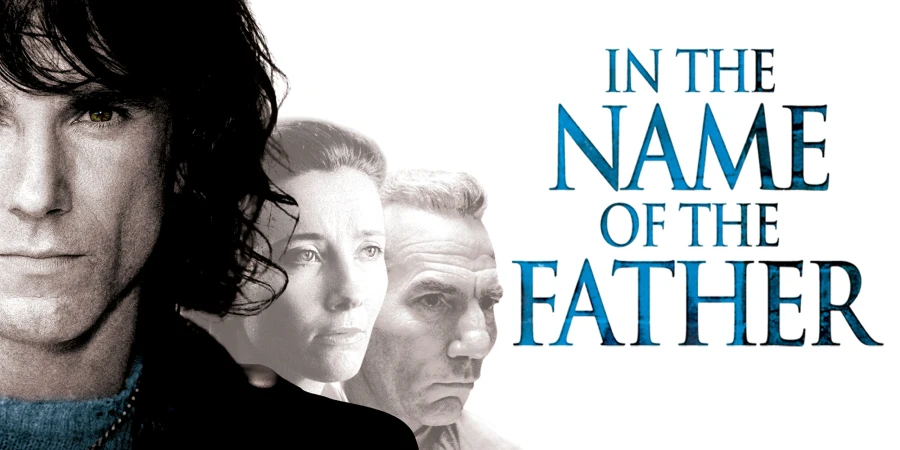

Four men spent fifteen years in British prison for an IRA bombing they did not commit, and the British government knew it. In the Name of the Father (1993) puts that injustice on screen with a fury that feels almost confrontational. Jim Sheridan directs Daniel Day-Lewis through one of the most physically and emotionally demanding performances of the decade. This film does not soften the story to make it comfortable.
Detailed Summary
Gerry Conlon’s Life Before the Bombing
Gerry Conlon (Daniel Day-Lewis) is a petty thief and drifter from Belfast, living in the sectarian chaos of early 1970s Northern Ireland. He steals from his own community, embarrasses his father Giuseppe, and generally treats responsibility as someone else’s problem. His father, a quiet and deeply principled man, eventually arranges for Gerry to leave Belfast and stay with relatives in England, hoping distance will straighten him out.
Gerry drifts to London, squats with hippies, and continues his low-level criminal activity. He and a friend, Paul Hill, are present in Guildford at entirely the wrong time.
The Guildford Pub Bombings
In October 1974, the IRA bombs two pubs in Guildford, killing five people. Gerry and Paul Hill are nowhere near the bombs when they go off, but their presence in the area and their Irish backgrounds make them immediate targets for the Surrey Police. Detective Superintendent Robert Dixon leads an interrogation campaign that relies entirely on psychological pressure, sleep deprivation, and outright threats.
Gerry, young and easily frightened, eventually signs a false confession. Paul Hill signs one too. Two other people, Paddy Armstrong and Carole Richardson, also confess under similar duress. They become known as the Guildford Four.
The Arrest of Giuseppe and the Maguire Seven
The police do not stop at the four young people. They arrest Gerry’s father Giuseppe Conlon, who had traveled to England specifically to support his son and find a lawyer. Giuseppe is entirely innocent of any involvement with the IRA or explosives. Seven members of the Maguire family are also arrested and charged, becoming known as the Maguire Seven.
Giuseppe is convicted alongside his son and sentenced to prison. This detail is the film’s most quietly devastating fact: a father goes to jail for trying to help his son.
Prison, Resistance, and the Father-Son Bond
Gerry and Giuseppe are placed in the same prison, which the film treats as both a cruelty and a strange gift. Giuseppe refuses to let bitterness consume him. He maintains his dignity, writes letters, prays, and insists on pursuing legal channels even when Gerry wants to burn the system down. Day-Lewis and Pete Postlethwaite play these two men against each other brilliantly: Gerry loud and raging, Giuseppe patient and aching.
A genuinely terrifying IRA enforcer named Joe McAndrew enters the prison, and for a time he pulls Gerry toward violence and radicalism. Giuseppe actively works to pull his son back from that edge. The tension between those two gravitational forces gives the middle section of the film its real dramatic charge.
Giuseppe’s Death and Gerry’s Transformation
Giuseppe Conlon dies in prison in 1980, still a convicted man, still protesting his innocence. His death is the film’s turning point. Gerry, watching his father’s body covered with a prison sheet, makes a silent decision to fight legally rather than violently. He stops performing rage and starts doing actual work.
Solicitor Gareth Peirce (Emma Thompson) has been building a case for years. She obtains a police document that proves the Surrey Police fabricated evidence and withheld proof that another man had confessed to the Guildford bombings. That document, which the police buried, is the key to everything.
The Appeal and the Road to Exoneration
Peirce presents the suppressed evidence in court. The prosecution offers no resistance. Gerry walks out of the Old Bailey in 1989, fifteen years after his wrongful conviction, shouting his innocence to the crowd outside. The Guildford Four are formally exonerated. Giuseppe, of course, is not alive to see it.
Movie Ending
Gerry Conlon walks out of the Old Bailey a free man, arms raised, voice cracking as he screams his father’s name into the open air. It is one of the most viscerally satisfying moments in 1990s cinema, and Sheridan earns every second of it by making the audience sit through fifteen years of bureaucratic cruelty first.
What makes the ending genuinely complex is what it refuses to resolve. Giuseppe is dead. The British government did not rush to apologize. The men who fabricated evidence faced no serious legal consequences. Gareth Peirce fought for years largely because institutions failed at every level before she arrived.
Gerry’s final voiceover, delivered over the real archive footage of the actual Gerry Conlon outside the Old Bailey, anchors the ending in documented reality. Sheridan cuts between Day-Lewis and the real man deliberately. That choice forces the audience to remember this is not a story someone invented for dramatic effect.
Giuseppe’s death before the exoneration is the film’s most pointed accusation. Giuseppe died in 1980, nine years before his son was freed. Giuseppe was never exonerated while alive. Gerry dedicates his freedom explicitly to his father’s name, and the title of the film lands with full weight in that final moment.
Are There Post-Credits Scenes?
No. In the Name of the Father has no post-credits scene of any kind. After the end title cards explaining what happened to the real individuals involved, the film simply ends. Stay for the credits if you want to absorb the title cards, but nothing additional follows.
Type of Movie
This is a biographical legal drama with strong elements of political thriller. The tone is urgent and angry rather than mournful. Sheridan keeps the pacing aggressive for a courtroom drama, and the early Belfast sequences carry an almost kinetic energy that pushes the film away from stiff prestige territory.
It is also, quietly, a father-son film. The genre machinery runs on injustice and law, but the emotional engine is a relationship between two men who needed more time together than the state allowed them.
Cast
- Daniel Day-Lewis – Gerry Conlon
- Pete Postlethwaite – Giuseppe Conlon
- Emma Thompson – Gareth Peirce
- John Lynch – Paul Hill
- Mark Sheppard – Joe McAndrew
- Corin Redgrave – Detective Superintendent Robert Dixon
- Beatie Edney – Carole Richardson
- Don Baker – Ronnie Smalls
Film Music and Composer
Trevor Jones composed the orchestral score, which works in tension with a soundtrack that pulls from period rock and Irish folk music. Jones keeps the orchestral elements spare, letting silence do heavy lifting during the interrogation and courtroom scenes.
Bono and Gavin Friday contributed the song In the Name of the Father, which plays over the opening credits. It sets a combative, almost confrontational tone before a single frame of Belfast appears on screen. The track earned an Academy Award nomination for Best Original Song.

Filming Locations
Sheridan shot significant portions of the film in Dublin rather than Belfast. Dublin streets doubled for both Belfast and London during production. This was partly a practical decision given the political situation in Northern Ireland at the time.
Several scenes set inside the prison were filmed at Kilmainham Gaol in Dublin, a decommissioned Victorian prison with a brutal architectural weight that cameras love. That location choice is not incidental: Kilmainham held Irish republican prisoners for over a century, which gives scenes set there an uncomfortable historical resonance.
Some London court sequences were filmed in actual or replica legal settings in England. Sheridan moved between locations fluidly, keeping a documentary roughness to the visual approach that suits the material.
Awards and Nominations
In the Name of the Father received seven Academy Award nominations, including Best Picture, Best Director for Jim Sheridan, Best Actor for Daniel Day-Lewis, Best Supporting Actor for Pete Postlethwaite, Best Supporting Actress for Emma Thompson, Best Adapted Screenplay, and Best Film Editing. It won none of those Oscars, which remains one of the more baffling clean sweeps in the ceremony’s modern history.
Pete Postlethwaite’s nomination prompted Steven Spielberg, during production of Schindler’s List, to call Postlethwaite possibly the best actor in the world. The film won a Golden Bear at the Berlin International Film Festival.
Behind the Scenes Insights
- Daniel Day-Lewis reportedly lost significant weight for the role and stayed in character throughout filming, including refusing to leave his cell set between takes.
- Jim Sheridan and Terry George co-wrote the screenplay, adapting Gerry Conlon’s memoir Proved Innocent. They made significant dramatic changes to the real timeline, including placing Gerry and Giuseppe in the same prison cell, which did not happen in reality.
- The real Gerry Conlon visited the set and met Day-Lewis during production.
- Emma Thompson did extensive research into Gareth Peirce’s legal work and mannerisms before filming began.
- Pete Postlethwaite based Giuseppe’s physicality partly on his observations of elderly Irish Catholic men, building the character from posture and gesture outward.
- Sheridan pushed for the Belfast opening sequences to feel visually chaotic, using handheld cameras to mirror the unpredictability of life in a conflict zone.
Inspirations and References
The film adapts Proved Innocent: The Story of Gerry Conlon of the Guildford Four, Gerry Conlon’s own memoir published in 1990. Conlon wrote the book after his release to document both the wrongful conviction and the years of failed appeals.
The broader context includes the Prevention of Terrorism Act and the legal and political atmosphere of 1970s Britain, where the pressure to convict someone for IRA atrocities overrode basic procedural protections. Sheridan and George also drew on journalistic coverage of the case that had accumulated through the 1980s as campaigners worked to reopen it.
Alternate Endings and Deleted Scenes
No officially released alternate endings exist for In the Name of the Father. Sheridan has not publicly released a director’s cut with substantial additional footage.
Some early test screenings reportedly prompted edits to pacing in the middle section of the film, but no specific deleted scenes have been released or documented in detail through official channels. What reached cinemas appears to be Sheridan’s intended version.
Book Adaptations and Differences
The film adapts Conlon’s memoir Proved Innocent but takes significant dramatic liberties. Most famously, Giuseppe and Gerry Conlon were never housed in the same prison cell in real life. Sheridan invented that arrangement to create a sustained father-son dynamic on screen, and it is the right creative call: it compresses years of correspondence and occasional prison visits into something visually alive.
The film also compresses and dramatizes elements of Gareth Peirce’s investigation. Her discovery of the suppressed police document is presented as a late-night archive revelation, which plays as a thriller beat even if the actual legal process was far more gradual. The real Gerry Conlon and Gareth Peirce both noted inaccuracies but supported the film as capturing an emotional truth about the case.



Memorable Scenes and Quotes
Key Scenes
- The interrogation sequence, where Gerry signs a false confession under hours of psychological pressure, is physically uncomfortable to watch. Day-Lewis shows Gerry’s resistance collapsing in real time, not through a single dramatic break but through visible exhaustion.
- Giuseppe’s death scene. He dies quietly, and Sheridan keeps the camera on Gerry’s face rather than on Giuseppe’s body. Day-Lewis does not cry immediately. He just goes still, which is the right choice and a devastating one.
- Gareth Peirce opening the sealed box of evidence in the archive late at night and finding the suppressed document. Emma Thompson barely says a word. She just reads, and you watch her face understand what she is holding.
- The Old Bailey steps. Gerry walks out, raises his arms, and shouts that his father was an innocent man. It is an unambiguously cathartic scene and Sheridan does not undercut it.
- The prison scene where Giuseppe burns Joe McAndrew’s drug supply on behalf of Gerry. It is a quiet act of paternal defiance in a place where Postlethwaite’s character has almost no power.
Iconic Quotes
- “I’m an innocent man. I spent fifteen years in prison for something I didn’t do. I watched my father die in a British prison for something he didn’t do.”
- “Will you be my father? In here, will you be my father?”
- “I’m Giuseppe Conlon. I’m an innocent man.”
Easter Eggs and Hidden Details
- Sheridan cuts to real archival news footage at several points, blending documentary material with dramatized scenes. Audiences paying close attention will notice the shift in film grain and image quality.
- The Kilmainham Gaol setting carries unspoken historical weight: the prison held leaders of the 1916 Easter Rising before their execution. That context is never stated in the dialogue, but it charges the prison sequences with an extra layer of Irish political history.
- The film’s opening frames Gerry against Belfast streetscapes that appear almost apocalyptic, with fires and debris visible in the background of shots that focus on his face. Sheridan uses that chaos as visual shorthand for the world that produced Gerry’s recklessness.
- The actual Gerry Conlon appears briefly in the film’s closing real-footage material. The cut between Day-Lewis and the real man is deliberate and worth watching closely.
Trivia
- The seven Academy Award nominations made it one of the most nominated films at the 1994 ceremony. Its failure to win any of them surprised many observers at the time.
- Pete Postlethwaite’s Giuseppe is almost entirely invented from brief documented facts about the real man. Postlethwaite built the character largely from imagination, making the performance even more remarkable.
- Bono’s involvement in the soundtrack came through his connection to the Irish political dimensions of the story. He and Gavin Friday wrote the title song specifically for the film.
- The real Gerry Conlon died in 2014. He spent the years after his release campaigning for other wrongful conviction cases.
- Jim Sheridan had previously directed Day-Lewis in My Left Foot (1989), and their working relationship clearly deepened in this film. Day-Lewis won his first Oscar for My Left Foot, which makes the absence of a win here even more striking.
- The film faced some criticism from legal scholars and journalists for its composite characters and compressed timeline, but Gareth Peirce herself did not publicly condemn it.
Why Watch?
Pete Postlethwaite got the Supporting Actor nomination, but his performance here is the most underrated piece of acting in the entire film. Watch him sit across from Day-Lewis in that cell and do almost nothing except exist with complete moral clarity while everything around him corrodes. Day-Lewis rages; Postlethwaite radiates. That contrast is worth two hours of anyone’s life on its own.
Director’s Other Movies
- My Left Foot (1989)
- The Field (1990)
- Some Mother’s Son (1996)
- The Boxer (1997)
- In America (2002)
- Get Rich or Die Tryin’ (2005)
- Brothers (2009)
Recommended Films for Fans
- Bloody Sunday (2002)
- Michael Collins (1996)
- The Wind That Shakes the Barley (2006)
- Hunger (2008)
- Conviction (2010)
- Anemone (2025)
- The Hurricane (1999)
- Erin Brockovich (2000)
- Sacco & Vanzetti (1971)
- Philadelphia (1993)
- Philomena (2013)