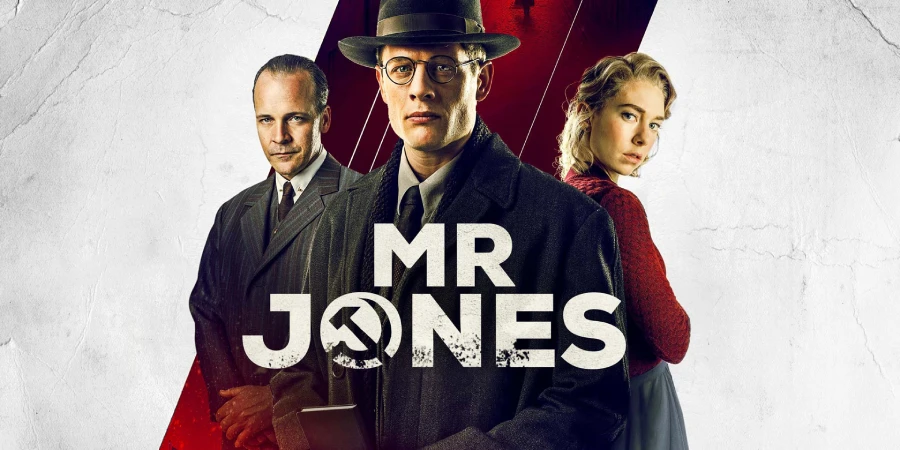

The children sing softly in the snow about bread, and the man listening cannot tell whether they are alive or already dying. Mr. Jones (2019) builds toward that moment with the patience of a thriller and the cold eye of a documentary. Agnieszka Holland tells the true story of a Welsh reporter who exposed the Ukrainian famine while the world’s most famous correspondent called him a liar.
Detailed Summary
A Warning Nobody Wants
In 1933, Gareth Jones, a young Welsh journalist and foreign affairs adviser to David Lloyd George, has just interviewed Hitler. He warns the former prime minister’s circle that Germany means war. They laugh at him, and budget cuts cost him his job.
Chasing Stalin’s Miracle
Jones cannot understand where the Soviet Union finds money for its industrial boom while the rest of the world sinks into depression. He wants to interview Stalin himself. Using his old Lloyd George connections, he secures a visa and heads to Moscow.
A Dead Contact in Moscow
His friend Paul Kleb, a fellow reporter, was supposed to meet him. Instead, Jones learns Kleb has been shot dead in a supposed robbery. Before dying, Kleb had been investigating something in Ukraine, and Jones resolves to find out what.
Duranty’s Court
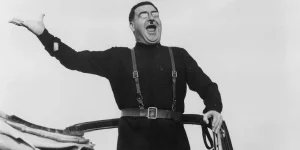
Walter Duranty, the Pulitzer-winning Moscow bureau chief of the New York Times, holds court at decadent parties fueled by drugs and sex. He assures Jones that the Soviet experiment is working. His assistant, Ada Brooks, seems to know more than she admits.
Slipping the Escort
Jones obtains permission to visit Ukraine under official supervision. On the train, he gives his minder the slip and steps off into the countryside alone. What he finds there occupies the film’s harrowing middle act.
The Famine
Villages lie silent. Corpses stiffen in the snow, grain is loaded onto trains for export, and starving children sing about hunger. Jones chews bark to survive. In one scene, children share meat with him, and he realizes with horror where it came from.
Arrest and Blackmail
Soviet authorities catch him and threaten six British engineers held as hostages. Unless Jones signs a statement denying what he saw, the engineers will suffer. He signs under duress and is deported.
Nobody Listens
Back in London, Jones holds a press conference describing the famine. Duranty publicly dismisses his account, and Lloyd George refuses to back him. Doors close across Fleet Street.
Movie Ending
Jones refuses to stay silent. He travels to Wales and meets William Randolph Hearst at St Donat’s Castle, pitching the famine story to the one press baron willing to defy Moscow. Hearst’s papers finally run his articles, and the truth reaches millions of American readers.
Meanwhile, the film’s framing device pays off. George Orwell, who has appeared throughout writing at his desk, is shown shaping the allegory that will become Animal Farm. The film suggests Jones’s testimony helped feed Orwell’s understanding of Soviet lies.
Then comes the coda. Title cards reveal that Jones was murdered in 1935 while reporting in Japanese-occupied Manchuria, one day before his thirtieth birthday. His guide had links to the Soviet secret police, and the circumstances remain suspicious.
Why does it matter? Duranty kept his Pulitzer. Jones died young and forgotten for decades. Holland ends not on victory but on the price of telling the truth when powerful people prefer the lie, which turns the final cards into an accusation.
Are There Post-Credits Scenes?
No. The closing title cards about Jones, Duranty, and the famine’s death toll are the last content before the credits. Nothing follows.
Type of Movie
Mr. Jones is a historical biographical drama with the structure of a political thriller. Its tone shifts from brisk period intrigue in London and Moscow to near-silent horror in Ukraine. Holland keeps the color palette bleak and the pacing deliberate.
Cast
- James Norton – Gareth Jones
- Vanessa Kirby – Ada Brooks
- Peter Sarsgaard – Walter Duranty
- Joseph Mawle – George Orwell
- Kenneth Cranham – David Lloyd George
- Krzysztof Pieczyński – Maxim Litvinov
- Marcin Czarnik – Paul Kleb
Film Music and Composer
Antoni Komasa-Łazarkiewicz, a longtime collaborator of Holland and her nephew, composed the score. His music stays restrained, favoring low strings and sparse textures over melodrama.
Notably, the most memorable musical moment is not the score at all. The children’s famine song, performed on camera, carries more dread than any orchestral cue could.
Filming Locations
Holland shot the film across Poland, Ukraine, and the United Kingdom. Kraków doubled for parts of 1930s Moscow, while Ukrainian locations grounded the famine sequences in the actual landscape where the Holodomor unfolded.
Scottish locations stood in for London and Wales. Shooting the Ukrainian scenes on real Ukrainian soil mattered to the production, since the film arrived as the country was still fighting to have the famine recognized as genocide.
Awards and Nominations
Mr. Jones premiered in competition at the 2019 Berlin International Film Festival, where it contended for the Golden Bear. It also received nominations at the Polish Film Awards.
Behind the Scenes Insights
- Screenwriter Andrea Chalupa is the granddaughter of a famine survivor and spent years developing the script.
- Holland, who grew up in communist Poland, has described the project as a story about the mechanics of propaganda rather than a simple biopic.
- James Norton learned Welsh phrases and researched Jones’s diaries, which survive in the National Library of Wales.
- The Polish title is Obywatel Jones, meaning “Citizen Jones”.
- The film is a Polish, British, and Ukrainian co-production.
- Peter Sarsgaard played Duranty’s charm and menace without a cartoonish villain turn, which Holland specifically wanted.
Inspirations and References
The film draws on the real life of Gareth Jones, whose 1933 reports described the famine he witnessed firsthand. Duranty’s rebuttal in the New York Times, which claimed Russians were hungry but not starving, is a documented episode of journalistic history.
Orwell’s Animal Farm provides the literary frame. In contrast to the film’s suggestion, historians debate how directly Jones influenced Orwell, though Orwell certainly knew of reporting on Soviet famine.
Alternate Endings and Deleted Scenes
No alternate ending has been released. Holland’s cut ends on the title cards, and the Orwell framing was part of the script from the start. Festival and theatrical versions match.
Book Adaptations and Differences
Mr. Jones is not based on a single book. Chalupa wrote an original screenplay built on Jones’s diaries, published articles, and historical research. Ada Brooks is a fictional composite rather than a documented figure, and the Orwell meeting is dramatic invention.

Memorable Scenes and Quotes
Key Scenes
- Jones laughed out of the room for predicting Hitler’s war.
- Duranty’s drug-soaked party, a vision of privilege amid starvation.
- Jones throwing an orange peel from the train and watching children fight for it.
- The children’s song in the snow.
- The meal Jones cannot un-eat.
- Signing the false statement to save the engineers.
- Orwell’s typewriter clacking as the pigs take shape.
Iconic Quotes
- Jones insisting that a journalist’s only job is to report what he saw (paraphrased).
- Duranty’s dismissal that you cannot make an omelette without breaking eggs, echoing his real-life phrasing (paraphrased).
- Ada’s warning that Moscow decides what counts as news (paraphrased).
Easter Eggs and Hidden Details
- Grain sacks on the export trains are stamped for foreign markets, underlining that food left Ukraine while people starved.
- Duranty’s apartment is lit in warm tones, while every Ukrainian interior is cold and gray.
- Jones’s notebooks on screen mirror the layout of his real surviving diaries.
- The phrase “Russians hungry but not starving” appears on a newspaper, quoting Duranty’s actual headline.
- Orwell’s farm animals appear in brief cutaways as the allegory takes form.
Trivia
- Gareth Jones was among the first Western journalists to use the word “famine” publicly about Soviet Ukraine.
- Duranty’s 1932 Pulitzer has never been revoked despite repeated campaigns.
- The film opened in Poland and the UK in 2019 and reached the United States in 2020.
- Holland had previously examined Soviet-era themes in Europa Europa and In Darkness.
- Vanessa Kirby filmed this shortly after her breakout role in The Crown.
- Jones’s story was little known outside Wales and Ukraine until the 2000s.
Why Watch?
Mr. Jones turns a forgotten reporter into a hero without softening what he saw. The famine sequence is as unflinching as mainstream cinema gets. It also asks a timely question: what happens when the truth-teller loses and the liar keeps the prize?
Director’s Other Movies
- Angry Harvest (1985)
- To Kill a Priest (1988)
- Europa Europa (1990)
- Olivier, Olivier (1992)
- The Secret Garden (1993)
- Total Eclipse (1995)
- Washington Square (1997)
- Copying Beethoven (2006)
- In Darkness (2011)
- Spoor (2017)
- Charlatan (2020)
- Green Border (2023)
Recommended Films for Fans
- Europa Europa (1990)
- Burnt by the Sun (1994)
- Katyń (2007)
- In Darkness (2011)
- Bitter Harvest (2017)
- The Death of Stalin (2017)
- Dear Comrades! (2020)