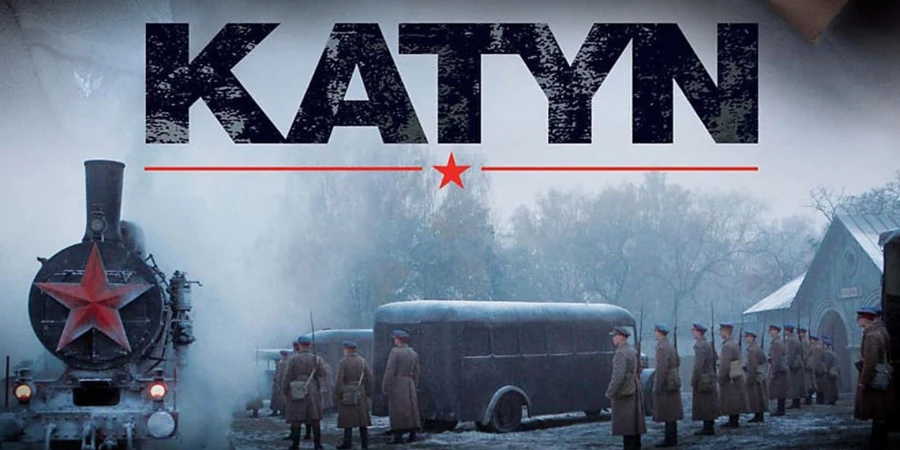

Trucks roll into a forest clearing, and one by one Polish officers climb down to a bullet in the back of the head. Katyń (2007) saves that sequence for last, after two hours of waiting rooms, rumors, and lies. Andrzej Wajda, whose own father died in the massacre, spent decades unable to tell this story. When he finally did, he refused to look away.
Detailed Summary
Two Armies, One Bridge
On September 17, 1939, Polish civilians fleeing the Germans collide on a bridge with others fleeing the Soviets. There is nowhere left to run. Anna and her young daughter Nika push through the crowd searching for Anna’s husband, Andrzej, a cavalry captain.
Andrzej Chooses Duty
Anna finds Andrzej among officers rounded up by the Red Army. She begs him to slip away in civilian clothes. He refuses; he swore an oath and will not abandon his men. His friend Jerzy, a lieutenant, stays at his side as the prisoners are marched east.
Kraków Under Occupation
Andrzej’s father, Professor Jan, teaches at Jagiellonian University in Kraków. In November 1939, German officers summon the faculty to a lecture hall and arrest them all. He later dies in Sachsenhausen, and his wife receives only a terse notice.
Life in the Kozelsk Camp
Andrzej keeps a diary in the Soviet camp at Kozelsk. The officers celebrate Christmas, trade rumors of release, and hold on to discipline. In spring 1940 the NKVD begins calling out names for transport. Jerzy’s name never comes up; Andrzej’s does.
Anna in the Soviet Zone
Anna and Nika survive in Soviet-occupied territory with help from a sympathetic Red Army major. He shelters them in his quarters and urges Anna to flee before the NKVD deports them. She escapes west with her daughter.
1943: The Germans Announce Katyń
German loudspeakers blare a list of names recovered from mass graves in the Katyń forest. Anna listens for her husband. Instead, she hears Jerzy’s name. Róża, the general’s widow, refuses to read a German propaganda script about the massacre, even under threat.
Jerzy Comes Home
The war ends, and Jerzy returns in the uniform of the Soviet-backed Polish army. He explains the mix-up: Andrzej had been wearing his sweater, so the Germans misidentified the body. Guilt eats at him, and he eventually shoots himself.
1945: A Lie Becomes Law
The new regime insists the Germans committed the crime in 1941. Agnieszka, whose pilot brother Piotr died at Katyń, commissions a gravestone reading 1940. Her sister Irena, a school headmistress, bends to the authorities to keep her job.
Tadeusz and Ewa
Tadeusz, a young former partisan, writes the true date of his father’s death on an art school application. Irena advises him to change it. He tears down a Soviet propaganda poster, flees the militia, and dies under a truck while Róża’s daughter Ewa watches in horror.
Movie Ending
Agnieszka’s gravestone goes up, and the security police drag her away for interrogation. Her defiance costs her freedom, while Irena’s compromise buys survival. Wajda offers no judgment on either sister; both are trapped.
Andrzej’s diary finally reaches Anna. As she reads, the film cuts back to April 1940, and the tone shifts from drama to documentary horror. Prisoners arrive at an NKVD building, and guards check names at a desk.
The general is led down a corridor, bound, and shot in the back of the head. Another officer follows, then another. Bodies are hauled out through a side door and stacked in trucks. The process is quick, bureaucratic, and relentless.
Andrzej’s turn comes in the forest. He stands at the edge of a pit, whispers the Lord’s Prayer, and falls. A bulldozer pushes earth over the dead. Then the screen goes black, and silence holds for a long moment before the credits roll.
Why end this way? For six decades the Soviet state denied the crime and Poland’s own government enforced the denial. By showing the killings last, without music or cutaways, Wajda forces the audience to witness what the characters could only imagine. The silence afterward is the film’s final argument.
Are There Post-Credits Scenes?
No. The credits play over Krzysztof Penderecki‘s music, and nothing follows them. The black screen before the credits is the real coda.
Type of Movie
Katyń is a historical war drama with the structure of an ensemble tragedy. Its tone is restrained and mournful, closer to a vigil than a thriller. Violence stays offscreen until the final ten minutes, which makes those minutes devastating.
Cast
- Maja Ostaszewska – Anna
- Artur Żmijewski – Andrzej
- Andrzej Chyra – Jerzy
- Danuta Stenka – Róża
- Jan Englert – The General
- Magdalena Cielecka – Agnieszka
- Agnieszka Glińska – Irena
- Paweł Małaszyński – Piotr
- Maja Komorowska – Andrzej’s mother
- Władysław Kowalski – Professor Jan
- Wiktoria Gąsiewska – Nika
- Antoni Pawlicki – Tadeusz
- Agnieszka Kawiorska – Ewa
- Sergei Garmash – Soviet major
Film Music and Composer
Krzysztof Penderecki, one of the most celebrated Polish composers of the twentieth century, provided the music. Rather than writing a conventional score, he drew on his existing concert works, including passages from his Polish Requiem.
Consequently, the film uses music sparingly. Long stretches play without any underscore, and the execution sequence unfolds to the sounds of engines and gunshots alone. When Penderecki’s choral writing finally arrives over the credits, it lands like a funeral mass.
Filming Locations
Wajda shot primarily in Poland. Kraków provided the backdrop for the university scenes, with the Jagiellonian setting grounding the Sonderaktion Krakau episode in real history. Those streets and courtyards carry the weight of the city’s actual occupation.
Forest and camp sequences were staged in Polish locations rather than at the real Katyń site in Russia. The muddy clearing, the pit, and the bulldozer recreate the massacre with grim plainness, and the ordinary-looking woodland makes the horror feel closer, not more distant.
Awards and Nominations
Katyń earned a nomination for the Academy Award for Best Foreign Language Film at the 80th Academy Awards, though The Counterfeiters took the prize. It also collected recognition at the Polish Film Awards.
Behind the Scenes Insights
- Wajda’s father, Captain Jakub Wajda, was among the officers murdered by the NKVD in 1940. His mother waited years for news that never came.
- Wajda was in his early eighties during production, and he had carried the project in his head since the communist era, when the subject was forbidden.
- Paweł Edelman, cinematographer of The Pianist, shot the film with a muted, wintry palette.
- Release was timed to September 17, 2007, the anniversary of the Soviet invasion of Poland.
- Russian actor Sergei Garmash took the role of the decent Soviet major, a casting choice that avoided painting all Russians as villains.
- Wajda has said he wanted to make a film about the families who waited, not only the men who died.
Inspirations and References
The screenplay adapts Andrzej Mularczyk‘s novel Post mortem, which approached the massacre through the women left behind. Historical events shape every thread: the Soviet invasion, the arrest of Kraków’s professors, the 1943 German discovery of the graves, and the postwar falsification of the date.
Notably, the film also reflects Wajda’s own family history. The scene of a mother refusing to believe her son is dead draws directly on his memories of his mother’s hope.
Alternate Endings and Deleted Scenes
No alternate ending has been released. Wajda built the entire film toward the final flashback and never considered softening it. The home video releases contain the theatrical cut, and no significant deleted scenes have surfaced in official form.
Book Adaptations and Differences
Yes, the film adapts Mularczyk’s Post mortem. The novel is more interior, lingering on the thoughts of the waiting women, while Wajda externalizes that grief through objects: the diary, the sweater, the gravestone. He also expanded the ending into the extended execution sequence, which the book handles more briefly.


Memorable Scenes and Quotes
Key Scenes
- Refugees from two invasions meeting in the middle of a single bridge.
- The Jagiellonian professors walking into a trap in their own lecture hall.
- Anna hearing the loudspeaker list and recognizing the wrong name.
- Róża’s silent refusal to read the German script.
- Jerzy’s final moments in a dark room.
- Tadeusz tearing the poster and running for his life.
- The execution sequence and the black screen that follows.
Iconic Quotes
- Andrzej telling Anna that his oath binds him more than fear (paraphrased from the Polish).
- Agnieszka insisting that the year on a tombstone is the one truth she can still control.
- Irena warning Tadeusz that an honest date on a form will end his future before it starts.
Easter Eggs and Hidden Details
- Andrzej’s sweater, passed from Jerzy, becomes the object that both hides and reveals the truth.
- Soviet and German propaganda posters appear in matching compositions, quietly equating the two occupiers.
- The professor’s arrest mirrors the officers’ capture, showing both halves of Poland’s elite destroyed.
- Rosaries and prayer recur as the only acts of resistance left to the condemned.
- The opening bridge scene plays out beneath a shrine, foreshadowing the religious framing of the finale.
Trivia
- Katyń was the first major Polish feature film to depict the massacre directly.
- Russian state television broadcast the film in 2010, a landmark moment in Polish-Russian relations.
- Penderecki and Wajda were close contemporaries, and the composer lent the project enormous cultural weight in Poland.
- Several leading cast members, including Ostaszewska and Żmijewski, were among the most prominent Polish stage and screen actors of their generation.
- Wajda had already received an honorary Academy Award in 2000 before the Katyń nomination.
- Maja Komorowska, who plays Andrzej’s mother, had worked with Wajda decades earlier.
Why Watch?
Katyń is history told by someone who lived inside it. The restraint of the first two hours earns every second of the finale. It asks what truth costs when lying is the price of survival. Few war films hurt this precisely.
Director’s Other Movies
- A Generation (1955)
- Kanal (1957)
- Ashes and Diamonds (1958)
- The Promised Land (1975)
- Man of Marble (1977)
- Man of Iron (1981)
- Danton (1983)
- Pan Tadeusz (1999)
- Sweet Rush (2009)
- Wałęsa: Man of Hope (2013)
- Afterimage (2016)
Recommended Films for Fans
- Ashes and Diamonds (1958)
- Come and See (1985)
- Schindler’s List (1993)
- Burnt by the Sun (1994)
- The Pianist (2002)
- Sophie Scholl: The Final Days (2005)
- The Lives of Others (2006)
- Ida (2013)