
A Soviet general in his prime is dragged into a prison van, violated with the handle of an umbrella, and then driven to a dacha to keep Stalin alive. Khrustalyov, My Car! (1998) is a nightmare set in February 1953, filmed as if the camera itself were drunk and terrified. Aleksei German spent years making it, and Cannes audiences fled the theater. History has since reversed that verdict.
Detailed Summary
Moscow in the Dead of Winter
Snow and chaos open the film. A boy narrates from memory about his father, General Yuri Klensky, a celebrated military surgeon who runs a Moscow hospital. The streets crawl with informers, drunks, and secret police.
A Crowded Apartment
Klensky’s family shares a communal flat with relatives, hangers-on, and a nervous foreigner. Everyone talks over everyone else. German packs each frame with faces and noise, so the viewer, like the family, cannot tell who is friend and who is spy.
The Doctors’ Plot Arrives
The regime announces that Jewish doctors are conspiring to kill Soviet leaders. Klensky, a prominent physician, reads the signs. His own hospital staff begins to avoid him, and a double resembling him appears around the city.
Flight
Klensky abandons his post and goes into hiding, bouncing between acquaintances and bottles of vodka. The general who once commanded operating theaters now sleeps in strangers’ rooms. His wife Nina holds the family together while agents watch the apartment.
The Arrest
Agents finally seize him. In a prison van, criminals rape him with an umbrella handle while guards look on, a scene of appalling brutality that German films without cutting away. Klensky emerges hollowed out.
Summoned by Beria
Instead of a cell, he is brought to a country dacha. Beria needs a doctor. Stalin has suffered a stroke and lies dying in his own filth, and the man who hunted Klensky now demands he save the tyrant.
Movie Ending
Klensky kneels beside the dying dictator. He massages Stalin’s swollen belly, and the leader releases a long fart before expiring. That is the death of the most powerful man on earth: not a thunderclap but a bodily noise in a stinking room.
Beria steps outside and calls to his driver with the words that give the film its title. The phrase, drawn from apocryphal accounts of Stalin’s death, marks the instant the old order ends and the scramble for succession begins.
Klensky walks free. However, he refuses to return home. Instead of reclaiming his rank, his family, and his hospital, he vanishes into the railways and the drink, a broken man who cannot re-enter the world that destroyed him.
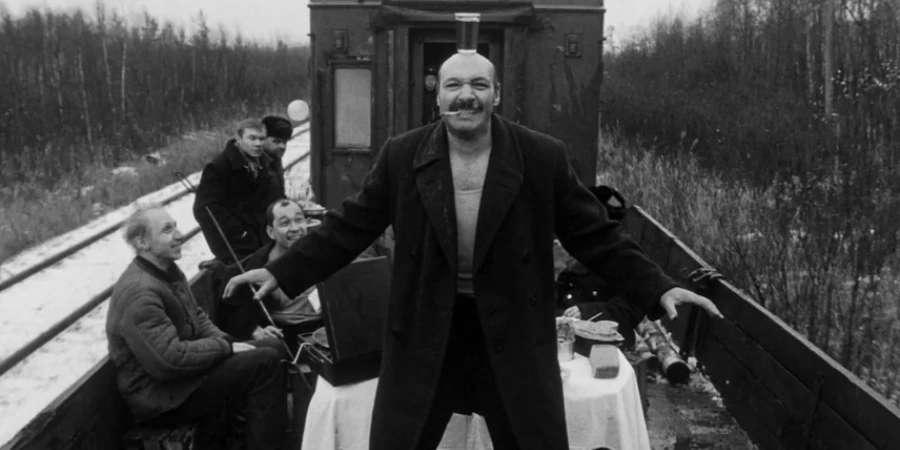
Years later, the final sequence finds him riding a freight car with a young companion, cheerfully balancing a glass on his head as the train rattles along. The son’s narration reveals he never came back to them.
Why end here? German refuses redemption. Survival under Stalin cost everything, and the man who outlived the dictator is not restored but erased. The train ride is a kind of freedom, but it is the freedom of someone who no longer belongs anywhere.
Are There Post-Credits Scenes?
No. The film closes on the train and the narration, followed by plain credits. German never used stingers or extra footage.
Type of Movie
Khrustalyov, My Car! is a historical drama, a grotesque black comedy, and an experimental art film all at once. Its tone is delirious and relentless. Long takes, overlapping dialogue, and chaotic blocking make the viewer feel trapped inside the paranoia of 1953.
Cast
- Yuri Tsurilo – General Yuri Klensky
- Nina Ruslanova – Nina, Klensky’s wife
- Mikhail Dementyev – Klensky’s son
Film Music and Composer
Andrei Petrov, one of the most prolific composers in Soviet cinema, provided the music. His contribution stays sparse. German preferred the clatter of real sound: radios, shouting, wind, and trains.
Consequently, music surfaces in fragments, often as period songs drifting from a loudspeaker. The soundscape, rather than a score, carries the film’s atmosphere.
Filming Locations
German worked out of Lenfilm studios in St. Petersburg, his lifelong base. His crew rebuilt 1953 Moscow in meticulous detail, from the communal apartment to the snowbound streets.
The dacha sequence recreates Stalin’s final hours in a cramped, filthy interior. German wanted squalor rather than grandeur, so every location looks lived-in, damp, and claustrophobic.
Awards and Nominations
The film competed for the Palme d’Or at the 1998 Cannes Film Festival, where its premiere famously drove viewers from the auditorium. It later received honors at Russia’s Nika Awards.
Behind the Scenes Insights
- German co-wrote the screenplay with his wife and longtime collaborator Svetlana Karmalita.
- Production stretched across most of the 1990s amid funding collapses and German’s obsessive perfectionism.
- The film is a Russian and French co-production, which helped keep it alive during Russia’s economic crisis.
- German shot in black and white to match the texture of his memories of the period; he was a boy in 1953.
- Cannes critics who dismissed the film in 1998 began reassessing it within a few years, and it now appears on many lists of the finest Russian films of its decade.
- German would make only one more film, Hard to Be a God, released after his death.
Inspirations and References
The story draws on the real Doctors’ Plot of early 1953, when Stalin accused mostly Jewish physicians of conspiring to murder Soviet leaders. His death that March halted the purge.
The title comes from a phrase popularly attributed to Beria as he left Stalin’s deathbed. German also drew on his own childhood; his father, the writer Yuri German, moved in the same Leningrad circles the film evokes.
Alternate Endings and Deleted Scenes
No alternate ending has been released. German cut the film himself and did not revise it after Cannes, despite the hostile reception. Any excised material has remained in the archives.
Book Adaptations and Differences
The film is not based on a book. German and Karmalita wrote an original screenplay rooted in history, memory, and rumor.



Memorable Scenes and Quotes
Key Scenes
- The opening snowstorm and the boy’s narration setting the dreamlike tone.
- Chaos in the communal apartment as relatives bicker over nothing.
- Klensky spotting his own double on the street.
- The prison van, the most notorious sequence in the film.
- Stalin’s death, reduced to a bodily function.
- Beria calling for his car.
- The glass balanced on Klensky’s head in the final shot.
Iconic Quotes
- Beria’s command to his driver, the line that names the film.
- The narrator’s confession that his father never came home (paraphrased).
- A drunken bystander’s remark that everyone is a spy, delivered as a joke that is not a joke (paraphrased).
Easter Eggs and Hidden Details
- Radios and loudspeakers in the background repeat propaganda about the Doctors’ Plot throughout the early scenes.
- The double who shadows Klensky foreshadows the state’s ability to replace any man.
- German fills corridors with extras who stare directly into the lens, breaking the illusion of invisibility.
- Umbrellas recur before the van scene, turning a mundane object into a threat.
- The final train echoes the opening narration, closing a loop of memory.
Trivia
- The runtime exceeds two and a half hours.
- German’s previous feature, My Friend Ivan Lapshin, came out fourteen years earlier.
- The film’s reputation grew so much that it later received restored re-releases abroad.
- Stalin’s real death occurred at his Kuntsevo dacha on March 5, 1953.
- German cast many non-professional actors to achieve his crowded, unpolished frames.
- Yuri Tsurilo was little known before this role, which made him a cult figure.
Why Watch?
Nothing else looks or sounds like Khrustalyov, My Car!. It drags you through Stalin’s last days with the logic of a fever dream. The experience is exhausting, obscene, and unforgettable. If you want to feel the terror of 1953 rather than merely learn about it, this is the film.
Director’s Other Movies
- The Seventh Companion (1967)
- Trial on the Road (1971)
- Twenty Days Without War (1976)
- My Friend Ivan Lapshin (1984)
- Hard to Be a God (2013)
Recommended Films for Fans
- Come and See (1985)
- Repentance (1987)
- The Inner Circle (1991)
- Burnt by the Sun (1994)
- Hard to Be a God (2013)
- The Death of Stalin (2017)
- Dear Comrades! (2020)