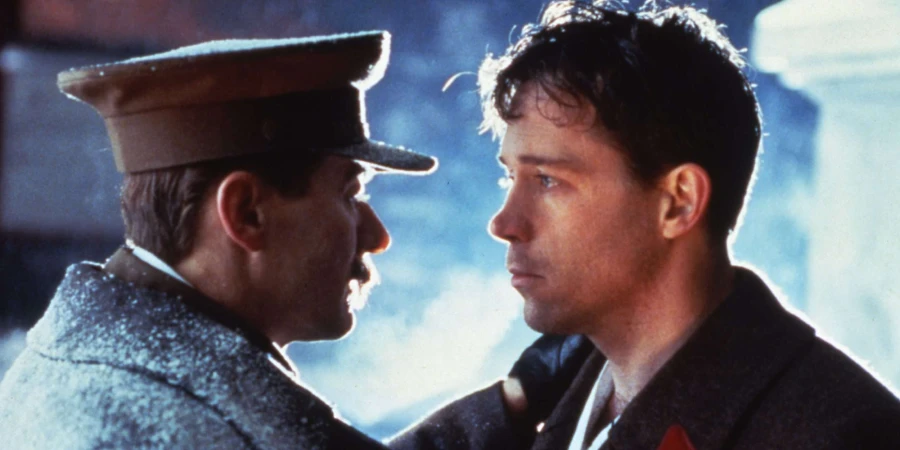
Ivan Sanshin is dragged from his wedding bed by secret police, convinced he is about to die. Instead, they hand him a projector and a reel of film. Stalin wants a movie. The Inner Circle (1991) follows a true believer who gets closer to the dictator than almost anyone, and sees nothing. Andrei Konchalovsky shot it inside the Kremlin itself, days before the Soviet Union ceased to exist.
Detailed Summary
A Wedding in a Communal Flat
Moscow, 1939. Ivan Sanshin, a projectionist at the KGB club, marries the lovely Anastasia and throws a party in their communal apartment. Their neighbors, the Jewish Gubelman family, join the celebration with their small daughter Katya. Everyone is happy, and everyone is afraid.
Arrested at Midnight
That same night, agents arrive. They haul away the Gubelmans and seize Ivan too. He assumes his life is over. However, the car delivers him to the Kremlin, where a projector has broken and the Master wishes to watch a film.
The Master Approves
Ivan threads the reel with shaking hands. Afterward, Stalin finds him in a corridor and tells him he projected well, an offhand compliment that Ivan treats as a benediction. Overnight, the nobody becomes Stalin’s private projectionist.
Katya in the Orphanage
Anastasia cannot forget the neighbors’ child. She tracks Katya to a state orphanage and visits her in secret. Ivan panics; any link to “enemies of the people” could end his career, and he forbids her from going again.
Whom Do You Love More?
Anastasia asks her husband whom he loves more, her or Comrade Stalin. Ivan answers without hesitation: Stalin. The scene sits at the heart of the film, a portrait of devotion so total that it crowds out the people in the room.
Beria’s Train
Years pass, and the war arrives. While serving on a train, Anastasia is “requisitioned” by Beria, the secret police chief, and Ivan registers only the honor of the attention until she returns pregnant. His faith in the system never wavers, even as his marriage disintegrates.
Anastasia’s Decline
Anastasia unravels. Grief for Katya, shame over Beria, and her husband’s blindness wear her down. Only when she is damaged beyond repair does Ivan slowly realize that both of them have been exploited.
Movie Ending
Anastasia does not survive her despair. Her death leaves Ivan alone with his projector, his privileges, and the portrait of a man who never knew his name. He goes on working, because stopping would require admitting what the job cost.
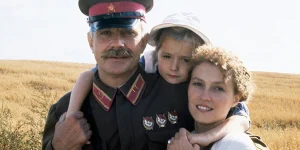
In 1953, a young woman appears at his door. It is Katya, now seventeen, who has treasured the memory of Anastasia’s kindness at the orphanage all these years. She is the living remainder of everything Ivan tried to ignore.
Then Stalin dies. Moscow pours into the streets for the funeral, and the crowd becomes a crush. Ivan and Katya are caught in the chaos as mourners trample one another to glimpse the coffin, and the dictator’s death claims victims even as he lies in state.
Why end here? Konchalovsky subverts the Hollywood cliché of the ordinary man rising to heroism; Sanshin ignores the openly displayed evidence of evil and succumbs to the privileges his job provides. The funeral crush is the cult of personality in miniature, and Ivan stands inside it to the last.
Are There Post-Credits Scenes?
No. The film ends with the funeral sequence and closing text about Sanshin’s life, followed by standard credits.
Type of Movie
The Inner Circle is a historical drama with elements of political thriller and domestic tragedy. Its tone is earnest and somber, punctuated by the strange comedy of watching Hollywood musicals beside the men running the Gulag.
Cast
- Tom Hulce – Ivan Sanshin
- Lolita Davidovich – Anastasia
- Bob Hoskins – Lavrentiy Beria
- Aleksandr Zbruyev – Joseph Stalin
- Feodor Chaliapin Jr. – Professor Bartnev
- Bess Meyer – Katya (age 17)
- Mariya Baranova – Katya (age 10)
- Irina Kupchenko – Orphanage directress
- Aleksandr Filippenko – Major Khitrov
- Lyubov Matyushina – Sonia Gubelman
Film Music and Composer
Eduard Artemyev composed the score. Best known for his electronic soundscapes in Tarkovsky’s Solaris and Stalker, he worked here in a more conventional orchestral register.
The music stays understated. Konchalovsky lets the films within the film, the musicals and comedies Stalin adored, supply much of the soundtrack, so that cheerful screen melodies play over scenes of fear.
Filming Locations
Konchalovsky shot the film on location in Moscow, including sequences within the walls of the Kremlin, which no major production had entered before. The Kremlin corridors and screening room carry an authenticity no set could fake.
Allowed back into Russia, he also gained access to Beria’s bullet-proof train compartment and the KGB headquarters building. Cinematographer Ennio Guarnieri captured Red Square and the Kremlin in somber, darkly beautiful tones.
Awards and Nominations
The Inner Circle received a nomination at Italy’s David di Donatello Awards in 1992. It was not a major awards player elsewhere, and its box office in the United States was modest.
Behind the Scenes Insights
- The story is based on Alexander Ganshin, Stalin’s personal projectionist from 1935 until the dictator’s death in 1953.
- Konchalovsky described Sanshin as the drop of water through which one could see the entire ocean.
- The film premiered in the United States on December 25, 1991, one day before the Soviet Union was dissolved.
- While in Russia, Tom Hulce met Ganshin himself to learn what working for Stalin had been like.
- Konchalovsky’s inspiration came from meeting the projectionist roughly twenty years before he made the film.
- Konchalovsky’s companion book notes that Beria does not rape Anastasia though he could have, a nuance he wanted preserved on screen.
- Columbia Pictures backed the project, with Italian producer Claudio Bonivento.
Inspirations and References
Ganshin’s real life provides the spine. For the sake of a job, a better apartment, and freedom from fear, he served a man who epitomized evil, and he remained annoyed by attempts to disparage his former boss even decades later.
Moreover, the film reflects Konchalovsky’s own history. He left the USSR in the late 1970s, and The Inner Circle was his first chance to confront the Stalin era with Western resources on Soviet soil.
Alternate Endings and Deleted Scenes
No alternate ending has been released. The theatrical cut runs about 137 minutes and has remained the standard version on home video. Konchalovsky’s companion volume discusses what he intended rather than material he removed.
Book Adaptations and Differences
The film is not adapted from a novel. Konchalovsky co-wrote an original screenplay with Anatoli Usov, and a nonfiction companion book, The Inner Circle: An Inside View of Soviet Life Under Stalin, appeared alongside the release to document Ganshin’s life and the production.
Memorable Scenes and Quotes
Key Scenes
- The wedding party interrupted by the arrest of the Gubelmans.
- Ivan’s terrified first screening inside the Kremlin.
- Stalin’s casual compliment in the corridor.
- Anastasia’s visit to the orphanage.
- The question of whom Ivan loves more.
- Beria’s train.
- The funeral crush.
Iconic Quotes
- Stalin telling Ivan that he projected well.
- Anastasia asking whether Ivan loves her or Comrade Stalin more, and his one-word answer.
- Young Katya repeating that her parents are traitors, parroting what the orphanage taught her.
Easter Eggs and Hidden Details
- The Gubelmans’ tabby cat lingers in the communal kitchen after their arrest, a small living trace of the vanished family.
- Ivan’s “no questions” attitude is stated as a motto, and the film returns to it as his defining trait.
- Hollywood musicals screened for Stalin contrast with the drab reality outside the Kremlin walls.
- Stalin’s gentle, fatherly manner is the only warm presence in the Kremlin, a deliberate inversion of expectations.
- The timing of the release turned the film into an accidental obituary for the Soviet state.
Trivia
- Aleksandr Zbruyev, a well-known Soviet actor, plays Stalin with unusual restraint.
- Bob Hoskins took the role of Beria between Who Framed Roger Rabbit and Hook.
- Some critics faulted the heavy Russian-accented English spoken by Soviet characters.
- The real Ganshin held his post for nearly two decades.
- Konchalovsky returned to the Stalin era three decades later with Dear Comrades!.
- Columbia opened the film in the same week the hammer and sickle came down over the Kremlin.
Why Watch?
The Inner Circle asks a hard question: how does an ordinary man serve a monster and feel honored by it? Tom Hulce’s wide-eyed devotion is frustrating by design. Add the real Kremlin locations, and you have a historical curiosity that rewards patience.
Director’s Other Movies
- The First Teacher (1965)
- Asya’s Happiness (1967)
- Uncle Vanya (1970)
- Siberiade (1979)
- Maria’s Lovers (1984)
- Runaway Train (1985)
- Tango & Cash (1989)
- House of Fools (2002)
- The Postman’s White Nights (2014)
- Paradise (2016)
- Dear Comrades! (2020)
Recommended Films for Fans
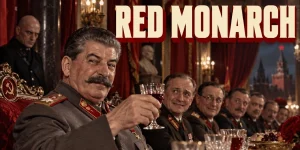
- Red Monarch (1983)
- Repentance (1984)
- Stalin (1992)
- Burnt by the Sun (1994)
- Khrustalyov, My Car! (1998)
- The Death of Stalin (2017)
- Dear Comrades! (2020)