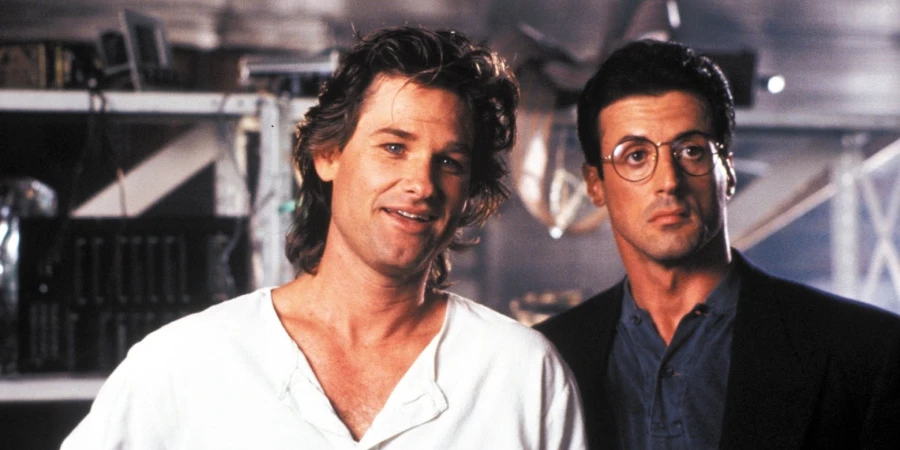
Tango & Cash is not just a film; it is a monument to 80s action excess. Sylvester Stallone and Kurt Russell star as two rival supercops framed for murder by a scenery-chewing villain. However, their forced partnership creates an explosive and hilarious cinematic ride. This is the definitive spoiler-filled breakdown of that very ride.
Detailed Summary
The Perfect Frame Job
Ray Tango (Sylvester Stallone) is a sophisticated, Armani-wearing detective from Beverly Hills. On the other hand, Gabe Cash (Kurt Russell) is a rugged, messy cop working the grittier streets of Downtown L.A. Both are thorns in the side of crime lord Yves Perret (Jack Palance), who has lost millions due to their separate police work.
Frustrated, Perret devises a plan to neutralize them both. He lures them to a warehouse with the promise of a drug bust. Instead, they find a dead, wire-tapped FBI agent, and the police swarm the building. A doctored audio tape appears to implicate both Tango and Cash in the agent’s murder.
Life in the Big House
Despite their protests, Tango and Cash are convicted and sent to a minimum-security prison. Perret, however, arranges their transfer to a maximum-security penitentiary populated by criminals they both put away. Their lives are immediately in jeopardy.
After surviving several brutal attacks orchestrated by Perret’s inside men, Tango realizes they will not survive long enough to appeal their case. Cash agrees, and they accept an escape plan from the prison’s warden, a secret accomplice of Perret who wants them dead during the attempt. With help from Cash’s sister, Katherine (Teri Hatcher), and a fellow inmate, they stage a daring rooftop escape.
Clearing Their Names
Now fugitives, Tango and Cash must prove their innocence. Katherine, who works as an exotic dancer, helps them navigate the criminal underworld. Their investigation leads them to the audio expert who doctored the incriminating tape. He confesses before being killed by Perret’s henchmen.
They also track down Skinner, one of Perret’s accomplices in the frame-up. Meanwhile, Tango trusts his partner to protect Katherine, who has now developed a romantic connection with Tango. The duo learns that Perret is not just a drug lord but a major international arms dealer. Ultimately, they discover his massive operation is hidden within a quarry outside the city.
The Final Assault
For the final confrontation, Cash procures a heavily armed, custom-built assault vehicle disguised as a monster truck. They use it to literally drive through the front gates of Perret’s compound, causing absolute chaos and destruction. What follows is a massive gunfight against Perret’s private army.
Cash confronts and kills Requin (Brion James), Perret’s main enforcer. Tango, meanwhile, faces Perret himself in a hall of mirrors. Perret reveals he has kidnapped Katherine. After a tense standoff, Tango and Cash shoot Perret simultaneously, killing him and saving Katherine. With their names cleared by the evidence found at the compound, the two cops finally embrace their partnership.
Movie Ending
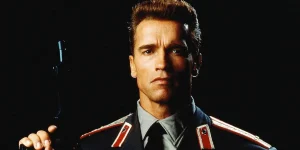
The ending of Tango & Cash is a triumphant conclusion for our heroes. After killing Yves Perret in the hall of mirrors, they successfully rescue Katherine. Evidence uncovered at Perret’s facility completely exonerates them of the FBI agent’s murder, restoring their reputations as top cops.
In the final scene, a newspaper headline celebrates their victory. We see Tango kissing Katherine, solidifying their romance and much to Cash’s mock annoyance. Cash then pitches a new TV show starring the three of them, suggesting their wild adventures will continue. Their rivalry has fully transformed into a loyal, if still playfully antagonistic, partnership.
Are There Post-Credits Scenes?
No, there are no post-credits or mid-credits scenes in Tango & Cash. Once the credits begin to roll, the movie is officially over.
Type of Movie
Tango & Cash is a quintessential buddy-cop action-comedy. Its tone is bombastic, self-aware, and unabashedly over-the-top. The film prioritizes high-octane action sequences, witty banter, and macho posturing over any semblance of realism, making it a perfect example of late-80s blockbuster filmmaking.
Cast
- Sylvester Stallone – Lieutenant Raymond “Ray” Tango
- Kurt Russell – Lieutenant Gabriel “Gabe” Cash
- Teri Hatcher – Katherine “Kiki” Tango
- Jack Palance – Yves Perret
- Brion James – Requin
- James Hong – Quan
- Marc Alaimo – Lopez
- Michael J. Pollard – Owen
Film Music and Composer
The score for Tango & Cash was composed by Harold Faltermeyer, a defining sound architect of the 1980s. Faltermeyer was already famous for his work on Beverly Hills Cop and Top Gun. His music for this film is a powerful mix of synthesizer rock, electronic percussion, and heroic brass themes.
The standout track, “Tango’s Theme,” perfectly captures the film’s high-energy and stylish tone. Consequently, the entire score complements the on-screen action with a driving, synthesizer-heavy rhythm that is unmistakably a product of its era.
Filming Locations
Principal photography for Tango & Cash took place primarily in and around Los Angeles, California. The contrast between Tango’s posh Beverly Hills and Cash’s grimy Downtown L.A. was effectively captured using real city locations. These settings visually reinforce the “oil and water” dynamic of the two main characters.
The imposing maximum-security prison scenes were filmed at the Mansfield Reformatory in Ohio, the same iconic location used for The Shawshank Redemption. In addition, the climactic showdown at Perret’s mining quarry was shot at a facility in Irwindale, California, providing a suitably epic and destructive backdrop for the finale.
Awards and Nominations
Tango & Cash did not receive any major prestigious awards. It was, however, nominated for three Golden Raspberry Awards (Razzies). These nominations were for Worst Actor (Sylvester Stallone), Worst Supporting Actress (Kurt Russell in drag), and Worst Screenplay.
Behind the Scenes Insights
- The film’s production was notoriously troubled. Original director Andrei Konchalovsky was fired deep into filming due to creative differences with producer Jon Peters over the tone. Konchalovsky wanted a more serious action-thriller, while Peters and Stallone pushed for a campier, comedic feel.
- Albert Magnoli (director of Purple Rain) was brought in to finish the film, reshooting many scenes and overseeing the entire third act. He remains uncredited as a director.
- Sylvester Stallone reportedly had significant creative control. He personally recruited composer Harold Faltermeyer and had a hand in many of the script’s comedic and action-oriented rewrites.
- Kurt Russell has stated in interviews that he essentially directed his own performance. He even claims to have ghost-directed several of his own scenes after Konchalovsky’s departure.
Inspirations and References
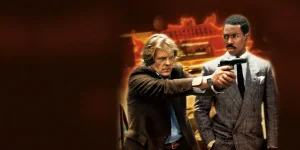
Tango & Cash is heavily inspired by the burgeoning buddy-cop genre of the 1980s, particularly films like Lethal Weapon (1987) and 48 Hrs. (1982). It takes the core formula—two mismatched partners forced to work together—and pushes it to an almost satirical extreme. The film constantly winks at the audience and its own absurdity.
Additionally, it plays off the established screen personas of its stars. Stallone’s Tango is a send-up of the slick action heroes of the era, while Russell’s Cash is a parody of the rebellious, anti-authority figures he often played.
Alternate Endings and Deleted Scenes
Due to the chaotic production and change in directors, several scenes were altered or cut. The most notable deleted sequence involved the scene where Cash dresses in drag to spy on a suspect. Reportedly, the original cut by Andrei Konchalovsky was much longer and played for suspense rather than comedy.
When Albert Magnoli took over, the scene was reshot to be much more overtly comedic, leading to Kurt Russell’s Razzie nomination for Worst Supporting Actress. No official alternate ending has ever been released, though the film was extensively re-edited in post-production, and the finale was constructed by the replacement director.
Book Adaptations and Differences
Tango & Cash is not based on a book or any other pre-existing source material. It is an original story written for the screen by Randy Feldman.
Memorable Scenes and Quotes
Key Scenes
- The Prison Shower Fight: Cornered by a gang of inmates, Tango and Cash are forced to fight for their lives, cementing their reluctant alliance.
- The Rooftop Escape: The duo ziplines from the prison roof across a power line to freedom in a spectacular and patently absurd action sequence.
- The Monster Truck Assault: Cash drives a weaponized monster truck directly into Perret’s compound, destroying everything in his path in the film’s most over-the-top moment.
- The Hall of Mirrors: The final showdown between Tango and Perret takes place in a disorienting hall of mirrors, a classic action movie trope executed with 80s flair.
Iconic Quotes
- “Rambo is a pussy.” – Ray Tango
- “You wanna be a cop, or you wanna be a rock star?” – Gabe Cash
- “I’m the guy that does his laundry.” – Ray Tango
- “I don’t know, but he’s got a real big gun.” – Dispatcher
- “This has got to be the guy that whacked my TV.” – Gabe Cash
Easter Eggs and Hidden Details
- The line “Rambo is a pussy” is an inside joke, as Sylvester Stallone famously portrayed John Rambo. Reportedly, this line was Stallone’s own ad-lib.
- When Cash is flipping through channels in his apartment, a brief clip from a Looney Tunes cartoon is visible, mirroring the cartoonish level of violence in the film.
- During the prison sequence, one of the inmates Tango and Cash confront is played by professional wrestler “The Warlord“ (Terry Szopinski), a recognizable face for WWF fans of the era.
Trivia
- Patrick Swayze was the original choice to play Gabe Cash, but he turned it down to star in Road House.
- Jack Palance won the Academy Award for Best Supporting Actor two years later for City Slickers. His Oscar speech became one of the most memorable in the ceremony’s history.
- The film’s script was written by Randy Feldman, a former Marine who worked as a bouncer in Hollywood.
- Despite its troubled production and lukewarm critical reception, the film was a financial success and has since become a beloved cult classic.
Why Watch?
Watch this movie for a pure, unfiltered dose of 80s action absurdity. It features two charismatic leads at the top of their game, wildly inventive action, and a script full of quotable one-liners. It is the perfect popcorn movie.
Director’s Other Movies
The film had two directors due to a troubled production.
Andrei Konchalovsky (original director):
- Runaway Train (1985)
- Duet for One (1986)
- The Inner Circle (1991)
Albert Magnoli (uncredited replacement director):
- Purple Rain (1984)
- American Anthem (1986)
- Street Knight (1993)
Recommended Films for Fans
- Lethal Weapon (1987)
- 48 Hrs. (1982)
- Beverly Hills Cop (1984)
- The Last Boy Scout (1991)
- Big Trouble in Little China (1986)
- Demolition Man (1993)