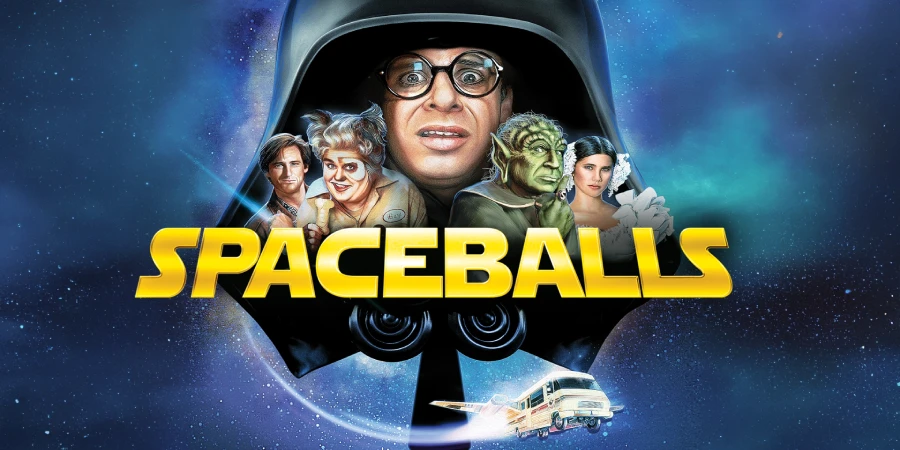

Mel Brooks took one look at the Star Wars phenomenon and decided the galaxy needed a good hard laugh. Spaceballs is a relentless, gleefully stupid parody that somehow manages to mock its source material while also celebrating everything fans love about it. Brooks stuffed the film with fourth-wall breaks, sight gags, and jokes that land so fast you miss half of them on a first watch. It remains one of the sharpest comedy parodies ever committed to film.
Detailed Summary
The Opening Crawl and Spaceball One
Brooks wastes zero time. A massive spaceship crawls across the screen in direct homage to Star Wars, except this one just keeps going and going, eventually revealing an absurdly long vessel with a vanity plate on its rear end. It sets the tone instantly: nothing in this universe is sacred.
President Skroob (Mel Brooks) rules the planet Spaceball, a world that has squandered all of its air. His solution is to steal the air supply from the peaceful neighboring planet Druidia. Dark Helmet (Rick Moranis) commands Spaceball One and leads the mission with all the menace of a very angry toddler.
Princess Vespa’s Escape and the Mission Begins
Princess Vespa (Daphne Zuniga) flees her own wedding on Druidia, unwilling to marry the boring Prince Valium. Her escape triggers a chain of events that puts her directly in Spaceball’s crosshairs. Dark Helmet orders her capture immediately.
King Roland (Dick Van Patten), Vespa’s father, hires a mercenary to retrieve her. That mercenary is Lone Starr (Bill Pullman), a roguish space bum who flies a Winnebago spaceship called Eagle 5 alongside his half-man, half-dog companion Barf (John Candy). Lone Starr owes a massive debt to the gangster Pizza the Hutt and desperately needs the reward money.
The Capture and the Schwartz
Lone Starr and Barf intercept Vespa and her droid companion Dot Matrix (voiced by Joan Rivers). However, Dark Helmet catches them all and takes them prisoner aboard Spaceball One. Brooks uses the capture sequence to squeeze in several brilliant visual gags, including a shot of the ship going to “ludicrous speed.”
Lone Starr discovers a small locket around his neck. Meanwhile, the group escapes into the desert planet Vega in a pod. They stumble upon Yogurt (also played by Mel Brooks), a wise mystic who introduces Lone Starr to the Schwartz, a clear parody of the Force. Yogurt also runs a merchandise empire, in a gloriously self-aware swipe at Star Wars licensing.
Merchandising, Training, and Disguises
Yogurt’s caves overflow with Spaceballs branded merchandise: dolls, lunch boxes, flamethrowers. Brooks turns the joke into a full scene, mocking Hollywood’s obsession with franchise revenue. It is one of the film’s most quoted moments.
Lone Starr trains with the Schwartz ring and begins to develop his abilities. Vespa and Lone Starr grow closer during their time on the desert planet, setting up the romantic subplot. Barf and Dot Matrix provide comic relief throughout, largely by existing near each other.
Vespa’s Recapture and the Hair Threat
Dark Helmet eventually locates the group and captures Vespa again. He threatens to reverse her nose job unless King Roland gives up Druidia’s air shield combination. It is a masterfully absurd piece of leverage that works precisely because Vespa cares deeply about her hair and her nose.
King Roland, heartbroken and powerless, surrenders the combination. Consequently, Spaceball One aims its massive air-sucking machine, called the Mega Maid, at Druidia. Lone Starr races to stop them before the planet loses all of its air.
The Infiltration of Spaceball One
Lone Starr and Barf board Spaceball One in disguise. They stumble through the ship in a series of escalating gags, including a memorable scene where Dark Helmet watches a Spaceballs VHS tape to track the heroes in real time. He literally fast-forwards to find out where they are, acknowledging the film itself as the most reliable intelligence source available.
Brooks leans fully into the meta-comedy here. Characters react to being in a movie. On the other hand, the plot keeps moving forward with enough momentum that the jokes never fully derail the story.
Movie Ending
Lone Starr confronts Dark Helmet aboard Spaceball One as the Mega Maid vacuum machine prepares to drain Druidia’s atmosphere. Their Schwartz duel parodies the lightsaber battles of Star Wars with the rings functioning like glowing swords. Moranis commits fully to the physical comedy, and the duel is both genuinely funny and surprisingly well-choreographed.
Lone Starr defeats Dark Helmet and sets Spaceball One to self-destruct. He and Barf escape just before the ship explodes, though the Mega Maid survives the blast and hovers, intact, in space. However, Lone Starr uses the Schwartz to reverse the Mega Maid’s vacuum function, forcing it to blow Druidia’s stolen air back onto the planet. The giant robot maid’s head then explodes in a parody of the Star Wars Death Star climax.
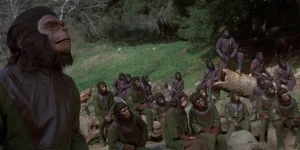
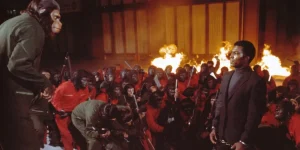
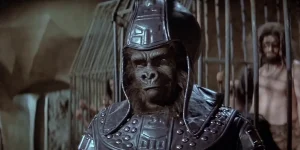
Dark Helmet, President Skroob, and Colonel Sandurz (George Wyner) survive the destruction and land on a planet of apes, a direct nod to the ending of Planet of the Apes. Their fate is comic humiliation rather than true defeat. Brooks refuses to grant his villains any dignity.
Lone Starr delivers Vespa to Druidia and declines the reward, having fallen in love with her. He flies away on Eagle 5, but Yogurt contacts him with a crucial revelation: Lone Starr’s locket identifies him as a genuine prince. He returns to Druidia, marries Vespa, and the film closes on a joyful wedding ceremony interrupted, briefly, by a facehugger creature from Alien bursting out of a dinner guest’s chest and tap-dancing to “Hello! Ma Baby.” It is a perfectly chaotic final joke.
Are There Post-Credits Scenes?
Spaceballs does not include a post-credits scene. The alien chest-burster gag effectively functions as the film’s final comedic punctuation, landing just before the credits roll. Audiences in 1987 had no particular expectation of post-credits sequences, and Brooks delivers his last laugh before the credits rather than after them.
Type of Movie
Spaceballs is a sci-fi parody comedy. It primarily targets Star Wars but also takes swipes at Star Trek, Alien, and Planet of the Apes. In addition, it works as a general satire of Hollywood blockbuster culture and franchise merchandising.
The tone is broadly comedic, relying on slapstick, wordplay, fourth-wall breaks, and rapid-fire visual gags. It never aims for sophisticated wit; instead, it goes for maximum laughs at maximum speed. Mel Brooks treats every frame as a delivery mechanism for jokes.
Cast
- Mel Brooks – President Skroob / Yogurt
- John Candy – Barf
- Rick Moranis – Dark Helmet
- Bill Pullman – Lone Starr
- Daphne Zuniga – Princess Vespa
- Dick Van Patten – King Roland
- George Wyner – Colonel Sandurz
- Joan Rivers – Dot Matrix (voice)
- Michael Winslow – Communications Officer
- Jim J. Bullock – Prince Valium
Film Music and Composer
John Morris composed the film’s orchestral score. Morris was a frequent Mel Brooks collaborator, having also scored Blazing Saddles and Young Frankenstein. His work on Spaceballs directly spoofs John Williams’ iconic Star Wars themes while maintaining its own comedic identity.
The film also features the song “Spaceballs” performed by the Spinners during the opening sequence, blending disco and comedy in a way that perfectly matches Brooks’ sensibility. Furthermore, Van Halen’s “Good Enough” appears during Lone Starr’s introduction, grounding the film in its very specific 1980s moment.

Filming Locations
Principal photography took place primarily on soundstages at Mel’s Cite du Cinema in Montreal, Canada. The controlled studio environment allowed Brooks and his team to build the elaborate sets required for Spaceball One’s interiors and Yogurt’s caves. Location shooting in natural desert landscapes supplemented the alien planet sequences.
Shooting in Canada offered significant production cost advantages. Moreover, the studio infrastructure in Montreal allowed the production to construct large-scale practical sets that gave the film a genuine visual scale, even on a parody budget.
Awards and Nominations
Spaceballs did not receive major awards recognition from mainstream bodies like the Academy Awards or the Golden Globes. Its cultural impact has proven far more durable than any trophy cabinet entry could measure.
Behind the Scenes Insights
- Mel Brooks personally called George Lucas before production began to ask permission to make the parody. Lucas approved on the condition that no Spaceballs merchandise be sold, which became a delicious irony given the film’s extended merchandising jokes.
- Rick Moranis wore a helmet so large that the prop department had to rig a special support system to keep it from tipping over or injuring him during takes.
- John Candy improvised several of Barf’s reactions on set, and Brooks encouraged him to push the physical comedy as far as possible.
- Brooks played both President Skroob and Yogurt, requiring significant scheduling coordination so he could direct scenes involving his own characters without causing production delays.
- The “ludicrous speed” sequence involved a practical camera effect and a physical drag effect on the actors to simulate extreme acceleration, which Moranis and Wyner reportedly found genuinely uncomfortable.
- Mel Brooks later acknowledged that the film’s box office performance was solid but that its reputation grew substantially through home video rentals and cable television broadcasts throughout the late 1980s and 1990s.
Inspirations and References
Spaceballs draws its primary inspiration from Star Wars (1977), parodying its characters, plot structure, and visual language with loving precision. Lone Starr mirrors Han Solo and Luke Skywalker simultaneously, while Dark Helmet is an obvious Darth Vader surrogate. Barf combines Chewbacca’s loyalty with a very human set of neuroses.
Star Trek, Alien, and Planet of the Apes all receive direct parody treatment within the film. In contrast to films that parody a single target, Brooks scatters his references across the broader sci-fi genre, making Spaceballs a mosaic of 1970s and 1980s blockbuster culture. Brooks also drew from his own earlier parody work, particularly the structural approach he refined on Blazing Saddles.
Alternate Endings and Deleted Scenes
No widely documented alternate endings or significant deleted scenes from Spaceballs have been made publicly available through major home video releases or official studio archives. Brooks tends to edit aggressively during production rather than shoot multiple endings and choose later. As a result, the theatrical cut appears to closely reflect his original creative intentions.
Book Adaptations and Differences
Spaceballs is not based on any book or pre-existing literary source. Mel Brooks co-wrote the original screenplay with Thomas Meehan and Ronny Graham specifically for this production. No significant book-to-screen comparison applies here.

Memorable Scenes and Quotes
Key Scenes
- Spaceball One’s endless opening crawl across the screen, a direct and extended parody of the Star Wars opening shot.
- Dark Helmet watching a Spaceballs VHS tape to locate the heroes in real time, one of cinema’s most committed fourth-wall breaks.
- Yogurt’s merchandise cave, packed wall to wall with Spaceballs branded products, skewering Hollywood’s franchise economy.
- The “ludicrous speed” sequence, where Spaceball One shoots past light speed and the crew’s faces distort grotesquely.
- The Schwartz duel between Lone Starr and Dark Helmet, which escalates from parody lightsaber combat into pure physical comedy.
- The chest-burster creature from Alien performing a tap-dance number in the closing scene.
- The Mega Maid reversing direction to blow Druidia’s air back, spoofing the Death Star trench run climax.
Iconic Quotes
- “May the Schwartz be with you.”
- “Ludicrous speed, go!”
- “I am your father’s brother’s nephew’s cousin’s former roommate.”
- “Merchandising, merchandising, merchandising! That’s where the real money from the movie is made.”
- “We’re not just doing this for money. We’re doing it for a sh*t load of money.”
- “At the speed of light, we’ll be there in no time.” (followed by the ship immediately slamming to a stop)
Easter Eggs and Hidden Details
- The license plate on the rear of Spaceball One reads “SPACEBALLS”, a gag visible only for a brief moment in the opening shot.
- Yogurt’s merchandise cave contains a Spaceballs flamethrower, which Yogurt casually describes as the children’s toy of choice, a sly commentary on reckless franchise licensing.
- The chess game visible aboard Eagle 5 is a nod to a similar scene in Star Wars, where Chewbacca plays holographic chess against R2-D2.
- Dark Helmet’s oversized helmet wobbles subtly throughout several scenes, suggesting the prop was never fully stable and Brooks kept the imperfection as a running visual gag.
- During the VHS fast-forward scene, the film technically shows footage from Spaceballs itself playing on screen, meaning the characters exist in a universe where their own movie is available for purchase.
- Colonel Sandurz’s uniform closely mimics the design of Imperial officer uniforms from Star Wars, down to the rank badge placement on the chest.
Trivia
- George Lucas reportedly enjoyed the finished film after screening it privately, despite his initial condition that no Spaceballs merchandise be produced.
- Rick Moranis was known for arriving on set with detailed comedic notes about Dark Helmet’s physicality, treating the role with the same preparation he brought to more grounded work.
- John Candy accepted the role of Barf largely because of his admiration for Mel Brooks’ earlier parody films.
- Mel Brooks has mentioned in interviews that a Spaceballs sequel was discussed but never moved forward, partly out of respect for ongoing Star Wars productions.
- An animated television series titled Spaceballs: The Animated Series aired on G4 in 2008, with Brooks and Moranis reprising their voice roles.
- The film’s production budget was approximately 22.7 million dollars, and it earned around 38 million dollars at the North American box office.
- Daphne Zuniga has described working with Brooks as an experience defined by near-constant improvisation, where the script served more as a starting point than a fixed blueprint.
Why Watch?
Spaceballs remains the gold standard for sci-fi parody because Brooks never coasts on easy recognition jokes. Every gag has structure, every scene earns its laugh, and the cast commits completely to the absurdity. Moreover, its savagery toward Hollywood’s franchise machine feels even sharper today than it did in 1987.
Director’s Other Movies
- The Producers (1967)
- The Twelve Chairs (1970)
- Blazing Saddles (1974)
- Young Frankenstein (1974)
- Silent Movie (1976)
- High Anxiety (1977)
- History of the World, Part I (1981)
- Robin Hood: Men in Tights (1993)
- Dracula: Dead and Loving It (1995)
Recommended Films for Fans
- Blazing Saddles (1974)
- Young Frankenstein (1974)
- Airplane! (1980)
- The Naked Gun: From the Files of Police Squad! (1988)
- Galaxy Quest (1999)
- Robin Hood: Men in Tights (1993)
- Hot Shots! (1991)
- Mars Attacks! (1996)