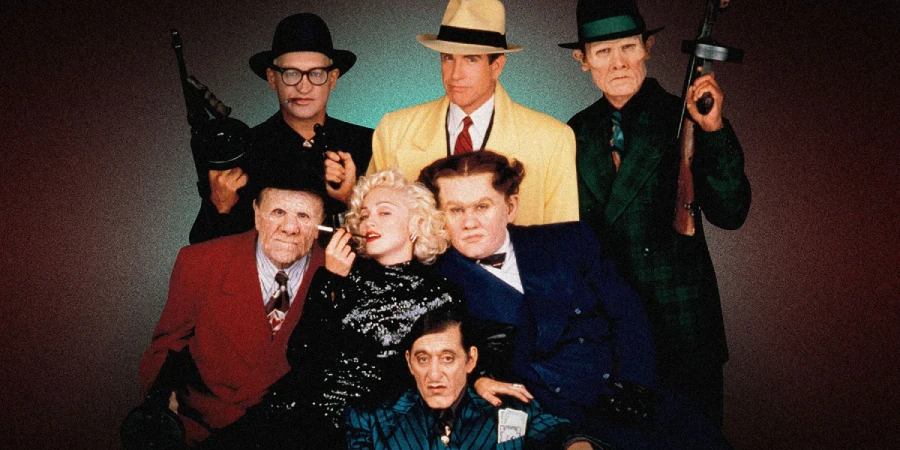

Warren Beatty’s Dick Tracy arrives like a walking, talking comic strip that somehow convinced a major studio to foot the bill. Shot entirely in a palette of seven bold colors, it turns 1930s crime fiction into pure visual spectacle. Beatty plays the square-jawed detective chasing down a criminal empire, and the film never lets you forget it is having an absolute blast doing it. Few comic book adaptations before or since have committed this hard to a single aesthetic vision.
Detailed Summary
Tracy Gets Pulled Back Into the Game
The film opens on Dick Tracy (Warren Beatty), a no-nonsense detective who wants a quiet life with his girlfriend, Tess Trueheart (Glenne Headly). However, the criminal underworld has other plans. A gang war is brewing, and Tracy finds himself drawn back into the thick of it almost immediately.
Big Boy Caprice (Al Pacino) muscled his way to the top by forcing the city’s small-time mob bosses to unite under his rule. He takes over the Club Ritz and installs a sultry new performer, Breathless Mahoney (Madonna), as the star attraction. Meanwhile, Tracy adopts a nameless street kid (Charlie Korsmo) who becomes known simply as The Kid.
Big Boy Consolidates Power
Big Boy is not content with running one club. He sets his sights on controlling every criminal operation in the city, bribing and intimidating officials along the way. Consequently, Tracy faces pressure from corrupt politicians who want the detective to back off.
Big Boy eliminates rivals who refuse to fall in line. Bodies stack up, and Tracy struggles to build a legal case against someone this well-insulated. In addition, Breathless Mahoney begins making advances on Tracy, complicating his personal life and his focus.
Breathless Plays Both Sides
Breathless is not simply a lounge singer. She feeds Tracy just enough information to keep him interested, while remaining loyal, at least on the surface, to Big Boy. Tracy finds her genuinely alluring, which creates real tension with the devoted Tess.
Tess grows increasingly frustrated as Tracy spends more time chasing Big Boy and, apparently, entertaining Breathless. The Kid bonds deeply with Tracy, seeing him as a father figure. Moreover, The Kid starts helping Tracy gather intelligence on Big Boy’s operation.
The Blank Enters the Picture
A mysterious masked figure known only as The Blank begins committing murders that seem designed to frame Tracy. The killings are precise, calculated, and deeply personal. Nobody knows who The Blank is, and the mystery drives much of the film’s second act.
Tracy investigates while juggling Big Boy’s escalating violence and Breathless’s seductions. The Blank’s identity remains hidden behind a featureless flesh-colored mask. As a result, every character in the film becomes a potential suspect.
Tracy Gets Framed
Big Boy and his associates plant evidence to implicate Tracy in criminal activity. Corrupt D.A. Fletcher (Dick Van Dyke) pushes hard to prosecute Tracy. For a stretch, it looks like the detective might actually go to prison rather than Big Boy.
Tracy refuses to cut corners or bend the law to save himself, which is precisely what makes him heroic rather than simply competent. The Kid and Tess stand by him. However, the walls keep closing in as Big Boy tightens his grip on the city.
The Final Confrontation Builds
Tracy gathers enough evidence to move against Big Boy directly. Big Boy, sensing the net tightening, launches an all-out assault to eliminate Tracy once and for all. The action escalates to a massive shootout at the Club Ritz.
During the chaos, The Blank’s involvement becomes crucial to Tracy’s survival. Furthermore, the true identity of The Blank begins to crystallize for attentive viewers just before the reveal lands. Big Boy’s elaborate criminal empire starts collapsing under its own weight.
Movie Ending
Big Boy’s final stand takes place atop a bridge, a visually stunning sequence that delivers exactly the operatic showdown the film has been promising. Tracy faces him directly, and Big Boy, for all his bombast, cannot match Tracy’s moral clarity or his aim. Big Boy falls to his death, and his criminal organization crumbles.
Then comes the revelation that many viewers remember most. The Blank is unmasked as Breathless Mahoney herself. She orchestrated the frame-up of Tracy and committed the murders, all while playing the role of temptress. It is a genuinely sharp twist because her flirtation with Tracy was never just seduction; it was misdirection.
Breathless, cornered and exposed, refuses to surrender. She dies in the standoff rather than face justice. Tracy, finally free of her manipulation, returns to Tess. Notably, the ending reinforces the film’s central moral: Tracy’s loyalty to law and love ultimately outlasts every temptation thrown at him.
D.A. Fletcher, revealed to have been working against Tracy all along, faces consequences too. The corrupt machinery surrounding Big Boy collapses along with Big Boy himself. Tracy gets his life back, adopts The Kid officially, and the city feels, at least briefly, a little safer.
The final scene carries genuine emotional warmth. Tracy and Tess reunite properly, and The Kid has a real home. In contrast to the film’s neon-drenched violence, the closing moments feel grounded and earned.
Are There Post-Credits Scenes?
Dick Tracy contains no post-credits scene. Once the film ends, it ends. No teasers, no hidden codas, nothing waiting for patient audience members.
Type of Movie
Dick Tracy is a comic book crime film with strong elements of musical entertainment and period action. Its tone is knowingly stylized, leaning into camp without fully becoming parody. Think film noir filtered through a pop-art sensibility.
Warren Beatty plays it straight even as everything around him explodes in primary colors. The result is a film that operates in a tonal register all its own. Families can enjoy it, but adults will catch the sharper edges underneath the spectacle.
Cast
- Warren Beatty – Dick Tracy
- Madonna – Breathless Mahoney
- Al Pacino – Big Boy Caprice
- Glenne Headly – Tess Trueheart
- Charlie Korsmo – The Kid
- Dick Van Dyke – D.A. Fletcher
- Dustin Hoffman – Mumbles
- James Caan – Spaldoni
- Mandy Patinkin – 88 Keys
- Paul Sorvino – Lips Manlis
- William Forsythe – Flattop
- Ed O’Ross – Itchy
- Henry Silva – Influence
- Seymour Cassel – Shoulders
- Charles Durning – Chief Brandon
- Michael J. Pollard – Bug Bailey
Film Music and Composer
Danny Elfman composed the film’s orchestral score, and it ranks among his most inventive work from that era. Elfman leaned into big-band jazz textures alongside his signature orchestral punch. The result sounds like a 1930s crime thriller filtered through a slightly surreal dream.
Separately, Madonna contributed original songs written specifically for the film, with lyrics by Stephen Sondheim. “Sooner or Later (I Always Get My Man)” became the film’s signature song. It earned Sondheim the Academy Award for Best Original Song.
Sondheim’s involvement elevated the musical sequences considerably. His lyrics are witty, layered, and sharper than the film itself sometimes manages to be. Furthermore, the collaboration between Sondheim’s Broadway sophistication and the film’s pulpy visual style produces a genuinely unusual artistic combination.
Filming Locations
Most of Dick Tracy was shot on soundstages at Warner Bros. Studios in Burbank, California. This was a deliberate creative choice rather than a logistical default. Beatty and production designer Richard Sylbert wanted total control over the visual environment.
By building everything on controlled sets, the team could enforce the film’s strict seven-color palette. Real locations would have introduced visual noise that the design philosophy absolutely could not tolerate. In addition, the artificial settings reinforce the comic-strip unreality that defines the film’s identity.
Some exterior sequences used carefully selected real-world locations dressed to match the period. However, the overwhelming majority of what audiences see exists only on a studio lot. The artificiality is the point.
Awards and Nominations
Dick Tracy received seven Academy Award nominations and won three. Its wins covered Best Original Song (Sondheim’s “Sooner or Later”), Best Art Direction, and Best Makeup.
The makeup win was particularly well-deserved. Transforming actors like Dustin Hoffman, Al Pacino, and William Forsythe into grotesquely cartoonish villains required extraordinary prosthetic work. The film also received nominations for Best Cinematography and Best Original Score, among others.
Behind the Scenes Insights
- Warren Beatty spent years developing the project before production finally began, making it one of his longest passion projects.
- Al Pacino’s Big Boy Caprice performance drew on vaudeville exaggeration and physical comedy, quite different from his usual dramatic intensity.
- The production intentionally restricted its color palette to seven colors: red, yellow, blue, green, orange, purple, and brown. Every costume, set piece, and prop had to conform to these colors.
- Dustin Hoffman spent significant time developing Mumbles’s near-incomprehensible speech pattern as a distinct character choice.
- Production designer Richard Sylbert modeled the visual language directly on the Chester Gould comic strip, flattening depth and emphasizing bold shapes.
- Madonna and Warren Beatty were in a relationship during production, which added real-life tension to some of their on-screen scenes.
- Charlie Korsmo, who played The Kid, had almost no previous acting experience at the time of filming.
- The film used more extras in crowd scenes than many productions of its era, contributing to its scale.
Inspirations and References
Dick Tracy draws directly from Chester Gould’s long-running comic strip of the same name, which Gould began in 1931. Gould’s strip was famous for its grotesquely deformed villains and its unflinching (for its era) depictions of crime and punishment. Beatty’s film translates that visual vocabulary into live action with remarkable fidelity.
The film also draws on the visual tradition of American film noir from the 1940s and 1950s. Cinematographer Vittorio Storaro references that tradition while pushing it into a heightened, almost abstract register. Moreover, the period setting and criminal milieu echo classic gangster films like Scarface and Public Enemy.
Stephen Sondheim’s musical contributions bring a Broadway sensibility into the mix. His work gives the film a layer of theatrical self-awareness that separates it from straightforward comic book adaptations.
Alternate Endings and Deleted Scenes
No officially released alternate ending exists for Dick Tracy. Beatty maintained tight creative control throughout production and post-production. As a result, the theatrical cut reflects his intended vision closely.
Some scenes featuring the villain gallery were reportedly trimmed for pacing, reducing screen time for several of the colorful supporting criminals. Specific details about deleted footage remain limited in publicly available sources. A longer cut has never received an official release.
Book Adaptations and Differences
Dick Tracy is not based on a novel. Its source material is Chester Gould’s comic strip, which ran in newspapers for decades. The film draws on decades of strip continuity for its characters and visual style, but it tells an original story rather than adapting a specific story arc.
Gould’s strip introduced characters like Flattop, Mumbles, and Big Boy across different decades of publication. The film consolidates villains from multiple eras into a single narrative. Consequently, it functions as a greatest-hits compilation of Gould’s rogues’ gallery rather than a direct adaptation.
Memorable Scenes and Quotes
Key Scenes
- Big Boy forcing the city’s gang bosses to unite under his leadership in a tense nightclub meeting, establishing him as the dominant threat immediately.
- Breathless performing “Sooner or Later” at the Club Ritz, a sequence that stops the film cold in the best possible way.
- The Blank committing murders with cold efficiency while Tracy scrambles to connect the evidence.
- Tracy’s interrogation of Mumbles, a comedic highlight in which Tracy somehow deciphers the unintelligible ramblings of Dustin Hoffman’s character.
- The bridge climax where Big Boy makes his final stand against Tracy, shot with the film’s full visual grandeur on display.
- The unmasking of The Blank as Breathless Mahoney, recontextualizing her entire arc in a single moment.
Iconic Quotes
- “I’m on my way.” (Tracy’s repeated refrain, simple and resolute, capturing the character perfectly)
- “I’m dressed like this because I just escaped from a Girls’ School.” (Big Boy, deflecting absurdity with more absurdity)
- “You’re living on the wrong side of the law. Tracy, I’m having a real good time.” (Breathless, explaining herself with unsettling cheerfulness)
- “What are you, some kind of comedian?” (Big Boy, threatening with comic menace)
Easter Eggs and Hidden Details
- Several background villains are designed to mirror obscure characters from Chester Gould’s original comic strip, recognizable only to dedicated fans of the source material.
- Vittorio Storaro’s cinematography uses flat, two-dimensional lighting setups that deliberately evoke the printed page rather than realistic three-dimensional space.
- The color palette of exactly seven colors mirrors the printing limitations of newspaper comic strips from the era when Gould’s strip was at its peak popularity.
- Big Boy Caprice’s costuming deliberately echoes the visual language of Al Capone while remaining cartoonishly exaggerated, blurring the line between historical reference and parody.
- Several crowd scenes contain characters dressed in visually distinct solid-color outfits, reinforcing the color restriction even in background details most viewers would never consciously notice.
- The Club Ritz set design references real 1930s nightclub architecture while pushing every detail slightly beyond realism, creating a space that feels simultaneously period-accurate and fantastical.
Trivia
- Warren Beatty acquired the rights to the Dick Tracy character years before the film went into production, protecting the property through a complicated legal arrangement.
- Al Pacino received an Academy Award nomination for Best Supporting Actor for his role as Big Boy Caprice.
- Vittorio Storaro, the film’s cinematographer, is one of the most decorated cinematographers in film history, known for his work on Apocalypse Now and Reds.
- The prosthetic makeup for the film’s villains took hours to apply each day, with some actors enduring four-hour or longer makeup sessions before filming could begin.
- Stephen Sondheim wrote all of the original songs performed in the film, marking an unusual collaboration between a Broadway legend and a Hollywood blockbuster.
- Charlie Korsmo later appeared in What About Bob? and Hook before leaving acting to pursue an academic career.
- The film grossed over 100 million dollars at the domestic box office, making it a solid commercial success for Disney’s Touchstone Pictures label.
- Warren Beatty directed, produced, and starred in the film simultaneously, one of the rare instances of a major star holding all three roles on a project of this scale.
Why Watch?
No film before or since has committed this completely to recreating a comic strip world in live action. Dick Tracy offers spectacular production design, a genuinely witty Sondheim score, and an unhinged Al Pacino performance that alone justifies the runtime. Furthermore, its visual boldness feels as fresh today as it did in 1990. Simply put, it is one of a kind.
Director’s Other Movies
- Heaven Can Wait (1978)
- Reds (1981)
- Bulworth (1998)
- Rules Don’t Apply (2016)
Recommended Films for Fans
- Batman (1989)
- The Rocketeer (1991)
- Sin City (2005)
- Sky Captain and the World of Tomorrow (2004)
- Who Framed Roger Rabbit (1988)
- The Mask (1994)
- Popeye (1980)