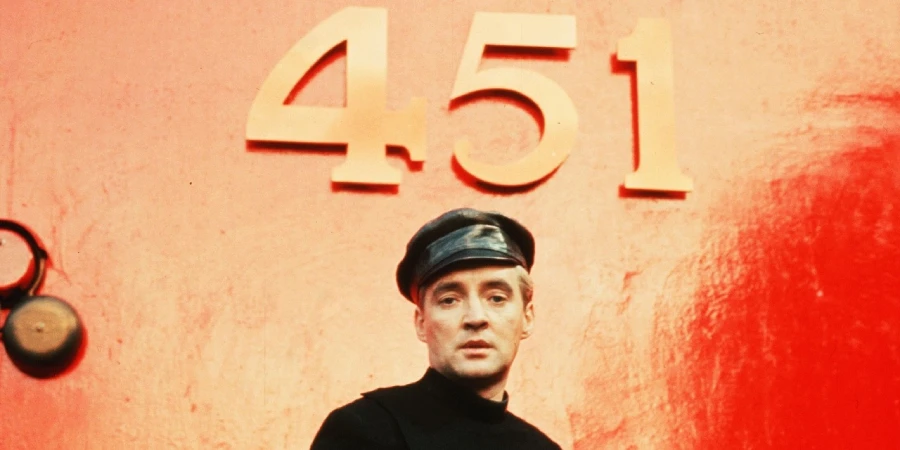

Books are burning, and nobody cares. François Truffaut’s Fahrenheit 451 (1966) takes Ray Bradbury’s incendiary novel and transforms it into a quietly unsettling British sci-fi film where conformity is enforced by flame. Oskar Werner delivers a performance of slow-burning moral awakening, and the film’s strange, dreamlike tone makes it feel more relevant with every passing decade. This is dystopia with a human heart.
Detailed Summary
A Fireman Who Burns Books
We meet Guy Montag, a fireman in a near-future society where books are illegal and firemen exist not to extinguish fires but to start them. Montag takes genuine pride in his work, torching illegal book collections without a second thought. His world is orderly, numb, and carefully maintained.
Montag lives with his wife Linda, played by Julie Christie, who spends her days watching interactive television and taking pills. She represents the ideal citizen: placid, unquestioning, and completely hollow. In contrast, her detachment signals everything wrong with this society.
The Encounter with Clarisse
On his commute, Montag meets Clarisse, also played by Julie Christie in a bold casting choice that creates a symbolic mirror between the two women. Clarisse is a schoolteacher flagged as a political suspect because she asks questions and engages with ideas. She immediately disrupts Montag’s complacency.
Clarisse asks Montag whether he has ever actually read a book. He laughs it off, but the question lodges in his mind like a splinter. Moreover, her curiosity and warmth stand in sharp contrast to Linda’s medicated indifference. Something in Montag begins to shift.
The First Stolen Book
During a raid, Montag secretly pockets a book instead of burning it. This small act of theft carries enormous weight in the film’s moral universe. He brings it home and hides it, beginning a covert collection behind a ventilation panel.
At first, Montag simply possesses the books. He stares at them, uncertain. However, curiosity eventually wins, and he opens one, beginning a process of intellectual awakening that cannot be undone. Reading, Truffaut shows us, is itself a revolutionary act.
The Captain’s Warning
Captain Beatty, Montag’s superior played by Cyril Cusack, delivers a chilling monologue explaining the philosophy behind book burning. Books, he argues, make people unhappy because they contain contradictory ideas and uncomfortable truths. Consequently, eliminating them ensures social peace.
Beatty is not stupid. He is, in fact, deeply well-read himself, which makes him one of the film’s most fascinating and troubling characters. His ideology is coherent and confident. He genuinely believes in what he does.
Montag’s Obsession Deepens
Montag begins reading voraciously, devouring novels, poetry, and philosophy in secret. His relationship with Linda deteriorates as the gap between them becomes a chasm. She watches her television “family”; he reads Dickens.
Linda discovers the hidden books and panics. She burns some of them herself in a desperate act of self-preservation. Her terror reveals how thoroughly the state has colonized even private domestic life.
The Denunciation
Linda ultimately reports Montag to the fire department. This betrayal by his own wife sends the narrative into its final, irreversible turn. Beatty leads a squad to Montag’s home and orders him to burn it himself.
Montag complies, torching his own house. Then he turns the flamethrower on Beatty, killing him. It is a shocking act of violence from a man who has spent the film quietly awakening. In contrast to his earlier passivity, this moment is explosive and definitive.
On the Run
Montag becomes a fugitive. A mechanical hound, a government tracking device, pursues him across the city. He evades capture and eventually reaches the outskirts of society, crossing into a wild, wooded landscape far from the urban grid.
Clarisse reappears here, living among a community of outcasts. She guides Montag toward safety and toward a revelation that reframes everything the film has built toward. The journey itself feels like crossing from death into life.
Movie Ending
Montag reaches the Book People, a community of exiles living in the forest, each of whom has memorized an entire book to preserve it from destruction. They do not carry texts; they become them. Each person introduces themselves by their book’s title rather than their own name.
Montag joins this community and begins memorizing a book of his own. The final images show the Book People walking slowly through a snow-dusted forest, murmuring their texts aloud in a quiet, almost meditative ritual. It is peaceful, melancholy, and deeply hopeful all at once.
Notably, Truffaut frames this ending without triumphalism. There is no revolution, no overthrow of the state. Instead, the act of remembering becomes its own form of resistance. The film trusts that preserving human thought is enough of a victory to celebrate.
For audiences, the most resonant question the ending poses is whether memory alone can sustain a civilization. Truffaut leaves that deliberately unanswered. Furthermore, the gentle, almost fairy-tale quality of the final sequence gives it a timeless, mythological weight that pure realism could never achieve.
Are There Post-Credits Scenes?
Fahrenheit 451 (1966) contains no post-credits scenes whatsoever. Credits roll over a quiet final image, and the film simply ends. You can safely leave when the credits begin.
Type of Movie
This is a science fiction drama with strong dystopian undertones. Truffaut’s tone is deliberately cool, detached, and even slightly surreal rather than action-driven or thrilling. The pacing is slow and contemplative by design.
In contrast to later dystopian films that lean into spectacle, this one favors interior psychological drama. It feels closer to a character study than a genre film. Some viewers find its stillness hypnotic; others find it frustrating.
Cast
- Oskar Werner – Guy Montag
- Julie Christie – Linda Montag / Clarisse
- Cyril Cusack – The Captain (Beatty)
- Anton Diffring – Fabian
- Jeremy Spenser – Man with the Apple
- Bee Duffell – The Book Woman
- Alex Scott – The Life of Henry Brulard (a Book Person)
Film Music and Composer
Bernard Herrmann composed the score, and his contribution elevates the film enormously. Herrmann, already legendary for his work with Alfred Hitchcock on Psycho and Vertigo, brought his signature orchestral intensity to Truffaut’s quieter vision. The result is a score that feels both anxious and elegiac.
Herrmann’s music for Fahrenheit 451 relies heavily on strings and woodwinds, creating a texture that is haunting rather than overtly dramatic. His main theme carries a sense of loss and longing that perfectly underscores Montag’s awakening. For many listeners, the score is as memorable as the images themselves.


Filming Locations
Truffaut shot the film primarily in England, using locations in and around Pinewood Studios in Buckinghamshire. The futuristic residential streets were filmed at a real housing estate in the Roehampton area of London. These locations gave the film a genuinely unsettling quality because they looked almost ordinary.
Using mundane, real suburban architecture rather than elaborate sets was a deliberate choice. It grounded the dystopia in recognizable domesticity, making the horror feel closer and more plausible. The forest sequences at the end were also shot in English woodland, lending the finale a quiet, fairy-tale atmosphere.
Awards and Nominations
Fahrenheit 451 did not receive major awards recognition upon its release. However, Bernard Herrmann’s score has since received significant retrospective appreciation among film music scholars and enthusiasts.
Behind the Scenes Insights
- Truffaut and Oskar Werner clashed severely during production, and their working relationship deteriorated to the point where they reportedly stopped speaking to each other directly on set.
- Truffaut deliberately cast Julie Christie in both the role of Linda and Clarisse to suggest that Montag is drawn to the same face but an entirely different soul.
- Fahrenheit 451 was Truffaut’s first and only English-language film, and he struggled significantly with the language barrier throughout the shoot.
- Truffaut had long dreamed of adapting Bradbury’s novel and pursued the project for several years before it was finally greenlit.
- The production reportedly used a real flamethrower on set for the book-burning sequences, creating genuine on-set tension among the crew.
- Oskar Werner reportedly had significant disagreements with Truffaut over the interpretation of Montag, with Werner wanting a more heroic portrayal than Truffaut intended.
Inspirations and References
Fahrenheit 451 adapts Ray Bradbury‘s 1953 novel of the same name directly. Bradbury wrote the novel during the McCarthy era in the United States, and its anxiety about censorship, conformity, and the suppression of dissent reflects that specific political climate. Truffaut, however, brought a distinctly European sensibility to the material.
Bradbury himself acknowledged influences from earlier dystopian fiction, notably George Orwell‘s Nineteen Eighty-Four and Aldous Huxley‘s Brave New World. Both novels share the same core fear: that modern society might voluntarily surrender its intellectual freedom for the comfort of ignorance. Truffaut’s film absorbs all of these anxieties and filters them through his own humanist vision.
Alternate Endings and Deleted Scenes
No widely documented alternate endings or significant deleted scenes from Fahrenheit 451 have entered the public record. Truffaut’s version of the story follows Bradbury’s ending reasonably faithfully. The production’s internal conflicts focused on performance and tone rather than on structural changes to the narrative.
Book Adaptations and Differences
Truffaut’s film adapts Bradbury’s novel closely in its broad strokes but makes notable changes. In the novel, Clarisse disappears early and does not reappear; in the film, she guides Montag to the Book People at the end, giving her a far more significant role. This change softens the narrative and provides a warmer emotional resolution.
In addition, the novel includes a much more elaborate subplot involving Faber, an elderly retired professor who assists Montag via a hidden earpiece. Truffaut largely removes this character, streamlining the story to focus tightly on Montag’s personal transformation. The film also omits the nuclear war that destroys the city at the novel’s climax, keeping its ending quieter and more ambiguous.
Furthermore, the novel gives Beatty a more complex backstory, suggesting he once loved books deeply before choosing to reject them. Cyril Cusack’s Beatty in the film is formidable and ideologically confident, but this particular layer of tragic self-betrayal receives less explicit development on screen.

Memorable Scenes and Quotes
Key Scenes
- The opening credits sequence: Instead of displaying written credits, Truffaut reads them aloud over images of television antennas, immediately establishing a world hostile to text.
- The first book burning raid: Montag and his colleagues gleefully torch a house full of books, including a woman who refuses to leave and burns with her library.
- Montag reads aloud from David Copperfield: A quiet, intimate scene where reading transforms from a forbidden act into something almost sacred.
- Montag burns Beatty: A sudden, shocking eruption of violence that marks the point of no return for the protagonist.
- The Book People in the forest: The final sequence, where human beings walk through snow murmuring novels from memory, achingly beautiful and quietly devastating.
Iconic Quotes
- “A book is a loaded gun in the house next door.” (Captain Beatty, paraphrasing Bradbury’s text)
- “We must all be alike. Not everyone born free and equal, as the constitution says, but everyone made equal.” (Captain Beatty)
- “I’m antisocial, they say. I don’t mix. It’s so strange.” (Clarisse)
Easter Eggs and Hidden Details
- Several of the books Montag and his crew burn are real, recognizable titles; sharp-eyed viewers can spot works by Dickens, Swift, and others in the flames, a quiet tribute to literary history.
- Truffaut includes Cahiers du Cinema, the influential French film journal he himself wrote for as a young critic, among the books burned, a pointed and personal joke about cultural censorship.
- Julie Christie playing both Linda and Clarisse is not accidental doubling for budget reasons; it is a thematic statement that the same woman can embody either conformity or freedom depending on the society around her.
- The television “family” that Linda interacts with speaks in cheerful, meaningless platitudes, a clear satirical echo of real mid-century American television programming.
- The monorail system visible in background shots is a real elevated rail line, chosen to suggest futurism without the expense of elaborate set construction.
Trivia
- This was François Truffaut’s only film made in the English language throughout his entire career.
- Ray Bradbury reportedly appreciated the film, despite its departures from his novel.
- Bernard Herrmann conducted the score himself, as he did for most of his major film commissions.
- The dual casting of Julie Christie was Truffaut’s own idea, not a suggestion from producers or the source material.
- Truffaut cited the book-burning sequences as among the most emotionally difficult scenes he ever directed, given his deep personal reverence for literature.
- Oskar Werner wore his hair notably shorter than Truffaut wanted, a small act of defiance that reflected their larger on-set conflict.
Why Watch?
Fahrenheit 451 remains essential viewing precisely because its central fear, that societies will choose comfort over truth, feels more urgent now than it did in 1966. Truffaut’s cool, melancholy style rewards patience and repays repeated viewing. Bernard Herrmann’s score alone is worth the runtime.
Director’s Other Movies
- The 400 Blows (1959)
- Shoot the Piano Player (1960)
- Jules and Jim (1962)
- Stolen Kisses (1968)
- The Wild Child (1970)
- Day for Night (1973)
- Small Change (1976)
- The Last Metro (1980)