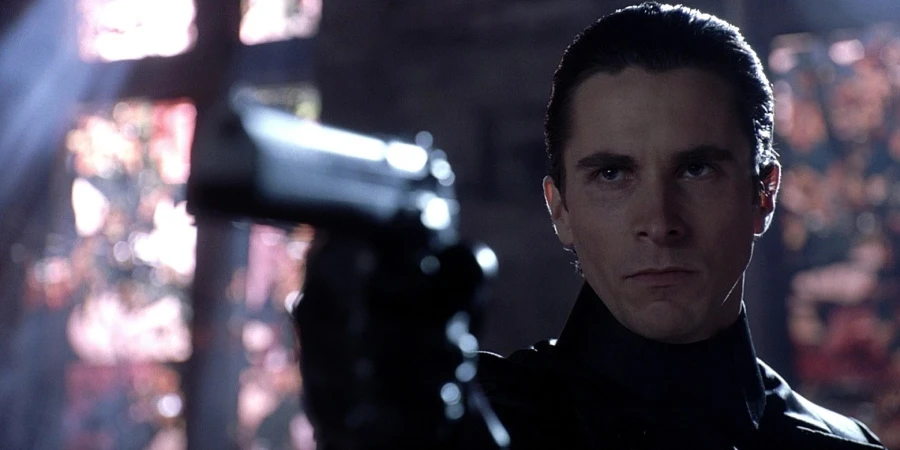

Humanity solved war, poverty, and hatred by simply outlawing feeling. Equilibrium (2002) takes that premise and runs with it at full speed, delivering a dystopian action film that is simultaneously a gun-fu spectacle and a surprisingly sincere meditation on what makes life worth living. Writer-director Kurt Wimmer built a world so oppressively grey that a single beam of sunlight feels like a revolution. This is a film that never got its due, and it absolutely deserves a second look.
Detailed Summary
A World Without Feeling
In the fictional city-state of Libria, a totalitarian government called the Tetragrammaton controls every citizen through a mandatory emotion-suppressing drug called Prozium. Art, music, literature, and any object that might trigger feeling are classified as Sense Offenses and punishable by death. Citizens inject Prozium on a strict schedule, becoming emotionally blank instruments of the state.
Enforcement falls to an elite class of warriors called Grammaton Clerics. These soldiers practice Gun Kata, a fictional martial art that combines firearms with precise, mathematically calculated combat stances. It is visually striking and completely ridiculous in the best possible way.
John Preston and the Cracks in the Facade
John Preston, played by Christian Bale, is Libria’s finest Cleric. He opens the film by raiding an underground resistance hideout and personally executing his own partner, Errol Partridge (played by Sean Bean), after catching him reading poetry. Preston does this without hesitation and without feeling. He is the perfect weapon.
However, everything begins to shift when Preston accidentally breaks his morning dose of Prozium. Rather than report the incident and obtain a replacement, he hesitates. Curiosity, buried beneath years of chemical suppression, starts to surface. Consequently, he stops taking the drug entirely.
The Awakening
Preston begins to feel. Music moves him. Sunlight on his face stops him cold. He secretly keeps a banned vinyl record and listens to Beethoven’s Ninth Symphony, nearly weeping at the sound. For a man who executed his own partner for reading a poem, this is a seismic internal collapse.
Meanwhile, Preston’s new partner, the ambitious Andrew Brandt (played by Taye Diggs), grows suspicious. Brandt is calculating and loyal to the Tetragrammaton, making him a constant threat lurking just at the edge of every scene. Preston must now perform emotional blankness while experiencing everything for the first time.
Mary O’Brien and the Underground
Preston arrests a Sense Offender named Mary O’Brien, played by Emily Watson. She is scheduled for incineration, but something in her open defiance of the system fascinates him. He delays her execution and visits her in holding, and their conversations begin to plant seeds of genuine resistance in him.
Mary speaks plainly about why feeling matters, even when it hurts. She refuses to pretend her emotions are a disease. Ultimately, her courage mirrors the awakening Preston is already experiencing, and she becomes the emotional anchor of his transformation.
Preston also makes contact with the Underground, a resistance movement operating beneath Libria. Its members plan to expose Father, the totalitarian leader whose face broadcasts across every screen in the city. Preston agrees to infiltrate the movement on behalf of the Tetragrammaton while secretly helping the resistance from within.
The Betrayal and the Machinery of Oppression
Preston discovers that the Underground’s plan hinges on obtaining a sample of the emotion-suppressing Prozium and exposing its formula to the world. In addition, they need access to the Vice-Counsel DuPont (played by Angus Macfadyen), who sits directly beneath Father in the Tetragrammaton’s hierarchy.
Mary’s execution eventually proceeds, and Preston cannot stop it in time. Her death hits him like a physical blow, which is entirely the point of the scene. He has now fully crossed the threshold; there is no returning to the blank compliance that defined his former life.
Brandt, meanwhile, has been building a case against Preston. He reports his suspicions to DuPont, setting a trap. Preston, however, outmaneuvers them by revealing to DuPont that Brandt is himself a Sense Offender, using fabricated evidence and psychological manipulation. DuPont executes Brandt on the spot, and Preston gains direct access to the inner sanctum.
Movie Ending
Preston finally reaches the seat of power and demands an audience with Father. DuPont reveals a stunning twist: Father is dead. The broadcasts of Father are recordings. DuPont himself has been running Libria, and he has known all along that Preston stopped taking Prozium. In fact, the entire Underground contact was a test, a trap designed to identify and eliminate resistance members using a sympathetic Cleric as bait.
DuPont confesses something even more surprising: he himself feels emotion. He never took Prozium. He has been ruling a system designed to eliminate feeling while quietly indulging his own. This hypocrisy sits at the rotten core of the Tetragrammaton, and Wimmer makes sure the audience absorbs it fully before the finale erupts.
Preston refuses to be complicit. He engages DuPont and his guards in a brutal, extended Gun Kata sequence inside the inner chambers of power. Preston dispatches wave after wave of Clerics and soldiers, and the fight choreography here is at its most ambitious. Specifically, the final duel between Preston and DuPont is a violent, almost operatic confrontation, with Preston ultimately slashing DuPont across the face and killing him.
Outside, the Underground executes its plan. Resistance fighters destroy the Prozium manufacturing facility, which sends a cascade of explosions across Libria’s skyline. Citizens begin to feel for the first time, overwhelmed and disoriented. The broadcasts of Father flicker out. Preston walks out of the burning building into daylight, and the film ends on that image, quiet and earned, suggesting liberation rather than spelling it out.
What matters about this ending is its emotional logic. Preston did not save the world because he was told to. He saved it because he felt something worth saving. The film argues that consciousness without feeling is not really consciousness at all, and Preston’s arc proves that point through action rather than dialogue.
Are There Post-Credits Scenes?
Equilibrium contains no post-credits scenes. Once the credits roll, the film is done. There is no tease, no sequel setup, and no additional footage. You can safely leave when the credits begin.
Type of Movie
Equilibrium is a dystopian science fiction action film with strong philosophical undertones. Its tone sits at a curious intersection: cold and clinical in its world-building, yet surprisingly earnest in its emotional core. Kurt Wimmer never winks at the camera or treats the premise as campy.
In contrast to many action films of its era, Equilibrium slows down regularly to let its ideas breathe. It is more interested in Preston’s internal journey than in its set pieces, even though those set pieces are genuinely thrilling.
Cast
- Christian Bale – John Preston
- Emily Watson – Mary O’Brien
- Taye Diggs – Andrew Brandt
- Angus Macfadyen – Vice-Counsel DuPont
- Sean Bean – Errol Partridge
- William Fichtner – Jurgen
- Matthew Harbour – Robbie Preston
- Emily Siewert – Lisa Preston
Film Music and Composer
Klaus Badelt composed the score for Equilibrium. Badelt was a frequent collaborator with Hans Zimmer and had worked on projects through Zimmer’s Remote Control Productions. His score here is orchestral, sweeping, and deliberately oppressive in its quieter moments.
Notable tracks accompany Preston’s awakening sequences, pairing emotional swells with his first sensory experiences. The music does a great deal of heavy lifting in scenes where Bale must convey everything through physical reaction alone. Moreover, Beethoven’s Ninth Symphony appears non-score in the film and serves as a pivotal emotional catalyst for Preston’s full awakening.


Filming Locations
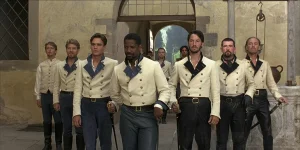
Principal photography took place primarily in Berlin, Germany. The production made extensive use of fascist-era architecture, particularly Tempelhof Airport and various buildings from the Nazi-era construction period. These locations were not chosen arbitrarily.
The angular, monumental scale of that architecture communicates totalitarian authority without a single line of dialogue. Libria feels genuinely oppressive because its buildings were designed by a real totalitarian government. In addition, some interior scenes were shot on purpose-built sets that echoed the cold geometric aesthetic of the exterior locations.
Awards and Nominations
Equilibrium did not receive major awards recognition upon release. It performed modestly at the box office and largely bypassed the awards circuit, finding its audience primarily through home video and later cult following.
Behind the Scenes Insights
- Kurt Wimmer invented Gun Kata specifically for this film, developing it as a fictional martial discipline with its own internal logic and visual grammar.
- Christian Bale trained extensively in the Gun Kata choreography and performed many of the movements himself, contributing to the fluidity of the combat sequences.
- The film was produced on a relatively modest budget, which forced the production to be creative with its set designs and location shooting in Berlin.
- Sean Bean’s character Partridge dies early in the film, continuing a well-documented pattern in Bean’s career of playing characters who do not survive to the third act.
- Wimmer wrote the screenplay himself and directed from that script, giving the film an unusual consistency of vision for a genre action picture.
- The Tetragrammaton name refers to the four-letter Hebrew name for God, a deliberate choice that frames the government as a false religious authority.
Inspirations and References
Equilibrium draws most heavily from George Orwell’s Nineteen Eighty-Four, borrowing its surveillance state, thought-crime framework, and all-powerful figurehead leader. The concept of Sense Offenses mirrors Orwell’s thoughtcrime almost directly. Wimmer has never hidden this debt.
Aldous Huxley’s Brave New World is another clear reference point. Specifically, the use of a mandatory drug to regulate human behavior maps directly onto Huxley’s soma. Both works warn against happiness purchased through the erasure of authentic experience.
Ray Bradbury’s Fahrenheit 451, with its book-burning state and underground preservationists, also echoes throughout the film. Furthermore, the visual and tonal language of Equilibrium owes a debt to the aesthetic of 1984 (1984) and THX 1138 (1971), particularly in its preference for bleached, colorless environments.
Alternate Endings and Deleted Scenes
No officially released alternate endings for Equilibrium are widely documented. Several scenes appear to have been tightened or trimmed in post-production, particularly sequences involving Preston’s children and the domestic life he maintains as cover. However, no substantial deleted scene package has been released publicly.
Some home video releases included minor bonus features, but no dramatically different cuts of the film exist in the public domain. Wimmer’s theatrical version remains the definitive and only widely available version.
Book Adaptations and Differences
Equilibrium is not based on a book. Kurt Wimmer wrote an original screenplay. The film draws inspiration from multiple literary works as noted above, but it is not an adaptation of any single source text.

Memorable Scenes and Quotes
Key Scenes
- Preston executing his partner Partridge in cold blood after catching him reading Yeats, establishing the film’s brutal moral baseline immediately.
- Preston breaking his Prozium dose and pressing his hands against the frosted window as sunlight bleeds through, the first genuine emotional moment for his character.
- Preston listening to Beethoven’s Ninth in the dark and barely holding back tears, a scene Bale performs with extraordinary restraint.
- The puppy scene, in which Preston hides a litter of dogs from Tetragrammaton officers, revealing how far his transformation has progressed.
- The final Gun Kata corridor sequence, where Preston fights his way through the inner chambers of the Tetragrammaton in a sustained, balletic action set piece.
- DuPont’s confession that Father is dead and that he himself feels emotion, recontextualizing the entire power structure of Libria in a single scene.
Iconic Quotes
- “Without the capacity to feel, to experience, our very humanity is a meaningless coincidence.” (Mary O’Brien)
- “It’s not the will to die, it’s the will to live.” (John Preston)
- “You want to know what I say? I say there’s something wrong with a world that doesn’t want this.” (Partridge, reading Yeats before his execution)
- “I pay it gladly.” (Mary O’Brien, on the cost of feeling grief)
Easter Eggs and Hidden Details
- The word Tetragrammaton is the classical term for the four-letter Hebrew name of God, implying the government has positioned itself as a divine authority.
- Preston’s apartment is visually identical to those of other Clerics, emphasizing uniformity, but small details begin to appear as his awakening progresses, notably a slight disarray in his belongings.
- The burning books in the opening raid sequence include visible classics, a nod to Fahrenheit 451 that is easy to miss at full action pace.
- Partridge reads from W.B. Yeats’ poem The Lake Isle of Innisfree before his death, a poem about peace, solitude, and longing, which makes Preston’s act of execution even more brutal in retrospect.
- DuPont’s office is lined with confiscated art objects, suggesting he has been quietly collecting emotional contraband for years before Preston ever begins his own awakening.
- Gun Kata practitioners always position themselves mathematically to avoid enemy fire based on probability calculations, and if you watch closely, Preston’s stances genuinely shift between each combat context.
Trivia
- Equilibrium was shot in roughly 59 days, a tight schedule for a film with this level of action choreography and location work.
- Christian Bale filmed this movie while also preparing for other projects, demonstrating the intense schedule he maintained throughout the early 2000s.
- The film earned a modest theatrical return but became a cult classic through DVD sales and cable broadcasting, particularly popular among action and science fiction enthusiasts.
- Gun Kata has since been referenced, parodied, and imitated in other films and media, giving the fictional martial art a small but genuine cultural afterlife.
- Wimmer later revisited similar thematic territory with Ultraviolet (2006), though that film was received far less favorably than Equilibrium.
- The film’s production design team deliberately avoided primary colors throughout the costume and set design, reinforcing the emotional suppression theme visually.
- Some early promotional materials marketed the film primarily as a martial arts action picture, which undersold its dystopian and philosophical ambitions significantly.
Why Watch?
Equilibrium earns its cult status by committing fully to an idea that lesser films would play for laughs. Christian Bale carries the emotional weight of the entire story on his face, and the Gun Kata sequences remain genuinely inventive more than two decades later. Furthermore, its core argument, that a life without feeling is no life at all, lands with unexpected sincerity. This is lean, focused genre filmmaking at its most earnest.
Director’s Other Movies
- The One (2001) – co-writer
- Ultraviolet (2006)
- Salt (2010) – writer
- Law Abiding Citizen (2009) – writer