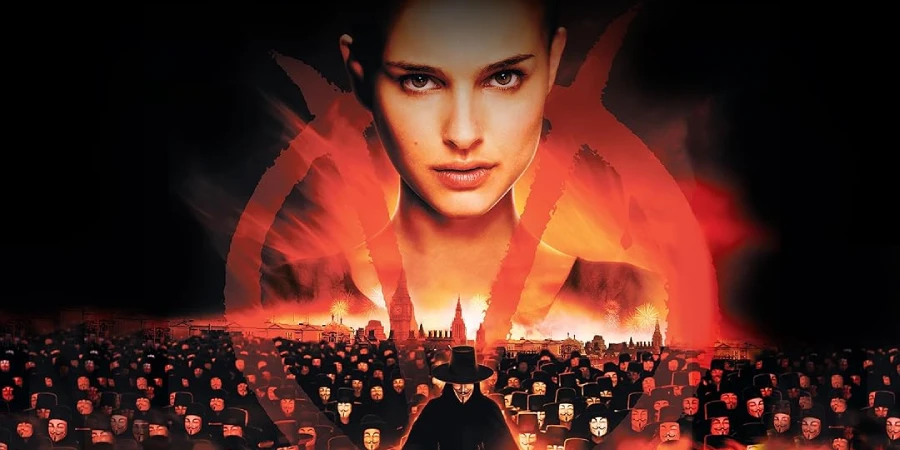

Guy Fawkes tried to blow up Parliament in 1605 and failed spectacularly. V for Vendetta asks what happens when he succeeds, and it wraps that question in a black cape, a Guy Fawkes mask, and one of the most quotable scripts of the 2000s. Natalie Portman shaves her head on camera. Hugo Weaving never once removes his mask. James McTeigue’s 2005 film is a political thriller that arrives with genuine anger behind it, and that anger never lets the audience get too comfortable.
Detailed Summary
A Fascist Britain Sets the Stage
Britain in this near future is ruled by High Chancellor Adam Sutler, played with theatrical fury by John Hurt. A totalitarian party called Norsefire controls every television screen, every curfew, and every citizen’s fear. Gay people, Muslims, and political dissidents have been erased or imprisoned.
Evey Hammond works at the state broadcaster BTN and navigates this world quietly, keeping her head down. She breaks curfew one night and runs straight into trouble with two corrupt secret police officers called Fingermen.
Enter V
A masked man in a long black cape materializes from the shadows and dispatches the Fingermen with knife work that feels almost theatrical, almost choreographed. He calls himself V, speaks in elaborate alliterative speeches, and takes Evey to a rooftop just in time for her to watch the Old Bailey explode in a carefully orchestrated fireworks display set to the “1812 Overture.”
V broadcasts on BTN the following morning, calling on British citizens to meet him at Parliament in exactly one year. The government immediately classifies him as a terrorist. That tension, between V as revolutionary hero and V as murderer, runs through every scene that follows.
Evey’s Complicated Alliance
Evey is not a simple damsel. She keeps secrets about her own past, including parents who were political activists killed by the state. After witnessing V kill Bishop Lilliman, a pedophile who worked with Norsefire, she panics and flees to her friend Gordon Deitrich.
Gordon turns out to have his own hidden life, including forbidden art and a Quran behind a secret panel. He airs a savage satirical broadcast mocking Chancellor Sutler. Norsefire arrests him and then kills him. Evey is captured in the raid.
The Imprisonment That Changes Everything
Evey wakes up in a cell. Interrogators demand she give up V’s location. She refuses. Her head is shaved. She is starved and threatened with execution. During her imprisonment, she reads a smuggled letter from a woman named Valerie Page, a lesbian actress who was imprisoned and killed by Norsefire for who she was.
Valerie’s letter becomes Evey’s anchor. It is easily the most emotionally devastating sequence in the film, and Portman earns every frame of it. When Evey finally declares she would rather die than betray V, the cell door swings open. She was inside V’s home the entire time. He staged the entire imprisonment.
Inspector Finch Closes In
Inspector Eric Finch, played by Stephen Rea, investigates V’s attacks and slowly realizes that the government he serves committed atrocities to seize power. A secret project called Larkhill saw Norsefire experiment on prisoners with a biological pathogen. V was one of those prisoners. He survived, mutated, and burned Larkhill to the ground.
Finch follows the evidence further and discovers that Norsefire actually released the pathogen on its own citizens, blamed a foreign terrorist group, then sold the cure through a connected pharmaceutical company. It is a full false-flag conspiracy, and Finch looks genuinely sick when he realizes it.
V’s List of Revenge
V systematically hunts down everyone who worked at Larkhill and had a hand in the experiments. Lewis Prothero, the government’s chief propagandist, loses his mind when V destroys his beloved doll collection. Bishop Lilliman dies. Dr. Delia Surridge, who conducted the experiments, is killed with a gentle poison but not before she tells Finch she deserves it.
Each killing is staged like a personal reckoning rather than random violence. V gives Surridge a peaceful death because she showed remorse. That distinction matters: V is brutal, but he is not indiscriminate.
Evey Chooses Her Path
After learning the truth about her imprisonment, Evey is furious with V. She leaves. Months pass. She returns on November 4th, the night before V plans to detonate Parliament.
V reveals he has already loaded a train full of explosives beneath the building. He gives Evey the detonator key and tells her the choice is hers. He then goes to face Peter Creedy, the ruthless head of the secret police.
Movie Ending
Creedy has Chancellor Sutler brought to V in a car park, where he promptly shoots Sutler in the head. Creedy wanted power for himself all along, and V was simply the pressure he needed to make his move. Creedy then orders his men to shoot V. They empty their magazines into him.
V does not fall. He absorbs every bullet, staggering but still moving, and then he kills every one of Creedy’s men with his blades before strangling Creedy himself. It is a sequence that is physically absurd and emotionally electric at the same time. When Creedy screams “Why won’t you die?” V answers: “Beneath this mask there is more than flesh. Beneath this mask there is an idea, Mr. Creedy, and ideas are bulletproof.”
V staggers back to his home and dies in Evey’s arms. She removes his mask and looks at his face. We do not see it. She tells him she does not want him to go. He says she cannot be his. Then he is gone.
Evey places V’s body on the train. She stands at the detonator. An enormous crowd has gathered outside Parliament, all wearing Guy Fawkes masks and cloaks. Finch arrives and asks Evey who V was. She tells him V was her father, her mother, her brother, her friend. He was all of us.
She presses the key. The train moves. Parliament explodes in a cascade of fireworks set to the “1812 Overture” again, echoing the Old Bailey detonation from the film’s opening act. People remove their masks in the crowd. Among them, ghost-like, stand Valerie, Gordon, and every person Norsefire destroyed. It is a visual argument that ideas outlive the people who carry them.
Finch watches the explosion and holsters his weapon. He chose not to stop it. That small gesture is one of the film’s sharpest character beats: a man built to enforce order quietly deciding that some orders should not be enforced.
Are There Post-Credits Scenes?
V for Vendetta has no post-credits scene. Once Parliament falls, the film is finished. You can leave when the credits roll.
Type of Movie
V for Vendetta is a political thriller with strong elements of dystopian science fiction and action. Its tone is serious and often bleak, but it balances that weight with moments of dark wit, particularly in V’s baroque speeches and Gordon Deitrich’s satirical broadcast.
It skews closer to drama than to spectacle, despite its action sequences. Audiences expecting a superhero film will find something more uncomfortable and more interesting than that.
Cast
- Hugo Weaving – V
- Natalie Portman – Evey Hammond
- Stephen Rea – Inspector Eric Finch
- John Hurt – High Chancellor Adam Sutler
- Tim Pigott-Smith – Peter Creedy
- Rupert Graves – Inspector Dominic Stone
- Stephen Fry – Gordon Deitrich
- Sinead Cusack – Dr. Delia Surridge
- Roger Allam – Lewis Prothero
- Ben Miles – Dascomb
- Natasha Wightman – Valerie Page
- John Standing – Bishop Lilliman
Film Music and Composer
Dario Marianelli composed the score. His work here is brooding and precise, using orchestral arrangements that support the film’s political gravity without overwhelming its quieter moments. Marianelli later won an Academy Award for his score for Atonement, and his work on V for Vendetta shows the same restraint and architectural thinking.
The film’s most memorable musical choice is actually a licensed piece: Tchaikovsky’s “1812 Overture“ accompanies both the Old Bailey explosion and Parliament’s destruction. Using the same piece twice is deliberate. It creates a structural rhyme that gives the ending its sense of completion rather than chaos.
Marianelli also incorporates a recurring motif tied to Valerie’s letter sequence, which makes the emotional pull of that scene land even harder. Julie London’s “Cry Me a River” appears in one of the film’s more intimate moments, giving V a rare flash of vulnerability inside his elaborate lair.

Filming Locations
Principal photography took place primarily in Germany, specifically at the Babelsberg Studios near Potsdam, which doubled for many interior and street-level London environments. Some scenes were filmed on location in London itself, including exterior shots around Parliament and Trafalgar Square.
Using European studio infrastructure to depict a fascist future Britain carries a quiet irony that director James McTeigue likely appreciated. Babelsberg has its own history with propaganda-era German cinema, and shooting a film about totalitarianism there is a choice with texture behind it.
Parliament’s destruction is achieved through visual effects, since you cannot actually blow up the Palace of Westminster for a movie. The establishing shots of the building, combined with the crowd sequences, give the finale a sense of real civic scale.
Awards and Nominations
V for Vendetta received a Saturn Award nomination for Best Science Fiction Film. Hugo Weaving’s performance attracted attention from genre award circuits, and Dario Marianelli’s score received recognition in the film music community. It was not a major awards-season presence, which honestly tells you more about awards-season taste than about the film.
Behind the Scenes Insights
- Natalie Portman’s head was shaved on camera in a single take, with cast and crew watching. She has spoken about how that moment affected her performance in the scenes that followed.
- Hugo Weaving never appears on screen without the Guy Fawkes mask. Every emotion V conveys comes through voice, posture, and the angle of his body. Weaving described the challenge as a kind of pure physical acting exercise.
- The Wachowskis, who wrote and produced the film, had originally planned to direct it themselves but handed the reins to James McTeigue, their longtime assistant director, marking his feature directorial debut.
- John Hurt, who played the tyrannical Chancellor Sutler, had previously played Winston Smith in the 1984 film adaptation of Nineteen Eighty-Four. Casting him as the oppressor rather than the oppressed is a knowing inversion.
- Portman worked with a dialect coach extensively to maintain a British accent throughout production.
- The film’s release was briefly complicated by its proximity to real-world political sensitivities around terrorism, and some advertising was adjusted in certain markets.
- Roger Allam, who plays propagandist Lewis Prothero, drew on the cadences of real political broadcasters to make the character feel genuinely familiar rather than cartoonishly villainous.
Inspirations and References
V for Vendetta is adapted from the graphic novel of the same name by Alan Moore and David Lloyd, serialized in the 1980s. Moore’s original work was a direct response to Margaret Thatcher’s Britain, drawing on anxieties about authoritarianism, nationalism, and the erosion of civil liberties.
The film updates those anxieties for a post-9/11 context, adding the false-flag bioterrorism plot as a commentary on fear-based governance. George Orwell’s Nineteen Eighty-Four is an obvious touchstone, and the film makes that lineage explicit by casting John Hurt.
Guy Fawkes and the real Gunpowder Plot of 1605 provide the historical spine. Fawkes was a Catholic rebel who attempted to assassinate King James I by blowing up Parliament. V reframes that failed act of destruction as a symbol of resistance rather than mere terrorism.
Alternate Endings and Deleted Scenes
No widely documented alternate ending exists for the theatrical release of V for Vendetta. Some deleted and extended scenes appeared on home release editions, including additional material fleshing out Inspector Finch’s investigation and some character beats for Gordon Deitrich.
Nothing in the deleted material fundamentally changes the story’s direction. The core arc from Evey’s imprisonment to Parliament’s destruction remained stable throughout production.
Book Adaptations and Differences
V for Vendetta is adapted from Alan Moore and David Lloyd’s graphic novel. Alan Moore famously disowned the film and had his name removed from the credits, which is consistent with his stance on all adaptations of his work.
Moore’s original text is set in a more specifically British political context, with Norsefire rooted in 1980s far-right anxieties rather than post-9/11 American ones. The film shifts that framing considerably. In Moore’s version, V is also a more morally ambiguous figure, and Evey’s arc is darker and more disturbing.
The Wachowskis softened certain elements of V’s character to make him more sympathetic. Purists argue this flattens Moore’s more complex portrait of an anarchist who is not necessarily a hero. That critique has genuine merit, though the film’s V is still far thornier than most cinematic protagonists.
David Lloyd’s visual design for the Guy Fawkes mask translates directly to screen and has since become one of the most widely recognized protest symbols in the world.

Memorable Scenes and Quotes
Key Scenes
- The Old Bailey explosion: V and Evey stand on a rooftop as the building detonates in perfect synchronization with the “1812 Overture.” It sets the film’s tone in under three minutes: theatrical, political, and completely committed to its own excess.
- Valerie’s letter: Read in voice-over while Evey sits in her cell, the letter covers Valerie’s life, her love, and her refusal to betray herself even as the state destroyed her. Portman sits almost still while Natasha Wightman’s voice does the heavy lifting. It is the film’s emotional peak, and it earns that position.
- Evey’s head is shaved: Shot without cuts and in close-up, this scene is physically uncomfortable to watch. Portman’s face cycles through fear, grief, and something that looks like release.
- The domino sequence: V arranges thousands of black and red dominoes into a letter V. He tips the first one. The cascade takes a long time to complete. It is a patience-testing, beautiful, completely absurd scene that somehow works as a character study.
- V versus Creedy’s men: Shot in slow motion and close quarters, V absorbs every bullet and keeps advancing. His coat billows. His knives catch the light. It is visually excessive in a way that feels entirely appropriate for a character who is himself excessive.
- Parliament’s destruction: Hundreds of people in Guy Fawkes masks stand in silence as the building detonates and fireworks bloom overhead. Then they remove their masks, and the dead walk among them.
Iconic Quotes
- “Remember, remember the fifth of November, the gunpowder treason and plot.”
- “Beneath this mask there is more than flesh. Beneath this mask there is an idea, Mr. Creedy, and ideas are bulletproof.”
- “People should not be afraid of their governments. Governments should be afraid of their people.”
- “Voila! In view, a humble vaudevillian veteran cast vicariously as both victim and villain by the vicissitudes of fate.” (V’s opening monologue, which Hugo Weaving delivers entirely in one breath.)
- “I know there’s no way I can convince you this is not one of their tricks, but I don’t care. I am me.”
Easter Eggs and Hidden Details
- John Hurt’s casting as Chancellor Sutler directly mirrors his role as Winston Smith in Nineteen Eighty-Four (1984). Putting the same actor on both sides of totalitarianism is a pointed piece of casting geometry.
- V’s shadow against the wall during the Old Bailey scene is framed to look like a bat, a visual nod to the comic book genre the film grows out of.
- The Norsefire logo is designed to evoke a cross combined with elements of fascist iconography from 20th-century European regimes, making its ideological lineage visually legible without labeling it explicitly.
- Valerie’s letter mentions specific dates and places in her life, and attentive viewers can cross-reference some of those details with timeline information mentioned elsewhere in the film.
- V’s lair contains hundreds of rescued artworks, books, and music records that Norsefire banned. Sharp-eyed viewers can spot specific titles and album covers among the collection.
- The BTN broadcast studio set was designed to visually echo real propaganda-era broadcasting aesthetics, with saturated reds and centralized framing that puts the anchor in a position of authority over the viewer.
Trivia
- The Guy Fawkes mask designed by David Lloyd for the original comic has been adopted by real-world protest movements globally, most famously by the hacktivist collective Anonymous.
- Hugo Weaving recorded all of his dialogue separately and it was then synchronized with his on-screen performance, since the rigid mask made lip-reading impossible and required precise audio work in post-production.
- James McTeigue’s feature directorial debut with this film followed years as assistant director on the Matrix trilogy. He knew the Wachowskis’ visual shorthand well before stepping into the director’s chair.
- Natalie Portman prepared for the role partly by reading the original graphic novel and researching political prisoners and resistance movements.
- November 5th, Guy Fawkes Night, is still celebrated in Britain with bonfires and fireworks, which gives the film’s climax a particular resonance for British audiences who grow up with that tradition.
- Alan Moore’s refusal to engage with the film meant that all his profits from the adaptation went to David Lloyd, who chose to remain involved and was more supportive of the project.
- V quotes or references a wide range of cultural works throughout the film, including Shakespeare, Beethoven, and several films from his private collection, functioning as a kind of walking archive of everything Norsefire suppressed.
Why Watch?
Hugo Weaving gives a performance through a rigid plastic mask that most actors could not match with their full face available, and that alone justifies two hours of your time. Weaving tilts his head two degrees and you feel V’s grief. Pair that with Portman’s shaved-skull breakdown scene and you have two of the decade’s more quietly extraordinary acting achievements sitting in the same film.
Director’s Other Movies
- Ninja Assassin (2009)
- The Raven (2012)
- Survivor (2015)