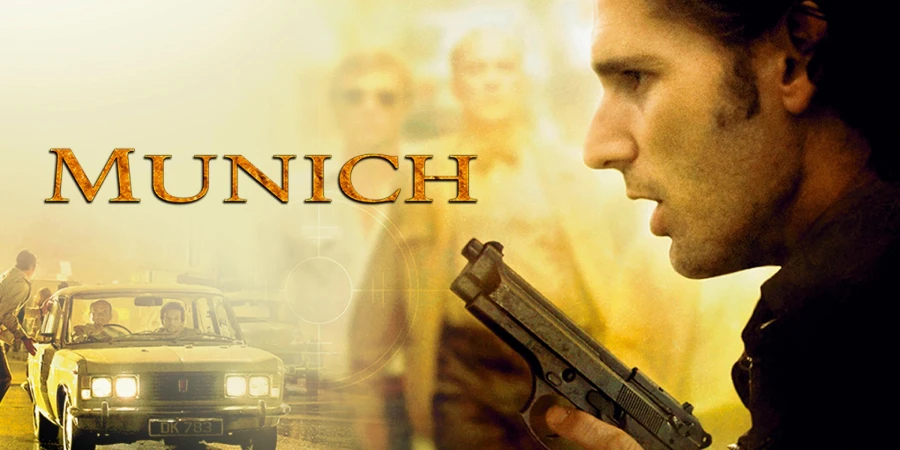

Munich is one of the most morally uncomfortable films Steven Spielberg has ever made, and that is precisely what makes it essential viewing. Based on the real-life Israeli covert operation that followed the 1972 Munich Olympics massacre, the film refuses to offer easy answers or satisfying revenge fantasies. Instead, it asks whether violence in the name of justice slowly destroys the very soul it claims to protect.
Detailed Summary
The 1972 Munich Massacre
The film opens with the actual events of September 5, 1972, when members of the Palestinian militant group Black September infiltrated the Olympic Village in Munich, Germany. They took eleven Israeli Olympic athletes and coaches hostage, demanding the release of Palestinian prisoners held in Israel.
Spielberg reconstructs the siege with brutal precision, cutting between the hostage crisis and television coverage that the world watched in real time. All eleven Israeli hostages died, along with a West German police officer. The massacre shocked the globe and set everything else in motion.
Israel Assembles a Secret Team
Shortly after the massacre, Israeli Prime Minister Golda Meir authorizes a covert assassination program targeting the eleven men believed to be organizers of the Black September attack. This operation is given the name Operation Wrath of God.
Avner Kaufman, a low-level Mossad officer played by Eric Bana, receives the assignment to lead the team. Avner is chosen partly because his father was a celebrated Israeli war hero, giving the mission a layer of symbolic weight. He accepts, even though his wife is pregnant with their first child.
Avner is essentially cut off from official Mossad support. His handler, Ephraim, played by Geoffrey Rush, makes clear that Israel will deny all knowledge of the operation if anything goes wrong. Avner funds the mission through a secret account and operates in the shadows of Europe.
Meeting the Mysterious Source
To gather intelligence, Avner makes contact with a mysterious French information broker named Louis, played by Mathieu Amalric. Louis operates through his father, a shadowy patriarch who runs a private intelligence network that sells information to anyone who pays.
This relationship is central to the film’s moral architecture. Louis’s father, Papa, insists on absolute neutrality; he will sell to governments, revolutionaries, or assassins without distinction. His casual amorality serves as a dark mirror to Avner’s increasingly strained sense of purpose.
The Assassinations Begin
Avner’s team, which includes a document forger, a toymaker-turned-explosives-expert, a getaway driver, and a cleaner, begins working through the list of targets. Their first kill takes place in Rome, where they stab Wael Zwaiter, a Palestinian intellectual and translator. The killing is chaotic and deeply unsettling.
Subsequent assassinations follow across Europe, including Paris and Cyprus. The team plants a bomb in a target’s phone, shoots another man in his hotel room, and carries out each kill with varying degrees of efficiency and horror. Meanwhile, Avner wrestles with the weight of what he is doing.
Not all hits go smoothly. In one tense sequence, the team discovers that a target shares a hotel floor with innocent bystanders, forcing difficult last-minute decisions. The film consistently refuses to let the audience settle into the comfort of clean, consequence-free violence.
The Hotel Room Encounter
One of the film’s most striking sequences occurs when Avner’s team and a unit of PLO operatives unknowingly book rooms in the same hotel. They share space, exchange conversation, and almost form a human connection before realizing who the others are.
Avner even engages in a quiet, late-night debate with a PLO member about homeland, belonging, and sacrifice. This moment crystallizes the film’s central tension: the enemy is not a monster but a human being with his own grief and conviction. Spielberg refuses to let that fact be forgotten.
The Team Begins to Unravel
As the operation continues, the psychological toll escalates. One team member, Robert, played by Mathieu Kassovitz, becomes increasingly disturbed by the killing and questions the moral legitimacy of the mission. His crisis functions as the conscience of the group made visible.
Furthermore, counter-operations begin targeting Avner’s team. Associates and informants turn up dead. The sense of being hunted grows. Avner starts to question whether the targets on his list were actually responsible for Munich, or whether some were simply political inconveniences dressed up as justice.
Targets Who Fight Back
In Beirut, Israeli commandos carry out a separate, large-scale raid on PLO leadership, which Avner’s team assists with. This sequence shows the broader machinery of Israeli retaliation operating alongside Avner’s small, deniable cell. It also signals that the lines between sanctioned military action and covert assassination have blurred completely.
Back in Europe, one of Avner’s teammates is killed by a Dutch assassin working for unknown clients. Another team member is blown up by a booby-trapped phone, a method the team itself has used on others. Consequently, paranoia consumes the group.
The Lillehammer Affair
The film references the real Lillehammer affair, in which Israeli agents mistakenly killed an innocent Moroccan waiter named Ahmed Bouchiki in Norway, having wrongly identified him as a target. In the film, this catastrophic error deepens Avner’s crisis of conscience and shakes his faith in the intelligence they have been given.
Several Israeli agents involved in that operation were arrested by Norwegian authorities, representing one of the operation’s most embarrassing public failures. Avner absorbs this as further evidence that the mission is fracturing from within.

Movie Ending
Avner ultimately abandons the operation and relocates with his family to Brooklyn, New York. He is a broken man, haunted by the faces of everyone he has killed. His body survives; his certainty does not.
Ephraim flies to New York to meet him. He tries to persuade Avner to return to Israel, appealing to duty, to family legacy, to national purpose. Avner refuses. He invites Ephraim to share a meal at his home, a gesture of human warmth toward a man who represents the cold machinery of state. Ephraim declines and walks away.
In the film’s most haunting visual choice, the final shot pulls back to reveal the Twin Towers of the World Trade Center standing on the Manhattan skyline. This is not incidental framing. Spielberg deliberately plants us in New York in the mid-1970s with those towers in the background, drawing a quiet but devastating line between the cycles of political violence depicted in the film and the attacks of September 11, 2001.
The ending offers no resolution and no triumph. Avner got his revenge, completed his list, and lost himself in the process. The film asks whether the operation made Israel safer, and the Twin Towers in that final frame whisper the answer: the cycle did not end. Violence answered with violence simply created new grievances, new cells, and new catastrophes.
Moreover, the film intercuts Avner’s climactic moment of intimacy with his wife with flashback images of the Munich massacre itself. This jarring editorial decision suggests that the violence has permanently colonized his psyche, infecting even the most private and tender moments of his life. He cannot escape it. He may never escape it.
Are There Post-Credits Scenes?
Munich contains no post-credits scenes. Spielberg closes the film with the Twin Towers shot and lets it sit in total silence. No additional footage follows the credits. The silence is entirely intentional.
Type of Movie
Munich sits at the intersection of political thriller, historical drama, and moral meditation. It operates with the pacing of a spy film and the weight of a philosophical essay. The tone is relentlessly serious, cold in its procedural detail but deeply empathetic toward its characters.
In contrast to many spy thrillers, there is no glamour here. Spielberg strips away the fantasy of the genre and replaces it with exhaustion, doubt, and grief. Audiences expecting action-movie catharsis will find something far more demanding and far more rewarding.
Cast
- Eric Bana – Avner Kaufman
- Daniel Craig – Steve
- Geoffrey Rush – Ephraim
- Ciaran Hinds – Carl
- Mathieu Kassovitz – Robert
- Hanns Zischler – Hans
- Ayelet Zurer – Daphna
- Michael Lonsdale – Papa
- Mathieu Amalric – Louis
- Lynn Cohen – Golda Meir
Film Music and Composer
John Williams composed the score for Munich, continuing his long creative partnership with Spielberg. Williams brought a restrained, mournful quality to the music, avoiding the sweeping heroic cues audiences might associate with other Spielberg-Williams collaborations.
Notable elements include lullaby-like themes that carry a sense of irretrievable loss, and tense, percussion-driven passages during the assassination sequences. The score earned Williams an Academy Award nomination. His work here ranks among his more understated and emotionally complex achievements.


Filming Locations
Principal photography took place across multiple European countries to recreate the atmosphere of 1970s Europe. Malta stood in for several key locations, including sequences meant to represent Beirut. The production also filmed in France, Hungary, and New York City.
Shooting in actual European cities grounded the film’s sense of geography. The narrow streets, old apartment buildings, and European train stations gave the assassinations a realistic texture that studio sets could not replicate. These locations matter because the film lives or dies on authenticity.
Notably, some scenes depicting Munich itself were shot in Malta, as access to the original Olympic Village site in Germany presented logistical and political complications. The production team worked hard to recreate the 1972 setting with period-accurate detail.
Awards and Nominations
Munich received five Academy Award nominations, including Best Picture and Best Director for Spielberg. Additionally, the film earned nominations for Best Film Editing, Best Original Score, and Best Adapted Screenplay.
The film did not win in any of those categories at the Oscars. However, it received recognition from various critics’ associations and guild organizations throughout the awards season, solidifying its reputation as one of Spielberg’s most ambitious works.
Behind the Scenes Insights
- Spielberg kept the production moving at an unusually fast pace, reportedly completing the film in under a year from script to release, which was remarkable given the scope of the production.
- Tony Kushner and Eric Roth wrote the screenplay, with Kushner bringing a strong political and theatrical sensibility to the material.
- Eric Bana has spoken about the physical and emotional demands of the role, particularly the challenge of conveying Avner’s psychological deterioration through subtle performance rather than dramatic outbursts.
- Spielberg has described Munich as one of the most personal and difficult films of his career, partly because of the subject matter’s deep resonance with his own Jewish identity.
- Daniel Craig shot his role in the film shortly before being cast as James Bond, and Munich was frequently cited as evidence that he could handle complex, serious material in that role.
- The film’s production design team conducted exhaustive research into 1970s European aesthetics, sourcing period-correct cars, clothing, telephones, and hotel furnishings to maintain historical accuracy.
Inspirations and References
The film draws primarily from Vengeance: The True Story of an Israeli Counter-Terrorist Team, a book written by George Jonas and published in 1984. Jonas based the book on extensive interviews with a man identified as Yuval Aviv, who claimed to be the real-life model for Avner.
However, the accuracy of Jonas’s source has been disputed, and the Israeli government has consistently denied the specific details of the account. Spielberg and Kushner acknowledged these disputes and framed the film as “a prayer for peace” rather than a strict historical document.
In addition, the screenplay draws on One Day in September, a 1999 documentary by Kevin Macdonald that examined the Munich massacre itself with extensive archival footage and survivor interviews. That documentary provided important historical context for the film’s opening sequences.
Alternate Endings and Deleted Scenes
No officially released alternate ending exists for Munich. Spielberg has not publicly discussed significant structural alternatives to the film’s conclusion. The Twin Towers ending appears to have been part of the film’s design from an early stage.
Some reports have noted that the theatrical cut was itself quite long at approximately 164 minutes, and that earlier cuts ran longer. Specific deleted scenes have not been officially confirmed or released in detail, so making precise claims about cut material would go beyond what the available record supports.
Book Adaptations and Differences
As noted above, the film adapts Vengeance by George Jonas. The book presents Avner’s account in a more straightforwardly heroic light, with less of the existential ambiguity Spielberg and Kushner introduced. The filmmakers deliberately complicated the moral landscape that Jonas’s narrative presented as relatively clear-cut.
For instance, the film gives significantly more interiority and weight to the targets, presenting several of them as complex human beings rather than simply enemies to be neutralized. This shift is perhaps the single most important creative departure from the source material, and it defines the film’s entire emotional register.

Memorable Scenes and Quotes
Key Scenes
- The opening recreation of the Munich hostage crisis, intercut with television broadcasts, establishing the film’s documentary-like immediacy.
- Avner’s first assassination in Rome, where the team’s inexperience turns a clinical operation into a messy, humanizing horror.
- The hotel hallway standoff between Avner’s team and PLO operatives, where shared humanity briefly cuts through ideological division.
- The late-night debate between Avner and the Palestinian operative about belonging, homeland, and the cost of fighting for a place to call home.
- The intercutting of Avner’s intimate moment with his wife and the massacre flashbacks, one of the most formally daring sequences in Spielberg’s filmography.
- Ephraim’s refusal to accept Avner’s dinner invitation in Brooklyn, a quiet scene of enormous emotional weight.
Iconic Quotes
- “Every civilization finds it necessary to negotiate compromises with its own values.” – Golda Meir
- “We are supposed to be righteous. That’s a beautiful thing. And we’re losing it.” – Avner
- “There is no peace at the end of this. You know that.” – Papa
Easter Eggs and Hidden Details
- The deliberate placement of the World Trade Center towers in the final shot is Spielberg’s most prominent visual commentary, linking the 1970s cycle of political violence to post-9/11 anxieties without stating anything explicitly.
- Several of the television broadcasts recreated in the film use footage that closely mirrors the actual ABC News coverage from 1972, with period-accurate graphic styles and anchor framing.
- The recurring motif of food preparation, particularly Avner cooking elaborate meals for his team, functions as a symbol of his attempt to preserve normalcy and domesticity against the corrosive work of killing.
- Avner’s insistence on paying for everything from the secret fund with strict receipts mirrors real-world intelligence tradecraft and subtly reinforces the film’s theme that even violence operates within bureaucratic systems.
- The hotel where Avner’s team and PLO operatives share space appears deliberately anonymous, suggesting that violence does not belong to any specific geography; it follows people everywhere.
Trivia
- Spielberg reportedly greenlit the project quickly after reading Tony Kushner’s script, and the entire production, from green light to theatrical release, happened within roughly a year.
- Eric Bana is Australian, and his preparation for the role included extensive work on both an Israeli accent and a physical transformation to convey Avner’s slow deterioration.
- The film was released in December 2005, strategically timed for awards season consideration.
- Daniel Craig appears in a supporting role as Steve, the team’s South African-born driver and enforcer, a role he played with quiet menace that helped confirm his action credentials ahead of Casino Royale.
- Spielberg chose not to include a dedication at the start of the film, allowing the opening massacre footage to speak for itself without framing commentary.
- The production secured cooperation from some European governments for location shooting but encountered sensitivities around depicting certain historical events, requiring creative rerouting of some sequences.
- John Williams completed the score under significant time pressure, given the film’s accelerated production and release schedule.
Why Watch?
Munich is the rare political thriller that challenges you as much as it grips you, forcing a genuine reckoning with the cost of revenge, the corruption of certainty, and the human face of political conflict. Spielberg operates at the peak of his craft here, and the ensemble cast delivers uniformly exceptional work. Few films about political violence are this honest, this uncomfortable, or this necessary.
Director’s Other Movies
- Duel (1971)
- Jaws (1975)
- Close Encounters of the Third Kind (1977)
- Raiders of the Lost Ark (1981)
- E.T. the Extra-Terrestrial (1982)
- The Color Purple (1985)
- Empire of the Sun (1987)
- Schindler’s List (1993)
- Amistad (1997)
- Saving Private Ryan (1998)
- A.I. Artificial Intelligence (2001)
- Minority Report (2002)
- Catch Me If You Can (2002)
- The Terminal (2004)
- Lincoln (2012)
- Bridge of Spies (2015)
- The Post (2017)
- Ready Player One (2018)
- West Side Story (2021)
- The Fabelmans (2022)
Recommended Films for Fans
- Black Sunday (1977)
- One Day in September (1999)
- The Battle of Algiers (1966)
- Syriana (2005)
- Zero Dark Thirty (2012)
- Three Days of the Condor (1975)
- The Debt (2010)
- Tinker Tailor Soldier Spy (2011)
- Carlos (2010)
- Bridge of Spies (2015)