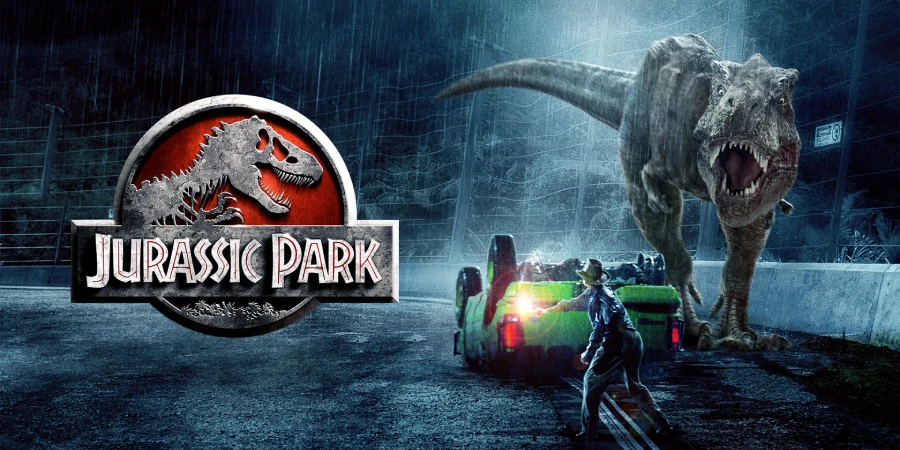

Steven Spielberg put a living, breathing Brachiosaurus on screen in 1993, and audiences forgot they were watching puppets and pixels. That single moment, Grant’s jaw dropping, the swelling John Williams score, the creature eating from a treetop as if it had always existed, rewired what cinema could promise. Thirty-plus years later, the film still delivers its gut-punch on schedule, because the craft underneath the spectacle is genuinely rigorous.
Detailed Summary
The Amber Mine and the Opening Kill
Before we see a single dinosaur clearly, Spielberg reminds us they are dangerous. A velociraptor is being transferred into its paddock at night. It lunges. It kills a worker. Robert Muldoon, the park’s game warden, watches helplessly as the animal drags the man into the dark.
This cold open does something smart: it refuses to let wonder arrive before dread. We hear the raptor before we see it, and we never really see it clearly at all.
The Endorsement Tour Begins
Dr. Alan Grant and Dr. Ellie Sattler are digging for fossils in Montana when a helicopter arrives. John Hammond, the billionaire behind a mysterious park on Isla Nublar, wants their professional endorsement. He offers to fund their dig in exchange for a weekend visit.
Grant reluctantly agrees. He is immediately established as someone who finds children more unsettling than ancient predators, which the film will exploit to great effect later.
Arrival at Isla Nublar
Grant, Sattler, chaos theorist Dr. Ian Malcolm, and lawyer Donald Gennaro fly to the island by helicopter. Spielberg holds back the reveal until the jeeps roll through open grassland and a Brachiosaurus lifts its neck into the frame.
Grant climbs out of the jeep without thinking. His face crumbles. Sattler sits beside him, looks away at a flower, then turns and sees the same thing. Two scientists confronting the impossible, and neither of them says much. They do not need to.
The Visitors Center and the DNA Video
Hammond gives the group a tour of the visitors center, including a cheerful animated video explaining how the park extracted dinosaur DNA from mosquitoes preserved in amber, then filled genetic gaps with frog DNA.
Malcolm immediately starts poking holes in the science, delivering his famous lecture about how the scientists were so preoccupied with whether they could that they never stopped to think whether they should. It is the film’s thesis statement, delivered while eating a meal, which is exactly the right register.
The Raptor Paddock and Hammond’s Hubris
Muldoon takes the visitors to the raptor paddock. The animals are not visible, but their intelligence is terrifyingly apparent as they test the fence, looking for weaknesses. Muldoon explains that Hammond had three of the original eight raptors killed. The lead raptor learned how to open the door to the pen in a previous escape.
Hammond brushes this off. His confidence is not stupidity; it is something more interesting. He genuinely believes he has built something wonderful, and that belief makes him blind.
Dennis Nedry’s Betrayal
Dennis Nedry, the park’s lead programmer, has secretly made a deal with a rival biotech company. He plans to steal fifteen frozen embryos and deliver them to a boat waiting at a dock. To cover his escape, he plants a virus called “White Rabbit” that shuts down most of the park’s security systems, including the electric fences.
Nedry’s motivation is mundane: Hammond underpaid him and refused to cover cost overruns. The film frames him as a villain but does not make him cartoonish. He is just a greedy, underpaid tech worker making a catastrophically bad decision.
The T. Rex Paddock Breakdown
During the initial tour, the park’s vehicles stall in the T. rex paddock when the power goes out. The goat placed as bait disappears with a thud. Rain pours down. A cup of water on the dashboard begins to ripple in perfect concentric circles.
Grant hears something. Malcolm hears something. Then the fence post beside the vehicle buckles, and the Tyrannosaurus rex steps through. What follows is one of the best action sequences Spielberg ever staged: a relentless, logical escalation from awe to pure survival panic.
Gennaro abandons the children and hides in a bathroom. Malcolm distracts the rex with a flare. Grant pulls Tim and Lex Murphy, Hammond’s grandchildren, from the dangling car before it falls into a tree. Gennaro gets eaten on his toilet, which is both hilarious and entirely deserved.
Nedry’s Death and the Failed Escape
Nedry’s jeep slides off a muddy road during the storm. He tries to winch it free, encounters a Dilophosaurus, and attempts to charm it. The dinosaur tilts its head, fans out a colorful frill, and spits venom directly into his eyes.
He staggers back to his jeep. Inside, he reaches for the can containing the stolen embryos. He cannot see. He does not make it. The embryos melt in the tropical heat, his bargaining chip worthless, the plan ending not with drama but with grotesque futility.
Survival in the Park
Grant, Tim, and Lex spend the night in the trees, watching a Brachiosaurus feed at eye level. It is one of the film’s most quietly beautiful moments. Grant, the man who does not like children, is already protecting these two with everything he has.
Back at the visitor center, Sattler and Hammond learn the full scale of the crisis. Sattler volunteers to help Muldoon restore power from an auxiliary generator shed. She runs through the jungle while Muldoon watches for raptors. A raptor catches Muldoon mid-sentence, and he delivers the grimly funny line, “Clever girl,” before vanishing into the brush.
Restoring Power and the Kitchen Scene
Sattler restores partial power. Grant’s group reaches the visitor center. While the adults try to reboot the park’s systems, Tim and Lex shelter in the commercial kitchen, and two raptors hunt them through the stainless steel corridors.
Lex slides across the floor. A raptor’s claw taps on a reflective surface, mistaking its own reflection for prey. Tim lures a raptor into a freezer. It is an extraordinarily well-constructed sequence, all tight angles and industrial noise, building from near-miss to near-miss without a single false step.
Lex Hacks the System
Lex, a self-described computer nerd, recognizes the park’s file system as a Unix-based 3D interface. She sits down at the terminal and navigates it while a raptor presses against the door behind her. Grant holds the door. Lex locks the system back down with thirty seconds to spare.
The scene is borderline absurd as computer science. As a dramatic device, though, it works perfectly because Spielberg has spent the entire film seeding Lex’s competence so the payoff feels earned rather than convenient.
Movie Ending
With the locks restored, Hammond calls the mainland for rescue helicopters. Grant and Sattler barricade themselves in the control room while two raptors claw at the door. Lex has locked the system, but there is a second raptor breaking through the ceiling tiles above them.
It drops into the room. The other two break through the door. Grant, Sattler, and the children are seconds away from being killed. Then, from nowhere, the Tyrannosaurus rex crashes through the visitor center wall and seizes the closest raptor mid-lunge.
This has divided viewers ever since. How did the T. rex get inside without being heard? Spielberg does not explain it, and honestly, the choice is correct. This is not a film built on tight internal logic; it is built on primal emotional rhythms. The apex predator arriving to eradicate the creatures that had been outwitting everyone for an hour feels mythic rather than accidental.
Grant drops the second raptor off a balcony. The third gets taken by the T. rex as it bursts through the When Dinosaurs Ruled the Earth banner. Outside, Hammond and Malcolm are already in a jeep. The group sprints out and drives to the helicopter landing pad.
On the helicopter, Grant has Tim and Lex asleep against him, one on each side. Hammond asks whether he will endorse the park now. Grant’s silence is the only answer Hammond gets. Outside the window, pelicans glide over the ocean, and Grant watches them with the eyes of a man who has permanently changed his mind about what it means to bring something extinct back to life.
What the ending actually says, underneath the rescue and the relief, is that Hammond lost. Not to chaos theory or to Malcolm’s warnings, but to his own creation. Everything he built is unsalvageable. The grandchildren he brought in to charm endorsers nearly died because of him. And the film does not punish him with death; it punishes him with having to live with it, which feels right.
Are There Post-Credits Scenes?
No. Jurassic Park has no post-credits scene of any kind. When the credits roll, the film is finished. There is nothing to wait for.
Type of Movie
Jurassic Park is a science fiction thriller with strong elements of adventure and horror. Its tone shifts deliberately and skillfully: the first act plays like a wonder-filled science documentary, the second act tips into survival horror, and the third act becomes a straight action-chase film.
Spielberg threads family-friendly energy through the whole thing without defanging the genuine terror. Children watching it are not being protected from the scary parts; they are being trusted to handle them.
Cast
- Sam Neill – Dr. Alan Grant
- Laura Dern – Dr. Ellie Sattler
- Jeff Goldblum – Dr. Ian Malcolm
- Richard Attenborough – John Hammond
- Joseph Mazzello – Tim Murphy
- Ariana Richards – Lex Murphy
- Wayne Knight – Dennis Nedry
- Bob Peck – Robert Muldoon
- Samuel L. Jackson – Ray Arnold
- BD Wong – Dr. Henry Wu
- Martin Ferrero – Donald Gennaro
Film Music and Composer
John Williams composed the score, and it ranks among the best work of his career. The main theme opens with solo French horn calls before building into a full orchestral statement that is celebratory without being saccharine.
Williams understood that this film needed music for two emotional extremes simultaneously: the joy of discovery and the terror of consequence. He did not write a monster-movie score. He wrote a score about wonder with a shadow underneath it.
Notable tracks include the main “Jurassic Park Theme”, “Journey to the Island”, and the tense, percussive cues during the T. rex attack sequence. The raptor hunting scenes use sparse, rhythmic strings that stay just below the line of outright panic, which makes them more unsettling than a loud score would.
Filming Locations
Principal photography took place in Hawaii, primarily on the island of Kauai. The lush, tropical valley landscapes gave the film its sense of an ancient, untouched world, a place where evolution might have taken a different path.
Interior scenes and additional work took place on soundstages in California. The visitor center sequences, including the kitchen raptor chase, were built sets rather than location shoots, which gave Spielberg and his crew precise control over lighting and camera placement.
Kauai’s particular geography, deep green valleys, dramatic ridgelines, near-constant mist, did most of the film’s heavy lifting in establishing the island as somewhere genuinely prehistoric. No set decorator could have manufactured that.
Awards and Nominations
Jurassic Park won three Academy Awards: Best Sound, Best Sound Editing, and Best Visual Effects. All three were entirely deserved, and the visual effects win is one of the least controversial in Oscar history.
The film also won a BAFTA for Best Special Visual Effects and received numerous technical nominations across major ceremonies. Its legacy in the effects category is that it essentially made the previous generation of practical creature-feature filmmaking obsolete overnight.
Behind the Scenes Insights
- Spielberg originally planned to create the dinosaurs entirely through go-motion animation, an updated version of stop-motion. Early tests from Phil Tippett‘s team were impressive but felt mechanical. When Industrial Light and Magic showed CGI test footage of stampeding dinosaurs, Spielberg switched course.
- Practical animatronic dinosaurs, built by Stan Winston‘s studio, were used extensively for close-up work. The full-scale T. rex puppet weighed several tons and was hydraulically operated. It occasionally malfunctioned on set, soaking crew members and frightening cast in equal measure.
- Sam Neill reportedly genuinely disliked children before making the film. Spielberg found this amusing and useful, believing Neill’s awkwardness with his young co-stars in early scenes would read authentically on camera.
- Laura Dern ran the gauntlet of the raptor-pursuit sequence through the generator shed in genuinely difficult conditions, including rain and slippery terrain. Most of what looks like fear is real physical exertion.
- A hurricane hit Kauai during production, causing significant damage. The crew sheltered in the hotel and, according to accounts, Spielberg used the downtime to read the screenplay for Schindler’s List, which he would direct immediately after.
- Jeff Goldblum’s delivery of Malcolm’s dialogue was largely his own interpretation. His habit of pausing mid-thought, trailing off, and picking up a new thread was not scripted with such specificity.
- The cup-of-water ripple effect was created by a guitar string attached underneath the dashboard. Someone plucked it rhythmically. The simplicity of the solution became one of the film’s most discussed practical tricks.
Inspirations and References
The film is directly adapted from Michael Crichton’s 1990 novel of the same name. Crichton also co-wrote the screenplay alongside David Koepp, which gave the adaptation unusual fidelity to the source material’s scientific framing, even as it softened some of the novel’s grimmer elements.
Crichton’s novel drew heavily on chaos theory, specifically the work associated with Edward Lorenz and concepts like sensitive dependence on initial conditions. Malcolm’s lectures in both the book and the film are built on this foundation.
Spielberg cited his own childhood fascination with dinosaurs as a personal driver. The film also owes a visible debt to the tradition of creature-feature filmmaking stretching back through King Kong (1933), though it consciously updates and complicates that tradition’s relationship with spectacle and consequence.
Alternate Endings and Deleted Scenes
Several scenes from Crichton’s novel did not make the final cut. A sequence involving Pteranodons in an aviary was written and partially developed but removed from the 1993 film; it eventually appeared in Jurassic Park III (2001).
The novel includes a significantly darker ending in which the Costa Rican government firebombs the island to contain any possible dinosaur spread. Spielberg and Koepp deliberately chose a more hopeful, ambiguous conclusion that kept the door open for sequels without requiring a complete reset.
A subplot involving Grant finding dinosaur nests in the wild, evidence that the frog-DNA-based animals have begun breeding despite all being engineered as female, was condensed from its fuller treatment in the novel to a brief visual beat in the film.
Book Adaptations and Differences
Crichton’s novel is considerably darker and more violent than the film. Several characters who survive on screen, including Hammond, die in the book. Hammond is not a sympathetic dreamer in the novel; he is arrogant and largely unsympathetic, and the book kills him via a pack of Procompsognathus in a moment of unglamorous irony.
Malcolm also dies in the novel, though Crichton later retconned this by reviving him for the sequel, The Lost World (1997). The film simply keeps him injured and alive from the start.
Lex’s character is significantly reworked. In the novel, she is the younger sibling and a baseball fan, while Tim is the computer expert. The film swaps their skills and ages, making Lex the hacker and Tim the dinosaur-obsessed younger child.
The novel also contains far more extended scientific exposition through Malcolm’s chaos theory lectures. Koepp’s screenplay wisely distills these into a few pointed exchanges rather than trying to dramatize pages of theoretical mathematics.
Memorable Scenes and Quotes
Key Scenes
- The first dinosaur reveal: Grant and Sattler stand in the open field, Grant’s hat tumbling from his hand, as a living Brachiosaurus fills the frame. Williams’s theme swells. Spielberg holds on their faces, then on the valley full of animals, then back to Grant’s face again. No dialogue. No explanation needed.
- The water cup ripple: A plastic cup on a car dashboard. Two small rings of water pulsing outward with each distant footfall. Twenty frames of screen time that do more suspense work than most films manage in an entire act.
- The T. rex attack in the rain: Grant pressing Tim and Lex against the car as the rex sniffs them through the sunroof. Goldblum limping through rain with a flare. The vehicle tumbling over the paddock wall into a tree below. Relentless, precise, magnificent.
- “Clever girl”: Muldoon crouching in the brush, watching one raptor distract him, realizing too late there is another flanking him. Bob Peck plays the moment with complete stillness, which makes it devastating.
- The kitchen raptor hunt: Stainless steel reflections, scrabbling claws on tiles, the raptor studying its own reflection, Tim slamming the freezer door. The whole sequence runs on silence and geometry.
- The T. rex finale: A raptor leaping at Grant, then the T. rex jaw closing around it mid-air, the When Dinosaurs Ruled the Earth banner falling through the chaos. Ridiculous and thrilling in equal parts.
Iconic Quotes
- “Life finds a way.” — Dr. Ian Malcolm
- “Your scientists were so preoccupied with whether or not they could, they didn’t stop to think if they should.” — Dr. Ian Malcolm
- “Clever girl.” — Robert Muldoon
- “Hold on to your butts.” — Ray Arnold
- “Welcome to Jurassic Park.” — John Hammond
- “When the pirates are disarmed, when Jurassic Park has been closed down, then we can all go home.” — Dr. Malcolm (paraphrased from dialogue)
Easter Eggs and Hidden Details
- The skeleton in the visitor center lobby is positioned so that it appears to be lunging at the camera in the same direction the T. rex lunges during the climax, a visual rhyme that only registers consciously on repeat viewings.
- The Jeep license plates on the park vehicles read JP-04 and similar sequential numbers, suggesting the island had far more vehicles than we see, hinting at a larger operation behind the scenes.
- During the raptor kitchen sequence, the claw sound on the floor was achieved partly by Spielberg dragging a fork across a metal mixing bowl on set. A practical solution that ended up being more unnerving than any sound design library option.
- The Dilophosaurus frill and venom-spitting behavior depicted in the film are not supported by the fossil record. Crichton and Spielberg invented both traits for dramatic effect. The animal was likely much larger than the film portrays.
- Nedry’s computer screen, when he activates the White Rabbit virus, briefly displays a cartoon animation. This was a real program called Barney, created by Silicon Graphics, and its inclusion was not a planted Easter egg but a genuine artifact of period technology.
- Samuel L. Jackson’s character, Ray Arnold, loses his arm to a raptor off-screen. Sattler finds it in the generator room. Jackson had no idea until he read the relevant script page.
Trivia
- Spielberg acquired the rights to Crichton’s novel before it was even published, reportedly after reading an early manuscript.
- The film’s mix of CGI and practical animatronics was carefully managed so that CGI dinosaurs appear mostly in long shots and daylight, while the Stan Winston animatronics handle close-up detail work. The two techniques complement rather than replace each other.
- Phil Tippett, whose go-motion work was being replaced by CGI, was given the title of “Dinosaur Supervisor” on the film. He worked with the ILM team to ensure the digital creatures moved with biological plausibility rather than computer precision.
- The T. rex roar in the film is a composite of multiple animal sounds, including elephant, alligator, and tiger vocalizations, layered and pitch-shifted by sound designer Gary Rydstrom.
- Richard Attenborough had not acted in a feature film for over a decade before taking the role of Hammond. Spielberg personally sought him out.
- The film grossed over 900 million dollars at the worldwide box office during its original theatrical run, making it the highest-grossing film in history at the time of its release, a record it held until The Lion King (1994) briefly approached it.
- Bob Peck, who played Muldoon, died in 1999. His performance in this film remains his most widely seen work.
- The production used over fifty crew members just to operate and maintain the full-scale T. rex animatronic during filming.
Why Watch?
Watch it for the T. rex paddock sequence, specifically the moment a cup of water on a dashboard tells you more about approaching danger than any jump scare ever could. Spielberg’s control of information, what he shows, what he withholds, and for exactly how long, is on ruthless display in that scene. No film in the franchise that followed has come close to replicating it.
Director’s Other Movies
- Duel (1971)
- Jaws (1975)
- Close Encounters of the Third Kind (1977)
- Raiders of the Lost Ark (1981)
- E.T. the Extra-Terrestrial (1982)
- The Color Purple (1985)
- Empire of the Sun (1987)
- Schindler’s List (1993)
- Amistad (1997)
- Saving Private Ryan (1998)
- A.I. Artificial Intelligence (2001)
- Minority Report (2002)
- Catch Me If You Can (2002)
- Munich (2005)
- Lincoln (2012)
- Bridge of Spies (2015)
- Ready Player One (2018)
- West Side Story (2021)
- The Fabelmans (2022)