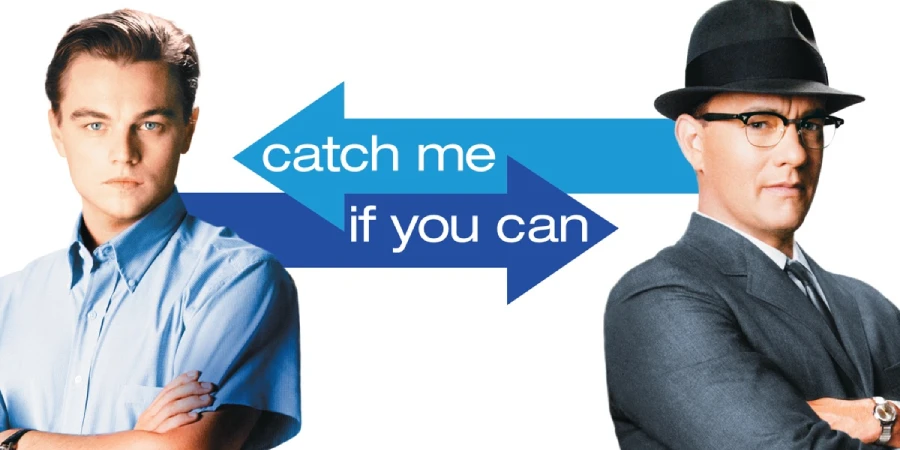

Frank Abagnale Jr. conned his way across America before he turned 21, and Steven Spielberg shoots the whole thing like it is the best party you were never invited to. DiCaprio plays Frank with a grin so wide and a spine so hollow that you root for him even as he ruins lives. This film does something genuinely uncomfortable: it makes fraud look like freedom, right up until the moment it does not.
Detailed Summary
A Family Falling Apart
The film opens in the early 1960s with Frank Abagnale Sr., played with wistful charm by Christopher Walken, a small-time schemer who loves his family and his country club membership in equal measure. Frank Jr. idolizes his father completely. When the IRS begins squeezing the family finances and his parents’ marriage crumbles, teenage Frank Jr. cannot process it.
Frank runs away from home rather than choose which parent to live with after their divorce. He arrives in New York City with a few hundred dollars and a head full of his father’s lessons about confidence and presentation.
The First Con: Becoming a Pan Am Pilot
Frank figures out early that people see the uniform before they see the person. He orders a Pan Am pilot’s uniform by posing as a pilot whose luggage was lost, and suddenly doors open everywhere. Hotels give him free rooms. Banks cash his fraudulent payroll checks without question.
Spielberg lights these early scenes in warm golds and Pan Am blues, making Frank’s deceptions feel glamorous rather than criminal. The sequence where Frank walks through JFK Airport surrounded by a flock of actual flight attendants is pure wish fulfillment, and Spielberg knows it.
Enter Carl Hanratty
FBI agent Carl Hanratty, played by Tom Hanks in the film’s most underrated performance, picks up Frank’s trail after a string of fraudulent checks. Their first confrontation happens in a Florida hotel room, and Frank talks his way out of it by pretending to be a Secret Service agent. Carl ends up embarrassed and furious.
This scene sets up the entire film’s central dynamic. Carl is methodical, humorless, and completely earnest. Frank is improvisational, charming, and completely empty inside.
Frank Becomes a Doctor, Then a Lawyer
Frank’s impersonations escalate. He poses as a pediatric doctor in Georgia, where he falls into a hospital routine by simply acting confident and mirroring what real doctors do around him. He never treats patients directly but supervises residents, which works until the pressure of an actual emergency sends him fleeing.
He then moves to Louisiana and passes the bar exam on his third attempt, legitimately, while posing as a Harvard Law graduate. This detail matters: Frank is genuinely intelligent, which makes his frauds feel less like tricks and more like wasted potential.
Brenda and the Closest Thing to a Real Life
Frank meets Brenda Strong, a young nurse played by Amy Adams in one of her earliest substantial film roles. He falls for her, and it reads as genuine. He proposes marriage. He meets her family, including her father who is also a lawyer, and Frank plays the earnest fiancé with something close to sincerity.
Brenda’s father even offers to help Frank get legitimately licensed as a lawyer. For a brief stretch, Frank has a real life within reach. He almost takes it, which makes what follows genuinely sad rather than just exciting.
Christmas Eve Phone Calls
One of the film’s quietest and most effective choices is the recurring beat where Frank calls Carl Hanratty on Christmas Eve. Frank is alone. Carl is alone. They talk like two people who have no one else. Carl keeps trying to trace the calls while pretending he does not care about the conversation.
These calls are the emotional spine of the film. Frank clearly wants to be caught by someone who knows who he really is, not the pilot or the doctor or the lawyer, just Frank.
The Trap in Miami and the Chase to France
Carl finally corners Frank in Miami after Frank tips his hand by attempting to print checks tied to Pan Am. Frank escapes again, flees to Europe, and sets up a check-forging operation in France using young women as couriers.
Carl tracks him to Montrichard, France, where French police help make the arrest. Frank is caught. He looks genuinely relieved for about three seconds before it registers that he is going to a French prison, which is notably grim.
Movie Ending
Frank spends time in French custody before Carl negotiates his transfer to American custody. On the flight back, Frank slips out of the plane’s bathroom window on the runway, landing in a field in what is one of the film’s few moments of pure physical desperation.
Carl catches him again, this time in Brenda’s hometown in Louisiana, where Frank had gone to find her. She has moved on. Frank is broken, not dramatic and cinematic-broken, but quietly, flatly broken. DiCaprio plays the scene with almost no performance at all, which is exactly right.
Frank serves time in a federal prison. Carl visits him regularly. He notices Frank casually identifying a forged check that stumped the FBI’s fraud unit, and Carl pushes to have Frank work for the bureau rather than rot in a cell.
Frank eventually agrees. The final scenes show him working for the FBI’s financial crimes division, building a legitimate career out of the same skills he spent years misusing. A title card confirms he built a successful fraud consulting firm and has been married to the same woman for decades.
What the ending quietly argues is that Frank never needed to con anyone. He was always talented enough. His frauds were not about money; they were about outrunning a version of himself he could not accept, a kid from a broken home with a father who taught him that performance was everything. Carl, stubborn and patient and oddly paternal, is the first person who sees Frank clearly and refuses to look away.
Are There Post-Credits Scenes?
No. Catch Me If You Can has no post-credits scene. When the film ends, it ends. Spielberg was not in the habit of stingers in 2002, and frankly the film does not need one.
Type of Movie
This is a biographical crime drama with strong comedic undercurrents. Tonally it sits in an unusual place, lighter than a thriller, warmer than a heist film, sadder than a caper. Spielberg keeps the energy breezy for long stretches and then quietly pulls the rug out.
Genre-wise it borrows from cat-and-mouse thrillers and coming-of-age drama simultaneously. The tone shifts noticeably in the third act, and that shift is deliberate. By the time Frank is in a French prison, the party is clearly over.
Cast
- Leonardo DiCaprio – Frank Abagnale Jr.
- Tom Hanks – Carl Hanratty
- Christopher Walken – Frank Abagnale Sr.
- Martin Sheen – Roger Strong
- Amy Adams – Brenda Strong
- Nathalie Baye – Paula Abagnale
- Frank Abagnale Jr. – a Pan Am official (cameo)
Film Music and Composer
John Williams composed the score, and it is one of his most playful, most distinctly retro works. He leans into a jazzy, swinging sound that evokes early 1960s lounge culture without ever feeling like pastiche. Muted trumpets, light snare brushwork, and breezy woodwind lines run through the film like a con artist’s whistle.
The main theme is genuinely fun to listen to outside the film, which is rarer than it sounds for a Williams score. It signals immediately that Spielberg wants you relaxed and charmed before he tightens the screws.


Filming Locations
Production shot across multiple American states to recreate the geography of Frank’s decade-long flight. Montreal, Quebec stood in for several American cities, a common cost-saving measure that works here because the film never lingers long enough in any one place for the geography to feel wrong.
Los Angeles and various Southern California locations doubled for New York, Georgia, and Florida. Montrichard, France was used for the French sequences, and its small-town architecture gives those scenes a genuinely European claustrophobia that contrasts nicely with the wide-open American sprawl of the earlier acts.
Period accuracy in the locations matters because the film is so visually committed to its early-1960s world. Spielberg and cinematographer Janusz Kaminski used warm, slightly overexposed light in the American sequences to give everything a faded-Kodachrome quality that feels like memory rather than documentation.
Awards and Nominations
Christopher Walken received an Academy Award nomination for Best Supporting Actor, which was richly deserved. His single scene in front of the Rotary Club, where Frank Sr. fumbles through a speech about a fox outrunning the hounds, is the film’s emotional anchor.
John Williams received an Academy Award nomination for Best Original Score. The film also received Golden Globe nominations including Best Actor for DiCaprio.
Behind the Scenes Insights
- Spielberg shot the film in roughly 52 days, an unusually fast pace for a production of its scale, partly because he wanted to capture the restless energy of Frank’s life.
- DiCaprio and Hanks reportedly developed much of the warmth in their scenes through improvisation, particularly in the Christmas Eve phone call sequences.
- The real Frank Abagnale Jr. visited the set and spent time with DiCaprio, coaching him on mannerisms and the specific way confidence operates in a room.
- Spielberg took the project partly as a palate cleanser after A.I. Artificial Intelligence, drawn to the lighter tone and the father-son dynamics at the story’s center.
- Janusz Kaminski deliberately used a softer, more diffused light style than his usual work with Spielberg, aiming to make the 1960s feel like a half-remembered dream.
- The film’s animated opening title sequence was designed to feel like a vintage game show or variety program, setting the playful register immediately before a single frame of live action appears.
Inspirations and References
The film adapts the memoir Catch Me If You Can, written by Frank Abagnale Jr. with co-author Stan Redding and published in 1980. Abagnale claimed in the book to have successfully impersonated an airline pilot, a doctor, and a lawyer, among other roles, and to have cashed millions in fraudulent checks.
It is worth noting that Abagnale’s own account of his life has faced significant scrutiny over the years, with journalists and investigators questioning how much of the memoir is factual. Spielberg’s film treats the story as legend rather than strict biography, which is perhaps the honest approach given the source.
Tonally, Spielberg has cited classic Hollywood crime capers and the work of directors like Billy Wilder as reference points for the film’s light touch with morally compromised protagonists.
Alternate Endings and Deleted Scenes
No widely documented alternate ending exists for Catch Me If You Can. Spielberg has not publicly detailed any significant changes to the film’s conclusion from script to screen.
Several scenes were trimmed or cut during editing, primarily involving Frank’s European period and some of the intermediary check-fraud sequences. These cuts tightened the pacing in the second act considerably. The theatrical cut runs at a length that many critics felt was close to ideal, which is not something you can say about every Spielberg film from this era.
Book Adaptations and Differences
The film is based on Abagnale’s memoir of the same name. Jeff Nathanson’s screenplay compresses and simplifies the timeline significantly. Several of Frank’s alleged cons from the book do not appear in the film at all.
The character of Carl Hanratty is a composite and largely fictional construction. In the book, multiple law enforcement figures pursue Frank, but Spielberg and Nathanson consolidated them into one persistent agent to give the film a cleaner emotional structure. That choice pays off enormously: without Hanratty as a single surrogate father figure, the film loses half its emotional argument.
Brenda Strong is also a composite character based on multiple women in Abagnale’s account. Her role in the film is expanded and given more emotional weight than the book provides.


Memorable Scenes and Quotes
Key Scenes
- The Rotary Club speech: Frank Sr. tells a story about a mouse, a cat, and a fox to a room full of bored businessmen. Walken’s delivery is gentle and lost and proud all at once, and young Frank watches from the back of the room with an expression that contains the entire film.
- The first hotel check cash: Frank, in his pilot uniform, walks up to a hotel desk and cashes a personal check with complete ease. The clerk smiles. Frank smiles back. The camera catches his faint surprise that it worked.
- The Christmas Eve call: Frank calls Carl from a payphone somewhere warm. Carl sits at his FBI desk in an empty office. Neither of them wants to hang up. Hanks plays Carl’s loneliness with complete stillness, not a single actorly gesture.
- The doctor emergency: A patient codes in the hospital and Frank is the senior physician on the floor. He freezes, then manages to bluff his way through by barking orders at nurses. His hands shake slightly as he walks away. DiCaprio makes the relief look almost worse than the fear.
- Frank’s arrest in France: Carl walks through the door of the small print shop. Frank looks up. He does not run. He just looks tired.
Iconic Quotes
- “Two little mice fell in a bucket of cream. The first mouse quickly gave up and drowned. The second mouse wouldn’t quit. He struggled so hard that eventually he churned that cream into butter and crawled out.” – Frank Abagnale Sr.
- “I’m not chasing a boy anymore. I’m chasing a man.” – Carl Hanratty
- “Frank, I need you to tell me how you’re doing this.” – Carl Hanratty
- “People only know what you tell them, Carl.” – Frank Abagnale Jr.
Easter Eggs and Hidden Details
- The real Frank Abagnale Jr. appears in the film as a French police officer who arrests DiCaprio’s Frank. It is a brief, blink-and-miss-it cameo.
- The animated title sequence echoes the style of Saul Bass, whose work on films like Vertigo and North by Northwest defined the graphic identity of the very era the film depicts.
- The Pan Am uniform Frank acquires is accurate to early-1960s design specifications, a detail Spielberg’s costume department researched carefully to avoid anachronism.
- Carl’s office is decorated with a single framed photo of J. Edgar Hoover, a small period detail that grounds the FBI sequences without drawing attention to itself.
- Several of Frank’s check fraud techniques shown in the film are accurate to real methods documented in fraud prevention literature, a nod to Abagnale’s later career as a security consultant.
Trivia
- DiCaprio was 27 when the film was released, playing Frank from roughly age 16 to his mid-20s. His youthful appearance made the age stretch believable in a way that would not work for most actors.
- Tom Hanks based part of Carl Hanratty’s accent and mannerisms on a specific type of regional FBI agent he researched, rather than playing a generic government official.
- Spielberg conceived and greenlit the production quickly after reading the script, moving from acquisition to principal photography in a compressed timeframe by Hollywood standards.
- The film marked one of Amy Adams’s earliest major studio appearances, and her performance here attracted enough attention to accelerate her path to leading roles.
- John Williams recorded the score with a smaller ensemble than his typical orchestral forces, deliberately aiming for a club-jazz intimacy rather than a big cinematic sound.
- The film was released on Christmas Day 2002, a release date that suits its recurring Christmas Eve motif more than most marketing decisions do.
Why Watch?
DiCaprio plays Frank’s charm as a performance within a performance, and watching him slip between identities while quietly unraveling is more unsettling than any straightforward thriller. Hanks matches him with total stillness. No scene between them wastes a single line.
Director’s Other Movies
- Duel (1971)
- Jaws (1975)
- Close Encounters of the Third Kind (1977)
- Raiders of the Lost Ark (1981)
- E.T. the Extra-Terrestrial (1982)
- The Color Purple (1985)
- Empire of the Sun (1987)
- Schindler’s List (1993)
- Amistad (1997)
- Saving Private Ryan (1998)
- A.I. Artificial Intelligence (2001)
- The Terminal (2004)
- Munich (2005)
- Lincoln (2012)
- Bridge of Spies (2015)
- Ready Player One (2018)
- West Side Story (2021)
- The Fabelmans (2022)