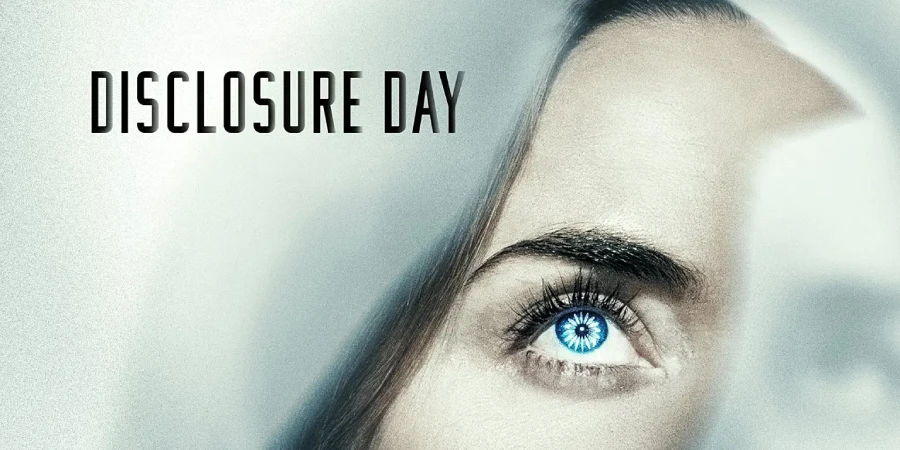

Seventy-nine years of classified files, one Kansas City weather anchor, and a single word that ends the movie. Disclosure Day is Steven Spielberg’s most cynical alien picture and, oddly, his most hopeful one. Every spoiler sits below, including what the alien says and why Spielberg flatly refuses to translate it. Consider yourself warned.
Detailed Summary
A Hostage Swap Inside a Wrestling Arena
Spielberg opens on noise, sweat, and a wrestler’s boot coming down at the camera lens. Dr. Daniel Kellner, a cybersecurity specialist, has stolen a glowing extraterrestrial artifact plus decades of classified files from the Wardex Corporation. Wardex holds his girlfriend, Jane Blankenship, and wants a trade.
Daniel double-crosses them and escapes with Jane and the backpack. Meanwhile, Wardex CEO Noah Scanlon brands him a foreign spy, which turns every federal agency into a search party. Both fugitives go to ground at the convent Jane once called home.
The Cardinal and the Weather Report That Broke the Internet
In Kansas City, television meteorologist Margaret Fairchild finds a red cardinal sitting in her kitchen. It studies her for a moment, then flies off. Something dormant in her brain switches on.
Live on air during a weather segment, she starts speaking languages she never learned. Her voice then collapses into hard, non-human clicking. Footage of the incident circles the planet within hours.
Wardex recognizes that language instantly. Consequently, Scanlon sends his lieutenant Casper Boyd to bring her in, and Margaret slips out of a hospital minutes before agents arrive.
Scanlon Makes His Case for Silence
Colin Firth plays Scanlon as a true believer rather than a sneering executive. He genuinely thinks public knowledge of alien contact would collapse civilization overnight. That sincerity makes him far scarier than any gunman on his payroll.
Wardex has reverse-engineered alien hardware and experimented on captive extraterrestrials since the 1947 Roswell crash. Scanlon vivisects one of them on camera while it screams. Spielberg does not soften the moment.
A Mind Taken Over
Three cylindrical “diving devices” exist on Earth. Direct human contact floods the nervous system with energy our biology cannot process. Daniel uses his to bend light around himself and walk past armed teams unseen.
Scanlon uses his very differently. He straps into a chair, bites down on a mouthguard, and pilots Jane’s body like a drone to track Daniel to a motel. Burns and neurological damage are the price, and he pays without blinking.
Wardex captures Daniel there. However, he shoves Jane out a window with the device first, which turns out to matter enormously later.
Margaret Walks Into a Black Site
Her growing abilities point Margaret toward the facility holding Daniel. Scanlon waves her through security, because he already knows precisely who she is. Then she stands before him and he sees his late wife instead.
Guards lower their rifles. Margaret and Daniel simply walk out. Boyd, immune to her influence, grabs a weapon and gives chase.
The Train Crash and the House That Should Not Exist
Boyd rams their car into the side of a passing freight train. Daniel hauls Margaret clear and both scramble aboard as the wreckage vanishes behind them. Wyatt Russell’s Jackson, Margaret’s boyfriend, got abandoned at a gas station somewhere back in act two and barely reappears.
Hugo Wakefield, a former Wardex insider running a whistleblower cell, finally collects the pair. Inside a warehouse he has rebuilt Margaret’s childhood home, room for room. It functions as a psychological trigger, and it works.
Aliens abducted both of them as children, on the same night, in the same snow. Woodland animals lured them aboard: a cardinal, a fox, a deer. The visitors chose those gentle shapes specifically so the encounter would not shatter two ten-year-olds.
During that abduction, the visitors rewired Daniel for pure mathematical logic and Margaret for overwhelming empathy. One of them decodes the message; the other feels what it means. Neither half works alone.
Movie Ending
Kansas City’s fictional KCXE newsroom becomes the final battlefield, and Spielberg shoots it like a bunker under siege. Margaret, Daniel, and Hugo seize the control room and start pushing 79 years of Wardex archives onto a satellite feed. Scanlon rings the building with commandos.
He never storms it. Instead he cuts the power grid, and every screen dies mid-upload. Bureaucratic violence beats a kicked-in door every time.
Jane saves the broadcast at the last possible second. She bursts in carrying the third diving device, Margaret grabs it, and raw cosmic energy pours through her body into dead infrastructure. Power surges back, and Margaret faces the lens: “This is Disclosure Day.”
Scanlon watches his monitors light up and does something wonderfully un-villainous. He pulls up a chair and sits down, choosing to stop hiding the truth. Boyd storms off in disgust, which tells you everything about the gap between the two men.
What follows belongs to an unnamed national anchorwoman, played by former real-life newscaster Courtney Grace. She narrates Roswell wreckage, injured aliens, and dead ones, absorbing the truth on camera at exactly the same speed as the audience. Wars pause, markets freeze, and roughly seven billion people watch one feed.
Hugo then wheels in the secret he has guarded for years: a living extraterrestrial smuggled out of a Wardex black site. Towering and unsettling, the creature leans toward Daniel and fires off a burst of clicks. Daniel decodes the mathematics instantly but cannot feel the weight of it, so he whispers the translation to Margaret.
Margaret turns, looks straight down the lens at the entire planet, and delivers one word: “Listen.” Hard cut to black.
Here is the point audiences argue about most. Spielberg permanently withholds the rest of the translation, and plenty of viewers found that infuriating. The film has already handed you the answer, though.
Margaret’s involuntary broadcast earlier leaked a line about not fearing what you do not understand. Hugo explains that these visitors treat empathy as the supreme evolutionary advantage. Humanity, meanwhile, sits at DEFCON 2 and refuses to hear anyone.
So the message is not an equation or a cure. It is a plea from a species that solved communication to one that never bothered. Koepp has said that closing line appeared in his very first draft, and Spielberg has confirmed that “listen” essentially is the message.
Are There Post-Credits Scenes?
No, and the answer is unusually firm. Disclosure Day contains no mid-credits or post-credits sequence, and outlets confirmed this on release day after a wave of audience speculation. Spielberg treats that cut to black as the definitive ending.
Staying seated still pays off, though. John Williams’ credit music builds to a quietly devastating crescendo. Give it a minute before you reach for your jacket.
Type of Movie
Call it a science fiction conspiracy thriller with a spiritual undercurrent. Spielberg and Koepp modeled the structure on 1970s paranoia cinema, and Three Days of the Condor comes up repeatedly in their interviews. Chases, motels, black sites, and a ticking upload clock fill most of the runtime.
Tonally, the film swings between grubby espionage and open-mouthed awe. Some critics loved that whiplash; others found the first two hours a slog before the last 25 minutes redeem everything. The MPA rated it PG-13 for action, violence, some bloody images, and strong language, with a runtime of 145 minutes.
Cast
- Emily Blunt – Margaret Fairchild
- Josh O’Connor – Dr. Daniel Kellner
- Colin Firth – Noah Scanlon
- Eve Hewson – Jane Blankenship
- Colman Domingo – Hugo Wakefield
- Wyatt Russell – Jackson
- Henry Lloyd-Hughes – Casper Boyd
- Elizabeth Marvel – Sister Maura
- Michael Gaston – General Dobbs
- Gabby Beans – Angela Childs
- Jeremy Shamos – Claypool
- Elliot Villar – Agent Diaz
- Noah Robbins – Agent Munsey
- Hettienne Park – Serena
- Courtney Grace – NBC Anchor
- Chavo Guerrero Jr. – Wrestling Referee
Film Music and Composer
John Williams scored the film, marking his 30th collaboration with Spielberg. That number deserves a moment of silence all by itself.
Williams deliberately wrote against his own instincts here. Spielberg wanted the music sitting underneath the picture rather than out in front of it, unlike the almost operatic Close Encounters of the Third Kind score. Williams recorded more than two hours and 20 minutes of music across seven sessions, and roughly 82 minutes survived into the finished film.
Back Lot Music released the 16-track album on June 12, 2026. Waxwork Records followed with a deluxe double LP pressed on “Blue Iris” colored vinyl, including liner notes written by Spielberg himself. Track titles run lowercase and spare, among them “listen…”, “empathy…”, and “memory…”.
A restrained piano motif threads the whole score and clearly echoes Williams’ E.T. the Extra-Terrestrial writing. Notably, it lands hardest in a late scene where Daniel calms Margaret by pressing her hand against the strings of a grand piano. Spielberg has called it possibly the most restrained score of their entire partnership.
Filming Locations
Principal photography ran from February to May 2025 under the deliberately dull working title Non-View. Crews shot across New Jersey, New York State, New York City, Long Island, and Atlanta.
Southern New Jersey supplied the train sequence, filmed on the Cape May Seashore Lines railroad. Jersey City’s McGinley Square neighborhood hosted street work in April 2025. Casting calls also went out across the Hudson Valley for diner patrons, hotel guests, and locals willing to drive their own cars on camera.
None of that is Kansas City, which is rather the point. Margaret’s America needs to feel like anywhere, so the film leans on generic diners, motels, and overpasses instead of postcard landmarks.
The finale is the exception, and it matters enormously. Spielberg shot the national newsroom scenes on the real NBC set at 30 Rockefeller Center, with actual NBC personnel advising on how a control room behaves during breaking news. Koepp has said he wrote crew reactions directly from what those staffers told him they would really say.
Awards and Nominations
Awards season has not caught up with the film yet, given its June 2026 release. Its only recognition so far arrived at the Golden Trailer Awards in May 2026, where the campaign won Best Summer 2026 Blockbuster Trailer alongside two additional nominations.
Behind the Scenes Insights
- Koepp produced 42 drafts of the screenplay, the most of his entire career, working from an initial treatment Spielberg emailed him.
- Janusz Kamiński shot the majority on 35mm anamorphic using Panavision Panaflex Millennium XL2 cameras with C and T Series lenses, framed at 2.39:1.
- For the TV studio sequences, Kamiński switched to a Sony VENICE 2 Extension System, since 35mm proved impractical against the brightness of the on-set screens.
- Archival Wardex footage covering the 1940s through the 1970s was shot and processed to match each era’s look, giving the leaked files real texture.
- To light the landing craft, Kamiński rigged powerful lamps to drones from a New York outfit called Flying Monster, letting light climb and sweep across faces and terrain repeatably.
- Josh O’Connor and Henry Lloyd-Hughes both received their roles without auditioning.
- Paul Tazewell designed the costumes in his second Spielberg collaboration after West Side Story.
- Courtney Grace, a former television reporter and anchor, received only her two-page monologue and had no idea how pivotal her scene was until she watched the premiere.
- Professional wrestlers, including Chavo Guerrero Jr. as the referee, appear in the opening arena sequence.
- Emily Blunt has described Spielberg as her “movie dad” and said she cried in the car after he offered her the part.
Inspirations and References
Spielberg has pointed to one specific catalyst: the 2017 New York Times investigation into a secret Pentagon program studying unidentified aerial phenomena. That article reignited a fascination he has carried for decades.
Real testimony shaped the script directly. Whistleblower David Grusch’s 2023 congressional statements about recovered “nonhuman biologics” pushed Spielberg and Koepp to commit, and Daniel uses that exact phrase in the film.
Koepp has described the approach as a unified theory of UAP lore. Rather than debunking or cherry-picking, the pair folded in as much “remotely credible” material as possible, from Roswell in 1947 to the Kecksburg incident.
Stylistically, the DNA is 1970s conspiracy cinema. Koepp cites Three Days of the Condor explicitly, while Kodak’s production notes frame the film as a spiritual sequel to Close Encounters of the Third Kind. Spielberg also based the alien designs on consistent patterns in real witness reports, including the 1994 Ariel School encounter in Zimbabwe.
Alternate Endings and Deleted Scenes
No alternate ending exists, at least none anyone has released. Koepp has stated that Margaret’s final line sat in his very first draft, and that the control room was always where the story would land.
That said, 42 drafts leave a considerable graveyard. Koepp has referred to lively off-screen debate about the closing moments, which suggests plenty of discarded alternatives never reached a camera.
Music fans get the closest thing to deleted material. Williams recorded far more than the film uses, and Back Lot Music reserved some of those unused cues for the soundtrack album. Universal set the digital release for July 20, 2026, so any official bonus features will surface around home media.
Book Adaptations and Differences
Disclosure Day is not based on a book. Spielberg wrote the original story himself and handed the treatment to Koepp, who developed the screenplay from scratch.
Its source material, loosely speaking, is decades of real UFO reporting and congressional testimony rather than any novel. No tie-in adaptation has been announced either.


Memorable Scenes and Quotes
Key Scenes
- The opening wrestling arena hostage swap, shot from the mat as a boot slams toward the lens.
- Margaret’s live weather broadcast disintegrating into unlearned languages and alien clicks.
- Scanlon strapping into the chair and puppeteering Jane’s body against her will.
- The black site walkout, where Scanlon looks at Margaret and sees his dead wife.
- Boyd driving their car into a freight train, followed by a scramble onto the moving cars.
- The warehouse reconstruction of Margaret’s childhood home unlocking the abduction memories.
- Snow-lit flashbacks of two barefoot ten-year-olds following a cardinal, a fox, and a deer.
- Jane sprinting into the control room with the third device as the grid goes dark.
- The anchorwoman narrating 79 years of cover-up while visibly processing it in real time.
- Margaret’s final address to seven billion people.
Iconic Quotes
- “Listen.” (Margaret’s final word, and the film’s entire thesis)
- “This is Disclosure Day.” (Margaret, opening the global broadcast)
- “People have a right to know the truth.” (Daniel)
- “Full disclosure. To the whole world.” (Daniel)
- “They are starved for the truth.” (Hugo)
Easter Eggs and Hidden Details
- Eagle-eyed viewers report that the wall of monitors during the final broadcast includes craft resembling the Close Encounters of the Third Kind mothership and the ship from E.T. the Extra-Terrestrial, cheekily folding Spielberg’s back catalogue into this film’s history.
- An early sequence dramatizes the long-circulated legend that Richard Nixon showed comedian Jackie Gleason recovered alien bodies, though the film swaps the story’s formaldehyde jars for a coroner’s slab.
- One character in the credits carries the name Nathan Twinning, a nod to the real Air Force general tied to the earliest official UFO memos.
- Kecksburg turns up among the archived incidents alongside Roswell, rewarding anyone who has fallen down a UAP research hole.
- The convent hiding Daniel and Jane has its own invented lore: the Monastery of St. Clare of the Dawn, with Elizabeth Marvel’s Sister Maura as abbess.
- Because Universal sits under NBCUniversal, the network that breaks the story on screen is NBC, filmed at the genuine 30 Rock news set.
Trivia
- Spielberg first floated the project publicly in April 2024, and the title stayed hidden until December 2025.
- Universal originally dated the film for May 15, 2026, before shifting it to June 12.
- A new trailer aired during the Super Bowl LX broadcast in February 2026.
- The world premiere happened at Le Grand Rex in Paris on June 2, 2026, followed by a UK IMAX release on June 10.
- Opening weekend brought in roughly $44 million domestically and $92.9 million worldwide, the biggest opening for a Spielberg and Amblin project not based on existing IP.
- Against a $115 million production budget, the film had grossed just over $229 million worldwide by mid-July 2026.
- Critics were largely on board, with the film sitting around 80% and a Certified Fresh badge on Rotten Tomatoes.
- This marks Spielberg’s first feature since The Fabelmans in 2022 and his first sci-fi outing since Ready Player One.
- It is also the first Spielberg and Kamiński collaboration set squarely in the present day.
Why Watch?
Spielberg has made a summer blockbuster that argues we are killing each other because nobody listens. Blunt is extraordinary, Firth is quietly heartbreaking, and Williams delivers his most restrained score in years. Admittedly the middle drags, but the last 25 minutes justify the ticket entirely.
Director’s Other Movies
- Raiders of the Lost Ark (1981)
- E.T. the Extra-Terrestrial (1982)
- Jurassic Park (1993)
- Schindler’s List (1993)
- Saving Private Ryan (1998)
- A.I. Artificial Intelligence (2001)
- Minority Report (2002)
- Catch Me If You Can (2002)
- War of the Worlds (2005)
- Ready Player One (2018)
- The Fabelmans (2022)