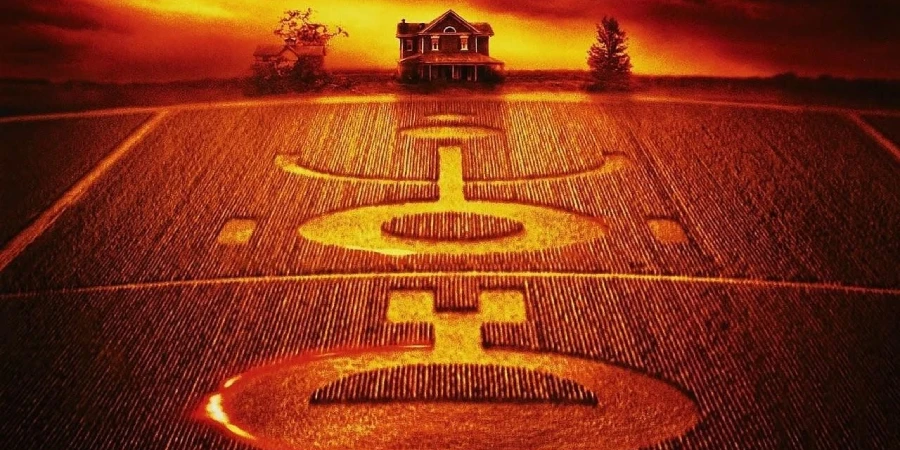

A crop circle appears overnight in Graham Hess’s cornfield, and within minutes M. Night Shyamalan has already told you everything you need to know about what kind of film this is: small, quiet, and absolutely terrified of the dark. Signs (2002) is a film about alien invasion that barely shows you any aliens, a faith film that keeps God offscreen, and a thriller built almost entirely out of a single family sitting in a farmhouse listening to things they cannot see.
Mel Gibson plays a former Episcopal priest who stopped believing after his wife died in a freak accident, and the whole movie is really about whether he will believe again before something awful crawls through the front door.
Detailed Summary
The Crop Circle Discovery
Graham Hess wakes to his children screaming in the cornfield outside their Bucks County, Pennsylvania farmhouse. Enormous geometric patterns have been flattened into the corn overnight, and nobody can explain how. Graham, his brother Merrill (Joaquin Phoenix), and his two kids Morgan and Bo stare at the formations from their roof with a quiet dread that Shyamalan milks beautifully.
News breaks quickly that similar patterns are appearing all over the world. Graham is unmoved, almost numb. He has not worn his priest’s collar since his wife Colleen died, and he carries that numbness like a second skin.
Colleen’s Death and Graham’s Lost Faith
Colleen Hess died after a driver named Ray Reddy pinned her against a tree with his car. She was still alive when Graham reached her, cut in half at the waist, and her final words were fragmented and strange. She told Graham to “see,” told Merrill to “swing away,” and said something tender to each of the children. Graham could not make sense of it at the time, and he has been spiritually hollow ever since.
This backstory is the spine of the whole film. Shyamalan keeps returning to it in fragments, and each fragment pays off in the final act. It is not elegant in the literary sense, but it is disciplined plotting.
Strange Occurrences Escalate
Bo keeps leaving half-full glasses of water around the house, claiming the water tastes “funny.” Morgan becomes obsessed with the aliens, listening to radio signals and reading about them obsessively. Graham finds a creature’s fingers reaching under a pantry door in the middle of the night, and the film’s scariest sequence plays out almost entirely in darkness with a baby monitor.
Shyamalan keeps the aliens barely visible for most of the runtime. A glimpse of legs on a rooftop. A hand under a door. Green skin in a news broadcast shot on a shaky camcorder at a children’s birthday party. Every reveal is rationed like water in a drought, and that restraint is where the film earns its tension.
The World Prepares for Invasion
Graham drives into town and speaks to Ray Reddy, the man who killed his wife. Ray is about to flee to the lake, and he tells Graham he has an alien locked in his pantry. This scene is low-key extraordinary. Shyamalan shoots Gibson sitting in a car, barely moving, as the weight of everything Ray says lands on him in real time.
Global news confirms that alien spacecraft have appeared over every major city. Graham’s family boards up the farmhouse and retreats to the basement. Morgan, who has asthma, forgets his inhaler upstairs, and this detail becomes critical later.
The Night of the Invasion
Locked in the basement, the family listens to the world seemingly end above them. Morgan reads his book about aliens by flashlight. Bo clutches her water glasses. Merrill tells a story about a home-run he once hit, a moment he describes as his finest, and Phoenix plays it with such unguarded warmth that you almost forget something is trying to get into the house.
An alien breaches the basement. Graham holds Morgan close and recites a calm, steady prayer, though it is not a prayer of faith so much as a reflex. The family escapes upstairs at dawn when the aliens, for reasons not fully explained in the film, begin retreating.

Movie Ending
One alien remains in the Hess house. It grabs Morgan and releases a toxic gas directly into his face. Morgan survives because his asthma-constricted lungs never absorbed the gas fully, his airways too tight to let it in. Graham carries his unconscious son into the living room and sees, in a single frozen moment, everything his wife said click into place.
Bo’s half-full water glasses are sitting on every surface in the room. Colleen told Merrill to “swing away,” and Merrill’s old baseball bat hangs on the wall. Graham screams at Merrill to swing, and Merrill beats the alien into every water glass in the room, soaking it completely. Water, it turns out, is toxic to the aliens. They invaded a planet that is 70 percent water and whose inhabitants are mostly water. Shyamalan wants you to feel the absurdity of that, and he earns the right to it because he seeded every piece of this solution across the entire film without it feeling like a cheat.
Morgan recovers. Graham picks up his collar from a drawer. Colleen’s last words make complete sense now: she was not delirious, she was seeing something, and Graham has to decide what he believes about that. He puts the collar on. He goes back to being a priest. Shyamalan cuts to black with the image of Graham in his clerical clothes walking toward the camera, restored.
Whether you buy the theological argument is personal, but the film commits to it completely and never hedges. That commitment is what makes the ending land rather than collapse under its own contrivance.
Are There Post-Credits Scenes?
Signs has no post-credits scene. Once the credits roll, that is it. You can leave the theater, or sit with what you just watched. Shyamalan is not interested in setting up a sequel.
Type of Movie
Signs is a science fiction thriller with a strong undercurrent of family drama and religious allegory. Its tone is slow-burn dread, punctuated by sudden bursts of genuine fright. It plays more like a chamber drama than a blockbuster, despite its alien invasion premise.
Shyamalan keeps the scope deliberately domestic. This is not a film about humanity; it is a film about one man’s relationship with God, using an alien attack as the pressure that forces the question.
Cast
- Mel Gibson – Graham Hess
- Joaquin Phoenix – Merrill Hess
- Rory Culkin – Morgan Hess
- Abigail Breslin – Bo Hess
- Cherry Jones – Officer Caroline Paski
- M. Night Shyamalan – Ray Reddy
Film Music and Composer
James Newton Howard composed the score for Signs. Howard had already worked with Shyamalan on The Sixth Sense and Unbreakable, and the collaboration had developed into something genuinely productive by this point. His score for Signs leans heavily on strings, building tension through repetition and slight harmonic dissonance.
The most effective musical choice in the film is restraint. Long sequences run in near-silence, with Howard’s score appearing only when Shyamalan needs to tip the emotional register. When it does arrive, the strings have real urgency. The Bernard Herrmann influence is audible throughout, and that is not a criticism.

Filming Locations
Principal photography took place in Bucks County, Pennsylvania. Shyamalan grew up in the Philadelphia area and has consistently used the Pennsylvania countryside as his preferred setting. It gives Signs a specific, grounded geography that a generic rural backdrop would not provide.
The farmhouse itself is a real working property, and the cornfields surrounding it are real corn. Shyamalan planted the crops specifically for the production. Shooting on actual farmland rather than a set gives the early outdoor scenes a texture and smell that you can almost sense through the screen.
Most of the film’s second half takes place entirely inside the house, and that confinement was an intentional choice. Limiting the space limits the characters’ options, and limited options produce fear.
Awards and Nominations
Signs received several Saturn Award nominations from the Academy of Science Fiction, Fantasy and Horror Films, including nods for best science fiction film and best writing. It did not make significant inroads at the major awards ceremonies, which is roughly what you would expect for a mainstream genre film from this era.
Behind the Scenes Insights
- Shyamalan wrote the script with Mel Gibson in mind for the role of Graham from the beginning.
- Abigail Breslin was making her feature film debut as Bo. Her performance, especially the dinner table scene, drew immediate attention from casting directors across Hollywood.
- Shyamalan cast himself as Ray Reddy, the man responsible for Colleen’s death, a choice that invited plenty of criticism and some genuine discomfort on set according to interviews with cast members.
- The alien seen at the children’s birthday party in the news broadcast was shot on a consumer camcorder deliberately, to give it the texture of amateur footage.
- Shyamalan required that the crop circle designs be created practically in the actual cornfield, with no digital alteration to the overhead shots.
- Joaquin Phoenix studied footage of actual minor-league baseball players to prepare for the scene where Merrill describes his home run.
Inspirations and References
Shyamalan has cited Alfred Hitchcock as a primary influence on his approach to building tension through withholding information. The basement sequence in Signs draws directly on Hitchcock’s principle that an audience knowing a bomb is under the table creates more suspense than the explosion itself.
Steven Spielberg’s Close Encounters of the Third Kind and War of the Worlds are obvious reference points for alien contact told through a domestic lens. Shyamalan pushes even further inward than Spielberg typically does, stripping away the wonder almost entirely in favor of dread.
Thematically, the film engages with C.S. Lewis’s framework of grief and faith, particularly the idea that losing a loved one can feel like a door slamming shut on belief. Shyamalan has not confirmed Lewis as a direct source, but the structural parallels are clear enough to mention.
Alternate Endings and Deleted Scenes
No alternate ending for Signs has been officially released by Disney or Touchstone Pictures. Several deleted scenes exist, primarily involving extended family moments at the dinner table and additional radio broadcast sequences that Shyamalan trimmed to keep the pacing tight.
One deleted scene shows Graham visiting Colleen’s grave, which Shyamalan cut because it made Graham’s grief too explicit too early. Keeping that information back serves the film’s structure, and cutting the scene was the right call.
Book Adaptations and Differences
Signs is an original screenplay written by M. Night Shyamalan. It is not based on any novel, short story, or pre-existing source material. No book-to-film comparison applies here.
Memorable Scenes and Quotes
Key Scenes
- The rooftop scene: Graham and Merrill climb onto the farmhouse roof at night and see a figure standing at the edge of the cornfield. The figure does not move. Neither do they. Shyamalan holds the shot for an uncomfortable length of time, and Gibson’s face does all the work.
- The baby monitor sequence: Graham listens to alien communication through a baby monitor in complete darkness. The sounds are guttural and inhuman. He cannot see anything, and neither can we. It is the most frightening two minutes in the film.
- The basement storytelling: Merrill tells the family about the best swing he ever took, a home run that felt perfect even though it was technically an out. Phoenix delivers it sitting on the floor against a wall, quietly, like a man saying goodbye. It is the film’s emotional peak, and it is not a horror scene.
- The birthday party footage: A camcorder video plays on Brazilian news, catching a real alien walking across a street between two buildings. Shyamalan shoots the family watching the television, Gibson’s hand rising slowly to cover his mouth. The alien is only visible for seconds.
- The final confrontation: Merrill swings the bat, glass after glass shatters, the alien convulses, and Graham holds his unconscious son in the center of the chaos. Every plot thread snaps shut in about ninety seconds.
Iconic Quotes
- “See. See.” – Colleen Hess, in Graham’s flashback to her death. Two words carrying enormous weight.
- “Swing away, Merrill.” – Graham, in the film’s climax, repeating his dead wife’s last words.
- “It was the best swing I ever took. Even though I got out.” – Merrill, in the basement.
- “There is no one watching out for us. We are all on our own.” – Graham, explaining to Morgan why he stopped believing in God.
- “I’m not really a reverend anymore.” – Graham, to Officer Paski, summing up his entire arc in one flat sentence.
Easter Eggs and Hidden Details
- Bo’s water glasses appear in the background of almost every interior scene throughout the film, long before their significance becomes clear. Watch any scene set in the kitchen or living room and count them.
- Morgan’s asthma inhaler is visible on the kitchen counter in early scenes and then conspicuously absent in later ones, subtly flagging the plot point before it becomes critical.
- Graham’s clerical collar appears briefly in a drawer shot very early in the film. Shyamalan frames it intentionally, a small visual promise of where the character ends up.
- The alien seen in the birthday party footage wears no clothing and carries no visible technology, which Shyamalan included deliberately to suggest these creatures are organic and unaugmented, making their water weakness more plausible within the film’s logic.
- Merrill’s baseball bat hangs on the living room wall in nearly every scene set in that room. It is hiding in plain sight as a weapon for the entire second half of the film.
Trivia
- Signs was a massive commercial success, earning well over $400 million worldwide against a comparatively modest budget. It remains one of the highest-grossing films of Shyamalan’s career.
- Abigail Breslin was around five or six years old during production. She would go on to receive an Academy Award nomination for Little Miss Sunshine just four years later.
- Shyamalan directed the film with almost no digital visual effects for the aliens during interior scenes, relying on practical costumes and careful framing to keep the creatures hidden.
- Mel Gibson and Joaquin Phoenix reportedly got along extremely well on set, with Phoenix describing Gibson as generous with younger cast members.
- Shyamalan wrote the role of Bo specifically as a child who speaks in a slightly odd, oblique way, a choice that makes her water-leaving habit seem like a quirk rather than a plot mechanism until the payoff arrives.
- James Newton Howard scored the film in a very short window, delivering the full orchestral score on an unusually tight schedule.
Why Watch?
Mel Gibson’s performance in the basement, holding his son and reciting something that sounds like a prayer but feels like a man drowning, is the reason to watch Signs. Shyamalan builds an entire theology around one father’s grief, uses an alien invasion as the chassis, and somehow makes it feel personal. That tonal tightrope walk, part horror, part quiet devastation, is rarer than it looks.
Director’s Other Movies
- Praying with Anger (1992)
- Wide Awake (1998)
- The Sixth Sense (1999)
- Unbreakable (2000)
- The Village (2004)
- Lady in the Water (2006)
- The Happening (2008)
- The Last Airbender (2010)
- After Earth (2013)
- The Visit (2015)
- Split (2016)
- Glass (2019)
- Old (2021)
- Knock at the Cabin (2023)
Recommended Films for Fans
- The Last House (2026)
- Disclosure Day (2026)
- Close Encounters of the Third Kind (1977)
- War of the Worlds (2005)
- The Sixth Sense (1999)
- The Village (2004)
- Leave the World Behind (2023)
- Invasion of the Body Snatchers (1978)
- Midnight Special (2016)
- A Quiet Place (2018)
- Cloverfield (2008)
- Unbreakable (2000)