M. Night Shyamalan’s 2004 film bets everything on a single secret, and for once, that secret actually earns its twist. A 19th-century village lives in terrified peace beside a forest full of creatures the elders call “Those We Don’t Speak Of.” Blind girl Ivy Walker eventually walks through that forest alone, and what she finds on the other side makes every yellow lantern, every red berry, and every whispered warning feel like an elaborate stage set. It is, because it is one.
Detailed Summary
A Village Bound by Fear
We open on a funeral. A young child is buried, and the grief feels genuine, period-accurate, and suffocating. Residents of Covington wear earthy yellows and browns, going about lives that seem lifted straight from colonial Pennsylvania.
Two rules govern everything here. Nobody enters the forest ringing the village. Nobody uses the color red, because red is “the bad color” that attracts the creatures lurking among the trees.
Lucius Hunt and the Forbidden Border
Joaquin Phoenix plays Lucius Hunt, a quietly intense young man who wants permission from the village elders to cross into the forest and reach the towns beyond it. His mother, Alice Hunt (played by Sigourney Weaver), sits on the council of elders who guard the village’s founding secrets.
Lucius pushes, the elders refuse, and we sense something deeply political underneath their denial. His desire to reach the outside world feels less like ambition and more like a symptom of everything rotten at the village’s foundation.
The Creatures Make Their Presence Known
Skinned animals appear on doorsteps. Red slashes mark the villagers’ doors overnight. The creatures seem to be warning the community to stay contained, and the terror they produce is palpable and communal.
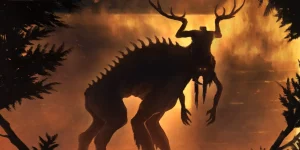
Shyamalan shoots these scenes with shadows and suggestion. We barely see the creatures directly, which is smart filmmaking. Full exposure would reveal the costume, and the costume would reveal the lie.
Ivy and Lucius
Bryce Dallas Howard plays Ivy Walker, daughter of head elder Edward Walker (William Hurt). Ivy is blind but radiates more courage than anyone else in the cast. Her relationship with Lucius builds slowly and tenderly, expressed in shy touches and careful words rather than grand declarations.
She calls Lucius her “safe harbor,” and that line lands with unexpected weight. These two feel like the emotional center of a film that otherwise risks becoming a puzzle box with no beating heart inside.
Noah Percy and the Stabbing
Adrien Brody plays Noah Percy, a childlike and unpredictable young man with a crush on Ivy. When Ivy and Lucius become engaged, Noah’s mental state deteriorates. He stabs Lucius multiple times with a knife, leaving him critically wounded and hovering near death.
This is the scene that shifts the film from thriller to urgent drama. Lucius needs medicine from the outside world, medicine the village cannot provide, and someone has to go get it.
Ivy Walks Into the Forest
Edward Walker, wracked with guilt and love for his daughter, makes a devastating decision. He tells Ivy the truth: the creatures are costumes, kept in a vault by the elders to maintain fear and keep the village sealed.
He then does something almost cruel in its bravery. He sends his blind daughter through the real forest to reach the towns beyond, to retrieve medicine for Lucius. Armed with a walking stick and her extraordinary senses, Ivy goes.
Ivy Encounters “The Creature”
She is not alone in the forest. Noah has discovered the creature costumes, put one on, and followed her. He lunges at her multiple times among the trees, and Ivy uses every bit of her spatial awareness to survive.
She sidesteps him near a pit in the ground. Noah falls in. He does not survive the fall. Ivy keeps moving without knowing exactly what just chased her, which makes her victory feel even more harrowing.
The Outside World Revealed
Ivy reaches a stone wall and calls out. A park ranger appears on the other side. She is in a wildlife preserve. Modern cars pass in the background. A security guard drives her to a ranger station where someone in contemporary clothing hands her medication from a medical supply box.
We see a newspaper. We see electrical lights. Everything confirms it: the village is a constructed community existing in present-day America, deliberately isolated inside a nature preserve.
Edward Walker’s Confession to the Elders
Back in the village, the other elders confront Edward. He has broken the covenant by telling Ivy the truth. He defends his choice as a father’s love, and the scene crackles with the guilt shared among people who built an entire world on a lie.
Walker reads a letter from the preserve’s sympathetic overseer, a wealthy man who bankrolled the whole project. One line confirms that the preserve will be maintained and no outsiders will be allowed in. The experiment continues.
Movie Ending
Ivy returns with the medicine. Lucius survives. Nobody outside the elders ever learns the full truth about what surrounds them.
That final beat is genuinely unsettling. Shyamalan does not frame it as a happy ending. Lucius lives, yes, but the village continues its generational deception. Children born into Covington will grow up terrified of a forest with no real monsters, policed by a grief-stricken group of adults who chose isolation over reality after suffering personal tragedies in the modern world.
Each elder, we learn in fragments, lost someone to urban violence or accident. Edward Walker lost his father to murder. They banded together and decided to opt out entirely, to build a place where that kind of loss could not reach them. The preserve’s wealthy patron lost his son to violence as well, and he funds the entire operation as a kind of shared memorial.
What Shyamalan asks at the end is thorny: do these people have the right to imprison future generations inside a fabricated past? The elders chose this life as adults. Their children never did. Ivy, the most morally awake character in the film, learns the truth, uses it, and then returns to a community that will never know what she knows. She chooses Lucius and stays. That choice feels both loving and tragic, which is exactly what the film intends.
The creatures were never real. But the grief that created them absolutely was.
Are There Post-Credits Scenes?
The Village has no post-credits scenes. Once the film ends, it ends completely. No stingers, no tags, no additional footage follows the credits.
Type of Movie
The Village is a mystery thriller with strong elements of period drama and psychological horror. Its tone is slow, deliberate, and elegiac rather than pulse-pounding.
Shyamalan plays it very straight throughout. There are no winks at the audience, no self-aware humor. The commitment to atmosphere over jump scares puts this closer to gothic literature than conventional horror.
Cast
- Joaquin Phoenix – Lucius Hunt
- Bryce Dallas Howard – Ivy Walker
- Adrien Brody – Noah Percy
- William Hurt – Edward Walker
- Sigourney Weaver – Alice Hunt
- Brendan Gleeson – August Nicholson
- Cherry Jones – Mrs. Clack
- Judy Greer – Kitty Walker
- Jesse Eisenberg – Finton Coin
- Frank Collison – Victor
Film Music and Composer
James Newton Howard composed the score for The Village, continuing his collaboration with Shyamalan that began with The Sixth Sense. His work here is among his best on any Shyamalan project, and that is saying something given that track record.
Violinist Hilary Hahn performs the solo violin passages that run through much of the score. Her playing is spare and aching, perfectly suited to the film’s mood of constrained grief.
Tracks like the main theme and Ivy’s central motif lean heavily on solo strings over minimal orchestration. That restraint keeps the score from overwhelming the film’s quiet dread with bombast.
Filming Locations
Principal photography took place in Chadds Ford, Pennsylvania, and surrounding areas of the Pocono Mountains. The production built the village set from scratch on farmland in that region.
Choosing Pennsylvania was deliberate. Chadds Ford carries genuine colonial history, and the landscape communicates isolation without needing any digital manipulation. Tall deciduous trees close in on every exterior shot, making the forest feel like a wall.
The choice to film in an actual wooded region rather than a studio backlot pays off visibly. Cinematographer Roger Deakins shoots the forest in tones of gold and grey that feel like a memory rather than a movie set.
Awards and Nominations
The Village received a nomination for Best Original Score at the Academy Awards for James Newton Howard’s work. It also picked up nominations from various critics’ groups and guilds, particularly for Roger Deakins’s cinematography.
Critical reception was divided on release, and the film won fewer awards than Shyamalan’s earlier work. Howard’s score remained the most consistently praised element across nearly all coverage.
Behind the Scenes Insights
- Shyamalan shot the film with natural and near-natural lighting wherever possible, working with Deakins to minimize artificial sources and keep interiors dim and realistic.
- Bryce Dallas Howard, in her first major film role, learned to navigate sets while blindfolded during rehearsals to prepare for playing Ivy’s blindness convincingly.
- Adrien Brody reportedly requested less dialogue to convey Noah’s condition more physically, relying on movement and expression rather than written lines.
- Shyamalan cast William Hurt partly because he wanted the paternal authority in the village to feel warm and earned rather than villainous, which required an actor whose natural screen presence reads as trustworthy.
- Roger Deakins used very little color grading in post-production, preferring to build the palette through production design and costume color choices on the actual set.
- The costumes deliberately exclude any colors outside the village’s established palette to keep visual continuity airtight throughout the film.
Inspirations and References
Shyamalan has pointed to real-world intentional communities and utopian social experiments as conceptual touchstones. Groups that chose radical withdrawal from modern society appear throughout American and European history, and the film draws on that tradition without citing a single specific case.
The broader literary inspiration connects to works like Shirley Jackson’s short fiction, where communities enforce conformity through collective terror. The village’s use of shared mythology to control behavior echoes Jackson’s The Lottery in particular, though Shyamalan never confirmed a direct debt.
Nathaniel Hawthorne’s preoccupation with Puritan guilt, hidden sin, and the corrupting weight of community secrets also feels deeply present in the film’s DNA.
Alternate Endings and Deleted Scenes
No officially released alternate ending exists for The Village. Shyamalan tends to guard his productions tightly during post-production, and no significant alternate cuts surfaced publicly.
Some deleted and extended scenes appear on the DVD release, including additional moments with the elders that expand on their backstories and the founding of Covington. These scenes deepen the emotional context but do not alter the film’s core structure or ending.
Book Adaptations and Differences
The Village is not based on a book. Shyamalan wrote the original screenplay himself. Some critics and viewers have drawn comparisons to Margaret Peterson Haddix’s 1995 novel Running Out of Time, which shares a remarkably similar premise of a contemporary American community living as if in an earlier historical period, with children eventually discovering the truth.
Shyamalan has denied direct influence from that novel. Whether coincidence or inspiration, the structural similarities between the two works remain a recurring topic among fans of the film.
Memorable Scenes and Quotes
Key Scenes
- Ivy walks into the forest alone: Shot from behind, her yellow cloak against the grey-green trees, tapping her stick into darkness. No music for several seconds. The silence does more work than any score could.
- Noah in the creature suit pursues Ivy: He lunges repeatedly and she evades by listening. No visual confirmation for the audience of what exactly is chasing her, which keeps the tension alive even knowing the costume is fake.
- Edward tells Ivy the truth: William Hurt’s voice breaks on almost every line. He sits at a small table with his hands folded and dismantles everything he built, and you feel his shame without him ever naming it directly.
- Ivy reaches the stone wall: She touches the rough stone surface, calls out into apparent silence, and a modern voice answers. That voice carries the full weight of the film’s entire deception in a single syllable.
- The skinned animals on the doorsteps: Deakins shoots them in early morning grey light. No music, no stinger. The image just sits there, ugly and still.
Iconic Quotes
- “You are my safe harbor.” (Ivy to Lucius)
- “The world moves for love. It kneels before it in awe.” (Edward Walker)
- “Do not enter the forest. We do not go there. We do not look there.” (Elder meeting)
- “I see the world, Ivy. Just not as you see it.” (Lucius)
Easter Eggs and Hidden Details
- The color red appears in small background details throughout early scenes, subtly signaling that the “bad color” rule is already being quietly violated before any crisis erupts.
- Ivy’s yellow cloak mirrors the yellow lanterns the elders use to signal safety, visually coding her as a figure of protection rather than danger even as she walks into the most dangerous space in the film.
- Several of the elder characters share surnames with real people connected to the founding of American utopian communities, a detail easy to miss on a first viewing.
- The vault where creature costumes are stored sits physically at the center of the village layout, placing the lie at the literal heart of the community’s geography.
- Lucius’s stillness throughout the film, his minimal gestures and long pauses before speaking, reads differently on rewatch as someone who suspects the world around him is performed rather than real.
Trivia
- This was Bryce Dallas Howard’s feature film debut in a leading role. Ron Howard is her father, though she pursued casting on her own merits and Shyamalan has noted he was unaware of the connection during initial auditions.
- Joaquin Phoenix and Shyamalan reportedly had a tense working relationship on set, with Phoenix pushing for a more naturalistic approach than the director initially scripted.
- James Newton Howard’s score was recorded with live orchestra in London, and Hilary Hahn’s violin solos were captured in separate sessions to allow maximum dynamic control in the final mix.
- Roger Deakins received an Academy Award nomination for his cinematography on this film, one of multiple nominations he accumulated before finally winning for Blade Runner 2049.
- Shyamalan himself appears briefly in the film, as he often does in his own productions, in a small role as a ranger’s assistant at the wildlife preserve.
- Production designer Tom Foden researched period Pennsylvanian architecture extensively to ensure the village buildings matched late 19th-century construction methods accurately.
Why Watch?
Watch it for Bryce Dallas Howard, who carries every scene she is in while playing a character who cannot see any of them. Her performance in the forest sequence, navigating terror by sound and touch alone, is more physically committed than anything else in the film. Shyamalan’s grip on atmosphere is real here, and Roger Deakins photographs Pennsylvania farmland like a painting of memory slowly going dark.
Director’s Other Movies
- Praying with Anger (1992)
- Wide Awake (1998)
- The Sixth Sense (1999)
- Unbreakable (2000)
- Signs (2002)
- Lady in the Water (2006)
- The Happening (2008)
- The Last Airbender (2010)
- After Earth (2013)
- The Visit (2015)
- Split (2016)
- Glass (2019)
- Old (2021)
- Knock at the Cabin (2023)