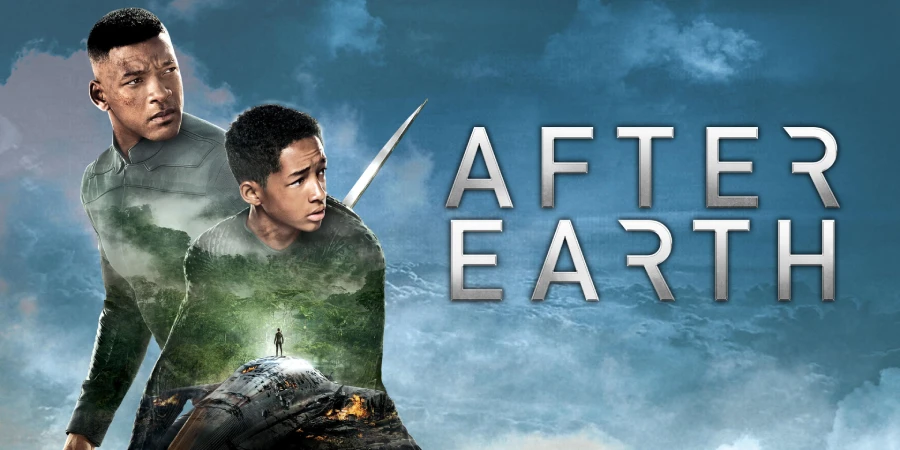

Will Smith spent most of his career playing the coolest man in any room, so casting him as a rigid, emotionally shut-down father who can barely look his son in the eye is actually a fascinating swing. After Earth (2013) arrived with a mountain of goodwill and left with a Razzie nomination, which tells you something about the gap between ambition and execution. Directed by M. Night Shyamalan, this sci-fi survival story strands a father and son on a future Earth teeming with creatures that literally smell fear. It is a film worth arguing about.
Detailed Summary
The World of Nova Prime and the Ranger Corps
Humanity abandoned Earth roughly a thousand years before the story begins, relocating to a planet called Nova Prime. A militaristic peacekeeping force called the Ranger Corps protects the population from an alien species known as the Ursa, creatures bred specifically to hunt humans by detecting the pheromones released through fear.
General Cypher Raige (Will Smith) is a legendary Ranger famous for “ghosting,” a technique that allows him to suppress fear entirely, rendering him invisible to the Ursa. His teenage son Kitai (Jaden Smith) desperately wants to become a Ranger too, but he carries serious emotional wounds from watching his sister Senshi die in an Ursa attack years earlier.
A Failed Mission and a Catastrophic Crash
Cypher, on the verge of retirement, decides to bring Kitai along on what should be a routine transport mission. A massive asteroid storm hits their ship mid-flight, forcing an emergency warp that drops them directly above Earth, a planet now quarantined and classified as a Class 1 Danger Zone.
Every organism on Earth has spent a millennium evolving specifically to kill humans. The ship tears apart during entry and crashes hard. Cypher survives but suffers severe leg fractures, leaving him completely immobile. Kitai is physically uninjured, which means the mission falls entirely on him.
Kitai’s Mission: Recover the Beacon
Only the tail section of the ship, which broke off roughly 100 kilometers away, contains a distress beacon. Kitai must hike across a hostile, unfamiliar planet alone to retrieve it. Cypher can monitor and communicate through a linked device, but he physically cannot follow.
Kitai carries a limited supply of nanosalt inhalers, a medication he needs because Earth’s atmosphere is only breathable in certain concentrations. Losing even one inhaler is potentially lethal, which raises the stakes immediately.
The Hike Through a Living Planet
What follows is essentially a one-man survival film with Will Smith watching from a chair. Kitai faces Earth’s fauna head-on: giant birds, enormous apes, and a pack of predatory big cats that chase him off a cliff. He survives by luck, athleticism, and his Ranger training, but barely.
At a critical point, he loses several inhalers. Kitai realizes he does not have enough medication to survive the night unless he climbs to a warmer altitude before the planet’s temperature plummets to lethal lows each evening. The cold snap sequence, where Kitai races to find warmth before freezing, is genuinely tense and arguably the film’s best-crafted action beat.
A large eagle attacks him and then, in an unexpected turn, sacrifices itself to keep him warm through the night. Kitai wakes up essentially adopted by nature after nearly being killed by it.
The Ursa on Board
Back on the crashed ship, a surviving Ursa that was being transported for training purposes has broken free. Cypher knows it is loose and heading toward Kitai. Kitai’s emotional armor is not strong enough to ghost yet, which means the creature can track him.
Cypher’s injuries worsen steadily. He faces the very real possibility of dying in the wreckage before Kitai reaches the beacon. This creates a dual race-against-time structure that the film handles with reasonable efficiency.
The Ghost of Senshi
Throughout the journey, Kitai experiences visions of his dead sister Senshi. She appears to him at vulnerable moments, offering gentle encouragement. These hallucinations function as his emotional anchor and the film’s way of externalizing his grief without much subtlety.
Senshi’s death is the emotional engine of the entire story. Kitai blames himself for not saving her, and Cypher, in his emotionally armored state, has never properly acknowledged what his son went through. This unresolved tension between father and son drives every scene they share.


Movie Ending
Kitai reaches the tail section and retrieves the beacon, but the Ursa arrives before he can activate it. With no inhalers left and the creature bearing down on him, Kitai does something the film has been building toward: he stops being afraid. Not through training, but through a genuine acceptance of death.
He ghosts. The Ursa loses him completely. Kitai then maneuvers the creature into a trap and kills it, using a cutlass (the Rangers’ retractable energy blade) in close combat. The sequence is shot with Shyamalan favoring wide frames and clean geography, so you always know where Kitai is relative to the creature, which is smarter staging than you might expect from this film.
Kitai activates the beacon. A rescue ship arrives. Cypher, barely alive at this point, is stabilized by the rescue team. Father and son share a physical moment of connection that the film earns somewhat; Cypher, for the first time, salutes Kitai as a fellow Ranger rather than commanding him as a subordinate son.
What matters about this ending is what it says about Cypher’s arc, not just Kitai’s. Cypher built emotional walls that protected him on the battlefield but cost him his relationship with his son. Watching Kitai ghost, genuinely, without the years of conditioning Cypher needed, forces Cypher to see his son clearly, maybe for the first time. Whether that moment lands emotionally depends entirely on whether Will Smith’s performance has made you believe in the wall, and that is where the film stumbles slightly, because Smith plays Cypher so robotically that the payoff feels more procedural than moving.
Are There Post-Credits Scenes?
After Earth contains no post-credits scene. Once the rescue arrives and the credits roll, that is the complete story. You can leave the theater without missing anything extra.
Type of Movie
After Earth is a science fiction survival film with strong coming-of-age undertones. Its tone sits somewhere between somber and earnest, rarely winking at the audience or allowing levity to cut the tension.
It owes a debt to single-character survival films like Cast Away, though it never fully commits to that stripped-down premise since Cypher’s monitoring creates a persistent co-protagonist. Genre-wise, it also brushes against military family drama, particularly in its fixation on Cypher and Kitai’s father-son dynamic.
Cast
- Will Smith – General Cypher Raige
- Jaden Smith – Kitai Raige
- Sophie Okonedo – Faia Raige
- Zoe Kravitz – Senshi Raige
- Glenn Morshower – General Li
Film Music and Composer
James Newton Howard composed the score. He is one of Hollywood’s most reliable dramatic composers, with credits ranging from The Dark Knight to Fantastic Beasts. His work here leans heavily on orchestral swells and sparse, eerie textures that evoke an Earth reclaimed by nature.
The score rarely calls attention to itself, which is both a compliment and a mild criticism. It services the film competently without producing a single track you will hum afterward. For a story set on a planet that has been evolving in spectacular, terrifying ways for a thousand years, the music feels oddly cautious.



Filming Locations
Principal photography took place in Costa Rica, Utah, and other locations chosen for their visually dramatic, wild landscapes. Costa Rica’s dense rainforest provided the lush, overgrown jungle sequences that sell the idea of Earth as a place reclaimed by nature.
Utah’s terrain contributed the more arid, rocky stretches of Kitai’s journey. Using real locations rather than purely digital environments gave the film a tactile quality that its script could not always support. You believe the planet, even when you do not quite believe the people on it.
Awards and Nominations
After Earth received Razzie nominations, including Worst Picture, Worst Director, and Worst Actor for Will Smith. It did not win significant awards in traditional categories. Critical reception was largely negative, with most reviews pointing to tonal flatness and weak character development.
Behind the Scenes Insights
- Will Smith developed the original story concept himself and brought it to Shyamalan, making him a producer with considerable creative control over the project.
- Jaden Smith was always intended to carry the physical bulk of the film’s runtime, a significant ask for a teenage actor with limited experience in solo lead roles.
- Shyamalan reportedly worked closely with Will Smith to shape the father-son dynamic, drawing on themes of emotional distance in high-achieving families.
- The production built detailed worldbuilding documents for Nova Prime society and the Ranger Corps, much of which never appears on screen but informed costume and production design choices.
- Practical locations were prioritized over green screen wherever possible, which is why the jungle sequences have a physicality that the film’s digital creatures occasionally lack.
Inspirations and References
Will Smith cited his observations about parent-child relationships and the pressures children of famous parents face as a core inspiration. The story directly mirrors his real-life dynamic with Jaden, which adds a layer of uncomfortable meta-commentary when Cypher barks orders at his struggling son.
Structurally, the film echoes classic survivalist literature where a young person must prove themselves against nature without parental protection. Works like Hatchet by Gary Paulsen occupy a similar narrative space. The Ranger Corps mythology and the Ursa design draw loosely from military science fiction in the tradition of Robert Heinlein’s Starship Troopers, though far less rigorously developed.
Alternate Endings and Deleted Scenes
No officially confirmed alternate endings or significant deleted scenes have been publicly released for After Earth. Sony did not produce an extended cut or a director’s cut for home video release.
Some behind-the-scenes materials hint at additional worldbuilding scenes involving Nova Prime that were cut during editing, presumably to keep the film’s focus on Kitai’s solo survival arc. Nothing substantive from those cuts has surfaced publicly.
Book Adaptations and Differences
After Earth is not based on a book. Will Smith conceived the original story, and a novelization titled After Earth was written by Peter David and published to coincide with the film’s release. A young adult prequel novel also accompanied the marketing campaign.
If anything, the relationship runs in reverse: the books expand on the film’s universe rather than inspiring it. The novelization fleshes out Nova Prime society and Cypher’s military history in ways the film does not have time for.

Memorable Scenes and Quotes
Key Scenes
- The cold snap race: Kitai sprints through darkening jungle as the temperature plunges, searching desperately for a thermal hotspot before his body shuts down. It is a purely physical sequence and the film’s most effective piece of tension.
- The eagle sacrifice: A giant bird that attacked Kitai earlier returns during the night and wraps its wings around him to keep him alive, dying from the cold itself. It is sentimental but visually striking, particularly the wide shot of the bird’s silhouette against a pale morning sky.
- Kitai ghosts: Standing exposed in front of the Ursa with no weapon raised, Kitai simply breathes and lets his fear go. The creature swivels its head, clicks its mandibles, and walks past him. Shyamalan holds the shot longer than expected, and it works.
- Cypher’s salute: After rescue, a barely-conscious Cypher lifts his hand and salutes Kitai as a Ranger. Kitai’s face crumples. It is the film’s most nakedly emotional moment.
- Senshi’s death flashback: Shown in fragments throughout, the memory of Senshi being taken by the Ursa while Kitai watches through glass is genuinely distressing, helped by Zoe Kravitz’s physicality in a role with almost no dialogue.
Iconic Quotes
- “Danger is very real, but fear is a choice.” Cypher delivers this line with the gravity of a man who has tattooed it on his soul. It functions as the film’s thesis statement.
- “Everything on this planet has evolved to kill humans.” A line designed to make Earth sound menacing, and it mostly succeeds at setting tone.
- “You are not a Ranger yet.” Cypher says this more than once, and each repetition lands differently depending on where you are in the story.
Easter Eggs and Hidden Details
- The Ranger Corps uniform design incorporates subtle organic shapes that echo the fauna of Nova Prime, a worldbuilding detail that is easy to miss on first viewing.
- Several background screens in the ship’s cockpit display Nova Prime geological data that matches details mentioned in the prequel novel, a small reward for fans who read the tie-in material.
- Kitai’s nanosalt inhalers are color-coded, and attentive viewers can track his dwindling supply by watching which colors disappear from his kit across the film’s runtime.
- The Ursa design features no eyes anywhere on its body, a deliberate choice that reinforces the idea that it hunts entirely through pheromone detection rather than sight.
Trivia
- Will Smith and Jaden Smith are the only father-son duo to share top billing in a wide-release Hollywood sci-fi film of this scale.
- Shyamalan took no screenwriting credit on the film publicly during marketing, reportedly to avoid audience bias given the mixed reception to some of his earlier work.
- Jaden Smith performed many of his own athletic sequences, having trained extensively in parkour-style movement prior to production.
- The accent used by characters on Nova Prime was deliberately constructed to sound like a future evolution of English, blending American and South African phonetic patterns.
- After Earth grossed roughly $243 million worldwide against a significant production and marketing budget, making it a financial disappointment for Sony.
- The film marked a notable career low point for Will Smith, who had not received this level of critical hostility for any previous project.
Why Watch?
Watch it specifically for the cold snap sequence and for the intellectual curiosity of seeing Will Smith deliberately dismantle his own screen persona in favor of something colder and stranger. Jaden Smith is imperfect but genuinely present on screen in ways that early reviews refused to acknowledge. It is a flawed film, but its central gamble, stranding a charismatic megastar behind glass so his kid can carry the movie, is bolder than it gets credit for.
Director’s Other Movies
- Praying with Anger (1992)
- Wide Awake (1998)
- The Sixth Sense (1999)
- Unbreakable (2000)
- Signs (2002)
- The Village (2004)
- Lady in the Water (2006)
- The Happening (2008)
- The Last Airbender (2010)
- The Visit (2015)
- Split (2016)
- Glass (2019)
- Old (2021)
- Knock at the Cabin (2023)
- Trap (2024)