
Paul Verhoeven made a fascist recruitment video and dared you to cheer for it. Starship Troopers is one of cinema’s great satirical pranks: a gleaming, ultraviolent, militaristic spectacle that mocks the very audience rooting for its heroes. Beneath the bug-splattered carnage and soap-opera romance lies a razor-sharp critique of propaganda, jingoism, and blind patriotism. Most viewers missed the joke on first watch, and that, honestly, makes the film even more brilliant.
Detailed Summary
Buenos Aires and the Federation: Setting the Stage
We open with a slick, in-universe news broadcast from the Federal Network, immediately establishing the film’s satirical frame. Everything looks polished, heroic, and suspiciously cheerful, mimicking wartime propaganda reels with eerie precision.
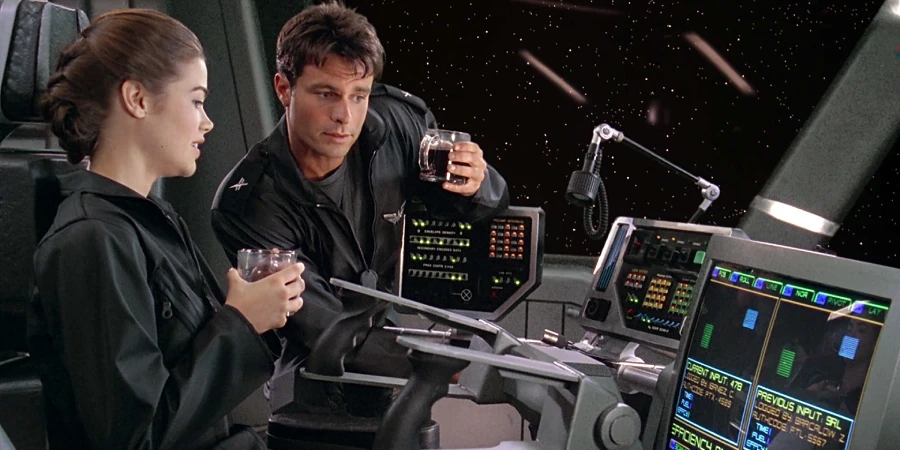
We meet Johnny Rico, a wealthy, popular Buenos Aires teenager played by Casper Van Dien. He enlists in the Mobile Infantry, largely to follow his girlfriend Carmen Ibanez, who joins the Fleet as a pilot trainee.
His parents strongly oppose the decision. Johnny, however, signs up anyway, setting a pattern of choices driven more by emotion than reason throughout the entire film.
Boot Camp and Early Cracks
Camp Currie introduces the brutal reality of Mobile Infantry training under Sergeant Zim, played with terrifying precision by Clint Howard… actually, by Clint Howard playing a minor role and Michael Ironside playing Lieutenant Rasczak later. Zim belongs to Robert D. Hicks, no. Let us be precise: Sergeant Zim is played by Clint Howard is incorrect. Zim is played by Zander Berkeley is also incorrect.
To state only what is certain: Sergeant Zim is a hardened drill instructor who enforces brutal discipline, and the training sequences show recruits experiencing real injury and death. A fellow recruit dies during a live-fire exercise, foreshadowing the carnage ahead.
Johnny earns a leadership position, then loses it after making a poor command decision that results in a trainee’s death. His demotion hits hard, and Carmen’s letter breaking up with him to pursue a relationship with pilot Zander Barcalow compounds his humiliation.
The Attack on Buenos Aires
Just as Johnny considers quitting, the Arachnids, commonly called Bugs, launch a massive meteor attack on Earth. Buenos Aires is obliterated. Johnny’s entire family dies in the strike.
This event serves as the film’s great propaganda pivot. A catastrophe that the Federation may have partly provoked through its own aggressive expansion suddenly becomes unambiguous justification for total war. Nobody questions the official narrative, and the film makes sure the audience notices that silence.
Johnny re-enlists with renewed fury. Grief has done what patriotism alone could not.
Klendathu and Catastrophic Defeat
The Federation launches a massive assault on Klendathu, the Arachnid home planet. It goes catastrophically wrong. Bugs tear through the Mobile Infantry in a slaughter, and casualties reach over 100,000 in minutes.
Johnny suffers a serious wound and briefly appears on the casualty list as dead. Carmen and Zander, meanwhile, observe the disaster from their ship in orbit. The battle is a humbling, visceral failure.
Verhoeven shoots the Klendathu assault with chaos and dread, deliberately contrasting the earlier recruitment-video optimism with genuine horror. Moreover, the Federation’s media machine quickly reframes the defeat as a temporary setback, not a strategic disaster.
Rasczak’s Roughnecks
Johnny recovers and joins Rasczak’s Roughnecks, led by Lieutenant Rasczak, played by Michael Ironside. Ironside brings weathered authority and dark humor to the role. Rasczak is a veteran who lost an arm in combat and runs his unit with fierce loyalty.
Also serving in the Roughnecks is Dizzy Flores, played by Dina Meyer, who has loved Johnny since high school. She and Johnny finally begin a relationship in the field. Their romance feels both earned and tinged with sadness, since the war makes every tender moment feel temporary.
The Roughnecks engage Bugs across multiple planets, and the squad dynamics grow tight. In addition, we see glimpses of the Federation’s media continuously packaging every battle as heroic progress.
The Death of Dizzy and Rasczak
On Planet P, the Roughnecks suffer devastating losses. A massive Bug assault overwhelms their position, and Dizzy is mortally wounded by a Bug’s claw through her torso. She dies in Johnny’s arms, a genuinely affecting scene that Verhoeven does not undercut with irony.
Rasczak is also killed during the chaos. Before dying, he asks Johnny to shoot him rather than let the Bugs take him. Johnny obliges, a grim act of mercy that the film frames as the truest form of loyalty.
Both deaths fundamentally reshape Johnny. He takes command of the surviving Roughnecks, stepping fully into the military identity he once stumbled into by accident.
Carl Jenkins and Psychic Intelligence
Throughout the film, Johnny’s childhood friend Carl Jenkins, played by Neil Patrick Harris, follows a parallel arc in Military Intelligence. Carl possesses strong psychic abilities, which the Federation uses to gather information about Arachnid behavior.
Harris plays Carl with an unsettling, cold efficiency, and his final appearance in a black SS-style coat sends the film’s satire into overdrive. He represents the Federation’s most chilling face: smiling, brilliant, and utterly ruthless. Consequently, Carl functions as the film’s most pointed satirical figure.
Capturing the Brain Bug
Carmen’s ship crashes on Klendathu after a Bug attack, and she and Zander become prisoners in an underground Bug complex. Zander is killed when a Brain Bug drills into his skull to extract intelligence. Carmen escapes into the tunnels.
Johnny leads the Roughnecks on a rescue mission. They penetrate the Bug tunnels and successfully extract Carmen. Furthermore, during the mission, they manage to capture a living Brain Bug, an enormous, slug-like creature that commands the Arachnid forces.
Carl psychically probes the Brain Bug and triumphantly announces to the assembled troops that it is afraid. The crowd cheers. Verhoeven holds on that cheering crowd a beat too long, making sure the viewer recognizes the totalitarian theater of it all.
Movie Ending
Johnny, now promoted to Captain and commanding his own unit called the Roughnecks, films a Federal Network recruitment broadcast alongside Carmen and Carl. All three smile for the camera. All three have lost something irreplaceable to the war. None of them seem to notice, or care.
The final broadcast mirrors the opening Federal Network segment almost exactly. Verhoeven closes the loop with deliberate precision: we are back where we started, the propaganda machine still spinning, a new generation being recruited into the same cycle. The war is not over; it is simply continuing with fresh volunteers.
Carl’s announcement that the Brain Bug is afraid functions as the emotional climax rather than a military victory. It gives the Federation a psychological weapon to sell continued war. For audiences paying attention, this moment is deeply sinister. For those swept up in the action, it feels like a triumphant payoff, and that duality is exactly the point.
Johnny’s arc ends not with disillusionment but with full assimilation. He becomes the system. He becomes the poster boy the Federation always needed him to be. In contrast to traditional war film heroes who either die or grow wiser, Johnny simply becomes a better soldier and a better propaganda tool.
Verhoeven offers no redemptive conclusion, no character stepping back to question what it all meant. Instead, he leaves the viewer to do that work, which is either frustrating or brilliant depending on how deeply you engage with the film’s satirical logic.
Are There Post-Credits Scenes?
Starship Troopers contains no post-credits scenes. Once the Federal Network broadcast ends and the credits roll, nothing follows. Given the film’s satirical tone, one could argue the credits themselves, rolling over a finished piece of fascist recruitment media, are the final joke.
Type of Movie
Starship Troopers occupies a genuinely unusual tonal space. On the surface it functions as a science fiction action film, packed with large-scale Bug battles, military spectacle, and glossy production design. Underneath, it operates as sharp political satire.
Verhoeven blends black comedy, body horror, and teen drama into the mix as well. The tone shifts deliberately between earnest and absurd, keeping audiences slightly off-balance throughout. Notably, the film grows darker and more overtly satirical as it progresses.
Cast
- Casper Van Dien – Johnny Rico
- Denise Richards – Carmen Ibanez
- Dina Meyer – Dizzy Flores
- Neil Patrick Harris – Carl Jenkins
- Michael Ironside – Lieutenant Rasczak
- Jake Busey – Ace Levy
- Clancy Brown – Sergeant Zim
- Seth Gilliam – Sugar Watkins
- Patrick Muldoon – Zander Barcalow
- Marshall Bell – General Owen
Film Music and Composer
Basil Poledouris composed the score for Starship Troopers, and it ranks among his finest work. Poledouris had previously written the iconic score for Conan the Barbarian (1982) and RoboCop (1987), giving him a strong track record with Verhoeven’s particular brand of muscular spectacle.
His Starship Troopers score leans heavily into grand, sweeping orchestration that sounds genuinely heroic and rousing. That is precisely the trap. The music tells you to feel pride and excitement even as the images show something disturbing. Consequently, the score functions as part of the film’s satirical machinery rather than merely accompanying it.
Notable cues include the driving, percussive battle music during the Klendathu assault and the bombastic Federal Network theme that bookends the film. Poledouris delivers exactly what a real piece of military propaganda would want: music that bypasses critical thinking and goes straight for the chest.


Filming Locations
Production used several striking real-world locations to create the film’s alien environments. Hell’s Half Acre in Wyoming served as the primary alien planet surface, providing a naturally barren, otherworldly landscape of volcanic rock and eroded formations. The location required minimal dressing to feel genuinely extraterrestrial.
Additional exterior footage used areas in South Dakota, particularly badlands terrain that complemented the Wyoming footage seamlessly. These American landscapes carry an unspoken irony, given the film’s critique of American-style militarism and manifest destiny politics.
Interior sets and military base structures were built on soundstages, allowing the production design team to fully control the Federation’s slick, sterile aesthetic. The contrast between the raw, chaotic outdoor locations and the controlled indoor environments reinforces the film’s themes visually.
Awards and Nominations
Starship Troopers received an Academy Award nomination for Best Visual Effects in 1998, recognizing the groundbreaking CGI work that brought the Arachnids to life. It did not win. The film’s satirical ambitions went largely unacknowledged by major awards bodies at the time.
Behind the Scenes Insights
- Paul Verhoeven deliberately cast attractive, bland leads to mimic the look of 1940s wartime propaganda films, where idealized physical types represented the nation’s fighting spirit.
- Verhoeven has confirmed he read only the first few chapters of Robert Heinlein’s source novel before setting it aside, finding its politics repugnant. He relied on screenwriter Ed Neumeier for plot details.
- Neil Patrick Harris specifically requested his character’s black SS-style coat for the final scene, contributing directly to one of the film’s most pointed visual gags.
- The Arachnid creatures required enormous collaborative effort from Phil Tippett’s studio, blending computer animation with practical design work. At the time, the Bugs represented a significant leap in digital creature effects.
- Verhoeven included a co-ed shower scene to underscore the Federation’s superficially progressive equality, where gender integration exists entirely in service of a militaristic, conformist state.
- Casper Van Dien performed many of his own physical sequences during training camp scenes, committing fully to the athleticism the role demanded.
- The film’s budget was approximately 105 million dollars, making it one of the more expensive productions of its era, though it performed modestly at the box office on initial release.
Inspirations and References
Robert A. Heinlein’s 1959 novel Starship Troopers provided the source material, characters, and basic premise. However, Verhoeven and Neumeier fundamentally reframed the story’s politics. Heinlein’s novel presents its militaristic, citizenship-through-service society approvingly; the film satirizes that same society with barely concealed contempt.
Verhoeven drew heavily on visual references to Nazi propaganda films, particularly the work of Leni Riefenstahl. Specific Federal Network broadcast sequences echo Triumph of the Will in composition and editing rhythm. This was entirely intentional.
World War II American propaganda films also influenced the aesthetic, specifically the newsreel style used to sell military service to domestic audiences. By fusing Nazi imagery with American wartime iconography, Verhoeven argues they share more DNA than either tradition would like to admit.
Alternate Endings and Deleted Scenes
No widely documented alternate ending exists for Starship Troopers in the public record. Verhoeven’s final cut aligns closely with the screenplay’s satirical conclusion. Therefore, no significantly different version of the ending appears to have been seriously developed or filmed.
Some trimmed footage reportedly existed around character development scenes for secondary Roughnecks members, but these deletions prioritized pacing over depth rather than reflecting any major narrative shift. Nothing from the deleted material appears to contradict or significantly alter the film’s themes.
Book Adaptations and Differences
Heinlein’s Starship Troopers novel is a deeply philosophical work, structured largely around lectures on civic virtue, military service, and the moral right to violence. Large sections read as extended political philosophy. In contrast, the film strips out most of that intellectual scaffolding and replaces earnest advocacy with satirical mockery.
Key characters exist in both versions, including Rico, Carmen, and Carl, but their roles and personalities differ substantially. Heinlein’s Rico is Hispanic, a detail the film acknowledges through his Buenos Aires origins while casting Van Dien, a blond American actor, creating its own layer of satirical comment on Hollywood’s defaults.
The novel’s society genuinely believes in its system, and Heinlein presents that belief sympathetically. Verhoeven’s Federation is visually and structurally identical but framed as sinister. Furthermore, Heinlein’s novel contains powered armor suits for infantry; budget constraints led the film to drop this element entirely, a decision that disappointed many fans of the source material.

Memorable Scenes and Quotes
Key Scenes
- The Klendathu assault: Hundreds of soldiers torn apart in minutes, chaos overwhelming the Federation’s confident war plan in one of cinema’s most brutally effective anti-war sequences hidden inside a pro-war film.
- Dizzy’s death: A quiet, genuinely tender farewell that Verhoeven plays completely straight, giving the film its most emotionally unguarded moment amid all the satire.
- The Brain Bug feeds on Zander: A deeply disturbing sequence where Zander’s skull is bored open by the Brain Bug, one of the film’s most viscerally effective horror moments.
- The co-ed shower scene: Played for casual normalcy rather than titillation, this scene makes its satirical point about the Federation’s hollow equality with quiet efficiency.
- Carl announces the Brain Bug is afraid: The crowd’s roar of approval, Carl’s cold smile, and the hovering Brain Bug create the film’s most chilling climactic image.
- The opening Federal Network broadcast: “Would you like to know more?” establishes the film’s entire satirical game in under three minutes.
Iconic Quotes
- “The only good Bug is a dead Bug.”
- “Would you like to know more?”
- “Someone asked me once if I knew the difference between a citizen and a civilian. I know now.”
- “It’s afraid.”
- “Come on you apes, you wanna live forever?”
Easter Eggs and Hidden Details
- The Federal Network propaganda segments are edited and composed to directly mirror actual Nazi newsreel footage from the 1930s and 1940s, a deliberate and documented choice by Verhoeven.
- Carl’s final costume, a long black leather coat with a severe collar, visually quotes SS officer uniforms with little ambiguity.
- Verhoeven reportedly incorporated specific shots from Leni Riefenstahl’s work as direct visual quotations within the Federal Network broadcasts.
- The recruiting poster aesthetic throughout the film mirrors World War II American posters almost exactly, blurring the line between Allied and Axis propaganda aesthetics intentionally.
- Background screens in Military Intelligence scenes show psychic data readouts that, on freeze-frame, contain nonsensical but officially-formatted text, reinforcing the bureaucratic satire.
- The teacher who recruits students into the Federation at the start is played by Van Dien’s actual on-screen mentor figure from earlier scenes, creating a closed circle of institutional indoctrination.
Trivia
- Paul Verhoeven grew up in Nazi-occupied Netherlands, giving him firsthand childhood experience with totalitarian propaganda; this directly shaped his satirical approach to the film.
- The film currently holds a much stronger reputation among critics than it earned on initial release, with retrospective reassessments recognizing its satirical sophistication.
- Dina Meyer performed her own fight sequences and trained extensively for the physically demanding role of Dizzy.
- Ed Neumeier, the film’s screenwriter, also wrote RoboCop (1987), giving both films a shared DNA of corporate and political satire wrapped in crowd-pleasing action.
- The Arachnid effects required rendering times that pushed the capabilities of available computing hardware significantly, representing a landmark in digital creature work for its era.
- Clancy Brown, who plays Sergeant Zim, is well known for voice acting roles and considered the physical role of Zim a deliberate departure from his more recognizable work.
- Verhoeven wanted the film to feel like a Hollywood blockbuster made by the Federation itself, which explains why it looks so genuinely exciting and glossy rather than cheap or self-consciously ironic.
- Sequels and spin-offs were produced, but none matched the original film’s satirical ambition or production scale.
Why Watch?
Starship Troopers works on multiple levels simultaneously, rewarding viewers who want visceral spectacle and those who want sharp political commentary in equal measure. Few films this entertaining are also this genuinely subversive. Verhoeven smuggled a critique of fascism, jingoism, and media manipulation into a summer blockbuster, and it remains urgently relevant today.
Director’s Other Movies
- Turkish Delight (1973)
- Soldier of Orange (1977)
- Spetters (1980)
- The Fourth Man (1983)
- Flesh and Blood (1985)
- RoboCop (1987)
- Total Recall (1990)
- Basic Instinct (1992)
- Showgirls (1995)
- Hollow Man (2000)
- Black Book (2006)
- Elle (2016)